




Abstract

The natural beauty of the Amazon attracts tourists and natural historians from all over the world.1,2 In the region of Manaus, capital of the state of Amazonas, the tourist attractions include places such as museums, jungle hotels, zoos, walks through the forest, rivers, and beaches. 2 A popular site is the ruins of Village of Paricatuba (3°04'58.1"S 60°14'04.6"W), located on the banks of the Rio Negro, Municipality of Iranduba, state of Amazonas, Brazil. 1 These buildings opened in the 19th century and served as an agricultural school, hospital, and public prison. 1 During our scientific expedition (November 2020) to this site (Figure 1, top), we identified 15 adult specimens of Tityus dinizi Lourenço, 1997, inside these ruins. An adult male found inside the buildings was approximately 1 m above the ground (Figure 1, bottom). In Brazil, there are a total of 170 species of scorpions known,3,4 and approximately 28% of this fauna occurs in the state of Amazonas. 4
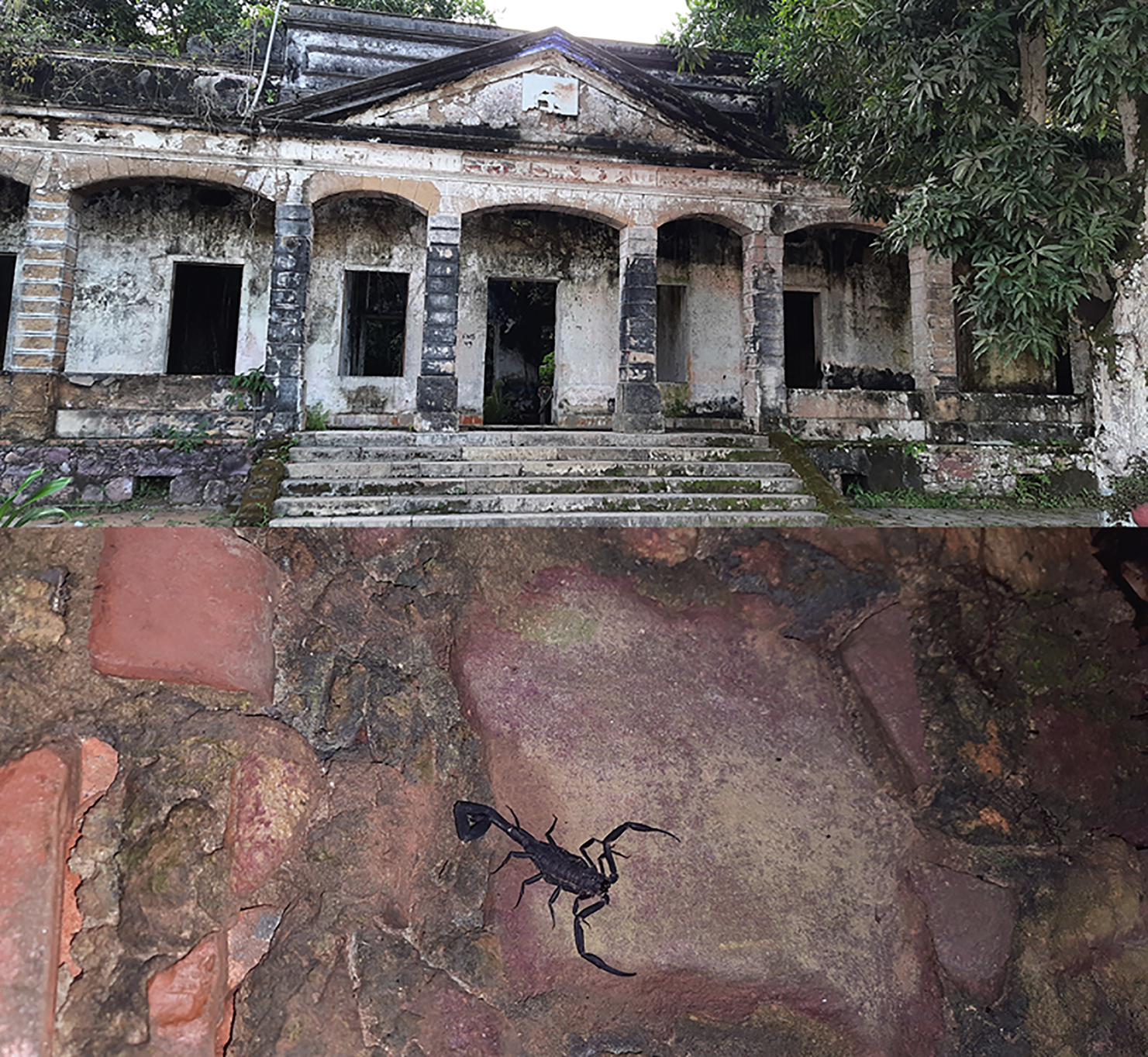
Historic site of Paricatuba in the state of Amazonas, Brazil (top); Tityus dinizi on an inner wall of the building (bottom).
The type locality of the scorpion Tityus dinizi (Buthidae) is the Anavilhanas archipelago, Rio Negro region, state of Amazonas, Brazil.5,6 Tityus dinizi belongs to the subgenus Atreus Gervais, 1843, that contains some potentially medically significant species. 6 Although this scorpion originates from primary forest, 3 the ruins where it was found are surrounded by a riverside community established on the banks of the Rio Negro. 1 Those who visit the Village of Paricatuba can have free access to the beaches and the dependencies of the historic buildings. 1 Venomous animals like scorpions can hide very easily where they live, and the color pattern of some of these arachnids has an enigmatic function that helps them not be easily detected.3,5 In general, tourists do not use safety equipment and are not aware of the presence of venomous animals in the historic site of Paricatuba. 1 Although the possible medical significance of Tityus dinizi is so far unknown, it is recommended that visitors to sites like this wear closed shoes, remain aware of their surroundings, and avoid contact with the walls and other structures in the ruins.
Footnotes
Acknowledgements
Author Contributions: Collection of venomous animals (JG, RP); drafting and approval of the manuscript (JG, RP).
Financial/Material Support: None.
Disclosures: None.