




Abstract

The Arecaceae family accommodates palm species that are densely distributed in the Amazon basin. 1 Some of these plants are of economic importance, such as Bactris gasipes Kunth, which had populations domesticated by Native Americans. 2 In the Amazon, palm trees can be used to build houses and canoes, 2 and fruits are an important part of the local diet, such as açaí (Euterpe precatoria), tucumã (Astrocaryum aculeatum) and pupunha (Bactris gasipes). 1 In addition to these foods, products such as palm hearts and dendê oil come from palm trees. 1 In the Amazon, several rural communities usually collect the fruits and edible parts of palm trees manually. 2 However, these plants may host different dangerous animals that seek shelter and prey.2,3 During scorpion collection in the central Amazon (Manaus region), Amazonas, Brazil, in September 2019, we found 20 specimens of Tityus silvestris (Pocock, 1897) in spiny palms (Astrocaryum spp.). An adult female was found in a bunch of fruits, while an adult male was detected in the petiole of the plant (Figure 1A, B). Currently, the state of Amazonas, Brazil, is home to 48 species of scorpions distributed in 3 families, namely, Buthidae, Chactidae and Hormuridae. 4 -6
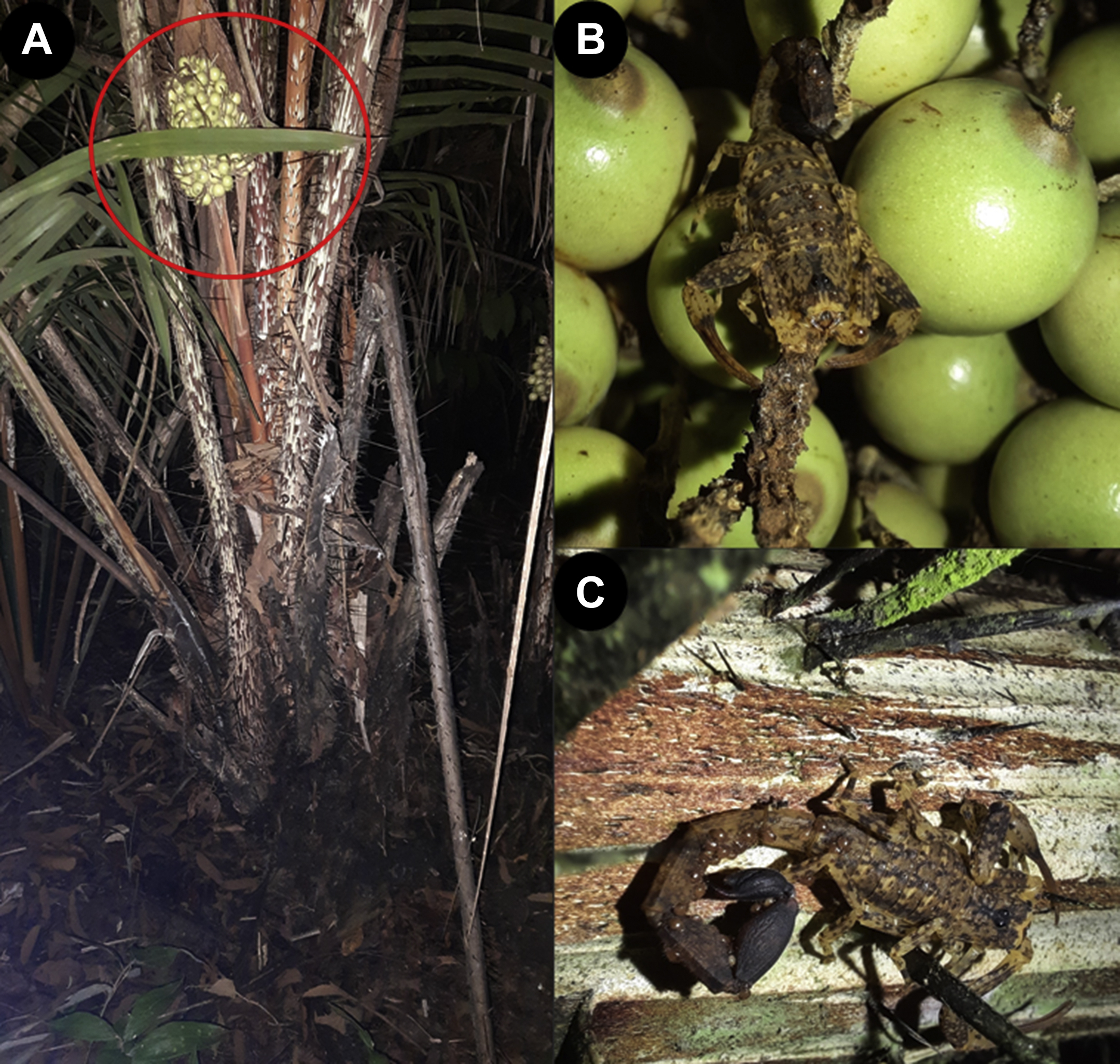
Palm tree in the Central Amazon (2°47’52.3”S 60°03’24.9”W). A, The red circle indicates where Tityus silvestris was found in Astrocaryum sp. B, An adult female in the bunch of fruits. C, An adult male in the petiole. Photo: JG Martins.
The scorpion Tityus silvestris was originally described from the Lower Amazon region, Pará, Brazil. 4 However, it has a wide distribution in “terra firme” forests in the Brazilian Amazon and in other Amazonian regions, such as French Guiana and Peru. 5 This scorpion measures between 25 and 45 mm in total length and is generally yellowish in color with dark spots scattered throughout the body. 6 A clinical record of Tityus silvestris envenomation in the city of Manaus, Amazonas, Brazil reported that the envenomed patient required antivenom therapy and intensive care. 7 Due to its morphological characteristics, such as small size and color, Tityus silvestris can be imperceptible in palm trees. The relative risks of handling the fruits or extracting edible parts from these plants can be reduced with the use of protective equipment such as leather gloves and boots that can prevent accidents with venomous animals hiding in palm trees.