





Abstract

To the Editor:
Snakes have the most diverse venom-delivery system of all vertebrates. Among the advanced snakes (Caenophidia) that occur in Brazil, there are 2 families that are known as “true venomous snakes” (ie, front-fanged snakes 1 )—Elapidae and Viperidae. There are also several other families that contain non-front-fanged species (NFFC 1 ) commonly considered “nonvenomous”—the Dipsadidae and the Colubridae are prominent. The Brazilian NFFC are a heterogeneous assemblage of snakes with several types of oral glands, such as supralabial, infralabial, and Duvernoy’s glands, which are composed of mucous and serous cells that produces toxic secretions and venom (Figure 1). 2
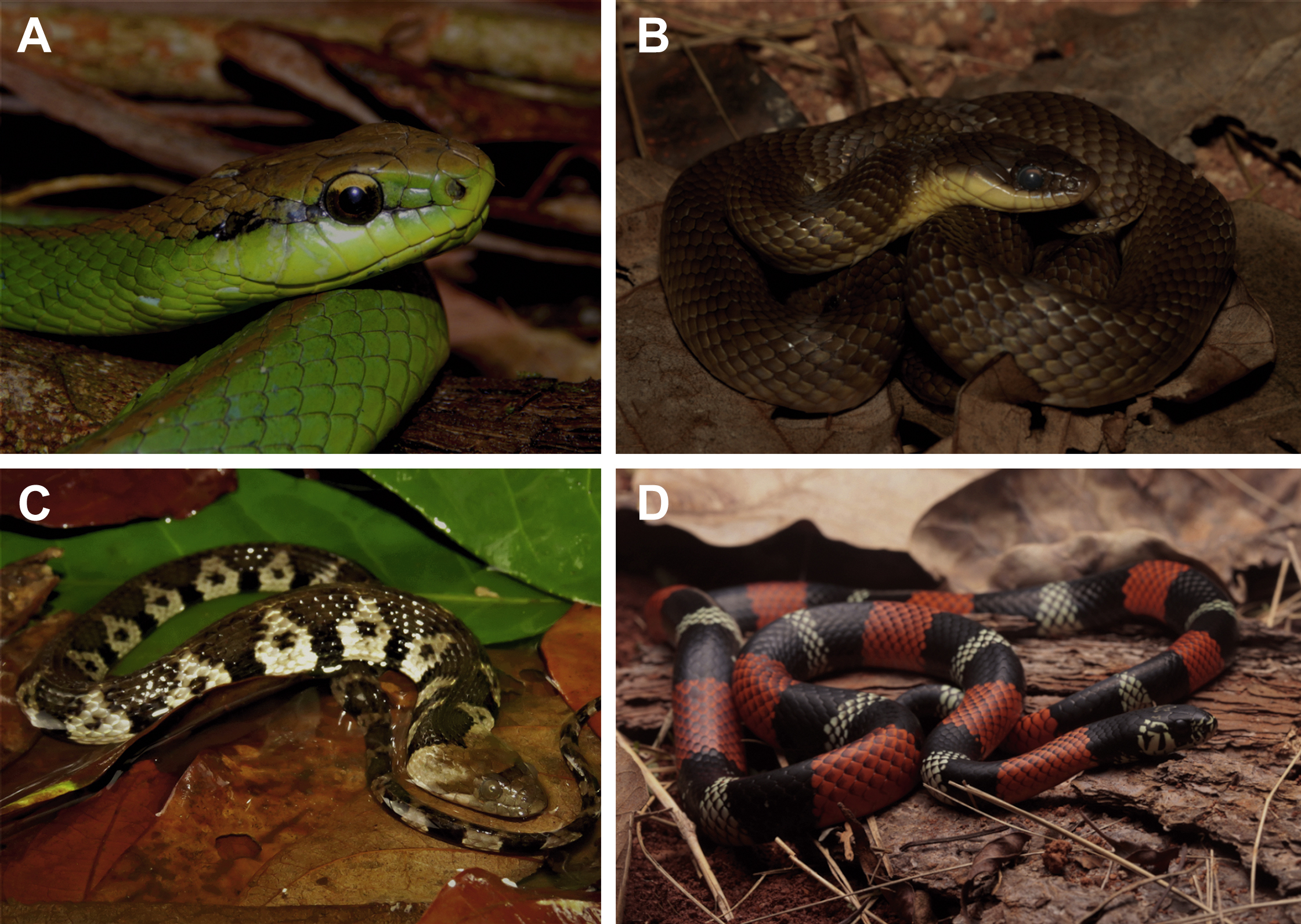
Brazilian non-front-fanged colubroid (NFFC) snakes involved in evenomation cases: (A) Philodryas olfersii, (B) Erythrolamprus poecilogyrus, (C) Helicops angulatus, and (D) Erythrolamprus aesculapii. Photos: N. Citeli (A and C) and A.S. Meneses (B and D).
From 2001, 2 Dipsadidae genera, Philodryas and Clelia, were also considered of medical importance according to the Brazilian Ministry of Health’s manual for diagnosis and treatment of envenomations by venomous animals. 3 Although this classification should be due to the severity and frequency of envenomations, bites caused by these snakes are probably uncommon. The inclusion of these genera by Brazilian Ministry of Health may be due to reports in the literature of envenomations4,5 and studies that describe the proprieties of their venom. Envenomations caused by Philodryas species include important local signs and symptoms, such as pain, edema, and hemorrhage, which are similar to Bothrops envenomations in some cases. 4 Envenomation caused by Clelia spp. in Brazil was only documented in a single report that describes “extreme sensitivity to touch,” prominent ecchymosis, and edema. 5
In a review developed in São Paulo state, Brazil, in 2003, 6 16 genera of NFFC were associated with snakebites, and the species were considered by authors as “mildly venomous snakes.” The clinical manifestations included abrasions (in 30% of the cases), local pain (28% of the cases), hemorrhage (15% of the cases), and swelling (10% of the cases). The review also described envenomations caused by Erythrolamprus poecilogyrus, whose bite causes intense pain and local hemorrhage; Erythrolamprus miliaris, whose bite causes a serious hemorrhage (which was treated with Bothrops antivenom despite no evidence of efficacy); and Helicops angulatus, which causes coagulopathy. However, a recent study provided formal evidence of mild coagulopathy in envenomations caused by H angulatus. 7
Another study 8 identified clinical manifestations in bites caused by Helicops, Hydrops, and Philodryas that were treated at the Juruá Regional Hospital, Acre state, Brazil. Envenomation caused by Hydrops triangularis bites caused nonspecific symptoms, such as vomiting, headache, and local pain. Victims of envenomations by Philodryas viridissima envenomation reported pain, bleeding, edema, erythema, and ecchymosis.
In general, envenomation caused by the Brazilian NFFC snakes includes symptoms such as local pain, edema, erythema, hemorrhage, and other symptoms that may lead to a false diagnosis and thus be confused with bites by Bothrops. 6 Symptoms like gingival hemorrhage have also been reported for envenomation caused by the genus Philodryas. 6
Aside from studies carried out directly in hospitals and the cases reported separately, another source of information on envenomations caused by NFFC snakes is the DATASUS platform, operated by the Brazilian Ministry of Health. Between 2007 and 2020, approximately 2.5 million snakebites occurred in Brazil, of which about 2 million reported incidents did not include identification of the snake. Only 360,000 of these reports included identification, either at the genus level (eg, Bothrops) or as “nonvenomous” (NFFC snakes). According to the DATASUS platform, of the more than 21,000 cases registered for NFFC snakes, 877 were considered moderate, 64 severe, and 16 were fatal. These data probably reflect snake misidentification by health teams in Brazil. On the Brazilian Ministry of Health’s website, there is currently no protocol for treatment of NFFC snakebites and no robust information stating that NFFC snakes can cause envenomation. Additionally, no information on native snakes is provided for Brazilian citizens and tourists, including in the practical guide “How is Brazil taking care of tourists’ health?” 9 Another important point is that, recently, social media commonly shows people freely handling snakes in Brazil. The purpose of this attitude is not clear, and it may be an attempt at environmental education or even just to show free handling.
Snakebite is a serious public health problem in Brazil. Some important steps have already been indicated to solve this problem, such as correct identification of the snake, access to treatment, and adequate treatment for victims. Given the similarity of envenomation symptoms in some cases, it is important to train health teams to correctly identify the genera of the snakes that cause the most severe envenomations. Hospitals should receive support from herpetologists and other biologists with familiarity of the local snake fauna, and the population should be taught about the symptoms of snakebites. In some cases, due to the similarity of the symptoms (eg, Philodryas olfersii envenomation), the Bothrops antivenom is used. 10 This is done empirically in Brazil and other South American countries. It is important to remember that, currently, there is no antivenom in Brazil for envenomations caused by NFFC snakes and that the misuse of the available antivenoms for venomous snakes of greater medical importance (eg, Bothrops antivenom) may cause harmful side effects such as early adverse reactions.
Finally, the Brazilian Ministry of Health must establish a treatment protocol for NFFC envenomations, including information on websites for citizens and tourists. Health education agents must provide educational measures that encourage people not to touch wildlife, especially snakes that are not traditionally known for being venomous.