Abstract

The Bengal tiger (Panthera tigris tigris) is one of the big cat species, found in the jungles of India, Nepal, Bhutan, Burma, Bangladesh, and the adjoining countries of Indian subcontinent. These muscular and gorgeous looking mammals are ferocious killers with powerful forequarters, with a length of 2.2 m to 3.0 m when fully grown and weigh more than 300 kg.
1
Tigers have a lifespan of 8 to 10 y in the wild; however, the life span increases up to 20 y in captivity. In 2010 there were merely 3200 wild tigers around the world, which was the lowest estimate of the century.
2
During the 2010 St Petersburg declaration on tiger conservation, the 13 countries where the last remaining tiger species are found made a commitment to double the population by 2022.
2
Nepal achieved this target in 2018 with an estimated 235 wild tigers, which was 121 in 2009.
3
There are stringent laws protecting these tigers; however, there are reports of poaching.
4
This animal is the target of poachers, who kill it for lucrative trade where the animal parts and hides are used as a souvenir item or a cure in indigenous medicine.
4
These terrestrial animals are apex predators and hunt other wild animals in a wide territory; however, when weak and frail, they target domesticated animals inside human settlements and sometimes also humans.
5
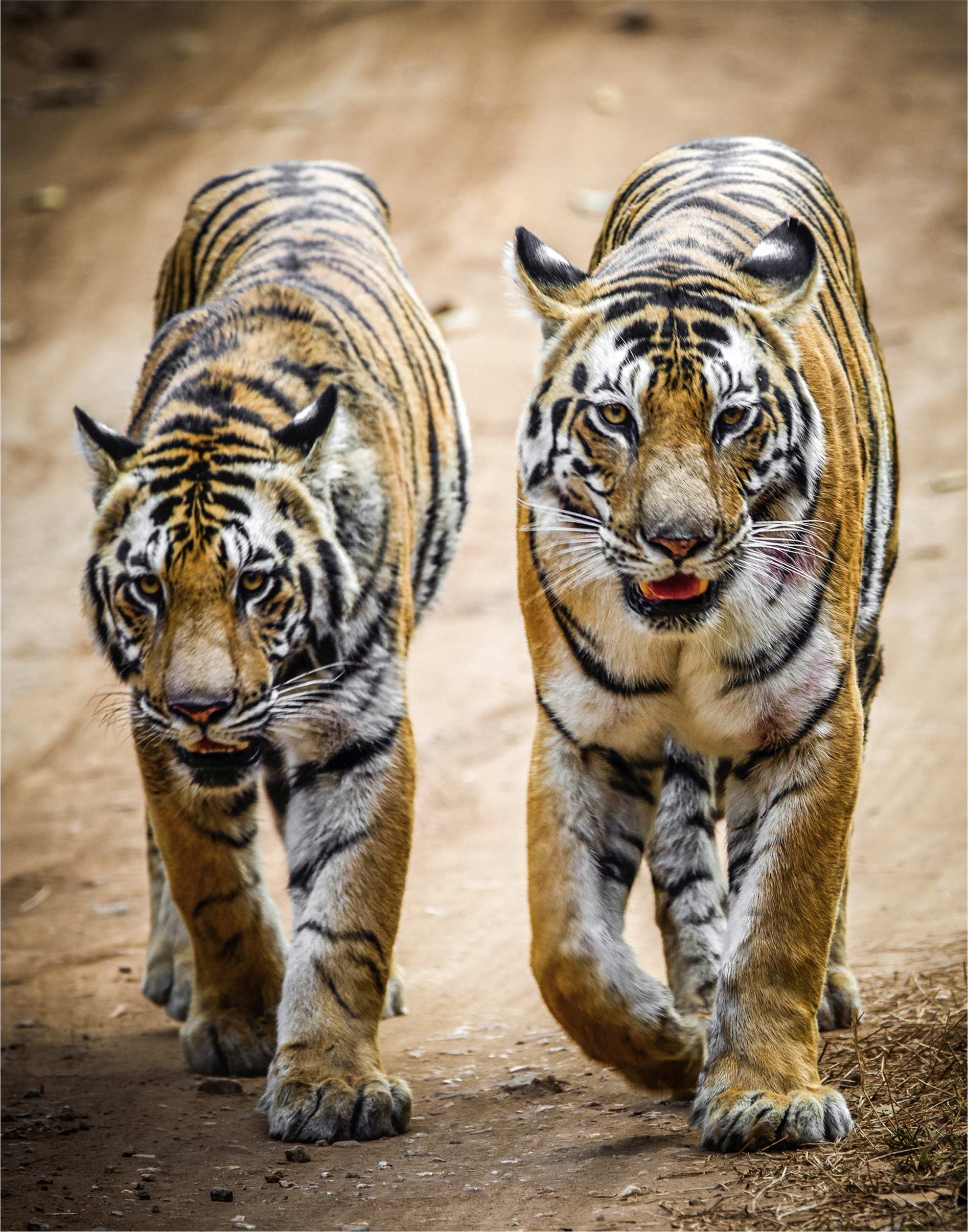
Therefore, they are infamously called “man-eaters” by the people who live near the wildlife conservation areas. The above picture was taken on February 2021, at Kanha National Park, Madhya Pradesh, India, 22.3345° N, 80.6115° E with a Nikon D610 camera using a 150–600 mm f/5–6.3 lens. A pair of Bengal tigers (Panthera tigris tigris) at Kanha National Park, Madhya Pradesh, India. Photo by Subho Bandyopadhyay.