






Abstract

A 5-y-old boy presented to the emergency department (ED) with painful blisters over the chest and both legs. Fresh blood was seen coming from his left ear. The blisters on the chest were ruptured by friction with his clothing (Figure 1). What caused these blisters? How should you manage this case?
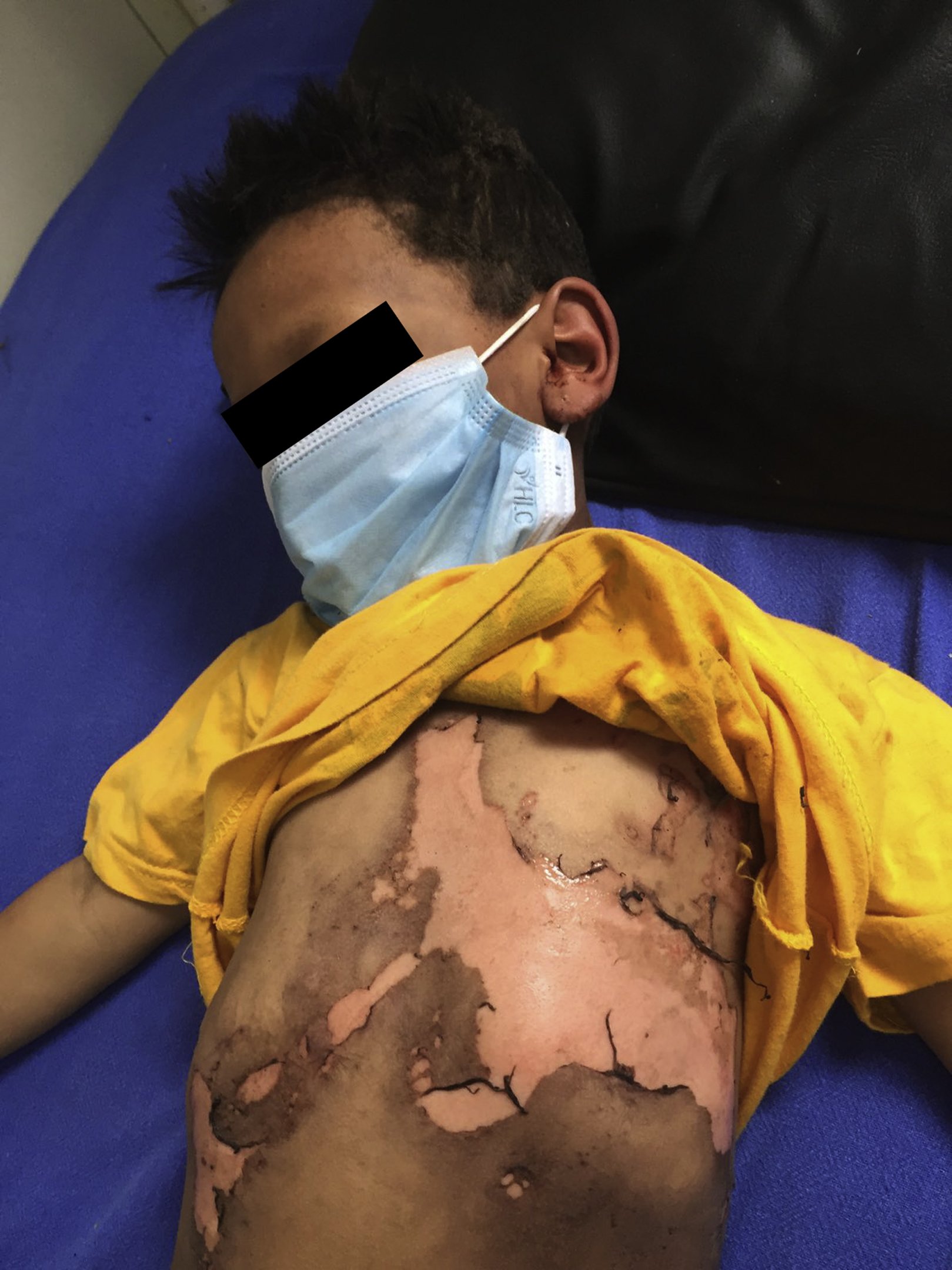
Ruptured superficial skin blisters over the chest and fresh blood over the left external auditory meatus.
Diagnosis
Partial thickness burns and ruptured tympanic membrane due to lightning injury.
Case Details
The patient was sleeping on the floor in a bed shared with his 9-y-old brother adjacent to the window in his rural house (cement floor, brick wall, and galvanized sheet roof). The elder brother reported thundershowers that night. He remembered waking up to a loud, crash-like noise, which he thought might be a thunderclap. He shouted in fear and called his parents. His parents came immediately into the room. Because there was a power outage, they lit their mobile phone flashlight. They saw a blister on the left side of the elder son’s face. Then they checked their younger son, who was unconscious. There were multiple blisters over his body, and he was bleeding from the left ear. His clothing was torn. They woke their neighbors and called for help. By then, the younger son had regained consciousness. A vehicle was arranged, clothes were changed, and both children were rushed to the hospital.
In the ED, the patient was fully conscious. On examination, he had a pulse rate of 124 beats·min-1, blood pressure 100/60 mm Hg, respiratory rate 20 breaths·min-1, and temperature 37.7°C. General examination showed singeing of the scalp hair; superficial burns over the chest, mostly on the left side; and blisters over both legs (Figure 2). The burnt area was erythematous. Fresh blood was seen in the external auditory meatus of the left ear. When the left external auditory canal was viewed with an otoscope, minimal bleeding and perforation on the anteroinferior quadrant of the left tympanic membrane were seen. The patient reported pain at the site of superficial burns. There was no entrance or exit wound. Computed tomography of the head was normal. The patient was admitted to the burn unit for further management.
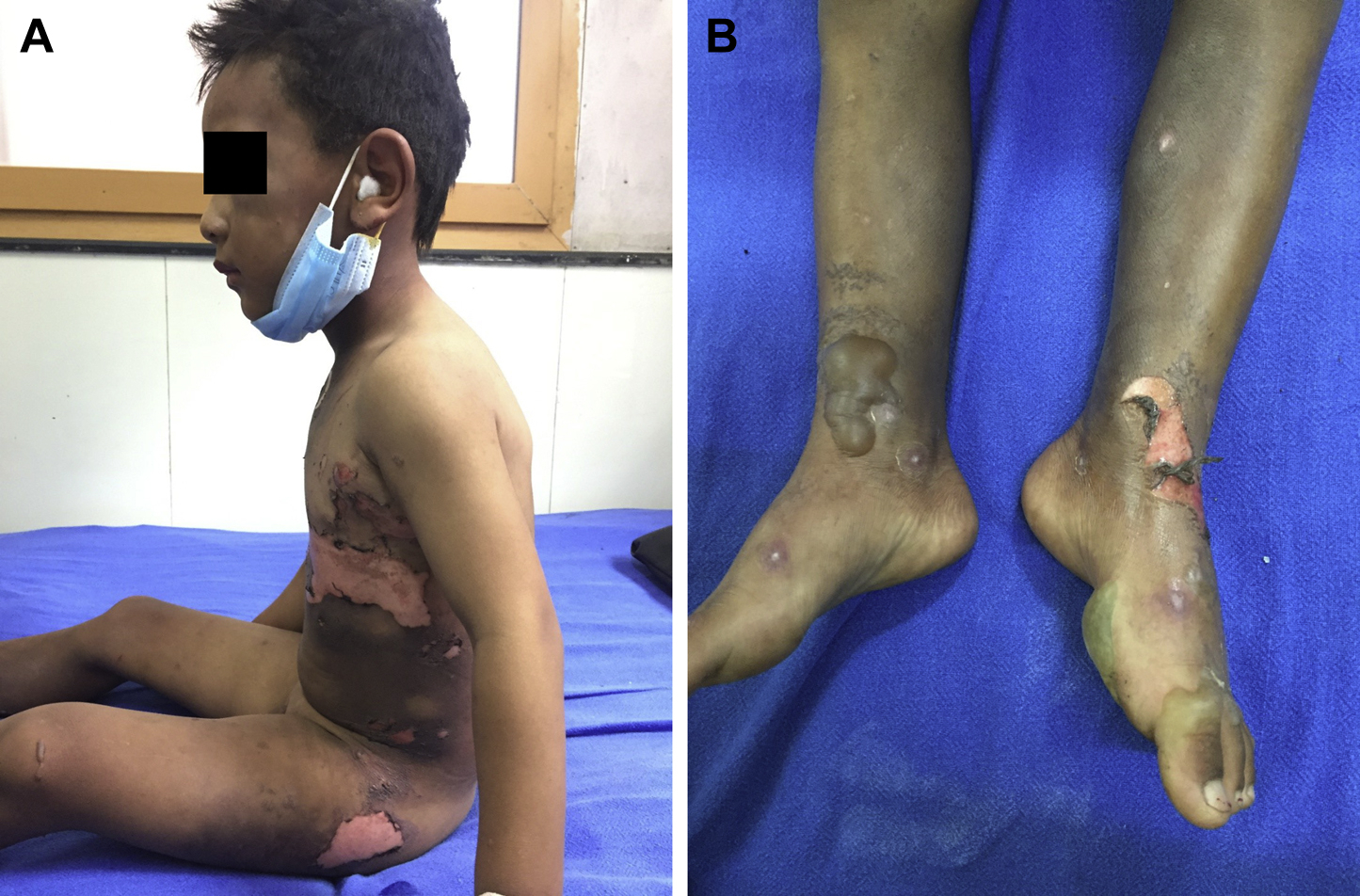
Superficial burns over the body (A) and lower limbs (B) of the younger brother.
The patient’s elder brother had no injury except for a 4×2 cm hemorrhagic blister over the left zygomatic prominence (Figure 3). His vital signs were stable, and there were no other complaints. The wound was cleaned, and he was discharged.
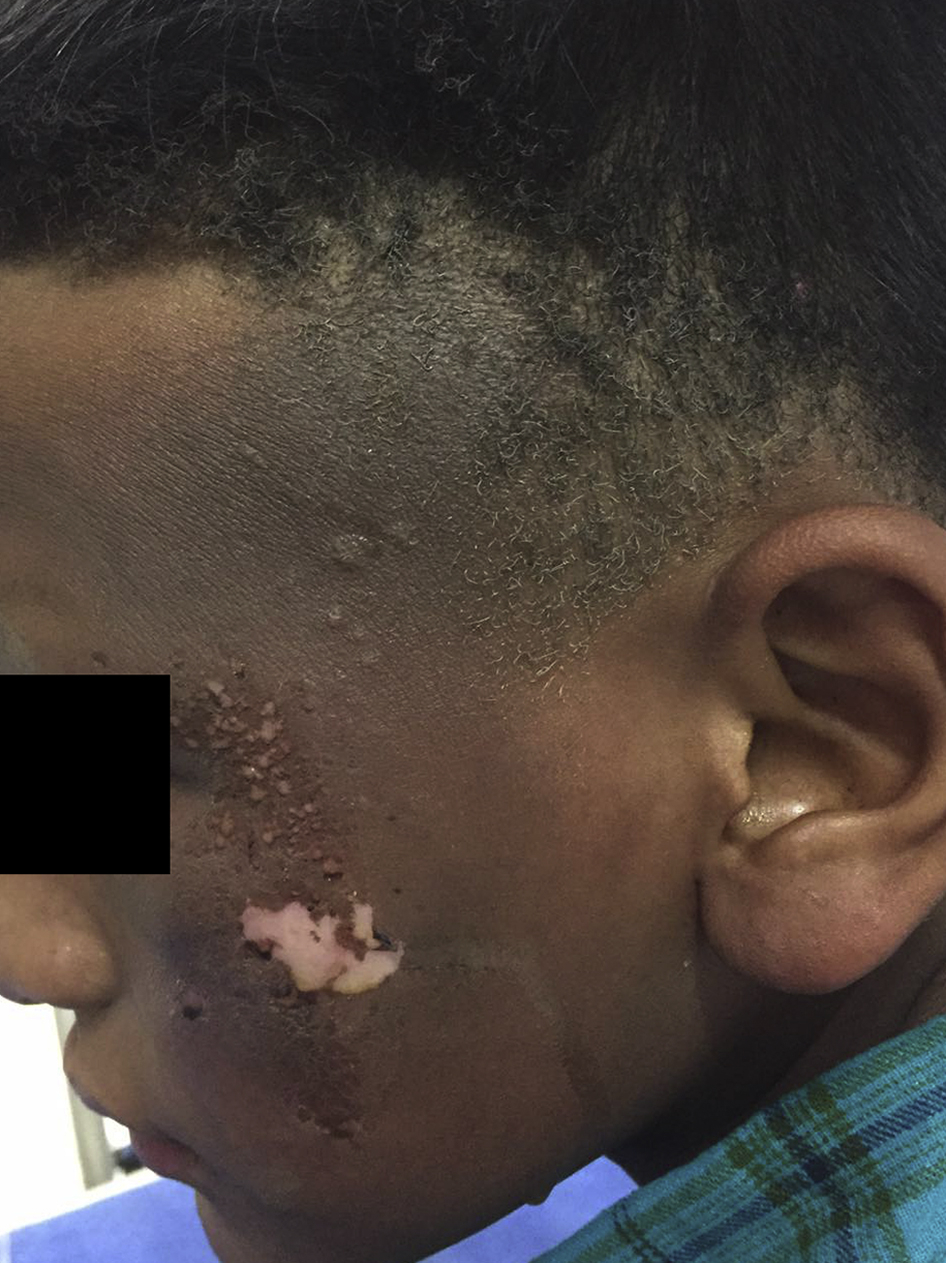
Supsterficial burn over the left side of the face in elder brother.
Discussion
Thunderstorms are frequent in Nepal during the rainy season. As in most less-developed countries where houses and other structures seldom have lightning rods, lightning injuries are common in Nepal. Unlike the victims of electrical injury, victims of lightning strike do not carry a residual charge and can be safely resuscitated. 1
A stable patient with no history of loss of consciousness, a normal neurologic examination, and a normal electrocardiogram requires no intervention. 2 A patient with a history of neurologic abnormalities after a lightning strike or with an abnormal neurologic examination in the ED should undergo appropriate imaging studies and be observed. 3
Burns associated with lightning injury are usually produced by contact with metal objects that are heated by the electric current. Full-thickness burns requiring skin grafting are rare. 1 Lightning burns usually involve side-splash and are superficial. 1 Tympanic membrane rupture caused by the blast effect is common in lightning injuries. 1
In the present case, there was only superficial skin involvement. The exact mechanism of injury in the present case could not be determined with certainty. The most likely mechanism was side-splash, because both children sustained superficial facial burns. Lightning should be in the differential diagnosis of unexplained burns, especially during and after thunderstorms.
Written informed consent was obtained from the patient’s father for the use of images and medical history for educational purposes, including publication.
Footnotes
Acknowledgements
Keywords: lightning, side-splash, superficial burn
Author Contributions: Literature review, manuscript draft and review, approval of final manuscript (AA, ADS, SN).
Financial/Material Support: None.
Disclosures: None.