






Abstract
Introduction
Protected areas in Western Australia are a significant resource base for nature-based tourism and recreation. Visitor incidents are of special interest to managers of these areas because of concerns regarding public safety. The ongoing monitoring and analysis of visitor incidents plays a major role in reducing incident occurrence.
Methods
Incident data recorded by the Parks and Wildlife Service from July 2011 to June 2017 were analyzed for an overview of trends and patterns of incident occurrence. For parks with the highest incident frequency, the level of risk experienced by visitors, combining incident probability and severity, was determined.
Results
A total of 459 visitor incidents were recorded, 77±11 per year. Minor incidents accounted for 48% of incidents, 43% were major, and 8% were fatal. Trip/Slip incidents were most frequent. Fatalities were mostly falls from a height or water-related incidents. Karijini National Park (highest number of incidents) and Ningaloo (highest number of fatalities) were identified as priority areas for managing visitor risk. The greatest individual visitor risk values were calculated for Mitchell River and Karijini national parks.
Conclusions
Recreational injuries are of great concern to the Parks and Wildlife Service in Western Australia. Quantifying and categorizing visitor incidents helps in understanding the trends and patterns of incident occurrence in protected areas, and priority areas for targeted visitor risk management intervention can be identified.
Introduction
Protected areas are spatially defined natural lands and waters that are managed, through legal or other effective means, for protection and conservation purposes. 1 In Australia, protected areas include national parks (NPs) and marine parks, managed forest areas, regional parks, nature reserves, and other conservation areas. These areas are considered a significant natural resource base for tourism and recreation activity, providing opportunities for visitors to engage in a wide variety of nature-based activities. 2
More than half of Australia’s protected areas are publicly owned and governed by both federal and state legislation. Government agencies, usually the parks and wildlife services of each state and territory, are responsible for the management of those areas, with a federal body, Parks Australia, overseeing national and marine parks of national importance. These agencies are responsible for over 7000 protected areas that cover more than 660,000 km2 (255,000 mi2). These protected lands and waters are managed for conservation purposes and to provide quality visitation opportunities for local visitors and tourists. Managing risks to visitors and preventing incidents and accidents are also part of park management agencies’ duty. 3
Visitors to protected areas expose themselves to a variety of environmental hazards and the risk of injury or death. Under Australian legislation, protected area management agencies owe visitors a duty of care when they provide access to these areas for visitation purposes. Owing to the size of Australia’s landmass and its inherent variance in topography, vegetation, and climate, government agencies have to consider a variety of possibilities visitors might experience harm. Research has identified drowning, falling from an elevated location (a cliff), or prolonged exposure to hot weather conditions to be some of the leading causes of environmental deaths in Australia. 4 -7 The potential for harm is magnified when international visitors find themselves in unfamiliar environments or participate in unfamiliar activities during their visit. 8
Protected area management agencies in Australia collect data on visitor incidents and accidents as part of their mandate. However, data collection and analysis are inconsistent, and results are rarely made available for public review. Previous research emphasized the difficulty of finding publications investigating trends and patterns of incident occurrence in Australian protected areas, which are preferably associated with positive regeneration of physical and emotional health rather than potential trauma and death. 9 One study attempted to explore park incidents in the state of Victoria and the implications for park staff mental health and well-being; however, this research was hampered by the fact that data records were incomplete or difficult to access. 9
This study attempts to gain insight into trends and patterns of incident occurrence in Western Australia (WA) to understand the extent of the problem management agencies face. WA is the largest state in Australia, with a landmass of 2.5 million km2 (9.7 million mi2). The Parks and Wildlife Service (PWS) manages a total of 1016 protected areas across the state, covering a total area of 250,000 km2 (97,000 mi2), which includes about 100 NPs and 17 marine parks as well as a large number of small regional park areas and remote nature reserves.
Each of these parks is characterized by unique geographic and climatic features, ranging from remote park locations in hot climatic conditions in the north of the state to urban or old-growth forest parks in the state’s south. The magnitude of recreational activity and associated visitor management varies across the state. Overall, visitation has been steadily increasing over the years, with the number of visits nearly doubling from 12 million reported for 2007 to just over 20 million in 2017. 10 With increasing visitation, the risk of litigation is a growing concern to agencies, as is the increased financial burden of maintaining a functional emergency response system across the state.
Risks to visitors in WA protected areas are managed in accordance with the principles prescribed in the AS/NZS ISO 31000:2009 Risk Management Standard, 11 consisting of a cyclic process of risk identification, analysis, evaluation, treatment, risk monitoring, and review. Since the appointment of a designated staff member in 2010 to coordinate visitor risk management (VRM) issues within the state, more effort has been given to the recording and analysis of incident data. Information on trends and patterns of incident occurrence is used in the evaluation of current risk management approaches, supporting the identification of ways in which risk management strategies can be improved and providing an empirical justification to change policy and procedures. 12
Ongoing monitoring and analysis of visitor incidents play a major role in identifying visitor safety concerns and reducing incident occurrence in the state. Current risk management approaches include the strategic placement of signage, response equipment availability, and improvements in the delivery of risk and safety messaging in promotional materials. Close collaboration with local emergency services and tourism operators supports developing a coherent picture of incident occurrence and to improve emergency response. The goal of this study is to explore trends and patterns of visitor incident occurrences and to identify priority areas for managing recreational risk.
Methods
Study Context and Data Sources
This study concerns visitor incidents occurring on WA lands and waters managed by PWS. A visitor incident is defined as an unintentional adverse event stemming from the direct use of, or interaction with, facilities or resources of recreational protected areas. 13 Here, visitors refers to persons temporarily visiting protected areas for purposes such as recreation or cultural appreciation. 14 Visitor incidents may include near-miss events with only minor adverse consequences requiring first aid treatment or may refer to incidents involving serious injury or the death of a visitor.
Visitor incident data, generated by PWS over a 6-y period from July 1, 2011 through June 30, 2017, were made available to the researcher. The selection of the analysis period denotes a renewed focus on visitor incident recording practices of the agency as a result of the appointment of a VRM coordinator in late 2010. The interval reflects Australian departmental reporting standards, with the financial (fiscal) year spanning from July of one year to June of the following year.
The data consisted of deidentified case incident reports, completed by agency staff who were directly or indirectly involved in the response to the incident. The dataset also included case reports produced by the VRM coordinator when the coordinator was notified by external information sources if incidents occurred within PWS tenure boundaries. The amount of detail contained in each case report varied, ranging from a comprehensive description of the causes, course, and consequences of events to a brief summary of case details. The details of this study were presented to the institutional ethical review board at Murdoch University to determine whether a human research ethics application was needed. This analysis was deemed exempt from requiring formal approval given that the data were deidentified before their release by PWS.
Coding Protocol and Data Analysis
A retrospective, descriptive analysis was performed on the data. Information about the date, time, and location of the incident was extracted from the case reports. Incidents were grouped according to their relevant management areas, reflecting the administrative boundaries of park areas or a combination of areas to represent actual visitor destination areas. Demographic information about the injured party and the activity undertaken before the incident was also extracted from the reports.
Incidents were categorized into 9 distinct types: animal-related incidents, trips/slips, falls from a height, lost or missing persons, water-related incidents, weather-related incidents, incidents involving a recreational vehicle, infrastructure-related incidents, and other incidents. 15 Each incident was coded according to the severity of the consequences described in the case reports. Following PWS operational guidelines for incident management, reporting, and reviewing, severity was categorized as minor, major, or fatal, based on the seriousness of injury and the extent of emergency response requirements. Minor incidents are defined as cases in which no medical treatment is required other than first aid. Incidents involving major fractures, severe head, neck, or back injuries, and/or need for ambulance or external agency assistance are defined as major incidents. Fatal incidents refer to incidents involving the death of 1 or more park visitors.
The data were limited to the inclusion of unintentional adverse events occurring in the context of outdoor recreational activity. Incidents referring to accidents that involved on-duty staff (including volunteers or contractors) or the nonrecreational operation of motorized vehicles (eg, vehicle accidents on park service roads, aircraft crashing on lands managed by PWS) were excluded from the analysis. Incidents were also excluded when they described infrastructural damage only (flood damage, vandalism), when they were solely based on pre-existing medical conditions (heart attack, seizure), or when they referred to a criminal or suicidal act occurring within PWS boundaries. Incidents involving visitors becoming lost were considered a significant near-miss event and were therefore included in the analysis even if the visitors did not require medical treatment after successful search and rescue operations.
Exploring Visitor Risk
Ten protected areas with the highest incident occurrence were selected to determine the level of risk experienced by visitors. Accepting the notion that risk reflects a combination of the probability of an adverse event occurring and the severity of the consequences of such an event, 16 the approach employed was 2-fold.
First, data on the number of incidents, as a numerator, were normalized by the volume of protected area visitation as the denominator. Incident probability was expressed in terms of the chance of any 1 visitor experiencing harm per 10,000 visitors. Second, incident probability was paired with the categorical severity of incidents. Severity reflects the average severity of incidents that occurred in an area for a given time period. A minor incident was valued as 1, a major incident was valued as 3, and any incident recording a fatality was valued as 6. 17 When combined, levels of risk represent the chance that visitors might experience harm, taking the frequency of incident occurrence per park area, the severity of these incidents, and visitation patterns into account.
Data are presented as mean±SD with range or as frequencies (percentage), as appropriate.
Results
Visitor Incidents in WA
Between July 2011 and June 2017, 459 visitor incidents were recorded, or 77±11 (63–90) per financial year (Figure 1). About half (48%, n=222) were classed as minor in severity, 43% (n=199) were major, and 8% (n=38) were fatal. The highest number of incidents was recorded for the fiscal year 2012/13, which was also the year with the most fatalities (n=12).
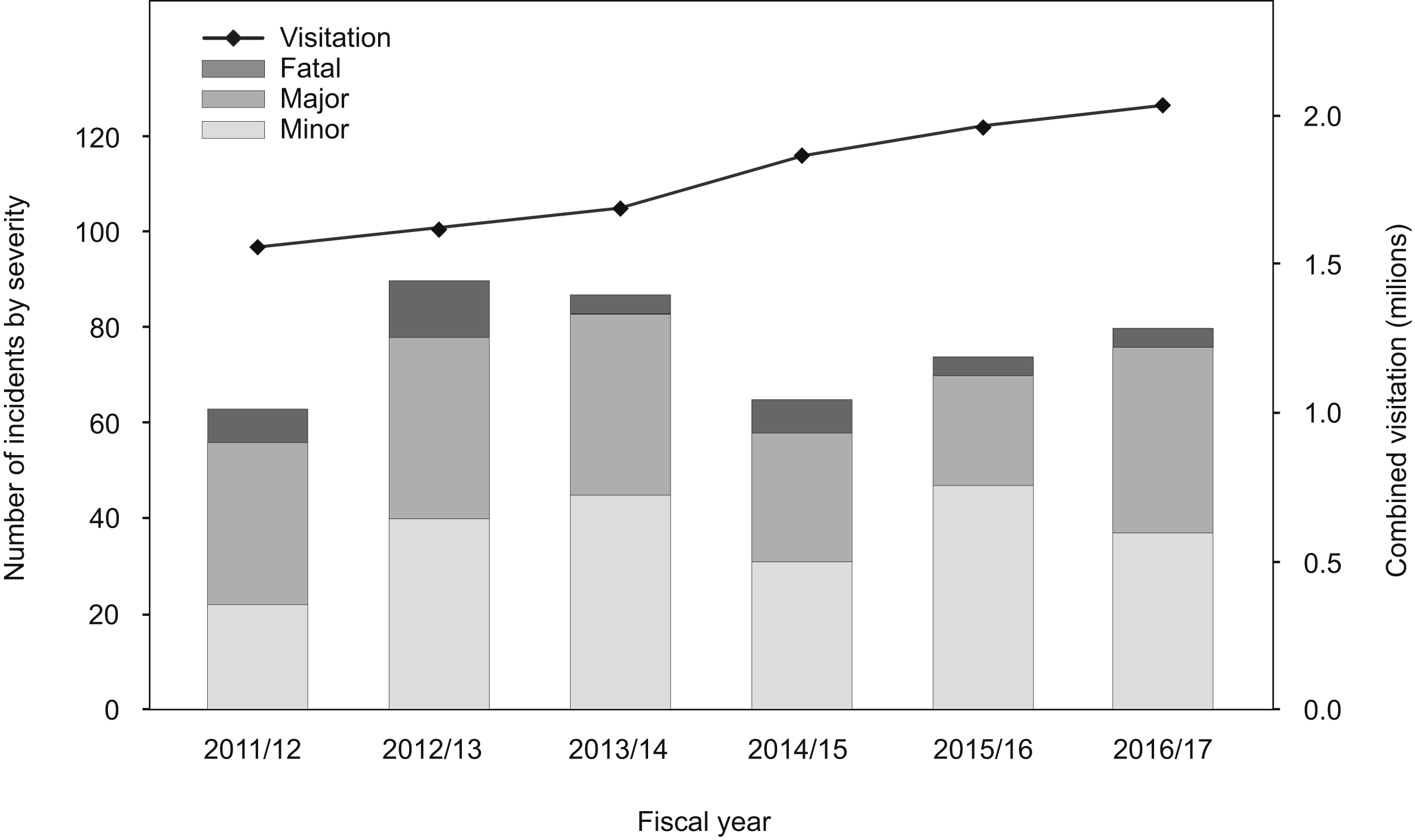
Annual incident count by severity category, projected against total protected area visitation in Western Australia (in millions).
Most case reports (87%, n=401) described incidents involving a single casualty. Of those, about half involved female visitors (48%, n=192) and half were male (49%, n=196); a further 23 reports did not include relevant information. Of all incidents, 12% (n=54) involved groups, with up to 8 casualties per case. The incident with the largest number of people affected involved a group of male rock-fishers being washed into the ocean by large waves. Three men were able to self-rescue with minor cuts and grazes, 4 men were rescued but experienced exhaustion and hypothermia after prolonged exposure to ocean waters, and 1 was later declared dead after the body was not found. Overall, most incidents with multiple casualties involved male-only groups (48%, n=26), 7% (n=4) referred to female-only groups, and 27% (n=15) involved both sexes. The sex of casualties was not recorded in a further 9 group-incident reports (17%).
Casualties were referred to as “child” (0–17 y) or “adult” (≥18 y) in incident case reports. A total of 13% of the incidents (n=62) involved children, of which most were minor in severity (66%, n=41). About one-third (32%, n=20) of incidents involving children were classed as major. One incident (n=1) involved the death of a child (14 y); the child died of the effects of a heat stroke as a consequence of prolonged exposure to hot weather conditions during a hike in a remote park.
Most incidents (58%, n=264) involved visitors from WA, 16% (n=75) were international visitors, and 11% (n=50) visited from out of state. International visitors had the greatest case fatality rate, with 15 fatalities. Nine of these fatalities involved visitors from European countries, mostly from Germany (n=3) and the United Kingdom (n=3). A further 3 fatalities were from Asian countries. No information on residency was provided in 15% (n=67) of all incident reports.
Incident types and severity levels are shown in Figure 2. Most of the minor incidents were trip/slip incidents (n=68) occurring during hiking activities or as visitors spent time at designated day-use areas. Other minor incidents involved injuries sustained from park infrastructure (n=35), animal-related incidents (n=21), and weather-related (n=19) or water-related (n=19) incidents. Similarly, major incidents were most often trip/slip incidents (n=46); however, falling from a height (n=38) and incidents involving lost/missing visitors (n=36) played a greater role in this severity category. Fatalities were most often water related (n=15) or falls from a height (n=15). Water-related fatalities were predominantly the result of swimming or snorkeling/diving activities, whereas falling from a height was often related to rock-fishing. A further 5 fatalities were weather related, all of which related to hot weather conditions.
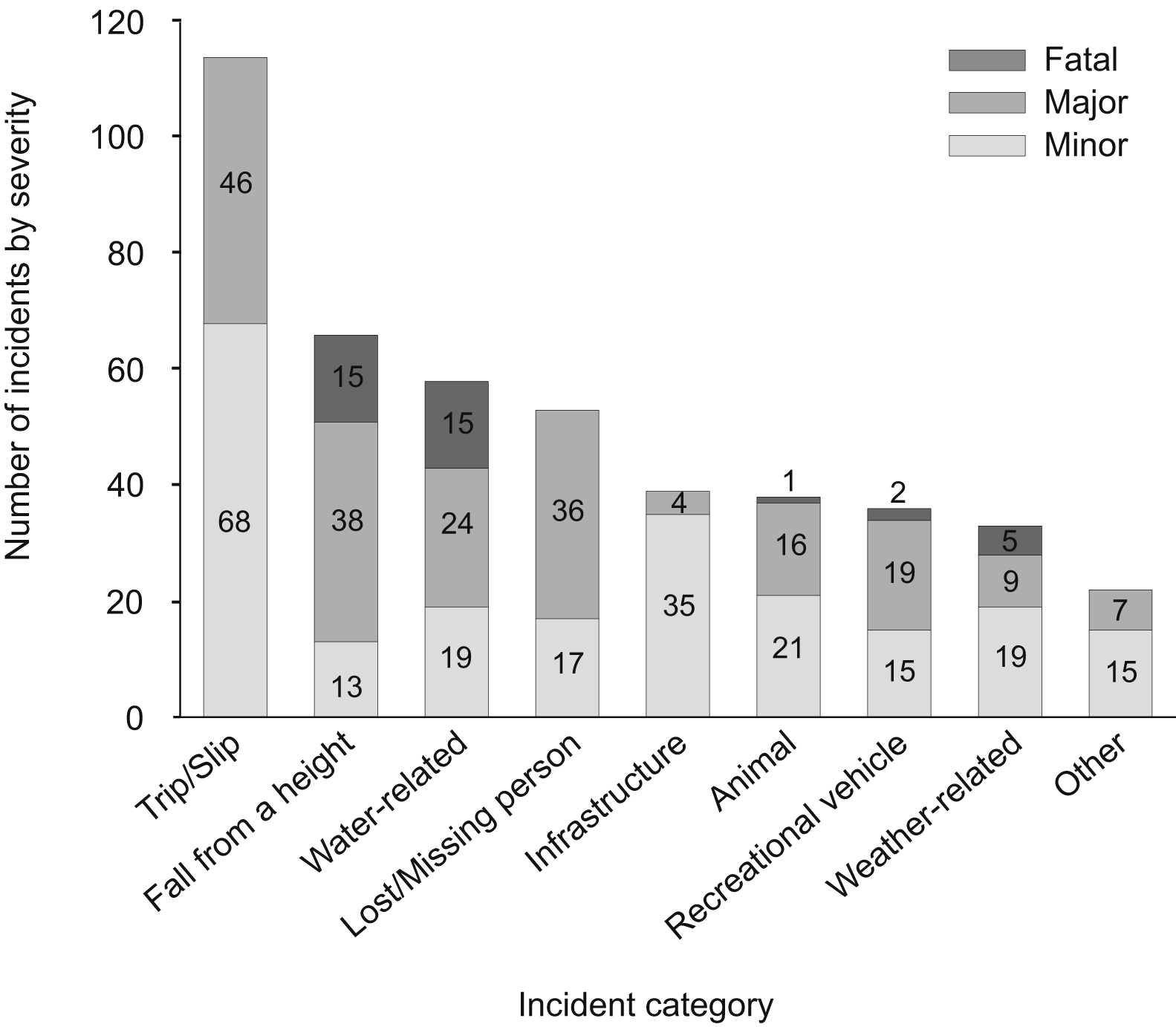
Incident types by severity.
Visitor Risk
Incident occurrence was confined to 65 of the 1016 protected areas managed by PWS (6%). Although this is largely a reflection of the magnitude of recreational activity in different protected areas across the state, only 10 areas reported more than a total of 10 incidents over the 6-y period. Nearly three quarters of all park visitor fatalities (71%, or 27 of 38 fatalities in total) occurred in these areas. Table 1 outlines the number of incidents and the fatalities in these priority areas.
Total incidents and fatalities in selected areas with greatest incident occurrence between July 2011 and June 2017
MP, marine park; NP, national park.
Karijini NP reported the greatest number of incidents (n=71), followed by Serpentine NP (n=34), the Ningaloo and Cape Range area (n=33), and Shoalwater Island Marine Park (MP) (n=33). However, most fatalities occurred in Ningaloo (n=8) and Leeuwin-Naturaliste NP (n=7). Drowning accounted for 7 of the 8 fatalities in Ningaloo and all fatalities in Leeuwin-Naturaliste NP. In Karijini and Torndirrup NPs, all fatalities involved a fall from a height. In Karijini NP, visitors were engaged in hiking (n=2) or rock-climbing (n=1) before the accident. In Torndirrup NP, all 3 fatalities involved rock-fishing.
Table 2 provides an overview of incident occurrence, as well as annual visitation data where available. Pairing incident data with visitation revealed that Mitchell River NP had the greatest probability of injury per park visitor; with relatively low visitation numbers (4,059–18,149 per year), there was a chance of 1 in every 4500 visitors being involved in an incident (or 2.2 incidents per 10,000 visitors). However, over the 6-y period, there was a reduction in incident probability for Michell River NP. In 2012/13 and 2013/14 fiscal years, approximately 1 visitor was injured for every 1300 visitors, decreasing to near zero in subsequent years.
Annual and mean incident occurrence, visitation and visitor risk (combining probability and severity) per protected area
MP, marine park; NP, national park.
Number of visitor incidents reported by the Parks and Wildlife Service per protected area per year.
The sum of protected area visits per year.
Chance of any 1 visitor being injured for every [10,000 / likelihood-value] visitors.
Mean severity of incidents per year per protected area; minor=1, major=3, fatal=6.
Visitor risk as a combination of the probability of incident occurrence and the average severity of incidents occurring per year.
Severity of consequences was greatest for Leeuwin-Naturaliste NP (4.0±0.9), followed by the Ningaloo area (3.3±1.5), Torndirrup NP (2.9±1.2), and Karijini NP (2.5±0.4). Incidents in Serpentine NP and the Bibbulmun Track were least severe.
When probability and severity were combined, Mitchell River NP and Karijini NP were identified as posing the greatest risk to visitors. Both parks are characterized by a substantial growth in visitation numbers over the period analyzed, and both parks show a declining risk trend stemming from a general decline in the probability of incident occurrence in each park. Serpentine NP and Stirling Range NP also represent high risk to visitors in WA, with a risk factor of 0.9.
Discussion
Visitor incident data presented in this paper suggest that particular areas represent a greater risk to visitors.
Overall, Karijini NP had the greatest number of incidents. Visitor risk calculations revealed a higher probability of incident occurrence and a higher severity of consequences, with the park presenting the second highest risk to visitors across the state. The remote nature of the park combined with intense temperatures can be considered the main contributing factors in such high incident rates. 15 In addition, Karijini is commonly nicknamed “the theme park of the state,” with outdoor adventure experiences being a major draw for visitors. Risk-taking behavior that includes ignoring safety warnings, combined with visitors’ lack of physical preparedness (eg, not wearing appropriate footwear), was identified to play a role in about one-third of incidents occurring in Karijini NP. 15
Serpentine NP, Ningaloo destination area, and Shoalwater Island Marine Park also recorded substantial numbers of incidents in total. The Ningaloo area was the destination with the greatest number of reported fatalities. Water-related incidents involving activities such as swimming, snorkeling, or diving were responsible for most incidents, with 7 drowning fatalities and 4 near-drowning events recorded for the area. Previous research identified international visitors as at high risk owing to their inexperience with dangerous ocean conditions, with the remoteness of day-use sites at Ningaloo greatly hampering the availability of emergency response. 15 International visitors had the greatest case fatality rate overall and were therefore identified as a high-risk group for protected areas in WA.
The occurrence of incidents and accidents in protected areas encourages larger questions of risk and responsibility. 18 Injury to visitors on lands and waters managed by public authorities may be followed by litigation in which compensation for losses is demanded.19,20 International tourists, when considered as a vulnerable group in need of risk information, are reliant on others for their safety. 8 Individuals may not acknowledge the understanding and experience required to deal with (foreign) environmental hazards, 21 and legal responsibilities may extend beyond relying on signs to manage visitor risk in natural protected areas. 22 During an inquest into the death of an international tourist in Queensland, the coroner emphasized that it is incumbent on Australian authorities to respond appropriately, particularly given the increasing economic benefit stemming from advertising the Australian wilderness as a tourism adventure. 23
The time of analysis for this research denotes a renewed focus on visitor incident recording practices in the PWS as a result of the appointment of a VRM coordinator in late 2010. Incident data presented in this paper suggest that risk management interventions since that time have been able to reduce incident frequency and severity, particularly when considering the increase in visitation numbers over that time. Although evaluation of the effectiveness of the various risk management approaches at individual park areas is beyond the scope of this paper, further research is needed to explore the applicability of different risk factors affecting public safety in parks. 24
Limitations
Results presented in this study reflect those incidents PWS recorded for internal reporting purposes. Hence, chief among the limitations of this study is the possibility that the data are incomplete and do not accurately reflect all incident occurrences in state. The agency's capacity to capture all incident data and the maintenance of incident reporting quality and consistency has been identified as a problem in previous research, particularly in view of the vastness of the state and the remoteness of many park areas. 15 Varying geographical characteristics and differences in park staff composition were identified as the main challenges to effective incident monitoring and analysis in the state. 15
Further inconsistencies in incident reporting practices included the varying depth of detail provided in the descriptions of medical conditions. Given that incidents are generally recorded by field rangers who have limited diagnostic abilities, the agency uses broad severity categories defining incidents as minor, major, or fatal injuries. Severity of consequences as used in this study is a broad representation of incident consequences and should thus be interpreted in context. In addition, this study did not consider factors influencing individual incident outcomes but instead focused on providing an overview to identify larger trends and patterns of incident occurrences in the state to identify priority areas as targets for further investigative efforts by the agency.
The relatively strict definition of a visitor incident to refer to only unintentional adverse events resulting from the use of, or interaction with, recreational park facilities resulted in a number of incidents being excluded from this analysis. These incidents nevertheless contribute to the demands on park personnel in WA. First, incident reports involving on-duty park staff and those describing acts of crime or suicide within park boundaries were removed from the dataset before its release by PWS due to their nonrecreational context and information sensitivity. A further 68 incidents were then excluded by the researcher, of which the majority (72%, n=49) referred to accidents involving motorized vehicles on park service roads. Other excluded incidents reported injury to volunteer park staff (n=2) or referred to infrastructural damage in parks without personal injury as a result of severe weather conditions (n=3). Given that the aim of this review was the possible prevention of incident occurrence, a total of 14 incidents were excluded from the analysis when the incident case report included a description of medical history as the cause of the incident. Although the events occurred inside park boundaries, these cases referred to incidents in which visitors had seizures or suspected heart attacks without a direct link to recreational activities undertaken when in the park (eg, at a campsite). Incidents that involved visitors experiencing chest pains or other relevant health issues during active recreational participation were not excluded from the analysis.
Conclusions
Recreational injuries in protected areas are of great concern to the PWS in WA for reasons of public safety and litigation. This paper reports the results of a retrospective analysis conducted on visitor incident data recorded from July 1, 2011 through June 30, 2017. The selection of the analysis period denotes a renewed focus on visitor incident recording practices of the park agency.
A total of 459 visitor incidents were recorded by PWS over the 6-y period, of which 48% were classed as minor incidents, 43% as major, and 8% as involving a fatality. Incidents categorized as slips and trips occurred most often; however, most fatalities involved falls from a height and water-related incidents. All weather-related fatalities were the result of prolonged exposure to hot weather conditions.
In terms of visitor demographics, there was an equal distribution between male and female in incidents involving a single casualty. Incidents with multiple casualties were most often male-only groups. The majority of incidents involved visitors from WA; however, international visitors had the greatest case fatality rate. A total of 13% of incidents involved children.
Incident data were also used to determine visitor risk. Based on calculations of likelihood of incident occurrence and when considering the severity of incidents, Karijini NP can be considered high priority for VRM in WA. The Ningaloo destination area had the greatest number of deaths.
Although this study is an appropriate starting point to understand incident occurrence in WA protected areas, more research could be directed toward evaluating various risk management approaches implemented throughout the state. Aspects that should be considered include the effectiveness of preventing inappropriate visitor behavior at different sites. In addition, whether visitors think that their safety lies in their own hands or the hands of others has important implications for the effectiveness of various approaches to manage risk. Further research should therefore also consider larger questions of risk and responsibility and how the management of safety manifests within the relationship between agencies and visitors in parks.
Footnotes
Acknowledgements
Acknowledgments: Dr. D. Lee, Dr. K. Rodger, and Dr. B. Weiler are acknowledged for their conceptual support in drafting the manuscript. The author is grateful to the anonymous journal reviewers for their critical comments, which greatly enhanced the quality of this paper.
Financial/Material Support: This research is part of a larger research project supported by an Australian Postgraduate Awards (APA) scholarship. This study was supported in kind by the Parks and Wildlife Service, which granted access to visitor incident data for analysis.
Disclosures: None.