






Abstract
A number of crotaline species have been associated with neurotoxic envenomation in North America. One clinical sign that can occur is myokymia: fine, involuntary, wave-like muscle movements occurring at regular intervals. We report an unusual scenario in which a single snakebite resulted in simultaneous envenomation of 2 patients. Both developed myokymia, with 1 having respiratory compromise. One patient also developed a hypersensitivity reaction to antivenom. Envenomation by the Grand Canyon rattlesnake,
Introduction
A number of crotaline species have been associated with neurotoxic envenomation in North America, including the Mojave rattlesnake (
Although the neurotoxic effects of venom may result in severe weakness or paralysis of muscles of respiration, more common findings are myokymia or fasciculations without paralysis. 1 -3 Myokymia is fine, involuntary, wave-like muscle movements occurring at regular (2–10 Hz) intervals, 4 whereas fasciculations are spasmodic, random, single twitches. When venom-induced neurotoxicity is severe, ptosis, extraocular muscle weakness, and respiratory weakness may occur. 5
Management of rattlesnake-envenomed patients includes treatment with antivenom. Hypersensitivity reactions are a known risk of treatment with antivenom. Hypersensitivity reactions are estimated to occur in approximately 5% of patients treated with Crotalidae polyvalent immune fab (Crofab, Boston Scientific) (FabAV) antivenom and believed to be more common in those with previous exposure to antivenom. 6 Patients with a known hypersensitivity to papaya extracts (papain, chymopapain, or bromelain [from pineapples]) or to sheep antigens may also develop hypersensitivity reaction to FabAV. Most cases are mild reactions that are treated by stopping the antivenom infusion and administering antihistamines. More severe reactions, including anaphylaxis with angioedema, hypotension, bronchospasm, and vomiting, occur in 1 to 2% of patients receiving FabAV and require treatment with epinephrine, antihistamines, and steroids.7,8
We report an unusual scenario in which a single snakebite resulted in simultaneous envenomation of 2 patients and produced different degrees of neurotoxicity, with 1 patient developing an acute hypersensitivity reaction to FabAV. The snake species involved,
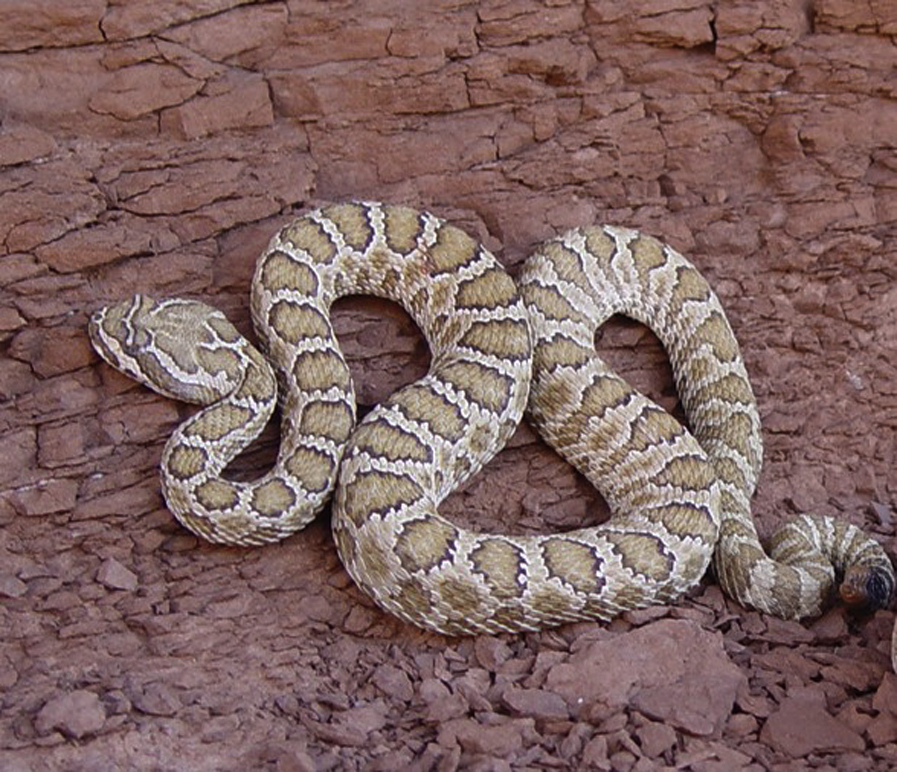
Example of
Case Descriptions
Patient 1
A 48-y-old man with an unremarkable medical history picked up what was later identified as a Grand Canyon rattlesnake in northern Arizona so he and a friend (Patient 2) could take a “selfie” with the snake. When his friend leaned over to show him the image on his phone, the patient’s left hand, which was holding the snake, was bumped by his friend’s right arm. Patient 1 lost control of the snake, which then bit both men simultaneously. One fang entered an upper extremity of each patient with the single strike. Patient 1 was envenomated in the left middle finger. He immediately went to a nearby emergency department. One hour after the bite, he was noted to have pain, swelling, and erythema of his left hand. He developed diffuse myokymia, starting with his right calf and progressing to involve all major muscle groups. Laboratory values included white blood cell count of 9.6 K·mm-3 (normal 4.0–11.0), hemoglobin of 14.1 g·dL-1 (normal 13.5–17.0), platelet level of 393 K·mm-3 (normal 130–450), prothrombin time (PT) of 13.6 s (normal 11.8–14.7), fibrinogen of 124 mg·dL-1 (normal 200–400), and a normal comprehensive metabolic panel. Six vials of FabAV were given, and he was transferred to the medical toxicology service at a tertiary care referral center.
On arrival approximately 4 h after envenomation, he had diffuse myokymia, including both peripheral and cranial nerve distributions. He had mild swelling of the left upper extremity, without any signs of necrosis. Despite receiving an additional 4 vials of FabAV (total of 10 vials), he continued to have neurotoxicity and worsening rhabdomyolysis, with a peak creatine kinase of 45,000 IU·L-1 (normal 35–232) 16 h after envenomation. Peak hemotoxicity occurred at the same time, with PT 17.0 s and fibrinogen of 105 mg·dL-1. Myokymia involved the shoulders and upper arms and was associated with some respiratory muscle weakness with a negative inspiratory force of −45 cm H2O (normal −60; −30 indicates respiratory insufficiency). An additional 4 vials of FabAV (total 14 vials) were administered. Within 1 h, the patient had improvement of myokymia and hemotoxicity. The patient received a total of 20 vials of antivenom in the first 36 h. He was feeling well, with normal platelet and coagulation results, and discharged home 60 h after presentation. One week after envenomation, he was asymptomatic and had returned to his regular activities. He did not have recurrence of coagulopathy on repeat laboratory testing up to 1 wk after envenomation.
Patient 2
The second patient was bitten on the lateral aspect of his right upper arm during the same bite that envenomated Patient 1. Patient 2 was a 40-y-old man with a history of chronic back pain and hypertension. His medications included lisinopril 2.5 mg daily and oxycodone 5 mg as needed. On initial evaluation at the outside emergency department, mild tachycardia was present but no swelling, erythema, or ecchymosis near the single puncture wound was seen. The patient reported diffuse myalgias, and myokymia involving the musculature of the back was noted. Initial laboratory values included white blood cell count of 5.1 K·mm-3, hemoglobin of 13.2 g·dL-1, platelet level of 268 K·mm-3, PT of 13.7 s, fibrinogen of 198 mg·dL-1, and a normal comprehensive metabolic panel. Antivenom treatment was deferred, and he was transferred to the medical toxicology service at the same tertiary care referral center.
On arrival approximately 6 h after envenomation, he reported diffuse pain and myalgias. His vital signs were remarkable only for a heart rate of 95 beats·min-1 and normal blood pressure. His mental status was normal. Mild myokymia of the back muscles was present, as well as swelling in the forearm and hand distal to the bite site on his lateral upper right arm. He had no history of atopy and no known previous exposure to snake venom or antivenom. Four vials of Fab AV were administered 8 h after the envenomation for local swelling, myalgias, and mild myokymia. On completion of antivenom infusion, approximately 1 h after treatment began, the patient developed a hypersensitivity reaction. His heart rate increased to 115 beats·min-1 and blood pressure fell to 80/40 mm Hg. He developed vomiting, and examination revealed angioedema of the lips and tongue, urticaria, and wheezing. He was treated with intravenous diphenhydramine 50 mg, famotidine 20 mg, methylprednisolone 60 mg, and epinephrine 1 mg followed by a continuous infusion. The urticaria, vomiting, hypotension, and bronchospasm resolved, and his angioedema stabilized over the next hour. An epinephrine infusion at 3 mcg·min−1 was continued for 6 h with gradual resolution of angioedema of the lips and tongue. By the next day, his symptoms had resolved, with the exception of mild myalgias. He did not develop rhabdomyolysis, and creatine kinase remained normal. He did not develop hemotoxicity other than the mild hypofibrinogenemia at presentation. He was discharged home 24 h after presentation with a prednisone taper. He returned to his usual activities that week. There was no recurrence of any symptoms reported through poison control follow-up, although he did not obtain the follow-up blood work recommended by the poison control center.
Discussion
The terms fasciculation and myokymia are often used interchangeably in the medical literature addressing rattlesnake envenomation. However, the term fasciculation technically refers to only a single motor unit firing, and myokymia refers to bursts of multiple motor unit action potentials. The patients described displayed myokymia. Myokymia is most commonly associated with envenomation by the Timber rattlesnake (
Neurotoxins present in venom act at the level of the neuromuscular junction, both presynaptically (β-neurotoxins) and postsynaptically (α-neurotoxins).
5
Perhaps the most studied of the β-neurotoxins is Mojave toxin,
3
a phospholipase A2 that produces a characteristic triphasic effect on acetylcholine release. This triphasic response begins with a decrease, followed by a transient increase, and then a near total block of acetylcholine release. Other β-neurotoxins, such as dendrotoxin from the eastern green mamba (
The identity of the molecular components of venom that induce myokymia remains unclear. Venom may interact with calcium channels on peripheral nerves.
12
This is supported by literature demonstrating response to calcium chloride.
1
Potassium channels might also be involved. For example, in Isaacs syndrome (a peripheral nerve hyperexcitability syndrome) autoantibodies are directed against voltage-gated K+ channels. The blockade of this channel (which could be analogous to venom components) brings the axon closer to action threshold, resulting in a greater number of discharges, which leads to myokymia. Thus, myokymia after
Respiratory failure from rattlesnake envenomation, whether due to respiratory weakness or airway compromise, is fortunately rare. In 1 study describing 256 rattlesnake bites, only 1% of patients with rattlesnake bite had respiratory failure. 12 However, a previous retrospective poison control system study identified myokymia involving the shoulders, chest wall, and torso as a risk factor for hypoxemia and respiratory failure. 13 The clinical effects seen in Patient 1 are consistent with these findings: He had evidence of respiratory compromise based on negative inspiratory force. Whether neurotoxicity and respiratory failure in crotaline envenomation are responsive to treatment with FabAV remains controversial and unclear. 14
In this case, myokymia appeared to respond to FabAV once a critical amount of antivenom was given. The hematological and neurological signs of envenomation resolved at the same total dose of antivenom. It is possible this was spontaneous as a result of the passage of time and not the antivenom, but he did have very rapid improvement temporally associated with an antivenom bolus. Although this improvement has been reported, 15 there have been other cases in which antivenom does not seem to ameliorate the neurological effects of Crotalinae venom. 16
Venom-induced anaphylaxis has been previously described and is believed to be due to histamine and bradykinin-potentiating peptides. 17 Patient 2 developed signs of a hypersensitivity reaction more than 8 h after the envenomation that was temporally associated with antivenom administration, leading to the conclusion that the reaction occurred secondary to antivenom and not venom. A risk factor for hypersensitivity reaction was not identified—no history of atopy, no known sensitivity to sheep or papain was elucidated, and no previous exposure to FabAV. Acute hypersensitivity reactions are reported to occur in only 5% of patients treated with FabAV. 18 Angioedema with potential for airway obstruction occurs less frequently (1–2%). These acute hypersensitivity reactions are treated by slowing the antivenom infusion rate, administering antihistamines and/or steroids, and, in the case of more serious reactions, administering epinephrine. 7 The uncommon occurrence of angioedema and the lack of identifiable risk factors for acute hypersensitivity to FabAV leads one to consider the possible contribution the angiotensin converting enzyme inhibitor (ACEI) may have made.
It is known that ACEIs predispose patients to angioedema and may directly cause it in some cases owing to higher levels of bradykinin.15,19 ACEIs are associated with increased risk for more severe reaction from venom immunotherapy as well as hymenoptera envenomation. Bradykinin is a potent vasoactive mediator that contributes to the hypovolemia and hypotension observed in patients with severe anaphylaxis. Breakdown of vasoactive kinins generated during anaphylaxis may be impaired in patients on chronic therapy with an ACEI. 16 Thus, elevated bradykinin concentrations expected in patients taking an ACEI could potentiate this reaction. However, there is little data indicating that ACEI medication increases the risk for anaphylaxis from FabAV specifically.
A striking feature of the cases reported is the difference in clinical manifestations despite simultaneous envenomation. One patient had significantly greater neurotoxicity with resultant respiratory compromise without impressive local findings, whereas the other had more typical local swelling and less neurotoxicity. This suggests that not only a difference in venom load but also the presence of patient factors not fully elucidated may be critical determinants of clinical presentation.
Conclusions
Simultaneous envenomation by the Grand Canyon rattlesnake,
Footnotes
Acknowledgements
Acknowledgments: The authors acknowledge Marty Feldner for the image.
Author Contributions: Drafted this manuscript, revised, and gave final approval (WH, CC, AO, MR).
Financial/Material Support: None.
Disclosures: None.