






Abstract
Introduction
Most recreational whitewater fatalities are caused by fixed underwater entrapment or by “flush drowning,” an obscure term frequently associated with high-volume rivers, continuous rapids, cold water, and a lack of prolonged underwater entrapment. Although entrapment drowning is typically associated with submersion hypoxia, flush drownings likely involve diverse mechanisms of death; as such, a concise definition is elusive. This said, certain risk factors may be predictively associated with flush drownings. We attempt to further characterize causes of fatal river accidents and possible effects of water temperature on injury pattern.
Methods
We reviewed river mortality data collected from the American Whitewater Association accident database comparing fatal whitewater accident trends in the Rocky Mountain region versus the Southeastern United States. We limited data from the Southeast to the months of June through August to create a warm water cohort. We then divided lethal accidents into flush drowning, entrapment submersion, or miscellaneous events, defining each category in specific terms.
Results
Flush drownings were more common in the Rocky Mountains than in the Southeast subgroup and involved older victims on average than entrapment drowning or miscellaneous events. Entrapment drownings were common in both regions, primarily occurring at fallen trees or rock formations.
Conclusions
Flush drownings appear to occur more frequently in older persons. Although hypothetical, the relative increase in flush drowning in the Rocky Mountains might partly be the result of colder water temperatures. If the cause of flush drowning is better understood, safety in whitewater recreation may be improved.
Keywords
Introduction
An American Whitewater Association (AWA) study suggests that the greatest risk of death in nonmotorized whitewater sports is associated with strainers (trees), sieves (rock formations), or large hydraulics. 1 Although asphyxia deaths after fixed underwater entrapment against solid objects are implicitly understood, deaths occurring without prolonged underwater entrapment can be perplexing. These latter accidents are sometimes referred to as “flush drowning,” a colloquial term used primarily by whitewater boaters that has no consensus definition. In common usage, this phrase lacks consistency and is often speculative in nature. Despite these shortcomings, flush drownings do have certain associations with environmental factors or demographics. As suggested by the name itself, flush drowning is often linked to high (flushing) flows or large volume rivers, which can complicate rescue efforts.1,2 Although not rigidly defined, flush drowning is typically associated with the proper use of personal floatation devices (PFDs) and a lack of fixed prolonged underwater entrapment. Whitewater publications variably cite cold water as a complicating feature of flush drownings.1,2 Although some sources attribute the mechanism of death in flush drowning to repeated submersion in turbulent water leading to asphyxia, multiple factors are likely involved, including the immediate or delayed consequences of immersion in cold water. 3
The AWA accident database was developed from reports collected from the 1970s onward with some anecdotal reports from earlier history. These reports are primarily derived from firsthand professional or recreational whitewater user accounts, although media or other sources are also used. Although ambiguously defined, flush drowning is referenced as a causative factor in numerous AWA accident reports, contributing largely to overall whitewater recreation mortality in the Rocky Mountain region. 4 To better understand mechanisms responsible for whitewater fatalities, we reviewed the AWA accident database cases resulting in death in a cold water subgroup (Rocky Mountain region, year round) and a warm water subgroup (Southeast states during summer). In addition to recording certain available demographics, type of craft, and river difficulty rating for each case, an accident type was assigned, including flush drowning, entrapment drowning, or miscellaneous causes. By reviewing trends within these parameters, we hope to better understand regional differences in injury patterns, and in particular the concept of flush drowning.
Methods
We collected information from the AWA accident database including events from 1950 to 2018. 4 An institutional review board ethical review was not submitted because data used in this report were based on publicly available information. Any correlation to care provided at our institution is coincidental. Demographics information such as age was occasionally supplemented from web-based news articles. A spreadsheet was created with the event date, age and sex of the victim, type of craft, river difficulty rating, and suspected cause of death (eg, flush drowning, tree entrapment). All numbers or percentages refer to individual cases rather than groups of victims in the same accident. Discrepancies within the AWA database were clarified by referring to the accident narrative. The age and sex of the victim were absent in some accident reports, but as available, age is presented in years as mean±SD with (range), as appropriate. Only accidents involving what we defined as traditional whitewater craft were entered into our data, including hard shell (kayaks, canoes, or drift boats) and inflatable boats (rafts, catarafts, or inflatable kayaks). We excluded reports in which victims were not wearing a PFD, or in which a PFD was observed initially falling off. The AWA database includes information on almost 1800 whitewater accidents, most of which were excluded from our data because the accident was not fatal, did not occur while boating in a whitewater craft (by our definition), occurred outside our study area, or the victim was not wearing a PFD (the AWA database lists lack of PFD as cause of injury or death in approximately 15% of accident reports). 4
Our primary data sets included deaths occurring in the Rocky Mountain region, with a secondary cohort in the Southeastern United States but limited to June, July, and August to select for the warmest possible water temperatures. To establish a crude comparison of water temperatures between the Southeastern versus Rocky Mountain rivers, United States Geologic Survey (USGS) data for 7 gauge sites for each area from July 1, 2018 were reviewed (Table 1). We applied the international scale of river difficulty, which rates river hazards as class 1 (small waves with no obstacles), class 2 (straightforward rapids), class 3 (rapids with moderate or irregular waves requiring maneuvering to avoid obstacles), class 4 (intense, powerful waves requiring pressured maneuvering), class 5 (extremely long, complex, highly violent rapids), or class 6 (limit of navigability). Because class 1 and 2 ratings are similar in nature, they were analyzed as 1 group.
Maximum water temperature of selected rivers on July 1, 2018
Numbers in parentheses represent respective United States Geologic Survey station numbers.
Mechanisms of injury resulting in death were broadly divided into entrapment submersion, flush drowning, or miscellaneous events. Entrapment submersion was defined as fixed underwater entrapment by equipment, rock formations, trees, dams, or bridges. We defined fatalities occurring without documented prolonged entrapment submersion or incapacitating trauma in which a PFD was worn as flush drownings. Brief submersion is expected in violent whitewater and did not preclude a flush drowning categorization. Our definition of flush drowning is substantially broader than the common usage of the term and limited other subgroups to either entrapment submersion or miscellaneous events, the latter defined as substantiated incapacitating medical events (eg, witnessed seizure), trauma (eg, spine fracture or descriptive head wound), or accidents without witnesses (primarily solo boating deaths).
The accident codes used in the AWA database typically aligned with our injury mechanisms, although speculation of a medical problem or injury was rejected if unaccompanied by supporting evidence. This dynamic accounted for the majority of cases we reclassified to flush drowning from alternate AWA injury codes. As such, deaths assumed to result from heart attack, stroke, epilepsy, head injury or other medical cause without evidence of injury, observed seizure, or other documented pathological confirmation of a lethal condition were considered flush drownings. We also considered victims who died of cardiac arrest immediately after rescue to be flush drownings, a clear departure from common understanding of the term. Our broad categorization of flush drowning clearly resulted in the inclusion of multiple death mechanisms, such as immersion-related events, submersion asphyxia without fixed entrapment, occult injuries, or medical problems unrelated to immersion or submersion. These data were then analyzed for variations among subgroups.
Results
We reviewed 302 recreational whitewater fatalities in the Rocky Mountain region, of which 104 occurred when using hard shell and 198 when using inflatable boats (Table 2). Likewise, similar deaths in the Southeast region of the United States during June, July, or August included 66 deaths, 31 in hard shell and 35 in inflatable craft. Flush drowning, as broadly defined for the purpose of this paper in the Introduction and Methods sections, constituted 61% of the fatalities in the Rocky Mountains versus 15% in the Southeast. In contrast, entrapment submersion comprised 74% of lethal Southeastern accidents versus 31% in the Rocky Mountain region. Miscellaneous events were well balanced between the groups, constituting 8% in the Rocky Mountains versus 11% in the Southeast. Subdividing accidents by craft type, we found Rocky Mountain hard shell boaters died from flush drowning in 39% of cases, entrapment submersions in 43%, and miscellaneous events in 17%. Comparatively, Southeastern hard shell boaters died from entrapment submersion in 77% of cases, flush drowning in 6%, and miscellaneous events in 16%. Inflatable boaters in the Rocky mountain region died from flush drowning in 72% of cases, entrapment submersion in 24%, and miscellaneous events in 4%. Likewise, inflatable boaters in the Southeast died from flush drowning in 23% of cases, entrapment submersion in 71%, and miscellaneous events in 6%.
Number of recreational whitewater fatalities by type and region
Rocky Mountain rivers include rivers in Colorado, New Mexico, Wyoming, Idaho, Montana, and Utah. Hard shell craft include kayaks, canoes, or dories.
Southeast rivers include rivers in Tennessee, West Virginia, Virginia, Alabama, North Carolina, Georgia, Arkansas, South Carolina, and Kentucky. Inflatable craft include rafts, catarafts, or inflatable kayaks.
Fatal whitewater accidents in the Rocky Mountain region were concentrated in class 3 (31%) or class 4 (38%) whitewater, with lesser amounts in class 5 (19%) or class 1 to 2 (12%). Whitewater fatalities in the Southeastern cohort were relatively equally divided among class 1 to 2 (32%), class 3 (24%), and class 4 (30%) whitewater, with lesser amounts in class 5 (14%). Many class 1 to 2 drownings occur at low head dam structures known to create complex lethal hydraulics and probably deserving of separate hazard category. The age of victims in the Southeastern cohort was 37±18 y (9–71), subdivided into 34±17 (9–67) for entrapment submersion, 51±14 (36–71) for flush drowning, and 44±14 (20–61) for miscellaneous events. The age of victims in the Rocky Mountain cohort was 44±16 y (3–80), broken down into 37±16 (3–67) for entrapment submersion, 48±15 (4–80) for flush drowning, and 36±17 (4–71) for miscellaneous events (Figure 1). The victims age could not be established in 9 Southeastern (14%) and 38 Rocky Mountain cases (13%).
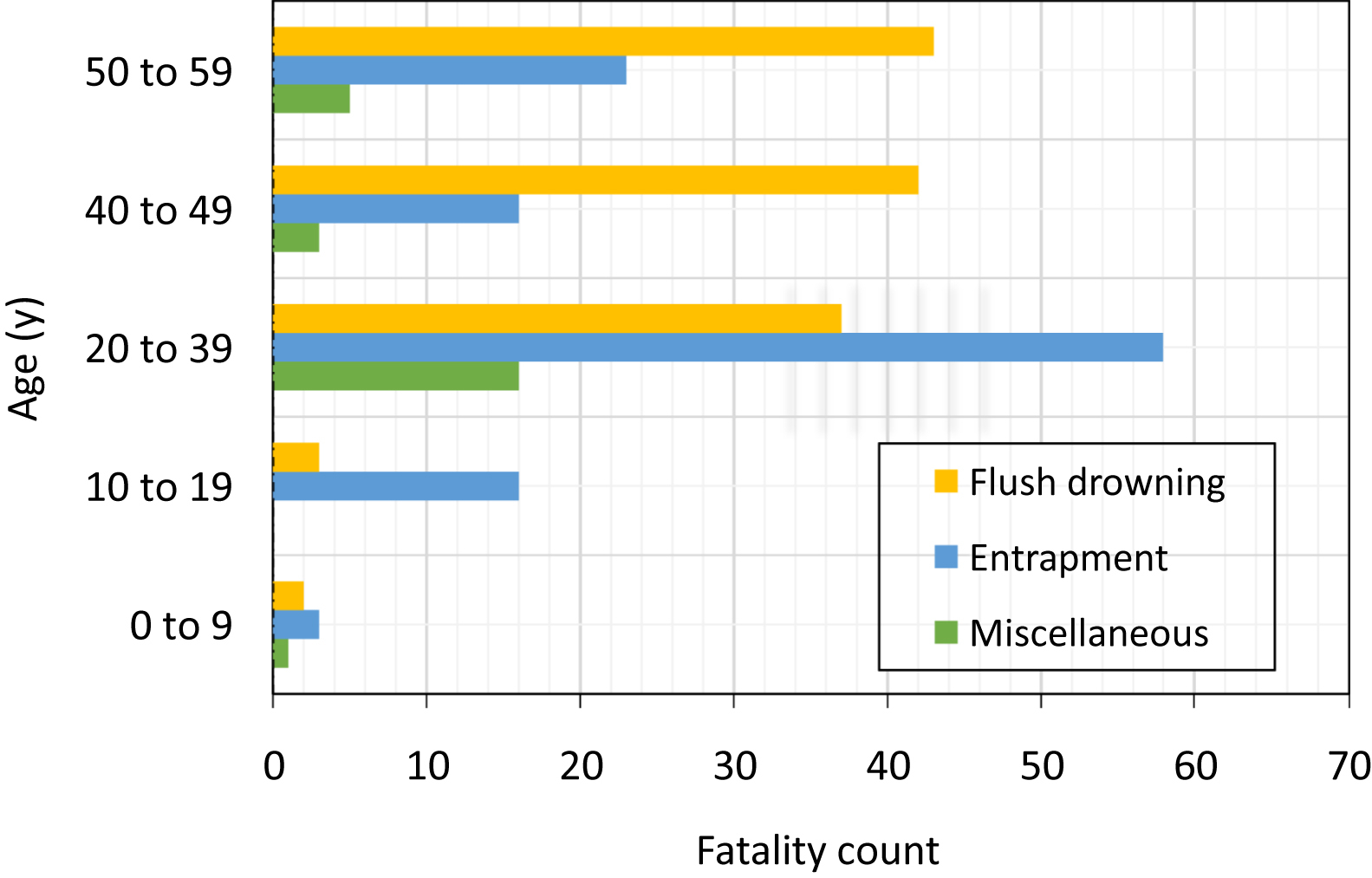
Whitewater fatality type segregated by age range. Rocky Mountain and Southeast cohorts combined.
Entrapment deaths in the Rocky Mountain region occurred in trees in 34 cases, rocks in 34 cases, equipment in 11 cases, dams in 10 cases, and bridges in 3 cases. Entrapment deaths in the Southeast region occurred at rocks in 33 cases, trees in 8 cases, dams in 7 cases, and equipment in 1 case. Among equipment entrapments in both cohorts, ropes were involved in 11 of 12 cases. The maximum temperature on 7 selected rivers monitored by USGS gauging stations in the Southeastern region on July 1, 2018 was 20 to 28°C with a mean±SD of 24.3±2.7°C. 4 Likewise, temperature ranges on 7 selected Rocky Mountain rivers on the same day ranged from 12 to 21°C with a mean±SD of 17.0±2.8°C (Table 1).
Discussion
Most recreational whitewater fatalities in our data were caused by either entrapment submersion or flush drowning, although some deaths were attributed to blunt or penetrating trauma. 4 The AWA accident database lists impact trauma as the suspected cause of 5 to 10% of all accidents, but over half of these reports describe nonlethal injuries. Underwater entrapment deaths appear problematic for both hard shell and inflatable boaters. Rock entrapments may occur at sieves and undercuts or when an arm or leg is wedged between rocks. Both watercraft and swimmers are also prone to entrapment by fallen trees, often called “strainers” because they filter large solid objects while allowing water to pass. Our data suggested a trend toward rock entrapment in the Southeast, with tree and rock entrapment represented equally in the Rocky Mountain region. Equipment entrapment most often resulted from ropes trapping victims under the surface, a scenario more common among inflatable boaters. Dam entrapments pose classification difficulties because it is often unclear whether death is caused by prolonged recirculation in uniform hydraulic features or underwater entanglement in supporting rebar, concrete, or debris.
The dominance of flush drownings in the Rocky Mountains as compared to the Southeast region was notable. Our data suggest 39% of hard shell and over 70% of inflatable boater deaths in the Rocky Mountains occur by flush drowning, versus 6% of hard shell and 23% of inflatable boaters in the Southeast. The introduction of additional variables in the Rocky Mountain cohort by including the entire year’s data was likely minimal because only 14 of 302 accidents occurred from September to April, with only 6 flush drownings. The prevalence of flush drowning seems to remain consistent in warm climates where very cold water is released from the bottom of manmade lakes, such as in the Grand Canyon. 5 We believe some of the variation noted in drowning type between the Rocky Mountains and Southeastern cohorts may be due to the effects of lower water temperatures in the Rocky Mountain region. There is a trend across all groups for flush drowning victims to be older, with only 5 flush drownings in persons under 20 y of age represented in our data. Taken together, our findings may suggest associations between flush drowning and immersion in cold water or flush drowning and older age.
To a degree, river difficulty ratings reflect the risk of navigating rivers, but major confounders exist, such as excessive flow, cold water conditions, or the appearance or disappearance of entrapment structures at certain levels. As such, the danger in whitewater activities may be diminished by careful preparation or avoidance of certain situations. For instance, the risk of entrapment can be mitigated by thorough scouting and portaging known entrapment risks. As with other adventure sports, proper equipment is essential for whitewater safety, as evidenced by the high number of whitewater fatalities occurring in the absence of a PFD. 6 Although thermal protection is recognized as standard safety gear among most whitewater enthusiasts, it may be more crucial than previously appreciated, particularly in water colder than 25°C. In addition, factors potentially increasing risk after cold water immersion, such as older age, should also be considered when establishing safety thresholds.
LIMITATIONS
In addition to being retrospective, our data were derived from web-based accident reports, which are often incomplete and speculative and rarely included autopsy findings. Because there are no peer-reviewed citations referencing or defining flush drownings, our accident categories are subjective in construction. Our flush drowning definition is extremely broad, likely encompassing deaths from numerous mechanisms, including unwitnessed prolonged submersion, occult medical or traumatic injury, and immersion-related events. Difficulties also arise in labeling entrapment fatalities, which may occur after incapacitation or death from other causes, thus underrepresenting flush drownings or miscellaneous events. Miscategorization among our 3 mechanistic subgroups was likely frequent, a limitation of the nature of the data pool.
The presupposition that water is warmer in Southeastern rivers during the summer is a generalization that is not always true. Water temperature can be influenced by the time of day, rainfall, dam releases, or other factors. USGS temperature data are only available at selected hydrologic stations; thus, temperature comparisons may not represent the sections of river most commonly associated with whitewater accidents. In addition, summer water temperature in many Southeastern rivers is cold enough to trigger cold water immersion syndrome. 7 Although water temperature may play an integral part in flush drowning, other regional variables between the Rocky Mountains and the Southeast may exist, such as the continuous nature of rapids in 1 area. It is also possible that an increased risk of entrapment submersion in the Southeast cohort accounted for differences in our data rather than an increased risk of flush drowning in the Rocky Mountains. Lastly, the Southeastern cohort lacked the size and power of the Rocky Mountain cohort and only included summer months, sometimes omitting primary boating seasons for some important rivers (eg, Gauley river).
Conclusions
Reducing risk in whitewater sports requires understanding applicable injury mechanisms. As previously described in the literature, we found entrapment drowning to be primarily caused by tree or rock entanglement. Although the mechanism of death observed in fixed underwater entrapment is self-evident, the cause of death in flush drowning remains as ill-defined as the term itself. Our data suggest flush drownings are more common in the Rocky Mountain region than during summer in Southeastern states. Of the various potential cofactors associated with flush drowning, cold water temperature and older age may be important. With a better understanding of the mechanisms of death in whitewater recreation, outfitters could provide a more comprehensive summary of risk to prospective customers. Because of the limitations of our data collection methods, further research will be needed to clarify these associations.
Footnotes
Acknowledgements
Acknowledgments: Special thanks to Charlie Walbridge and the AWA for their dedication to whitewater safety.
Author Contributions: Study concept and design (DF); acquisition of data (DF); analysis of data (DF, JL); drafting of manuscript (DF, JL); critical revision and approval of final manuscript (DF, JL).
Financial/Material Support: None.
Disclosures: None.