






Abstract

The Brazil’s lancehead (Bothrops brazili) was described by Alphonse Hoge in 1954, and the specific epithet is a tribute to Vital Brazil Mineiro de Campanha, a great Brazilian scientist and the founder of Butantan Institute (São Paulo). 1 Adult specimens are usually 70 to 90 cm in length, with a record of 149 cm. 1 Most specimens of Bothrops brazili lack a postocular stripe, and a pinkish or coppery iris color will distinguish this species from all other sympatric pit vipers. 1
This venomous species occurs in the equatorial forests of southern Colombia, eastern Ecuador, eastern Peru, northern Bolivia, southern and eastern Venezuela, Guyana, Suriname, French Guiana, and Brazil in the states of Acre, Rondônia, Roraima, Maranhão, Pará, Amazonas, and northern Mato Grosso. 1 The relative scarcity of geographical distribution records of the Bothrops brazili may be due to its preference for primary forest habitats and competition with Bothrops atrox, which adapts more readily in altered environments 1 and is the main cause of snakebites in the Amazon. 2 Although cases of envenoming by Bothrops brazili species are considered rare,1,3 this snake is very feared by indigenous people of southeastern Colombia. 1 The envenomation caused by Bothrops species is characterized by 3 main pathophysiological activities 2 : coagulant, hemorrhagic, and proteolytic or acute inflammatory effects. Botropic envenoming is responsible for the highest morbidity and mortality in Amazonia, and victims are often far from hospital care and antivenom availability. 2
During field activities of herpetological studies in the Alto Juruá region, western Brazilian Amazon, we found 6 specimens of Bothrops brazili in “terra firme” forests in 2 localities (Serra do Divisor National Park, Acre state, and Badejo do Meio, Guajará, Amazonas state). During the wet season, 3 specimens were found in the Serra do Divisor National Park in December 2017 and 3 others in the Badejo do Meio in March and April 2019. We present here images of two specimens encountered in our field studies (Figures 1 and 2).
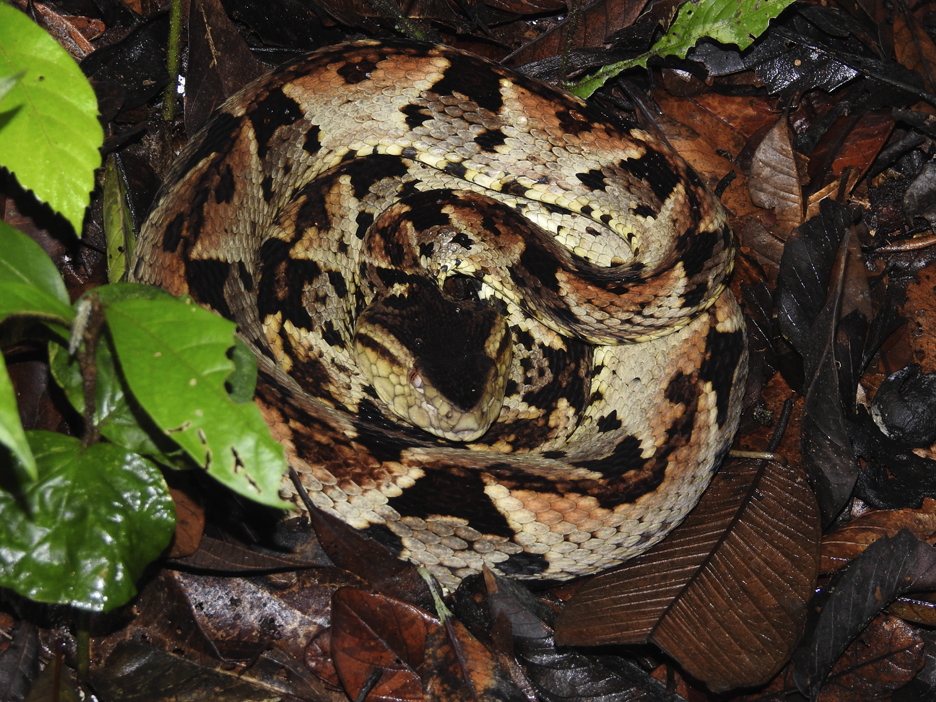
Adult specimen of Brazil’s lancehead (Bothops brazili) photographed December 2017 in the Serra do Divisor National Park, Acre state (07°26’ S, 73°39’ W).
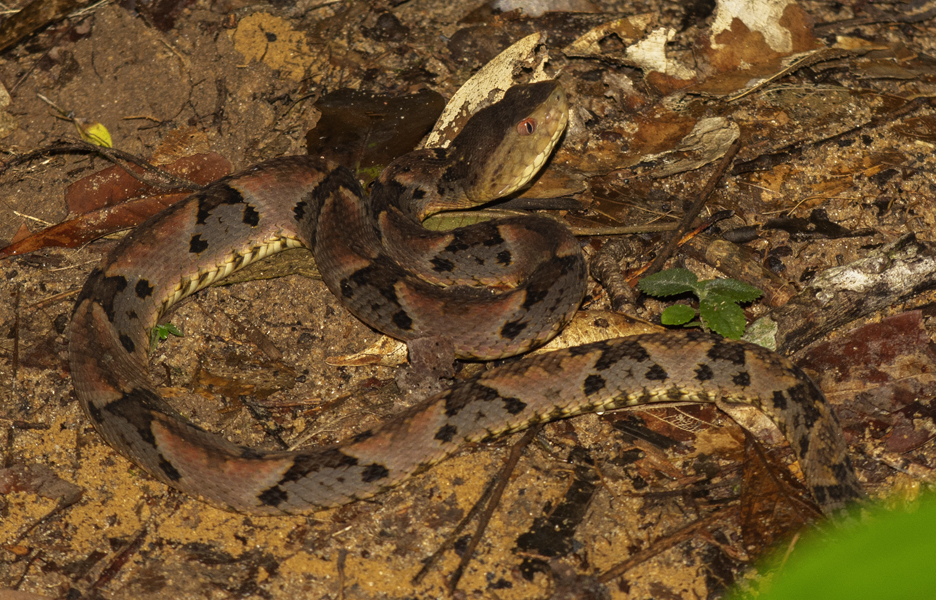
Juvenile specimen of Brazil’s lancehead (Bothops brazili) photographed March 2019 in the Badejo do Meio, Guajará, Amazonas state (07°29’ S, 72°43’ W).
As ambush hunters, Bothrops brazili's camouflage coloration makes it difficult for its prey or predators to detect it when it lies coiled in leaf litter. This also contributes to snakebites in unwary people walking in these environments.4,5 Despite the unusual number of encounters of this snake, 2 other species of Bothrops (Bothrops atrox and Bothrops bilineatus smaragdinus) are relatively more abundant in the Upper Juruá region6,7 and more often involved in snakebite,4,5 possibly because Bothrops brazili is less frequent and restricted to “terra firme” forest habitats. 1