






Abstract
Introduction
Studies have reported circadian desynchronizations and sleep disruptions in onshore populations in the Arctic during the polar day. Although the Arctic region is becoming more accessible by sea and evidence is growing to implicate the importance of fatigue in sailing accidents, no study related to circadian disruptions has focused on sailors. The aim of this study was to observe, during a 155-d polar sailing trip between Greenland and Russia, the evolution of the sleep-wake rhythm and core body temperature (Tc) in a sailor.
Methods
During the expedition, an electronic sleep diary was recorded daily and a continuous measurement of Tc using telemetric pills was performed every 10 d (recording depending on transit time, ≈24 h). Ephemerides were manually determined day by day using global positioning system position and revealed 3 phases (phase 1: decrease of night duration; phase 2: polar day; phase 3: increase of night duration).
Results
A significant difference (P < 0.05) was observed in daily sleep time between phase 2 (7.6 ± 2.5 h) and phase 3 (8 ± 2 h). The period of Tc rhythm changed during the expedition (phase 1: 24.2 ± 0.5 h; phase 2: 25 ± 0.3 h; phase 3: 24 ± 0.6 h). Dissociation between Tc rhythm and sleep occurred during phase 2.
Conclusions
Our study observed that during a polar sailing expedition, many circadian disruptions appeared as free-running rhythms or dissociation between sleep and Tc rhythm. Future studies will evaluate effects of these disruptions and their probable association with accident risks.
Introduction
Polar regions represent natural laboratories for the observation of biological rhythms. 1 Owing to the inclination of the Earth, these regions undergo significant yearly variations in day-night alternation. The Arctic is illuminated for several months (polar day) during the summer and is in complete darkness during winter (polar night). 2
The light-dark cycle is the predominant environmental factor for the synchronization of the human biological clock to the 24-h cycle. In our physical environment, a day lasts 24 h; to be in phase with it, external factors such as the light-dark cycle regulate the biological clock over a period of ≈24 h. Individuals deprived of environmental factors have a biological clock running throughout a period of ≈25 h (free run) 3 –5 and are therefore not adapted to the 24-h period of a normal day. The unusual photoperiod, characterized by the total absence of moonlight during polar days, may increase risks of desynchronization and sleep disturbances. 1 ,2,6–13
Core temperature (Tc) seems to be a pertinent marker of the biological clock14,15 owing to its capacity to keep to a rhythm despite extreme environment or extreme physical activity.16,17 Tc has a circadian rhythm (period of ≈24 h) with a trough (bathyphase, which encourages sleep mechanisms) in the middle of the night and a peak (acrophase, which promotes wakefulness) at the end of the afternoon. Many studies have reported an evolution of Tc related to the sleep-wake rhythm, 18 –21 mostly by promoting melatonin production. Melatonin, referred to as the sleep hormone, has a circadian rhythm with an inverse relation to Tc22,23 (ie, with an acrophase in the middle of the night and a bathyphase in the end of the afternoon). Most studies in polar regions focus on this hormone 1 ,6–8,11,13 because its production is highly influenced by light. 24 –26 Indeed, light slows its secretion by blocking the key enzyme of its synthesis, N-acetyltransferase. 24 Studies have found a significant decrease in its production 7 during expeditions in Antarctica and an important phase delay 16 in polar days. Only 3 studies have focused on Tc rhythmicity in the polar environment, 1 ,16,27 and they also reported an important phase delay in polar days. Thus, Arctic or Antarctic regions particularly affect sleep. 1 ,2,6–12 For example, out of 450 people living in northern Russia, > 80% reported sleep disturbances during times of extreme photoperiod. 9 Regarding scientific expeditions, a reduction in sleep time and quality during an extreme photoperiod was observed. 2 ,6–9
Since 1979, the Arctic ice area has reduced by 11% every 10 y, representing > 500,000 km2 per decade. 28 Thus, in northern Canada, shipping traffic is constantly expanding, from around 100 trips in 2003 to > 350 in 2013. 29 However, currently, despite the growing accessibility of the polar regions by sea, 30 studies have primarily included onshore populations. No study has focused on sailors’ biological rhythms. With ice melting, navigation in polar areas requires increased vigilance for cold and icebergs. Seafarers must remain awake as long as possible to ensure correct navigation and the safety of their crew. Lifestyle on board is very different from onshore: Sailors must sleep using a polyphasic sleep method, which entails sleeping multiple times during their 24-h day. This mode of sleep does not alter sleep mechanisms,31,32 but the combination with extreme environments, such as polar regions, could lead to sleep impairments. In the past decade, reports on maritime accidents have suggested that the majority are related to human errors 33 and that fatigue was one of the main reasons. 34 Accidents at sea often result in loss of life or serious pollution. Despite considerable progress in regulations and technological advances (eg, satellite navigation, on-board computers, etc), sailing remains dangerous. 35 Prolonged disturbance of biological rhythms and sleep for several weeks could negatively affect health24,36 or increase the risk of accidents. To improve safety of sailors in the future, it is necessary to study the impact of the polar day and polyphasic sleep on the sailor’s biological clock. The aim of this case study was to observe the Tc rhythm as a circadian marker and the sleep-wake rhythm of a seafarer during a 155-d polar sailing trip.
Methods
Participants
With approval from the ethics committee of the University Lille 2 of Health and Law, the study was conducted during a 155-d polar sailing trip between Sissimut (Greenland, 66°56'20”N 53°40'20”W) and Petropavlovsk (Russia, 53°2'40”N, 158°39'3”E; Figure 1). The participant was a 43-y-old male sailor with > 20 y of experience with an initial body mass index of 22.7 kg · m-2 (1.93 m, 82 kg). His Chronotype Horne and Ostberg 37 score indicated that he is neither a morning nor evening type.
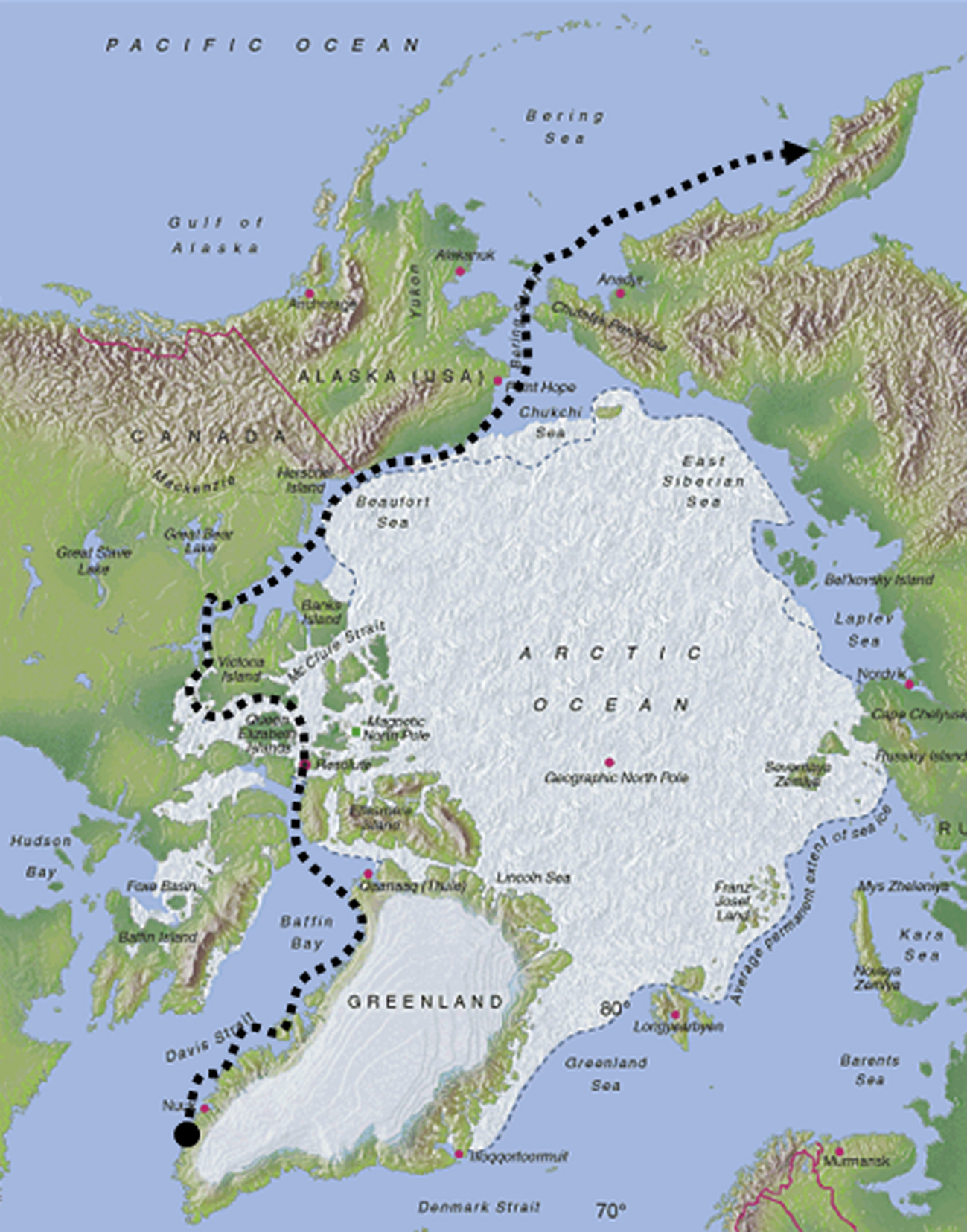
Mapping of the polar trip.
He was responsible for navigation, repairs, and organization of life on the boat (Maewan IV, trisalu, 11.3 m long). He remained on board all the time and welcomed 14 people during the sailing trip in small groups for a few weeks. On board, the maximum number of people never exceeded 6 persons. During the protocol, he did not take any medication or receive instructions on his sleep.
An electronic sleep diary was recorded daily during the 14 d preceding departure and indicated a monophasic sleep cycle (a single phase of sleep per day) with a duration of 7.0 ± 1.8 h (mean±SD). A continuous measurement, over 32 h, of the subject’s Tc using a telemetric capsule was performed 6 d before departure. This measurement showed a circadian rhythm (≈24 h) with an acrophase (peak rhythm) at 1617 and a bathyphase (trough rhythm) at 0347. The midline estimating statistic of rhythm was 36.7°C and the amplitude was 0.8°C.
Sleep-Wake Rhythm Measurement
Polysomnography is a heavy and impractical method at sea, and boat movements can result in misleading actimetry readings. Because of this, a sleep diary was used to measure the sleep-wake rhythm. This is an effective tool for the evaluation of the subjective quality of sleep and for the characterization of the sleep-wake rhythm.38,39 An internet-based electronic version was specially designed for the experiment. Daily, after each sleep period, the sailor indicated his bedtime and waking time, scored quality of sleep between 1 and 10, and commented on quality.
A computer with various protections against polar conditions was installed aboard. The skipper could access the sleep diary daily during the 155 d of the trip.
Core Temperature Measurement
Tc measurement was used because extreme conditions meant hormonal assays could not be performed during the sailing trip. It has been previously reported that Tc rhythm is related to the melatonin rhythm independent of polar conditions. 1 To measure Tc, we used a Bodycap e-Celsius device (Caen, France). This consists of a capsule (17.9 mm × 8.9 mm, 1.7 g) that, after intake, transmits Tc values with a precision level of ± 0.2°C to a monitor every 30 s. 40
During the 155 d, a Tc measurement session was taken approximately every 10 d, resulting in a total of 15 recording sessions (Table 1). For each measurement, only 1 capsule was ingested. The session duration depends on intestinal transit time (≈24 h), with recording times ranging from 21 to 118 h.
Sailing day for each Tc recording session
Tc, core body temperature.
Photoperiod Measurement
Every day, the boat’s position was calculated using a global positioning system (GPS) and Time Zero Navigator software (MaxSea, La Rochelle, France). Ephemerides were manually determined day by day after the experiment using the global positioning system coordinates and the National Oceanic and Atmospheric Administration application. The estimation of ephemerides reveals 3 distinct phases (Figure 2).
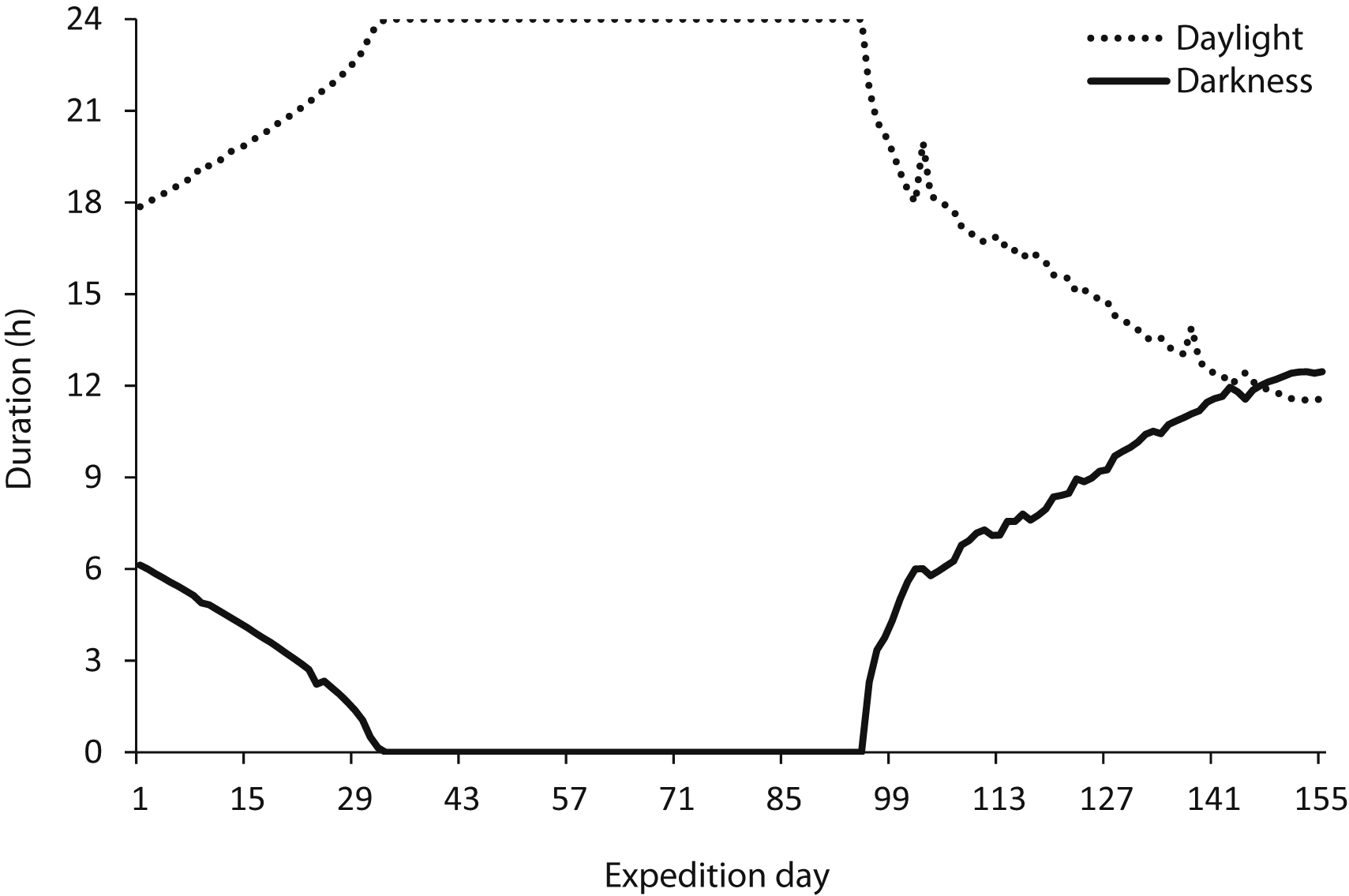
Evolution of the night and day durations during the sailing trip. Phase 1 (day 1 to day 32): phase during which the duration of the night decreased by 12 ± 06 min · d-1. Phase 2 (day 33 to day 94): polar day phase. Phase 3 (day 95 to day 155): phase during which the duration of the night increased by 12 ± 21 min · d-1.
Statistical Analysis
The Lomb and Scargle test 41 allowed the determination of Tc rhythm for each recording session. Cosinor’s model was applied to each Tc recording session (ellipse test 42 ), allowing the determination of the acrophase and bathyphase hours. For all Tc measurement sessions (n = 15), the daylight duration (per 24-h period) was calculated and the association between the bathyphase of Tc and sleep was converted into a binary variable. We carried out a logistic regression analysis to verify the probability of a desynchronization between the Tc rhythm and the wake-sleep rhythm as a function of the duration of the day. Significance was accepted at P < 0.05.
Results
Sleep-Wake Rhythm During the Expedition
Sleep became polyphasic with 1.5 ± 0.8 sleep periods per day. The number of sleep periods per day varied among the different phases with 0.9 ± 0.4 during phase 1, 1.5 ± 0.8 during phase 2, and 1.7 ± 0.8 during phase 3 (Table 2). A significant difference existed between phase 1 and phase 3 (P < 0.01). No significant difference (P = 0.30) was observed between phase 2 and phase 3. During phase 1, sometimes the skipper did not sleep, which can explain why the number of sleep periods per day is < 1.
Characteristics of sleep and Tc rhythm according to the phase of the expedition
Tc, core body temperature.
Significant difference (P < 0.05) from phase 1.
Significant difference from phase 2.
Significant difference from phase 3.
During the sailing trip, the daily duration of sleep was 7.4 ± 2.5 h and did not significantly differ from the onshore sleep duration (7 ± 1.1 h; P = 0.14). The duration of sleep varied during the trip, from 7.3 ± 01.3 h in phase 1 to 7.6 ± 2.5 h in phase 2 and 8 ± 1.9 h in phase 3 (Table 2). Significant differences between phase 1 and phase 3 (P < 0.01) and between phase 2 and phase 3 (P < 0.05) were observed.
Body Core Temperature During Sailing
The period of the Tc rhythm varied during the trip, from 24.2 ± 0.5 h during phase 1 (Table 2) to 25 ± 0.3 h during phase 2 (Table 2) and 24.1 ± 0.62 h during phase 3 (Table 2). A significant difference was observed in the period of the Tc rhythm between phase 2 (polar day) and phase 3 (return of night; P < 0.05).
During the polar day (phase 2), acrophase and bathyphase hours became irregular (Table 3, recording sessions 4 to 10). After darkness returned during phase 3 (Table 3, recording sessions 11 to 15), bathyphase reappeared during the night and acrophase during the day.
Association between the daylight duration, the hours of onset of Tc bathyphase and acrophase, and the sleep-wake rhythm during the expedition
Tc, core body temperature.
The sleep diary underlined a wakefulness phase during each Tc’s acrophase (Table 3, sessions 1 to 15), but a sleep phase in only 53% of bathyphase (Table 3, sessions 4, 5, 6, 7, 8, 10, 11). Dissociation between bathyphase and sleep mainly occurred during polar day (Table 3, sessions 4, 5, 6, 7, 8, 10). Logistic regression analysis showed a significant effect (P = 0.05) of the daylight duration on the association between Tc bathyphase and sleep.
Discussion
In this study, we observed the sleep-wake rhythm and the Tc rhythm of a sailor during a 155-d polar sailing trip. To our knowledge, no study has previously reported the evolution of circadian markers of a seafarer in this specific environment. We observed a lower sleep duration during the polar day (7.6 ± 2.5 h) compared to the period when darkness returns (8.0 ± 1.9 h; P< 0.05). Regarding the Tc rhythm, we observed that its period evolves as free-running (≈25 h) during the polar day, meaning that it is no longer synchronized with the duration of the day, before being reframed to a normal period of ≈24 h when night returns (Table 2). Finally, dissociation between the sleep and Tc bathyphase occurred also during the polar day (Table 3). All these results suggest that the variations of the day-night alteration may have disturbed the subject’s circadian markers.
During sailing, constant attention is required, forcing sailors to adopt polyphasic sleep. 31 According to the literature, such adaptation does not affect physical or cognitive performances,31,32 but the combination with polar day has not been studied yet. Here, we observed polyphasic sleep with an average of 1.5 periods of sleep per day. We observed a general increase in sleep periods during the trip, which is not really linked to the modifications of the light-dark cycle. No significant difference was found between the polar day in phase 2 and the return of darkness in phase 3. Based on these results it seems unlikely that photoperiod affected sleep periods. This increase could be explained by cumulative fatigue or an accumulated sleep debt, forcing the sailor to sleep more times a day.
The average sleep time recorded during sailing did not differ significantly from the recordings performed onshore. For comparison, the average sleep duration of the French population is 7.2 h, 43 which is even less than our subject. The use of polyphasic sleep in polar sailing provides sleep times similar to that in the onshore population, which seems to be a good strategy.
As with the number of sleep periods, the daily sleep time increased during the expedition. As mentioned earlier, the Arctic and Antarctic regions have a significant impact on sleep time. 1 ,2,6–13 Significant differences between polar day (phase 2) and phases with light-dark cycle (phases 1 and 3) indicate that our results suggest a similar trend, highlighting a possible involvement of the photoperiod in the regulation of sleep. 6 ,25,26,44 We can assume that the polar day may have disrupted melatonin production, shortening the subjects sleep. This interpretation requires caution because we did not measure melatonin levels. Moreover, the daily sleep time was higher during the polar day than during the first phase, which is not related to the photoperiod and calls into question its involvement. The increase in daily sleep time could also be explained by cumulative fatigue or accumulated sleep debt and the subject’s need to sleep longer. However, according to the sailor’s comments, numerous repairs on the boat, a long preparation time, and many people on board (6 people) made navigation more difficult during phase 1. This could explain the shorter daily sleep time and why the number of sleep periods was < 1 per day.
Regarding Tc, many studies have reported an evolution related to the sleep-wake rhythm. 18 –21 In this study, we see that the acrophase was well associated with awakening for each recording, but the bathyphase was dissociated from sleep during polar day. Several previous studies have emphasized a relationship between melatonin production and thermoregulatory mechanisms.22,23 During an Arctic expedition, scientists observed an increase in blood melatonin level related to a decrease in rectal temperature. 16 We can assume that a possible decrease in melatonin production during the polar day may have disrupted thermoregulatory and sleep mechanisms. The related effect of the day duration on the sleep period (P = 0.05) could support this conclusion, but this interpretation is made with caution.
We observed that the longer the duration of the day, the more acrophase and bathyphase hours of Tc become irregular (Table 3). After the return of light-dark cycle, acrophase and bathyphase gradually resynchronize. Biological rhythms are mainly regulated by endogenous factors, such as genetics, which give them a period of ≈25 h. 3 However, as explained in the introduction, in our physical environment a day lasts 24 h and to be in phase with it, external factors such as the light-dark cycle regulate the biological clock and synchronize circadian rhythms during a period of ≈24 h. Individuals deprived of environmental factors will have a biological clock running over a period of ≈25 h (free run) 3 –5 therefore not be adapted to the 24-h period of a normal day. In this study, the period of the Tc rhythm tended to be in phase with photoperiod, with a free-running rhythm during polar day and a resynchronization on a 24-h period during other phases. These results are similar to those of previous studies in onshore populations. 11 –13 During an Antarctic expedition, scientists found circadian rhythms (melatonin, sleep, cortisol) evolving in free-running rhythm during the polar day before resynchronizing on a 24-h rhythm after the reappearance of darkness. 13 Thus, the light-dark cycle seems to be an important synchronizer for our subject in the present study.
Limitations
Several limitations should be considered. First, this is a case study, and it is difficult to draw conclusion with only 1 subject. Second, because of the size of the boat and the extreme conditions in the Arctic, we were not able to stay with the subject during the protocol. For this reason some of our measures, such as Tc measurement, were not standardized. The use of polysomnography or actigraphy was not possible on a daily basis at sea. It was necessary to use a sleep diary, which is a subjective method. It would have been interesting to obtain melatonin samples and measure light intensity to provide a more complete analysis and compare our results with other studies. During the expedition, the subject welcomed 14 other people (in small groups). It would have been interesting to also obtain information about social activity and life on board (work, nutrition, meal hours) because these factors could have affected the sleep time and circadian rhythms of our seafarer. Finally, information about fatigue, sleep loss, poor maneuvering, or poor operation would have allowed us to investigate the impact of circadian disorders on accident risks.
Conclusions
We report that during a polar sailing expedition, many circadian disruptions appeared in our sailor subject as free-running rhythms or dissociation between sleep and Tc rhythm during extreme photoperiod. We believe we are the first to investigate circadian desynchronizations in a sailor in this kind of environment. Because of the increasing number of polar sailing trips and the implication of human errors and fatigue in the majority of sea accidents, particular attention should be paid to circadian impairments, which could be dangerous for the health and safety of the crew24,36 by affecting sleep impairments and cognitive abilities. 45 –47 Future studies should focus on evaluating the effects of circadian desynchronizations, relations with accident risks, and strategies to better manage them.
Footnotes
Acknowledgment
We thank the Ultra Sport Science Foundation for their support.
Author Contributions
Study concept and design, RH; obtaining funding, RH; acquisition of the data, RH; analysis of the data, KdB, BM, TP, RH; drafting the manuscript, KdB, BM, TP, RH, RJ, CE; critical revision of the manuscript, KdB, BM, TP, RH, CE; approval of final manuscript, KdB, BM, TP, RH, RJ, CE.
Financial/Material Support
This study was funded by Mobility as part of the Improve Your Way program.
Disclosures
None.