





To the Editor:
Wild boars (Susscrofa) exist worldwide. In Japan, there are 2 kinds of wild boar: S scrofaleucomystax (Japanese wild boar), which is the main type of wild boar in Japan, and S scrofariukiuanus (Ryukyu wild boar), which can only be found in Okinawa Prefecture. 1 Boars have upper tusks that act as a permanent whetstone and lower tusks with sharp edges. These tusks can cause deep lacerations or lethal penetrating wounds. We present the first case (to our knowledge) of near-fatal drowning caused by an attack from a wild boar in a rural part of Japan's Izu peninsula, which is located approximately 100 km west of Tokyo.
A 54-year-old male motor tourist stopped his vehicle near a cliff to urinate in the late winter season. The temperature was 11°C. When he passed a thicket and stood at the edge of the cliff to relieve himself, a wild boar jumped out of a thicket behind him. The boar attacked his legs, and he accidentally fell 10 m into the cold sea from the cliff (Figure 1). He swam to the rocky shore while swallowing some sea water, but he failed to successfully climb up onto the rock and began to drown. A fisherman who happened to be near the scene rescued him from drowning.
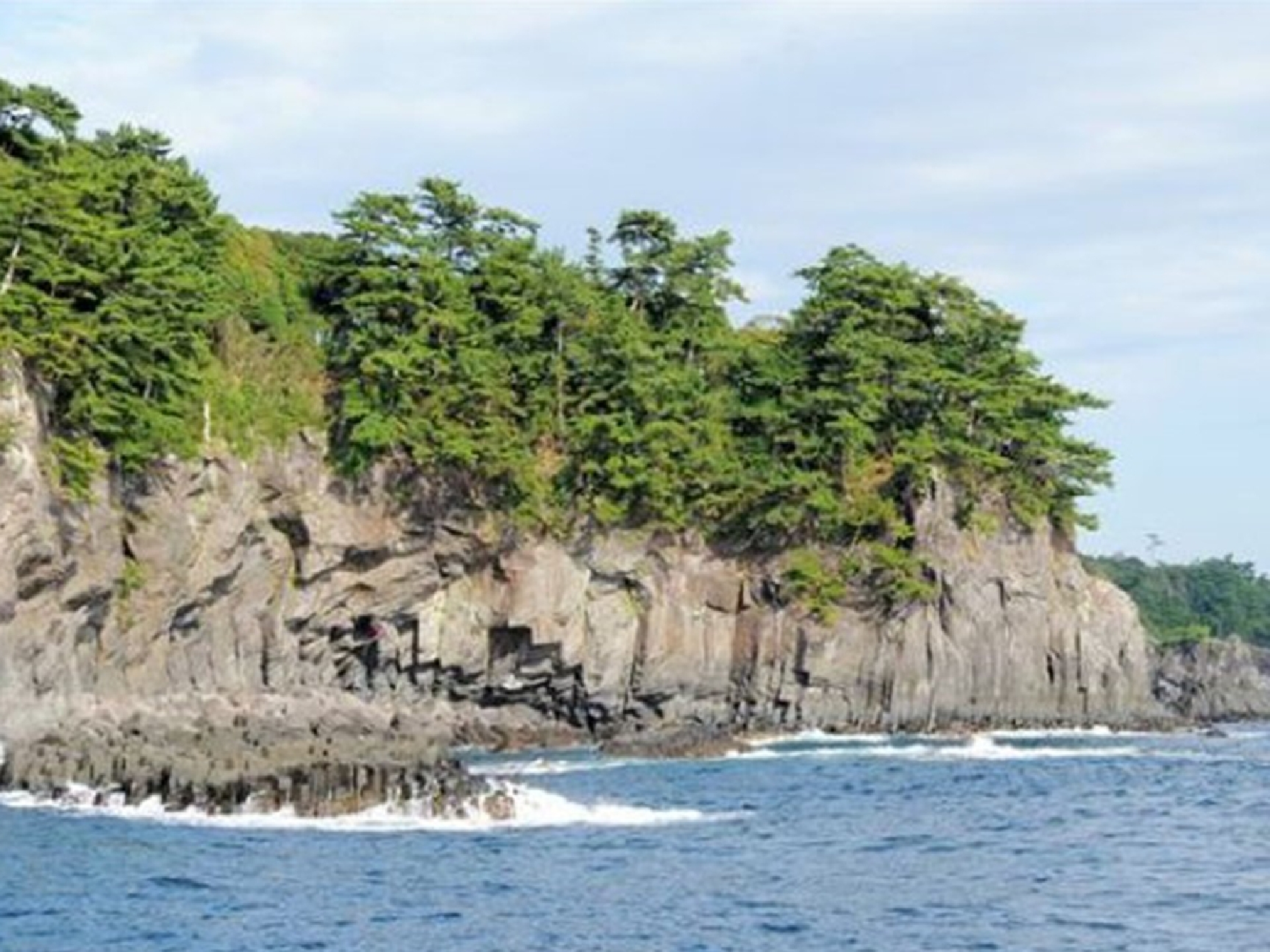
The cliff where the present case was attacked by a wild boar. The cliff is approximately 10 m in height.
When emergency technicians checked him, he was conscious, but a monitor showed a low saturated oxygen level (88% at room air); thus, he was given 10 L⋅min−1 of oxygen by a reservoir mask, which increased his saturated oxygen level to 97%. However, he complained of severe dyspnea and was agitated and the decision to intubate for helicopter transfer was made by the physician on scene. After intubation, aspirated seawater was suctioned from his lungs. He was transported to our hospital by helicopter.
On arrival, his Glasgow coma score was 10T, with a blood pressure of 160/132 mm Hg, heart rate of 100 beats⋅min−1, breathing spontaneously at 25 breaths⋅min−1, and blood oxygen saturation level of 98% under 10 L⋅min−1 of oxygen administered over endotracheal tube. Physical examination findings were scrape wounds on his forehead and bilateral hands. Focus assessment sonography for trauma was negative. An arterial blood gas analysis revealed a pH of 7.2; partial pressure of oxygen, 295 mm Hg; partial pressure of carbon dioxide, 38 mm Hg; bicarbonate, 14 mmo⋅L−1; base excess, −12 mmo⋅L−1; and lactate 10 mmo⋅L−1. Chest roentgen and computed tomography revealed bilateral aspiration (Figure 2). A biochemical analysis of the blood revealed leukocytosis (17,800/μL), increased creatinine phosphokinase level (235 IU⋅L−1), alanine transaminase (85 IU⋅L−1), aspartate transaminase (97 IU⋅L−1), and fibrin degenerative product levels (37 micrograms⋅mL−1) as abnormal findings. He was admitted to the intensive care unit with mechanical ventilation, infusion of antibiotics out of clinical concern for developing pneumonia after salt water aspiration, and a proton pump inhibitor.2,3 On the second hospital day, extubation was performed. His course was complicated by drug-induced rhabdomyolysis and itching, which subsided with simultaneous discontinuation of drugs. The drug that had caused rhabdomyolysis could not be determined. He was discharged on the sixth hospital day after his aspiration pneumonia and drug side effects both sufficiently improved. A sputum culture was later found to be negative.
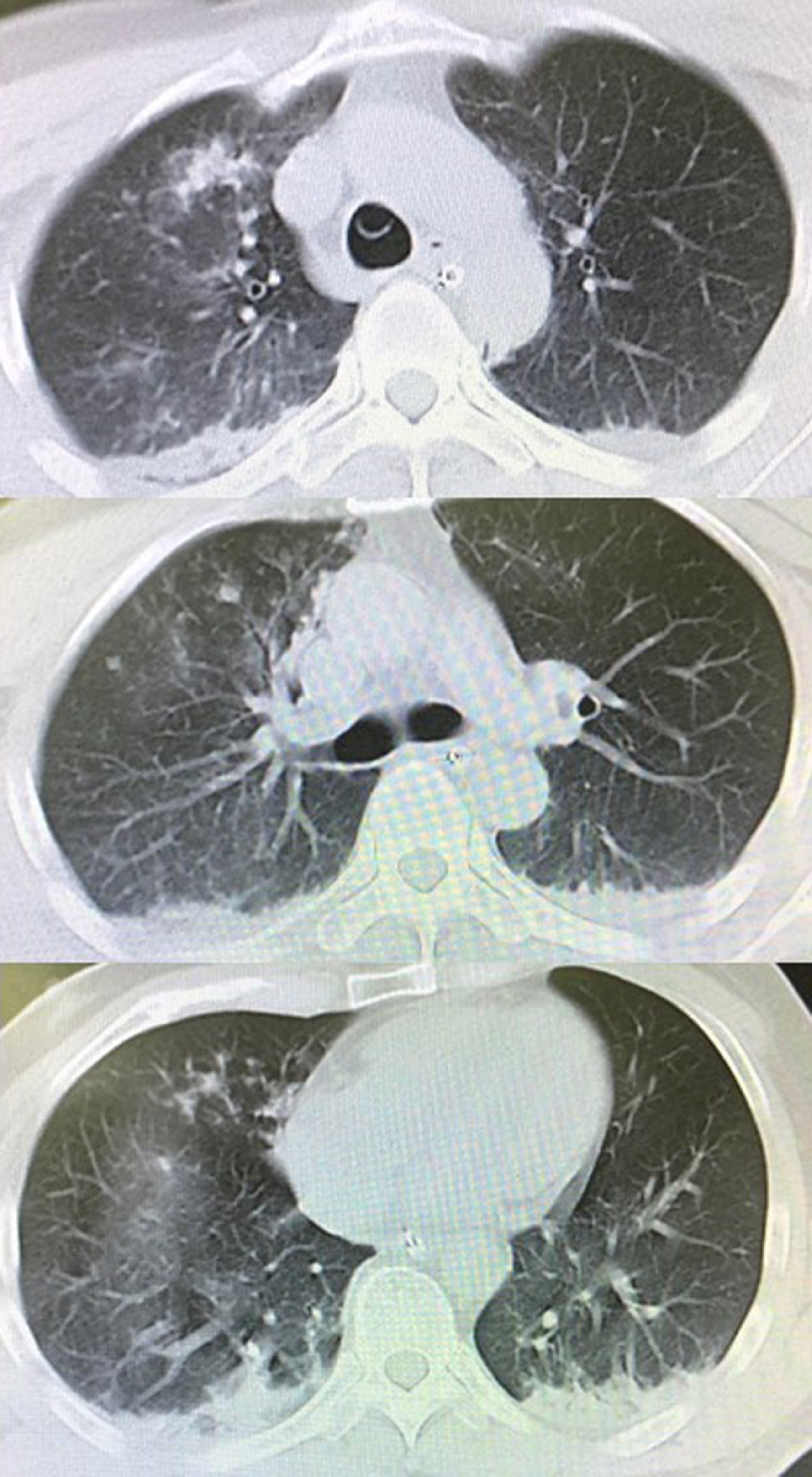
Computed tomography (CT) findings on arrival. CT reveals bilateral aspiration.
To our knowledge, this is the first report of near-fatal drowning caused by an attack from a wild boar. Most victims mauled by a wild boar experience injuries to only one part of their bodies, with the legs/feet being the most frequently injured body part. 1 Victims can also experience bone fractures when they fall or receive blows after initially being attacked by a boar. In more serious attacks, the wild boar can knock the human to the ground and then maul the victim. Such victims tend to sustain lethal injuries to multiple parts of their bodies compared with victims who are able to remain standing or upright. 4 –6 Fatalities are typically due to blood loss from wounds.
Although animals that live in the water can cause fatal drowning by dragging a victim into water, wild boars do not live in the water and therefore do not drown their victims in such a way. 7 –9 However, falling into cold water in particular can cause drowning as the victim cannot control the large intake of breath and the rapid increase in their breathing rate, and they have a reduced ability to hold their breath, manual dexterity, and ability to match their breathing rate to their swimming stroke.10,11 The present case fortunately was saved before dying from drowning. This unique case adds another cause to the list of documented etiologies of injury from wild boar attacks.
Footnotes
Financial/Material Support
Financial support was received from the Ministry of Education, Culture, Sports, Science and Technology (MEXT)-Supported Program for the Strategic Research Foundation at Private Universities, 2015-2019.