





Abstract

To the Editor:
Human envenomations by jellyfish are becoming more common with the increased human presence in the marine environment, such as participation in aquatic sports and marathon swimming. Moreover, during these events, there are risks when several competitors enter the aquatic environment at the same time. This may cause an increased likelihood of both sporadic and multiple contacts with cnidarians, especially when a large number of animals are in the water.
The increase in jellyfish populations in the summer is a concrete fact, with the causes still being studied, but certainly involving climatic factors, a gradual increase in water temperature (which has been occurring for years in Brazil), and probably an imbalance in fauna populations. The latter factor favors the reproduction of cnidarians and varies from changes in microplankton to a decrease in main predators, such as sea turtles. To this is added the human factor, because a large (and growing) number of beachgoers frequent the regions where the problem occurs. 1 –3
The cnidarians most associated with injuries in bathers and swimmers in Brazil are the scyphomedusa Chrysaora lactea (associated with several outbreaks described in bathers, especially in São Paulo, Paraná, and Santa Catarina states in the Southeast region); the hydromedusa Olindias sambaquiensis also has been associated with envenomation outbreaks in bathers in the same regions. These injuries are mild to moderate in severity, with rare systemic effects. 2 –4
Severe envenomation can be observed occasionally, caused by the Portuguese man-o-war (Physalia physalis) and cubomedusae such as Chiropsalmus quadrumanus and Tamoya haplonema. The Portuguese man-o-war is common along the coasts of North and Northeast Brazil. 1 –3,5–7
Treatment for this type of envenomation uses iced marine water immersion, due to its anaesthetic effect (the application of iced freshwater triggers venom discharge from intact cells on the skin), vinegar baths or compresses (also preventing the discharge of intact cells), and analgesics if pain persists, with good results. 1 –3,5,6 The lack of availability of ample volumes of vinegar at beach lifeguard stations to wash the lesions of victims is a problem, and our suggestion is to use vinegar-soaked compresses.
A recent randomized trial found that the use of hot water (45°C) for 20 to 30 min could be more effective than cold water.8,9 We think that the nociceptive activity of the venom is influenced by extreme temperatures, not exclusively by hot or cold water, because cold water also produces a good analgesic effect.1,3 The cited measures control the vast majority of envenomation by C lactea and O sambaquiensis. However, it is important to be alert for allergic reactions, which include severe respiratory manifestations and even anaphylactic shock, and can lead to death. 1 –6
The first outbreak was observed on November 27, 2011, in Paraná State (southeast region of Brazil) during an aquatic competition with 60 participants, in which 10 competitors already in open sea were injured (16%) minutes after the entry in the sea. Most of those injured (n=9; 15%) presented immediate intense pain at the contact site, erythematous and edematous plaques, and papules and piloerection on the lesions. The skin lesions varied in shape and size, from rounded to elongated or linear plaques with an urticariform aspect, varying in size up to 15 cm. A few competitors wore protective clothing (mainly thermal). The lesions occurred on different areas of the bodies, including the lower limbs, upper limbs, trunk, head, and neck.
Some patients experienced nausea and/or vomiting episodes immediately after the envenomation. The youngest competitor, aged 14 years, had cramps and back pain with chills, nausea, and vomiting. Cramp and back pain are common symptoms of muscle spasm, which may occur in cnidarian envenomation.
No acetic acid or iced marine water was available in the rescue boat, only topical moisturizers and topical corticosteroids. These were used, but due to the urgency of the situation, the therapeutic results were not recorded. The jellyfish species in the area was Chrysaora lactea, which was collected and identified in the described outbreak.
The second outbreak occurred in Bertioga (São Paulo State) during another aquatic marathon on November 14, 2016, and affected 60 of 247 (24%) swimmers. Contestants entered the water at the same time and after minutes in the open sea reported contact with jellyfish and burning pain on a growing scale, requesting medical attention. Seven athletes (11%) could not swim due to muscular pain and had to be taken out of the water and attended by the medical support team. The patients had erythematous and edematous oval and rounded plaques as well as papules. There was piloerection on the surface of some plaques; a few had linear lesions and intense pain (Figure 1). Six victims (10%) experienced nausea, vomiting, sneezing, and muscle pain. The treatment consisted of vinegar compresses and injectable dipyrone (metamizole) 1.0 g by intramuscular route (this drug is no longer approved in the United States but is used in various countries around the world). The jellyfish population was considered greater than normal in the area. The species collected at the site (several specimens) again was C lactea (Figure 2).
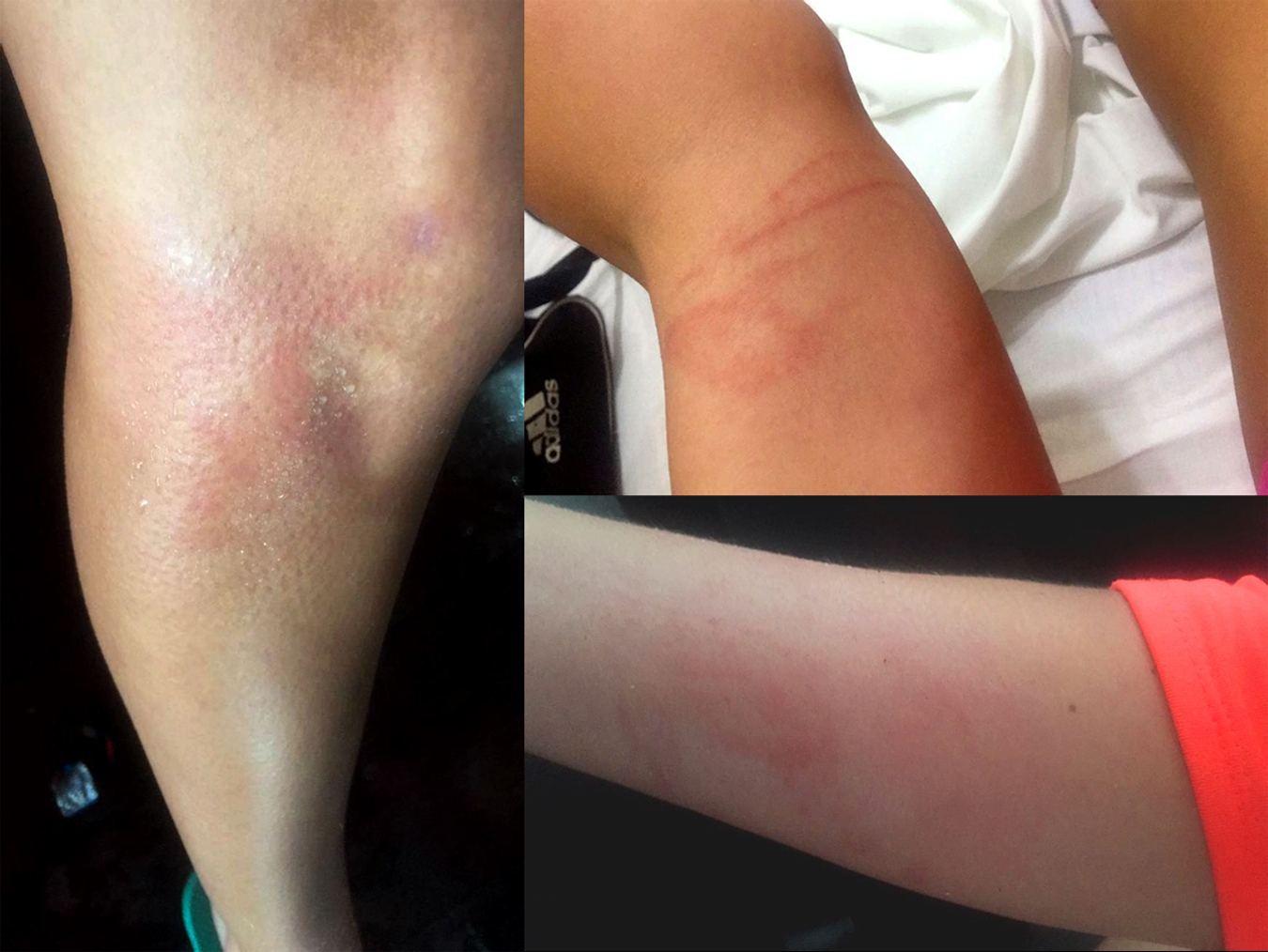
Images of erythematous and edematous plaques accompanied by intense pain observed in swimmers in Bertioga (São Paulo State, Southeastern Brazil). Note the piloerection on the plaque, a characteristic sign of cnidarian envenomation. Photographs: Marília Bianchini Lemos Reis.
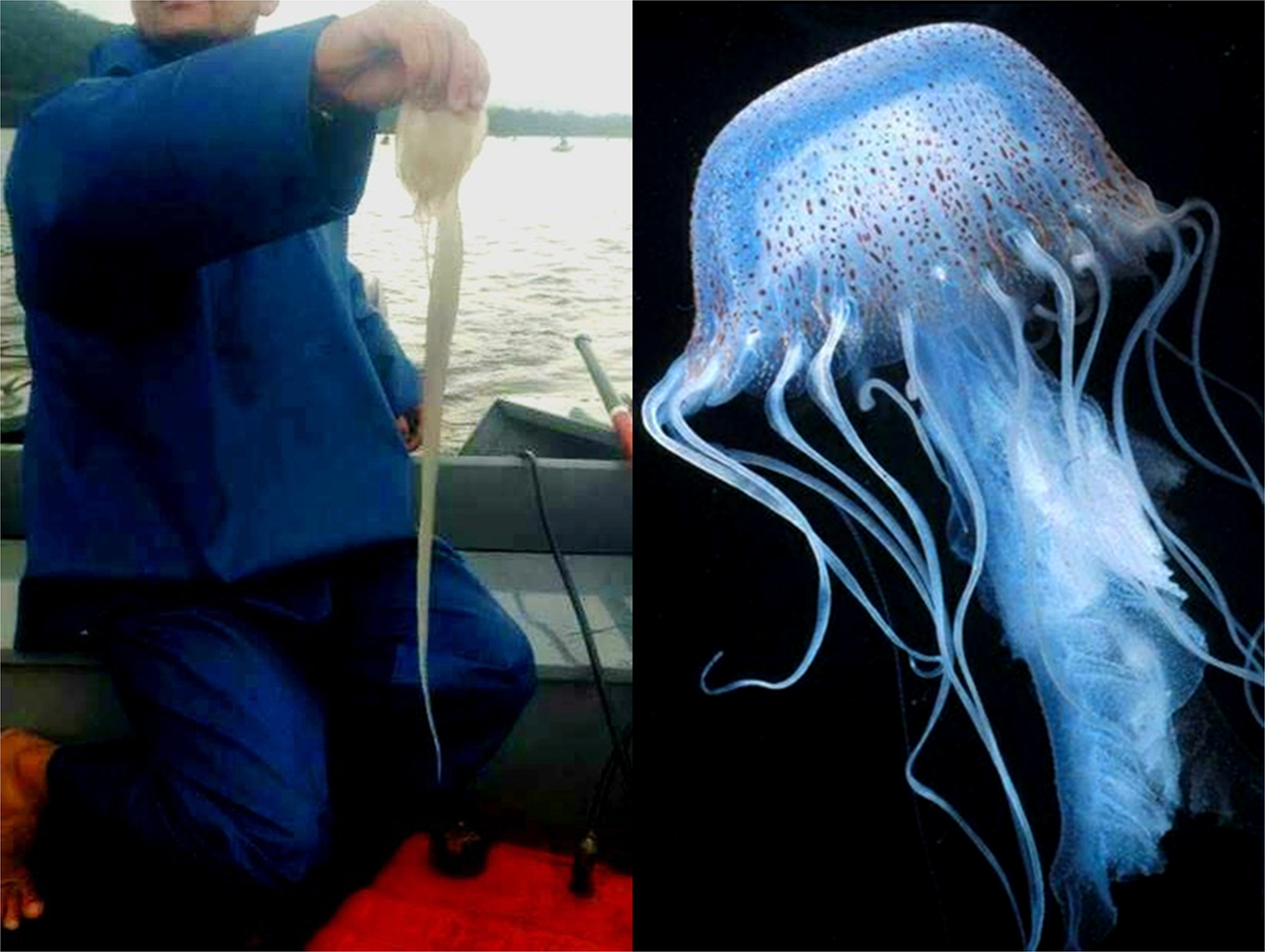
(Left) Chrysaora lactea, the jellyfish responsible for the envenomations in both outbreaks in aquatic marathons. Specimen collected in the marathon. (Right) C lactea, image collected in an aquarium for comparison. Photographs: Fábio Lang da Silveira and Organization of the Aquatic Competition 14 Bis.
The pattern of small and irregular skin lesions observed in the outbreaks is suggestive of injuries by cnidarians associated with mild to moderate envenomation, such as C lactea.
Injuries in aquatic athletes are generally sporadic and do not often occur en masse as observed. 10 Marine water masses, wind direction, and the reproductive cycles of marine animals obviously cannot be regulated during aquatic competitions. To avoid cnidarian envenomations under these circumstances, athletes should protect their skin by wearing special protective clothing, especially during the summer. The clothing provides a physical barrier and decreases the risk of sustaining a more serious sting. Medical assistance boats should carry receptacles with iced sea water, vinegar, and analgesics for fast application, as well as basic equipment for treating possible allergic phenomena, whose consequences may be serious. Increased knowledge about the biological cycle and reproductive season of the jellyfish may also help to reduce risks.
Footnotes
Acknowledgments
We thank to the organizers of the 14 Bis Aquatic Race, especially Mr. Percival Milani and Captain Marcelo Pereira of the Air Force of Brazil, for providing the image and data presented in the communication.