





To the Editor:
We thoroughly enjoyed reading Birkeland et al’s letter to the editor concerning our recent publication on changing trends in avalanche fatalities. 1 In general, we found their letter to be well written and reasoned. Most importantly, their letter serves as a springboard for further discussion on how best to interpret avalanche fatality data in light of underlying methodological limitations. Given these limitations, it further directs the conversation toward how best to use these imperfect data to reduce future avalanche deaths.
Before we begin our response in earnest, we must stress 2 points of clarification. First, Birkeland et al have organized their avalanche fatality data by ski season (ie, start counting fatalities in fall and end in the next summer). In contrast, our data were organized by calendar year. For anyone looking closely at these data, this may explain the minor discrepancies in the number of fatalities reported for a given year. Second, Birkeland et al included avalanche fatality data from 2014 to 2016. These data were not included in our model and, importantly, appear to include outliers, at least when compared with the preceding decade.
Birkeland et al’s main critique concerns the tension between what has happened historically with avalanche fatalities, and what is happening now. To a degree, this becomes a semantic argument, and a messy one at that. Nonetheless, it is a tension worth exploring given how this particular theme ultimately informed our approach to these data.
What we found most striking about the avalanche fatality data in the United States is the remarkable year-to-year variability. For instance, in 2009, the number of fatalities was 18. In 2010, it was 39, over a 100% increase. In 2011, the number of fatalities dropped back to 23, a 70% drop. 2 Why? It does not make sense that the basic forces that are likely to drive avalanche fatalities markedly change over a 12-month period. For instance, a difference in the quality of avalanche forecasting between 2009 and 2010 is not likely to account for this variability, nor changes in safety technology, nor even snowpack. There simply appears to be a considerable amount of inherent randomness, an almost “black swan” effect, within the data. Therefore, we deliberately chose to approach the fatality dataset through a 6-decade retrospective lens in an effort to limit the “noise” of year-to-year variability. This approach also provided a natural tie-in to Page et al’s work 15 years previously. 3 There is, however, a clear cost to this approach—namely, that our observations should be limited to a frame of reference of “what has happened” and not “what is happening.” We want to be clear that it was not our intent to answer the latter question. However, through a retrospective lens, we stand by our observation that avalanche fatalities have increased over the study period of 1951 to 2013. This is borne out by Figure 1 in our original article and even, we submit, in Figure 1 of Birkeland et al’s letter to the editor. Additionally, this trend appears to behave in largely linear fashion. Is it perfectly linear? Certainly not, and this is reflected in our reported r2 value of 0.68. 2
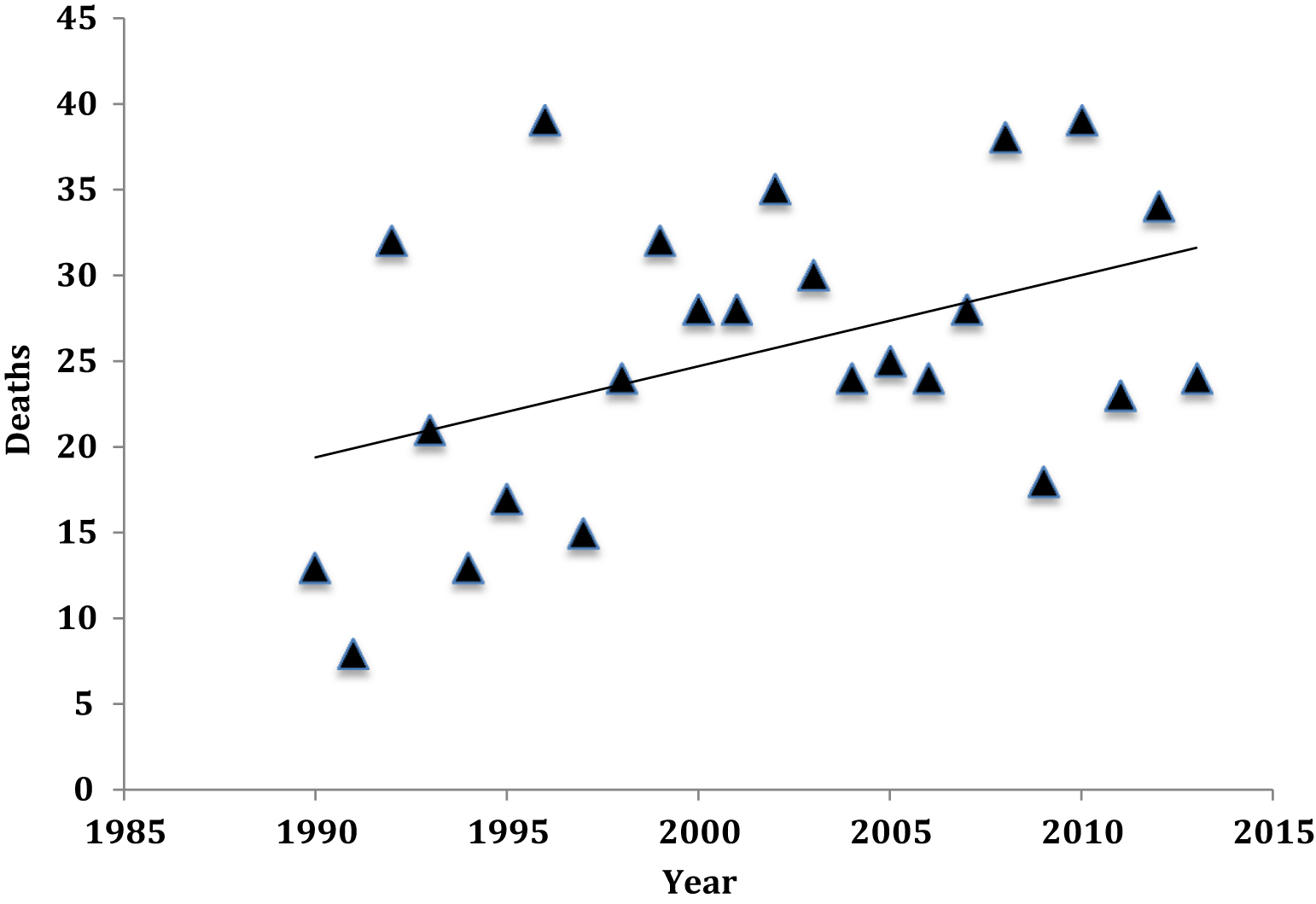
Avalanche deaths in the United States: 1990–2013.
So what is happening now? The messiness comes in defining “now.” For transparency, we considered chunking these data in several ways—by decade, by 15-year time blocks, and so forth—and then comparing one given time period with another. As we have shown, a year-to-year trend is likely meaningless, at least if we are trying to gauge the effect of any particular safety program or usage trend on overall avalanche fatalities. A 5-year trend may not be much better. We appreciate Birkeland et al’s interpretation of the “steps” in the data, specifically the advent of snowmobiles in the 1970s and the modern avalanche prevention tools of the 1990s. Ultimately, however, we felt that defining when these steps exactly began and ended was somewhat arbitrary and introduced considerable bias into the methodology and results. In this response to Birkeland et al, we have generated Figures 1 and 2, which are meant to graphically show the ramifications of these hypothetical time span choices. In Figure 1, we have chosen our “now” to begin in 1990 and have left out the outlier year of 2014, which was not included in our original article. In Figure 2, we have chosen our “now” to start in 1996, a year with a high fatality count at 39 deaths, and have included the 2014 outlier year with 11 deaths. Obviously these 2 graphs tell very different stories regarding the trend in avalanche fatalities. We have intentionally not included P values because, frankly, the methodological approach is garbage. It is merely an exercise in showing the methodological danger in defining “now” and how bias and error could be introduced depending on the story we wish to tell. There is an inherent push−pull to defining the “now.” If we use a smaller time span, we increase the effect of potential outlier years. If we use a larger time span, it is likely to include data not relevant to “now.” This methodological Gordian knot pushed us away from answering the question altogether, hence our focus on the entire dataset rather than a particular chunk.
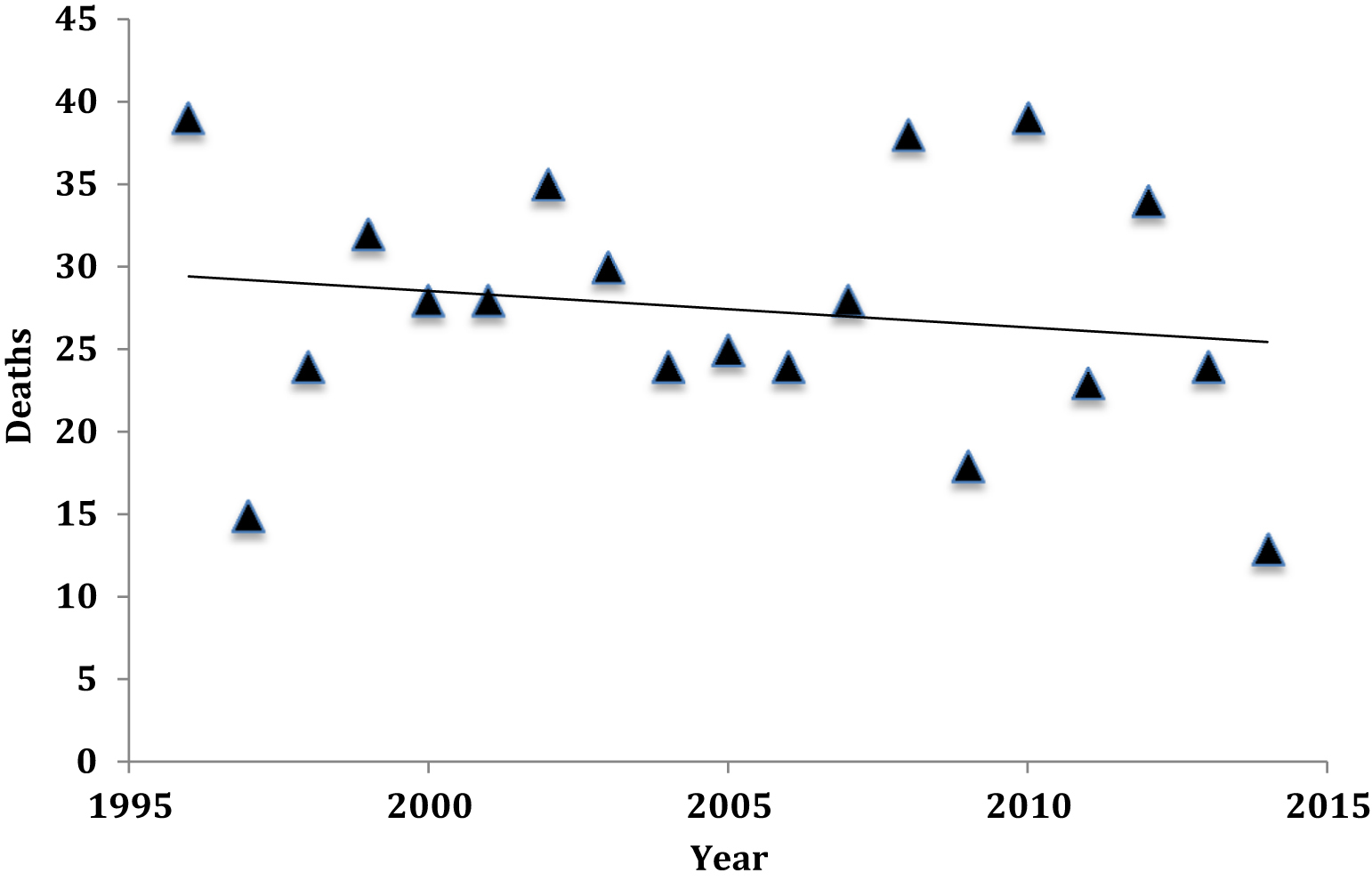
Avalanche deaths in the United States: 1996–2014.
So what is the current trend in avalanche fatalities? We agree the “eyeball” fatality trend in the last decade looks encouraging, especially in the context of increasing backcountry usage. However, marked variation in the data remains present and complicates our interpretation. Again, if we assume that the general effect of avalanche forecasting, new safety technology, and avalanche education are all relatively constant over a 3-year time span, and if we assume these interventions are effective, why did we observe such a seesaw effect in the fatality data over the past 3 years? Could there be drivers in the variability of fatalities other than randomness? We encourage future investigators to develop models to control for this variability in an attempt to parse out and quantify the invaluable efforts of our snow safety colleagues.