






To the Editor:
There are approximately 1500 species of scorpion throughout the world that are responsible for >1.2 million human stings per year. 1 Only about 30 species are potentially dangerous to humans, and they all, except one Scorpionidae in Iran (Hemiscorpius lepturus) belong to the Buthidae family. Eight genera are involved: 6 in the Old World, and 2 in the New World, which are Centruroides and Tityus.
Today, approximately 80 species of the genus Centruroides are present on the American continent and its islands, mostly in Central America. This genus mutates perpetually and new taxa regularly are identified such as C panamensis which was discovered in Panama in 2014. 2 Different cases of envenomation by Centruroides sp have been described in the medical literature, but never in the French Caribbean. The authors report the first published case of envenomation by C pococki, on the island of Guadeloupe.
The patient was a 48-year-old female farmer residing on the Island Terre de Bas (“îles des Saintes,” Guadeloupe archipelago) with no significant past medical history. She was stung at 5:30
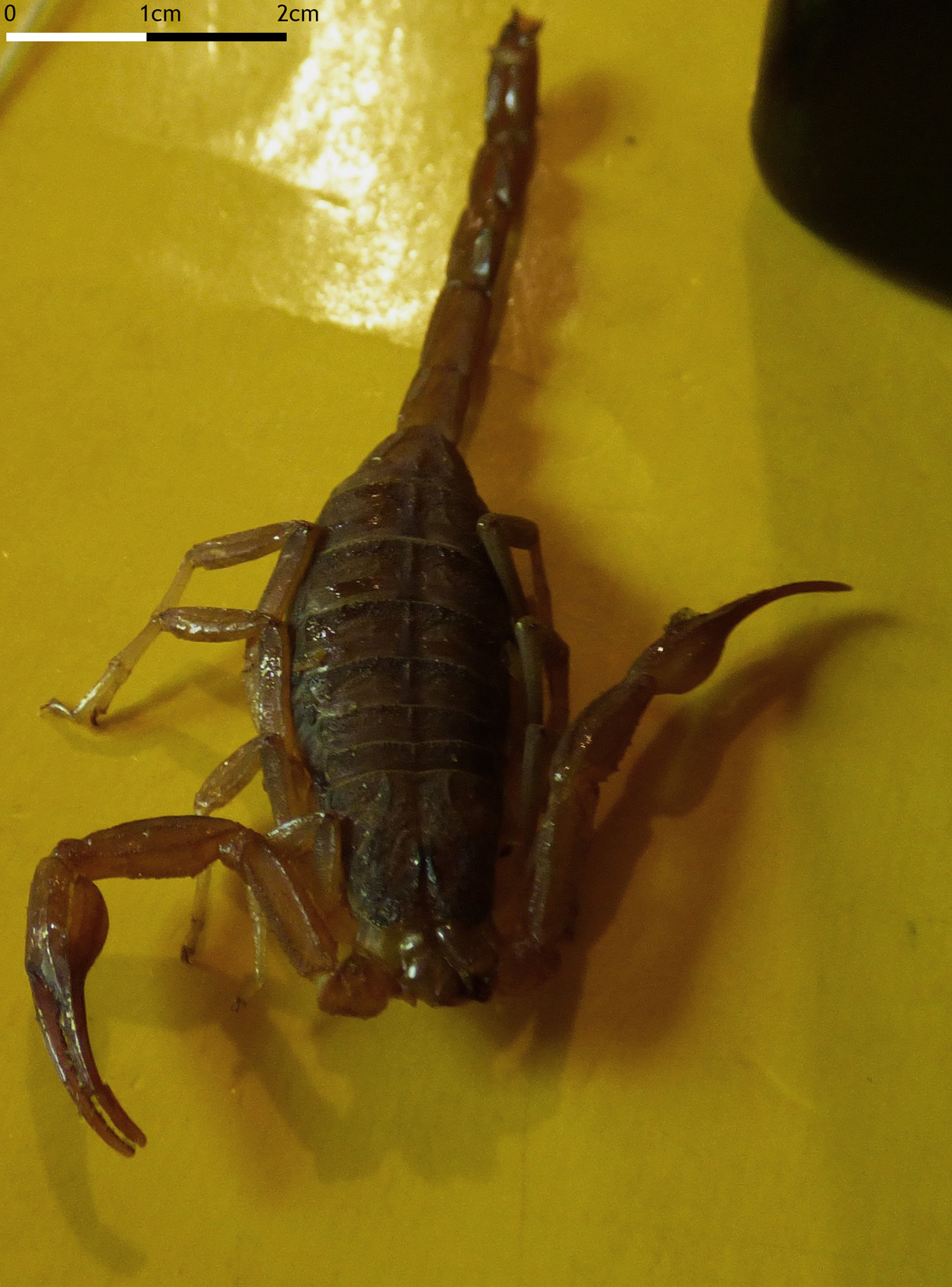
This specimen, Centruroides pococki, was responsible for our patient’s sting.
The following morning, 24 hours after being stung, the swelling went down but hypoesthesia appeared at the end of the finger that had been stung. This lasted for 5 days. The patient sent a photo of the scorpion to the Poison Control Center in Marseille where the team toxinologist identified it as being Centruroides pococki; this was also confirmed by the Natural History Museum in Paris. It is an endemic scorpion to Guadeloupe, first described in 1983. 3 It differs from its fellow Centruroides barbudensis, also present on the island, by its lack of brown spots and by its redder or even yellow overall color.
There are 3 other species of scorpion in Guadeloupe: one also from the Buthidae family, Isometrus maculatus, a scorpion present on several continents capable of mild envenomation, 4 and 2 from the Scorpionidae family, which are Oiclus nanus and Oiclus purvesii. Species from the genus Centruroides are mostly found in North and Central America where some taxa such as C sculpturatus (in Arizona) are responsible for cases of severe human envenomation, especially in children, potentially causing major breathing problems, and severe cardiovascular and neurologic conditions. Furthermore, in the United States and in Mexico there is a specific antivenom treatment containing F(ab)’2 from horses immunized with Centruroides venom, approved by the US Food & Drug Administration. 5 This genus also can be found in Latin America, although it is considered less toxic to humans compared with species in the genus Tityus such as Tityus obscurus in Guiana.