






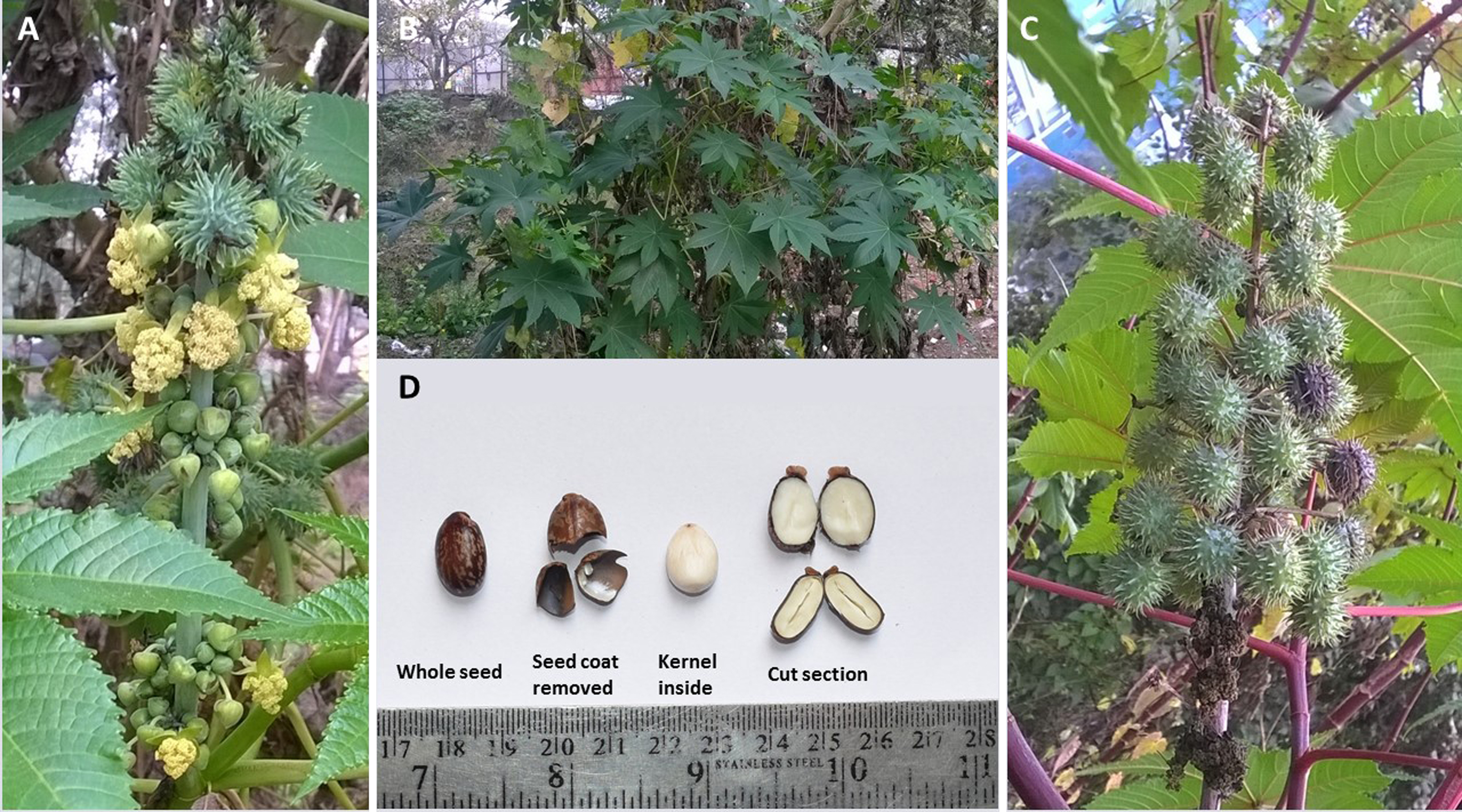
A, Clustered flowers of Ricinus communis. B, Palmate leaves with multiple lancelates. C, Greenish, deeply grooved fruit. D, Castor seed: intact, peeled, and on cut section. Photographs by Dr. Tanuj Kanchan.
Ricinus communis is an annual shrub belonging to the Euphorbiaceae family that grows wild in open fields of temperate and subtropical regions. It can be an uninvited nuisance shrub or a cultivated commercial plant. Also known as the castor plant and mole bean/moy bean, it is popularly known as arand in Hindi dialect. Most plants are stout, woody, and attain a height of 6 to 9 m with red to maroon branches. A dwarf variety of about 2 m also exists, with greenish branches and stems. The palmate leaves are 15 to 20 cm across with 7 to 11 lancelates. Clustered flowers are greenish-white to rust colored. Male and female flowers are present on the same plant, with shorter-stalked male flowers in branched peduncles vs broadly triangular female flowers. The greenish, deeply grooved fruit has a spinous tricoccus capsule that, upon opening, has 3 cells with each containing a seed. The seeds are smooth, oblong, and pinkish-gray, with dark brown speckles. The seeds contain a glycoprotein, ricin, which is regarded as the most potent phytotoxin. 1
Ricin is composed of A and B chains linked with disulphide bonds. 2 The A chain irreversibly inhibits protein synthesis by acting on the 60S subunit of ribosomes, causing cell death, 3 while the B chain binds to the glycoproteins and glycolipids on cell surface and facilitates the entry of ricin into the cell. Toxicity from ricin is primarily from the A chain mediated ribosomal inactivation, inhibiting protein synthesis.2,3 Other mechanisms of toxicity include cell membrane damage by the B chain and to lesser extent by type I (immediate) and type IV (delayed) reactions as a result of release of cytokine inflammatory mediators. 4 Ricin is also designated as a toxalbumin as it resembles toxicity produced by bacterial toxins like diphtheria, botulinum, and anthrax, which also possess A and B chains. The outer coat of the castor seeds resists digestion and, hence, swallowing of whole seeds is harmless as they pass intact in stools. Ricin is released upon chewing or crushing of seeds, leading to poisoning.
The oil extracted from the castor bean, popularly known as castor oil, is extracted in heated conditions and does not contain the phytotoxin ricin, which is inactivated in the process. Ricin inactivated at high temperature can be collected in powder form, which is water soluble and stable at wide range of pH. There are a wide variety of commercial uses of castor oil, the most popular being lubricant for engines (Castrol) and hydraulic brakes. 5 It is also used in paints, enamels, polish, waxes, printing inks, and greases. Castor cake is used as fertilizer. Pharmacologically R communis is shown to have cathartic, purgative, antidiabetic, antifungal, antibacterial, analgesic, and antinociceptive properties. Use of castor oil in induction of labor in pregnancy is also reported.5,6 Pharmacological observations are solely based on animal studies; therefore, medicinal use in humans is yet to be established. 5 The potential medicinal use of ricin in humans as immunotherapeutic agent against cancer is also being studied due to its propensity for protein synthesis inhibition.2,5
Ricin was also studied as a potential weapon during the First World War, and a “ricin bomb” was developed by the British military during the Second World War.2,3 Currently, serious concerns have been raised of the potential threat of ricin as a bioterrorism agent. Ingestion of 8 to 10 crushed seeds is reported to be fatal, with the victim dying within 3 to 5 days. When ingested, the symptoms of poisoning are mainly gastrointestinal and include nausea, vomiting, diarrhea, and abdominal cramps. 3 The patient may develop dehydration and hypovolemic shock, hemolysis, and ultimately hepatic and renal failure.2,7
Ricin is more life-threatening if inhaled rather than ingested as digestive enzymes can degrade the toxin to a certain extent. 3 Respiratory irritation, cough, dyspnea, and rapid onset of flulike symptoms including fever, weakness, nausea, and myalgia are seen after inhalation.
If the poison is injected locally, there will be pain and necrosis of the muscle at the injection site initially. 8 Allergic reactions are common when the toxin comes in contact with skin or eye. 4 The first case reported in which ricin was alleged to have been used as a homicide agent was the death of Bulgarian national Georgi Markov in 1978 at a bus stop in London. In this case, a poisonous dart laced with ricin was fired from a concealed umbrella tip into the thigh of the victim. 2 Since then, numerous cases have allegedly involved the use of ricin for suicide and homicide. 2 –4,8–10 Unintentional or accidental poisoning usually occurs after consumption of castor bean seeds. Although there is currently ongoing research to discover an antidote for ricin poisoning, treatment remains symptomatic and supportive.
Author Contributions: TK conceived the study and took photographs of the plant and its various parts. AA did the literature search and wrote the primary draft. RSS and TK further extended the literature search and were instrumental in revising the paper including the photography involving dissection of the seed. All authors contributed substantially to the paper and approved the final manuscript.
Financial/Material Support: None.
Disclosures: None.
Footnotes
Submitted for publication January 2016.
Accepted for publication June 2016.