






Abstract

Outdoor enthusiasts enjoy relaxing and swimming in recreational freshwaters including swimming pools, lakes, ponds, and rivers. Among the most commonly encountered aquatic insects in freshwater environments are backswimmers (Hemiptera: Notonectidae) and water boatmen (Hemiptera: Corixidae), both of which can inflict venomous bites and share many behaviors, including the use of buoyancy compensators to maintain their diving depth levels like scuba divers. Backswimmers and water boatmen are distributed worldwide and often mistaken for each other (Table). 1 For example, the common backswimmer, Notonecta glauca, a frequent freshwater-body resident throughout Europe and the United Kingdom, is known regionally as the “greater water boatman” (Figure 1). 2
The scuba-diving true bugs (phylum Arthropoda, order Hemiptera)
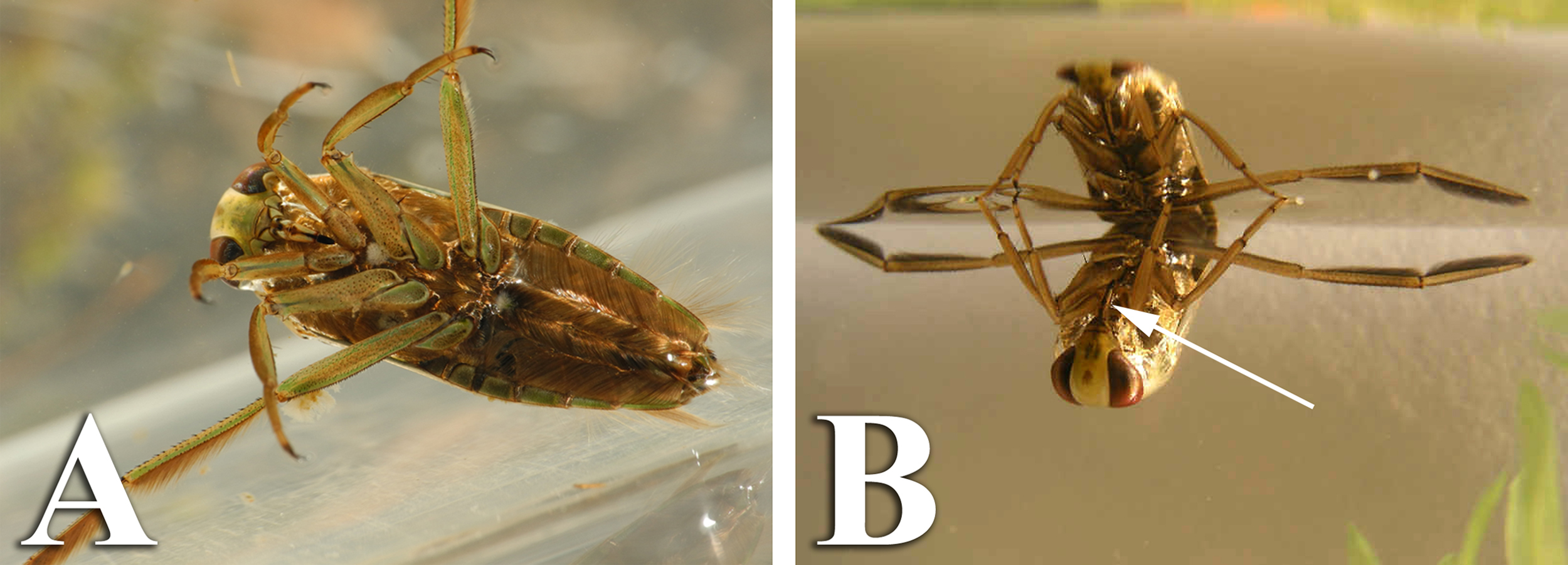
The backswimmer (phylum Arthropoda, order Hemiptera, family Notonectidae). A, Backswimmer swimming on its keel-shaped back and paddling with its oar-shaped hind-legs on or near a freshwater body surface. Source: Wikipedia (public domain). B, Backswimmer upside down and awaiting a meal just under the water surface. Note the prominent beak or proboscis, which can inflict a painful, envenoming bite (solid white arrow). Source: Wikipedia (public domain). Photographer: E. van Herk.
Such confusion results from the insects’ shared habitats and similar behaviors, including hind-legs adapted for paddling, reliance on buoyancy-regulating systems when diving, nighttime feeding habits, attraction to artificial lights, and capability for flight. These insects differ in their behaviors in other ways, including 1) backswimmers swim upside down, boatmen right side up; 2) backswimmers cruise the surface and subsurface, and boatmen the bottom and midlevel depths; 3) backswimmers are predacious carnivores, boatmen are herbivores; and 4) backswimmers can inflict painful bites with their segmented beaks designed for stabbing prey as large as tadpoles and small fish (Figure 1B), whereas water boatmen bites are nearly painless and inflicted by shorter, unsegmented beaks designed for siphoning liquefied plant matter (Figure 2). Although their venoms have not been studied in detail, both insects are venomous, with backswimmers producing a neurotoxic venom to paralyze prey and water boatmen producing an enzymatically active venom to dissolve vegetation.
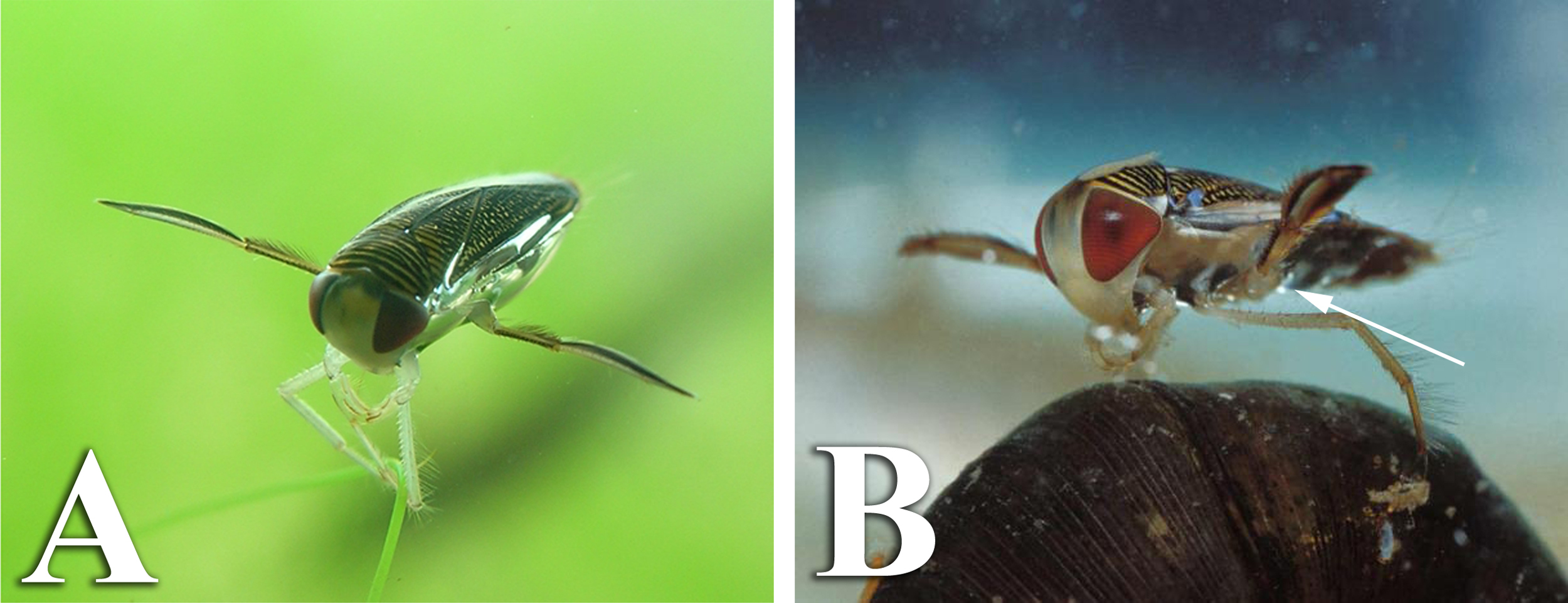
The water boatman (phylum Arthropoda, order Hemiptera, family Corixidae). A, Water boatman swimming on its ventral abdomen and paddling with its oar-shaped hind-legs near a freshwater body bottom. This water boatman has anchored itself at depth by hooking onto bottom vegetation with one of its mid-legs equipped with a curved appendage. Source: Wikipedia (public domain). B, The water boatman deploying its buoyancy-compensating air bubbles tucked under its wings and thoracoabdomen (solid white arrow). Source: Missouri Department of Conservation. Public domain.
Another recently discovered similarity between backswimmers and boatmen is an ability to wrap their bodies with inflatable air bubbles to regulate their dive depths just as buoyancy compensators (BCs) do for scuba divers. Backswimmers store trapped air bubbles in 2 lateral troughs on their ventral abdomens; water boatmen wrap trapped air bubbles under their wings and ventral abdomens (Figure 2B). These air bubbles will decrease in size as nitrogen diffuses out and oxygen is used for respiration.
Water boatmen regulate the buoyancy provided by their air bubbles by reinflating them with oxygen extracted from water as needed. In some species of backswimmers (Anisops spp), hemoglobin circulating in the insect’s specialized tracheated cells will supply extra oxygen to reinflate their air bubbles as needed.3,4 Although oxygen-binding hemoglobinlike proteins are found in many insects, hemoglobin has been detected in only a few insect species. 4
Both backswimmers and water boatmen rely on their BCs to maintain steady depth levels when foraging for food. Water boatmen can also anchor themselves at depth by attaching their hooked mid-legs onto aquatic vegetation (Figure 2A). Although primarily herbivorous, water boatmen, like backswimmers, will feed on insect larvae in unmaintained and abandoned swimming pools and in any calm-surface, freshwater bodies. Because backswimmers and water boatmen are preferred prey for many freshwater fish species, their coloration and morphology are often copied for fishing flies and lures.
Water boatmen forage at much deeper levels than backswimmers and are, therefore, less frequently encountered and less of a biting nuisance than backswimmers. Both insects lay their eggs on aquatic vegetation and debris. Because the insects are susceptible to chlorination, swimming pools should be rechlorinated regularly as needed, especially after heavy rains, and kept clear of algae, insects, amphibians, and small fish to prevent colonization by backswimmers and water boatmen. Swimmers are encouraged to recognize and to avoid painfully biting backswimmers paddling upside down on or near the surfaces of swimming pools, lakes, ponds, and rivers (Figure 1).