






Abstract

Keywords
Introduction
The Wilderness Medical Society convened an expert panel to develop a set of evidence-based guidelines for the prevention and treatment of North American pitviper envenomations. We present a review of pertinent pathophysiology, discuss prevention measures, and therapeutic management. Graded recommendations are made regarding each treatment and its role in management. These guidelines should assist in clinical decision making, but a “cookbook” approach is often insufficient, as each patient is unique and may respond differently to therapeutics. Physicians must use their experience and frequent clinical assessments to apply these recommendations to their individual patients. Consultation with a local toxicologist familiar with envenomations or poison control center is recommended to assist in patient management. These guidelines are for crotaline snakes in the United States and Canada, and should not be applied to other snakes species or geographic regions.
Methods
The expert panel was convened at the 2014 Annual Winter Meeting of the Wilderness Medical Society in Park City, Utah. Members were selected based on clinical and research experience and interest in snakebites and included members with specialties in emergency medicine, surgery, toxicology/toxinology, wilderness medicine, herpetology, and evolutionary biology. Relevant English language articles from 1965 to 2013 were identified through the PubMed MEDLINE database using search terms (antivenom, copperhead, cottonmouth, crotalid, Crotalinae, crotaline, Crofab, digital dermotomy, envenomation, FabAV, fasciotomy, first aid, pitviper, prevention, rattlesnake, snakebite, treatment, and Viperidae). Studies in these categories were reviewed and level of evidence was assessed. The panel used a modified Delphi consensus approach to develop recommendations graded based on the quality of supporting evidence and balance between the benefits versus risks and burdens for each modality according to criteria stipulated by the American College of Chest Physicians (Table 1). 1
American College of Chest Physicians classification scheme for grading evidence in clinical guidelines
RCT, randomized controlled trial.
Section 1: Characteristics
Venomous Snakes in the United States and Canada
The taxonomic family Viperidae contains the Old World taxa (subfamily Viperinae) and the Old and New World pitvipers (Crotalinae), which are venomous snakes with long folding fangs. Crotalinae are pitvipers with heat-sensing facial (loreal) pits, including the North American rattlesnakes (genera Crotalus and Sistrurus) and cottonmouths and copperheads (genus Agkistrodon). Crotalus contains almost all rattlesnakes and includes the larger, widely distributed, and more dangerous species. Sistrurus includes only 2 small species north of Mexico: the pigmy rattlesnake (Sistrurus miliarius) and the massasauga (Sistrurus catenatus). Cottonmouths or water moccasins (Agkistrodon piscivorus) and copperheads (Agkistrodon contortrix) are similar to rattlesnakes but lack a rattle, having tapered, pointed tails instead. All of these pitvipers are generally heavy-bodied snakes with triangular heads, vertically elliptical pupils, keeled dorsal scales, and a single row of subcaudal scales. Although these traits can be found in various nonvenomous snakes, the specific combination of keeled dorsal scales and undivided subcaudal scales is diagnostic for pitvipers in the United States and Canada. 2 The rattle is unique to rattlesnakes.
Coral snakes are the only other major venomous snakes naturally found in the United States and Canada and belong to the family Elapidae, which also includes cobras, mambas, and kraits. They are slender and identified by the order of their black, red, and yellow (or white) body rings (although they rarely can be melanistic) and do not possess any of the previously mentioned pitviper traits. 2 Because the management of coral snake envenomation differs from pitvipers, their management is not included in these guidelines.
Field guides and other publications list nearly a hundred subspecies of “dangerous” North American snakes; however, the taxonomy of these snakes remains incompletely defined as ongoing genetic analyses are improving species characterization. 3 Some experts suggest the elimination of many subspecific designations altogether. 4 Clinically, identification to the species or subspecies level is usually unnecessary for guiding treatment—with the exception of Mohave (Crotalus scutulatus), timber (Crotalus horridus), and Southern Pacific rattlesnakes (Crotalus oreganus helleri), among other taxa that may produce venoms containing potent Mohave or similar presynaptic neurotoxins. Snakebites with this toxin require management that differs from the majority of crotaline envenomations in the United States.5,6
Knowledge of pitviper geographic distributions can help identify a snake (Figure). A picture of the snake can also help with identification by an expert at a later time; however, trying to kill or capture the snake is not recommended as it could lead to a second patient requiring treatment. 7 If positive identification of a nonvenomous snake by an expert is made, no evacuation is necessary.
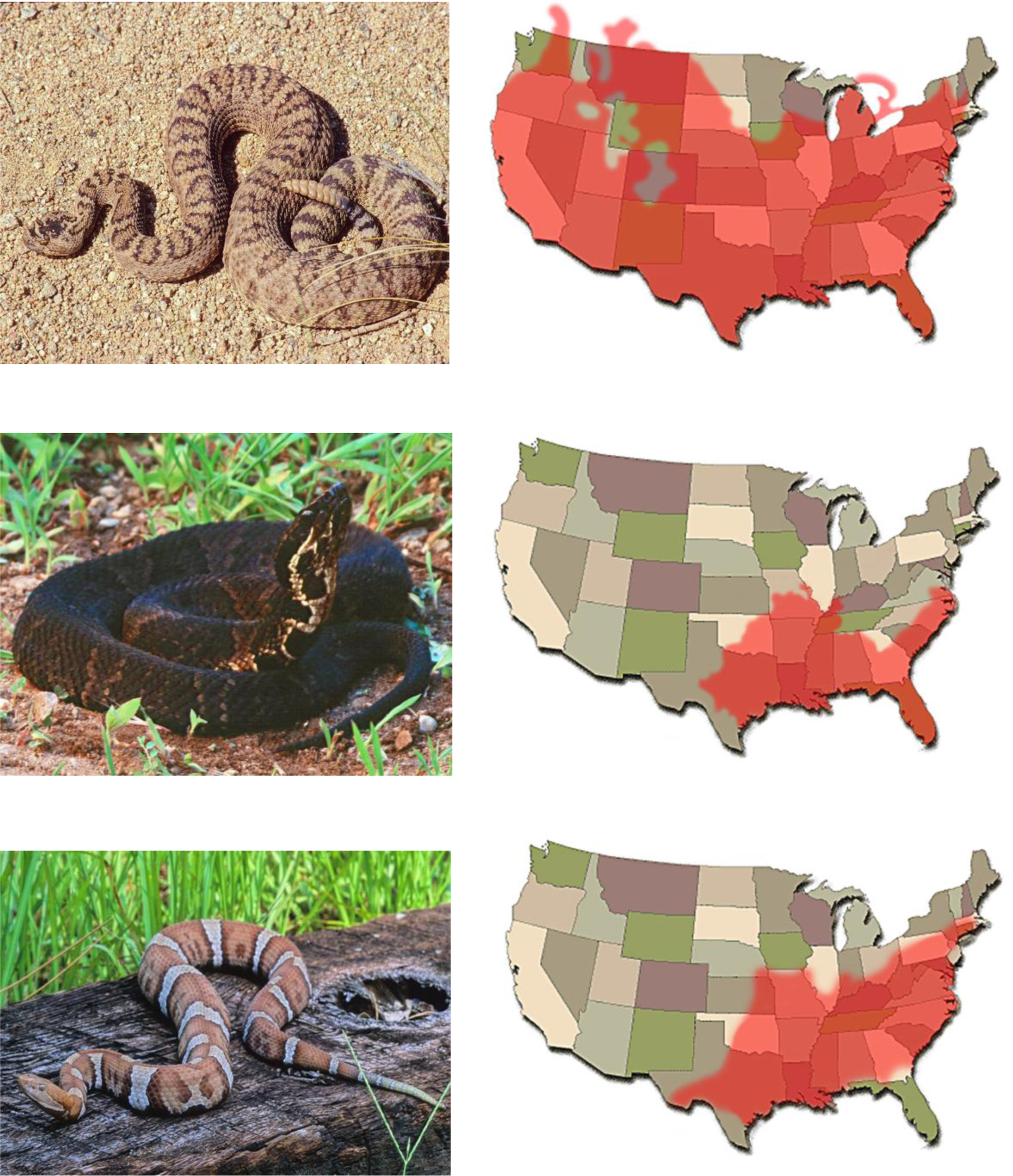
Three common pitvipers in the United States and Canada and their geographic range. From top to bottom: Western rattlesnake (Crotalus oreganus) and geographic range of Crotalus and Sistrurus; Cottonmouth (Agkistrodon piscivorus) and geographic range of A piscivorus; Copperhead (Agkistrodon contortrix) and geographic range of A contortrix.
Snakes are poikilothermic and tend to seek underground shelter during temperature extremes. Therefore, wild snakes are usually not a threat during cold weather unless their shelter is breached. Field and laboratory studies of temperate pitvipers indicate that they are more active with body temperatures between approximately 25°C and 30oC (77°F–86oF). 8 –10 Snake body temperatures are better correlated with substrate temperature than air temperature, and unshaded substrate temperature can be much hotter than the air on warm sunny days. 11
Venom Profiles
Some pitviper venoms are known to contain more than 100 different proteins and peptides that produce toxic effects in prey and envenomated humans.12,13 The toxic components of snake venom vary greatly and are naturally selected in response to prey susceptibility.14,15 These toxic constituents are known to vary considerably between species, 16 geographically within species, 17 –19 ontogenetically within individuals, 20 and even between siblings.21,22 The genes expressing toxins undergo more rapid evolution than nontoxin-related genes. 16 Given these variations in venom composition, it is not possible to predict the specific frequency of various venom components. Despite this limitation, important generalizations can be made based on genetic and molecular analysis of venom supported by clinical experience and may inform the clinical course. 20
Ontogenetic variation in snake venoms also appears to be correlated with changes in diet as young snakes mature, often switching from predation of lizards and frogs to a diet consisting primarily of small mammals.23,24 That may be related to the widespread myth that juvenile rattlesnakes are more dangerous than adults because they have not yet learned to meter their venom. Regardless of venom metering, small snakes have small heads and venom glands and simply do not have the volume of venom available in larger snakes, as is borne out by venom yields in laboratories that produce venom for pharmaceutical and research use: the average yield of 100-cm rattlesnakes is 1100 mg (dry mass) compared with 9 mg from 30-cm juveniles, 25 a difference of 2 orders of magnitude. That is consistent with clinical experience; namely, bites by medium and large rattlesnakes have been shown to produce mean snakebite severity scores that are almost double those produced by small rattlesnakes. 26
Section 2: Epidemiology and Prevention
Snakebites are estimated to lead to as many as 9000 emergency department visits annually in the United States. Venomous species account for approximately one third of these visits, almost all of which are pitviper bites. 27 Accurate snakebite statistics are difficult to assemble in the United States. Nonfatal bites by venomous species are underreported by epidemiological databases. Poison centers are not consulted on all bites, and many bites are never reported beyond a primary treating facility. Finally, an unknown but likely significant number of snakebite patients never seek medical treatment, especially if alarming symptoms fail to develop. Many experts continue to rely somewhat on the statistics published in 1966 by Dr Parrish, 28 based on his unprecedented survey returned by more than 5000 hospitals and 27,000 physicians in the United States. He estimated that approximately 6680 persons per year were treated for venomous snakebite in 1958 and 1959. 28 Based on the work of Parrish and more current, albeit less robust data, recent investigators have estimated the incidence of venomous snakebite in the United States at roughly 7000 to 8000 per year, 29 with annual fatalities averaging 5.2 between 1991 and 2001 30 and 7.4 between 1999 and 2007. 31 According to recent data from the American Association of Poison Control Centers (AAPCC), there were 6919 snakebites reported to poison centers in 2012, 4052 of which were pitviper envenomations. More than half (57%) of pitviper envenomations in this dataset resulted in moderate or major outcomes, as defined by the AAPCC, and 1 bite (by a rattlesnake) was fatal. 32 These data are based on voluntary reporting to poison control centers, and hence are certain to underreport the problem.
The majority of crotaline envenomations occur during intentional interaction with the snake, as opposed to an unintentional exposure to an unseen threat.33,34 Most snakebite patients are male, with white men 25 to 34 years old being at greatest risk of life-threatening envenomations. 35 Intentional interactions may be associated with alcohol or drug intoxication 33 –36 and typically occur when people try to catch, kill, or interfere with a wild snake, as well as when handling or caring for captive snakes. Moreover, caution must be exhibited when handling a dead snake or detached head as they may have intact bite reflexes.29,37 Knowledge of snake habits and appropriate avoidance measures, in addition to not deliberately antagonizing these animals, offers the most significant protection from unwanted exposure.
Most studies indicate that the majority of bites occur on the upper extremities, fewer on the lower extremities, and rarely on the face, neck, or trunk.27,34 Bites from unintentional encounters are predominantly on the lower extremities, whereas those resulting from intentional interaction are mainly on the hands and arms. 27 Certain protective clothing such as leather or heavy boots offers a protective barrier against envenomation, and denim may reduce the amount of venom by two thirds.38,39
Pitvipers are almost exclusively ambush predators 40 and seek out locations where they are likely to encounter prey (mostly rodents and other small mammals), then coil and wait motionless for prey to enter within strike range.40,41 In locations with harsh winters, snakes must migrate between winter dens and summer foraging areas, increasing the probability of human interaction.42,43 The kinematics of the strike and venom injection are usually different between defensive and predatory strikes, 44 and almost all bites to humans are defensive. As a result, research about predatory behavior is not necessarily applicable to human snakebites. The exception are bites by long-term captives, as these animals often lose fear of humans and associate any cage disturbance with feeding. Emergency departments presented with patients bitten by captive (and frequently exotic) snakes must reliably identify the snake and locate the appropriate antivenom. 45 A small but significant number of persons privately keep venomous exotic snakes—often illegally. These snakes may be misidentified or the species name withheld on account of potential legal consequences. When exotic antivenom is needed, it frequently requires collaboration with a zoo that keeps the same species. An exotic antivenom database is maintained for this purpose and can be accessed through local poison control centers.
Section 3: Field Management
Initial Management and First Aid
A priority after a snakebite is to avoid another bite, either to the same patient or to another. Patients should move away from the snake. The patient should be calmed, as fatalities are rare and serious sequelae are usually preventable. A good photograph, carefully taken from a safe distance (ie, equal to more than the length of the snake), can sometimes be transmitted by cell phone to an expert and may be valuable later for identification. If in doubt, determining whether the biting snake is a venomous species can make the difference between simple superficial wound care and a potentially hazardous and expensive evacuation.
There is nothing that can be done in the field to significantly alter the outcome of a serious snakebite, and field first aid should not delay rapid transfer to a facility capable of safely administering antivenom. 46 The degree of envenomation cannot be quickly determined with confidence; therefore, any bite by a venomous species must be considered a medical emergency and evaluated by a physician without delay. While en route or waiting for evacuation, first aid and wound care can be administered.
Time and date of the snakebite should be noted, either on the patient or in an incident report. Circumference of bitten appendage should be measured above and below the snakebite for later comparison and determination of subsequent swelling.47,48 The leading edge of erythema should be marked for comparison. Jewelry or constrictive clothing near the bite should be removed or cut to avoid constriction with subsequent swelling. (Recommendation grade: 1C)
Snakebites should be approached in a manner similar to that for any other puncture wound or laceration. Without delaying transport, the wound should be quickly cleaned in standard fashion (soap and running water, high-pressure irrigation or an antiseptic solution or both) and a sterile dressing applied to protect the wound. 49 (Recommendation grade: 1C)
There have been no studies directly assessing immobilization alone for the improvement of snakebite outcomes. Limiting movement of the affected area by immobilization with splinting techniques (without compression) may benefit the patient, although no rigorous trials have validated this practice. Depending on the evacuation needs, the affected area should be maintained at the level of the heart: raising it above the heart can cause increased systemic spread of venom, whereas lowering it may lead to increased swelling and local venom activity. However, this practice has not been proved with evidence or clinical trials. Furthermore, the limb and joints should be kept in a functional position in case they swell or the joints become immobile.50,51 (Recommendation grade: 2C)
Any initial symptoms should be clearly noted in a field report. Local symptoms should be noted and monitored for progression. Local tissue effects from hemotoxins or vasculotoxins can cause significant erythema, swelling, and tenderness at the envenomation site and can spread proximally and distally. Local tissue effects are the most common physical manifestations of pitviper envenomations and occur in more than 90% of patients with medically significant envenomations. 25 (Recommendation grade: 1C)
Systemic symptoms including hypotension, bleeding, angioedema, vomiting, and neurotoxicity indicate more severe envenomation. 52 Hematologic effects are multifactorial and include the degradation of fibrinogen and platelet aggregation or destruction. Although the majority of patients do not develop medically significant bleeding, the patient should be carefully examined for petechiae, ecchymosis, gingival bleeding, epistaxis, retinal hemorrhage, or signs of more serious hemorrhage (ie, intracranial or intra-abdominal). 53 Vomiting can also arise from autonomic response to fear and anxiety, and may be misleading. Hypotension can result from vasodilatation and third-spacing. The most common neurotoxic effects are from Mohave rattlesnake (C scutulatus) and Southern Pacific rattlesnake (C helleri), but are much less common in other US rattlesnake species. 54 All snakebite patients, especially those with local or systemic symptoms, should be transported immediately to a hospital for evaluation and monitoring for progression (Table 2). (Recommendation grade: 1C)
Local, systemic, hematologic, and neurologic signs and symptoms of snakebite envenomation
Can be from envenomation or autonomic responses to pain and anxiety, therefore not used as a sole indicator of systemic signs of envenomation.
Unfortunately, there are many myths associated with the field care of snake envenomations, some of which can be harmful to the patient. Despite a lack of evidence, many of these techniques have permeated popular culture and historical medical literature, and therefore they are often erroneously applied. The following techniques are of no benefit or are potentially harmful to the patient.
Oral suction
One study and review article showed that mouth or mechanical suction is not successful at removing venom in a “mock venom” human model, and the 0.04% to 2% of venom load extracted was clinically insignificant. 55 Furthermore, oral suction can introduce bacteria into the wound and increase the potential for superinfection or abscess formation. Finally, oral suction may pose a risk to the caregiver by absorption of venom through the oral mucosa. 56 (Not recommended)
Mechanical suction
An experimental model showed that mechanical suction devices can increase localized tissue damage around the wound in the shape of the device, causing tissue necrosis and sloughing, resulting in tissue loss that prolonged healing by weeks. 57 –59 (Not recommended)
Laceration or bleeding of the bite
Laceration or bleeding the bite site to enlarge the wound to increase blood flow often results in increased tissue damage and local irritation and is without any proven benefit. 60 (Not recommended)
Electricity or electrotherapy
At one time, it was theorized that electrical current may denature snake venom, but research demonstrated that electrotherapy is not useful for snakebite treatment and is harmful to the patient. 61 –63 (Not recommended)
Cryotherapy or cooling
Cryotherapy with ice or other cooling techniques is thought to reduce the spread of the snake venom; however, this technique has no proven benefit, and in extreme cases can result in increased localized tissue injury. 64 –66 (Not recommended)
Tourniquet placement
Tourniquets (either venous or arterial occluding tourniquets) can lead to ischemia and gangrene, which can result in a higher amputation frequency or antivenom requirements, and no studies have conclusively demonstrated tourniquets improve patient outcomes.46,67,68 (Not recommended)
Pressure bandaging
Clinical evidence for pressure bandaging with elastic or cohesive bandaging is limited, and it does not appear to have any benefit in crotaline envenomations. Pressure bandaging is thought to restrict the blood flow and progression of venom to systemic circulation by reducing lymphatic and venous return. One study using a porcine model with a lethal dose of venom showed pressure immobilization increased intracompartmental pressure after envenomation and delayed mortality. 69 Only when treating life-threatening snakebites containing neurotoxic venom (such as Australian elapids) does evidence support containing the venom with pressure bandaging. 70 These results have not been replicated in the United States and Canada where crotaline venom causes more localized tissue damage, and pressure bandaging may instead increase the severity of tissue damage; 1 animal study demonstrated lethal hyperkalemia when the pressure wrap was removed. 71 Furthermore, 2 studies indicated that physicians and laypeople rarely apply pressure bandaging correctly,72,73 and a third showed that even after training, practitioners were still unsuccessful at effective immobilization in cases of simulated snakebites. 74 Pressure bandaging has not been proven beneficial in studies and case series involving crotaline envenomations.75,76 (Not recommended)
The Dry Bite
Venomous snakes may also fail to deliver venom in an event commonly referred to as a dry bite that may occur in 25% or more of crotaline bites.25,77 Duration of fang contact also affects the amount of venom injected in both predatory and defensive situations, with venom quantities from defensive bites (eg, to humans) being more variable and often larger than predatory bites.78,79 It may be difficult to initially determine whether a bite was dry or if venom was injected. A dry bite should never be assumed, and serial observations and laboratory tests should be performed as indicated to monitor the possible development of envenoming. If there are fang marks and a positive identification of a pitviper, one must assume there is associated envenomation and seek medical attention immediately because delaying care increases morbidity and mortality. If evacuation is difficult or prolonged, the absence of local or systemic symptoms 8 hours after the bite may indicate a dry bite. (Recommendation grade: 1C)
Evacuation Considerations
As a general rule, all venomous snakebites should be evacuated and transported to the nearest emergency department. Rapid transport to an emergency department allows for life- or limb-saving interventions. For the caregiver familiar with envenomations, a positive identification of a nonvenomous snake would not necessitate evacuation; however, identification must be certain. Even a knowledgeable caregiver may not be able to predict the amount of envenomation from a snakebite or potential sequelae, and therefore observation for the sake of risk stratification is not recommended. [Recommendation grade: 2C]
Every effort should be made to evacuate snakebite patients; however, if the patient is in a remote location with a difficult evacuation, further considerations must be weighed, including patient and rescuer safety, likelihood of successful evacuation, and availability of resources required to carry out the evacuation. Evacuating to a health facility without access to antivenom may be of little benefit to the patient. The nearest healthcare facility should be contacted ahead of time, and if antivenom is unavailable, it may be sent from another facility or the patient’s immediate transport to a different facility arranged. This process can also be coordinated by contacting poison control directly. (Recommendation grade: 1C)
Section 4: Emergency Department Management
Initial Patient Assessment
On arrival to the emergency department, snakebite patients should be rapidly assessed, including airway, breathing, and circulation. After initial assessment and vital signs, the patient should be placed on continuous cardiac, blood pressure, and pulse oximetry monitoring. A thorough history including the time of the bite and signs or symptoms of envenomation should be taken from the patient or bystanders. It is important to remove constrictive clothing or jewelry because of the risk of increasing swelling. 7 The leading edge of tenderness, erythema, and swelling should be marked and limb circumference above and below the envenomation measured for future comparison. That should be repeated every 15 to 30 minutes until local tissue effects have stabilized. (Recommendation grade: 1C)
Local Wound Care and Antibiotics
Anaerobic and aerobic bacteria can be introduced by the snake’s fangs during the bite. 80 Despite this inoculation, wound infections occur in only 3% of pitviper bites. 81 A prospective trial compared prophylactic antibiotic treatment to none after pitviper envenomation and found no significant differences in rates of infection between the groups. 82 One analysis noted 0% infection rate after crotaline envenomation and prophylactic antibiotics. 83 Chloramphenicol failed to reduce the frequency of abscess formation complicating pitviper snakebites in a randomized controlled trial. 84 Based on current evidence, prophylactic antibiotics are not recommended, and antibiotics should only be administered if signs of infection develop, such as purulence (other signs of infection may be obscured by local tissue changes caused by venom). (Recommendation grade: 1C)
Any significant open wounds should be treated with moist dressings changed twice daily, and large debrided areas treated with negative pressure dressings. 49 Early active and passive physical therapy with range of motion and occupational therapy is recommended, especially for hand and digit bites to avoid stiffness and long-term dysfunction. 85 (Recommendation grade: 1C)
Opioids are preferred for pain control. Aspirin and nonsteroidal anti-inflammatory drugs are relatively contraindicated owing to risks of increased bleeding, platelet dysfunction, and potential for prerenal effects in patients with rhabdomyolysis. 50 ,86,87 (Recommendation grade: 1C)
Although there are no reported cases of tetanus associated with snakebites, patients should receive tetanus immunization according to standard recommendations from the Centers for Disease Control and Prevention. 88 Administration of tetanus immunization after reversing coagulopathy will minimize bleeding from injection sites. (Recommendation grade: 1C)
Diagnostic and Laboratory Assessment
If envenomation is suspected, intravenous access should be obtained in an unaffected extremity and initial laboratory studies performed: complete blood count (CBC) with platelets, basic metabolic panel, liver function tests, prothrombin time/international normalized ratio (PT/INR), partial thromboplastin time, fibrinogen, d-dimer, total creatine kinase, and urinalysis (Table 3). These studies provide baseline laboratory characteristics for serial evaluation and help diagnose anemia, thrombocytopenia, coagulopathies, and rhabdomyolysis. For critically ill patients with complaints of chest pain or shortness of breath, further diagnostic studies include a 12-lead electrocardiogram, chest radiograph, and troponin. If a patient presents with proteinuria, testing for myoglobinuria and microscopic hematuria should be performed. If myoglobinuria or severe muscle swelling is present, serial total creatine kinase assays are indicated to evaluate for rhabdomyolysis. Providers should perform serial comprehensive neurological examinations and order a noncontrast computed tomography scan of the brain if any deficit is identified or there is concern for hemorrhagic cerebrovascular accident. For patients with a potentially worrisome abdominal examination, providers should consider further imaging with abdominal ultrasound or computed tomography to assess for possible intra-abdominal bleeding. 50 (Recommendation grade: 1B)
Laboratory and diagnostic testing for snakebite evaluation
CBC, complete blood count with platelets; BMP, basic metabolic panel; LFT, liver function tests; PT/INR, prothrombin time/international normalized ratio; PTT, partial thromboplastin time; TCK, total creatine kinase; ECG, electrocardiogram; CT, computed tomography; FAST, focused assessment with sonography in trauma; US, ultrasonography.
Any abnormal results or changes in clinical condition warrant re-evaluation of laboratory studies.
Serial laboratory studies including CBC, basic metabolic panel, PT/INR, d-dimer, total creatine kinase, and fibrinogen should be obtained for all patients with pitviper bites. For suspected dry bites, patients should be observed for a minimum of 8 hours and undergo repeated laboratory studies before discharge, if vital signs are normal. For minor envenomations, patients should be observed for 12 to 24 hours and have repeat laboratory studies every 4 to 6 hours. Patients with moderate to severe envenomations should receive antivenom, be admitted to the hospital, and have repeat laboratory studies within 4 hours of the initial set. 50 (Recommendation grade: 1C)
Indication For Antivenom
Antivenom and supportive care are the mainstay for crotaline envenomation management. The ovine-derived Crotalidae polyvalent immune Fab antivenom (FabAV) was approved by the US Food and Drug Administration in 2000 and causes fewer adverse reactions than the previous equine-derived polyvalent product. FabAV works by binding to and neutralizing crotaline venom in the intravascular space and also diffuses into the interstitium arresting progression of local tissue injury. Whereas older resources use a snakebite grading scale to stratify crotaline envenomation, it is now recommended to administer antivenom in any patient with progressive signs or symptoms after a crotaline snakebite. 50
Patients with a dry bite or who have not been bitten by a pitviper should not receive antivenom. Patients with minor envenomation, defined as swelling and localized pain at the envenomation site, should be closely observed and not be given antivenom unless local tissue effects progress. 50 Snakebites to high-risk anatomical sites (ie, hands, joints, or face) may necessitate a more conservative approach, lowering the threshold for antivenom administration as localized tissue effects can have more severe and potentially long-term sequelae. 89 (Recommendation grade: 1C)
Patients with progressive local tissue findings or any systemic toxicity (signs, symptoms, or acute laboratory abnormalities) should receive antivenom. Progression after pitviper envenomation is defined as worsening of local tissue injury (≥2 cm of erythema expansion), systemic symptoms, or abnormal laboratory results. Moderate envenomation includes bites with severe local pain, worsening edema, mild to moderate systemic symptoms that are not life threatening, and abnormal coagulation tests without signs of bleeding. Severe envenomation includes bites with significant swelling and pain, systemic symptoms that are life threatening, and abnormal coagulation tests with serious bleeding. Common systemic symptoms include hypotension, systemic bleeding, or neurotoxicity. Various symptoms of neurotoxicity and myotoxicity include oral paresthesias, muscle fasciculations, altered mental status, or seizures. 90 For patients receiving antivenom, providers should contact a medical toxinologist or poison control center (United States (800)222-1222, British Columbia (800)567-8911, Ontario (800)268-9017, Québec (800)463-5060). (Recommendation grade: 1A)
Antivenom Administration
The initial dose of FabAV is 4 to 6 vials, with each vial reconstituted in 25 mL 0.9% sterile saline and gently rotated 180 degrees back and forth to dissolve the powder into solution. Although the manufacturer recommends reconstituting with 18 mL, 25 mL is associated with decreased dissolution times. 91 Once reconstituted, the 4 to 6 vials should be further diluted with normal saline to a volume of 250 mL. Then 25 mL should be infused intravenously over the first 10 minutes, and if there is no allergic reaction, the remaining infusion should be given over 1 hour. 92 Dosing is based on the amount of venom and not the weight of the patient, and therefore remains the same for children. For infants weighing less than 10 kg in whom fluid overload is a concern, the antivenom can be mixed in a smaller volume to approximate a 20 mL/kg bolus. 93 (Recommendation grade: 1A)
There are no absolute contraindications to FabAV because the benefits of antivenom outweigh the risks of reactions from allergy to FabAV or hypersensitivity to papain or papaya extracts—papain is used to cleave the whole antibody into Fab and Fc segments, and a small inactive amount may be left in the antivenom. 94 In these cases, patients should be pretreated for allergic reactions and monitored closely (see Section 6). (Recommendation grade: 1B)
It is important to obtain initial and prompt control of crotaline envenomations. As many as 88% of patients treated with antivenom achieve initial control, which is defined as no further tissue swelling or ecchymosis, improvement of vital signs, improvement of systemic symptoms, and stabilized coagulopathy. 92 In addition to reassessing vital signs and wound site every 15 to 30 minutes, repeat laboratory studies with CBC, PT/INR, partial thromboplastin time, and fibrinogen should be obtained within 1 hour of antivenom administration to assess response. If there is progression of local or systemic symptoms or worsening laboratory abnormalities within the first hour, 4 to 6 more vials should be given to gain initial control. 95 According to prior studies, 4 to 18 vials of FabAV may be required to achieve initial control. 92 (Recommendation grade: 1A)
All patients receiving antivenom should be admitted to the hospital for further observation, maintenance antivenom dosing, and repeat laboratory testing until abnormalities resolve. Manufacturer recommended maintenance dosing includes 2 vials of antivenom every 6 hours for 3 consecutive doses. The treating physician may elect to deviate from the redosing schedule based on the patient’s response and clinical course. 96 Patients should be monitored closely for any recurrence of signs and symptoms that warrant additional antivenom. Clinical deterioration should prompt repeat doses of antivenom and timely toxinologist or poison control center consultation. 92 (Recommendation grade: 1B)
Disposition
Dry bites that show no progression beyond the simple wound should be monitored for a minimum of 8 hours, with laboratory studies repeated during observation to monitor for possible delayed onset of venom effects. Patients who present late (>8 hours from their initial bite) should be observed for 2 to 4 hours with laboratory evaluation. Patients safe for discharge should have normal vital signs and not have abnormalities or concerning trends in laboratory studies. (Recommendation grade: 1C)
Patients with a minor envenomation (characterized by local pain, mild edema, no signs of systemic toxicity, and normal laboratory studies) should be observed for approximately 12 to 24 hours and should also have repeat laboratory studies before discharge. 50 Other factors influencing this observation time are patient age, comorbidities, bite location, and healthcare access (Table 4). (Recommendation grade: 1C)
Emergency medicine care of crotaline envenomations
Initial laboratory studies include complete blood count with platelets, basic metabolic panel, liver function tests, prothrombin time/international normalized ratio, partial thromboplastin time, total creatine kinase, fibrinogen, urinalysis.
Repeat labs include complete blood count with platelets, prothrombin time/international normalized ratio, and fibrinogen.
For patients who are admitted and receive antivenom, discharge information should include precautions on serum sickness and delayed coagulopathy. Provide clear information to return immediately for any signs of envenomation progression. Discharged patients should have repeat laboratory studies (CBC, PT/INR, fibrinogen) as an outpatient 2 to 3 days and 5 to 7 days after their last antivenom dose to evaluate for delayed onset or recurrent coagulopathy.54,97 They should also avoid contact sports, dental extractions, tattoos/piercings, and elective surgery for as long as 2 weeks. (Recommendation grade: 1B)
Section 5: Wound Management
Wounds after pitviper envenomation can be extensive and may require acute and chronic management. Common components of crotaline venom cause edema, hemorrhage, and sometimes necrosis at the site of envenomation. With the widespread availability of antivenom, surgical intervention in the acute management of snakebites is rarely required. 66
Debridement
The vast majority of patients with crotaline bites recover without the need for surgery. Occasionally, severe Crotalus spp envenomations require surgical intervention for wound debridement, whereas copperheads rarely produce wounds requiring debridement. 98 Historically, aggressive surgery was incorrectly advocated for the evaluation of injury, pain relief, compartment release, and prevention of further tissue necrosis. 99 In a series of 54 patients, conservative excision of ecchymotic tissue was performed, with a complication rate significantly higher than for nonsurgical management. 100 Histological evaluation of debrided tissue indicates live muscle fibers interspersed with necrotic fibers, which could recover.101,102 Given the complications associated with surgery and improvements in the pharmacological treatment of snakebites, early surgery is contraindicated. Excision should not be routinely performed; however, necrotic tissue and hemorrhagic blisters may benefit from debridement 3 to 5 days after injury, according to generally accepted surgical principles. 103 If secondary infection develops, more extensive debridement or antibiotic administration or both may be necessary. (Recommendation grade: 1B)
Compartment Syndrome: Fasciotomy and Digital Dermotomy
True compartment syndrome is a rare complication of snakebites; however, it can lead to permanent disability if there is a delay in diagnosis. The diagnosis of compartment syndrome may be difficult because the primary signs and symptoms are similar to that of crotaline envenomations, including pain on passive flexion and a tense extremity. The pathophysiology of pitviper envenomation is different from that of compartment syndrome as it is caused by superficial edema and inflammation in the subcutaneous tissues rather than subfascial spaces. In cases in which venom is deposited within a muscle compartment, however, administration of antivenom can prevent and treat compartment syndrome. 66 In general, fasciotomy is rarely indicated and generally discouraged, favoring antivenom administered for reduction of intracompartmental pressure. 103 –106 An experimental study of rabbits found antivenom for the preservation of muscle function to be superior to both fasciotomy alone and the combination of antivenom and fasciotomy. 102 In a series of 550 patients with snakebites, no patient needed fasciotomy, 80 and a second review found only 2 of 1257 reported cases underwent fasciotomy. 101 (Recommendation grade: 1B)
Serial examinations should be performed for 36 hours, at which point swelling is maximal. If concern arises for developing compartment syndrome, as in cases of severe swelling and edema that persists after appropriate administration of antivenom or development of suspicious clinical findings (worsening pain, paresthesias, pallor, etc), intracompartmental pressures should be objectively measured. If the pressures exceed 35 to 40 mm Hg, then a presumptive diagnosis of compartment syndrome should be made and appropriate surgical consultation obtained. 107 Although there is no uniform consensus for pressures defining compartment syndrome, clinical examination and serial pressure measurements should be carefully assessed if the diagnosis is entertained. Antivenom should be redosed (4–6 vials) and the extremity closely monitored with neurovascular examination and repeat pressure measurements. Early and aggressive use of antivenom almost always precludes the need for fasciotomy; however, in the rare patient who fails to respond, the decision to perform a fasciotomy should be made by a surgeon within 6 hours of signs of neurovascular compromise existing in the face of elevated pressures despite appropriate administration of antivenom. 66 (Recommendation grade: 1C)
The fingers and toes, because of their small diameter, have limited space to swell. Digit envenomation has been reported for as many as 21% of snakebites. 107 There is no accurate way to directly measure pressures in the digit; however, a tense, pale, insensate digit with poor capillary refill would increase clinical suspicion of digital compartment syndrome. Decision to perform digital dermotomy must be based on neurovascular examination with the aid of digital Doppler ultrasound. 66 If digital dermotomy is indicated, a longitudinal incision is made through the skin only from the web space to the mid distal phalanx and can be done under local anesthesia. Similar to fasciotomy, digital dermotomy is rarely required. (Recommendation grade: 1C)
Section 6: Unique Populations
Pregnant Women
Pregnant women with crotaline envenomations should be managed in close collaboration with an obstetrician. Snakebite envenomations may lead to increased morbidity to the fetus, and as many as 20% of documented envenomations in pregnancy have associated fetal death (with or without antivenom treatment). There have been no reported adverse reactions to antivenom in the mother or fetus 108 ; however, owing to envenomation, the fetus is at higher risk to coagulopathy-related complications such as placental abruption. 109 Therefore, snakebite patients who are pregnant should receive antivenom as indicated and fetal assessment or monitoring. 110 (Recommendation grade: 1C)
Pediatric Patients
Pediatric snakebite patients should receive the same dose of antivenom as an adult. The antivenom counteracts snake venom and is dosed according to the amount of venom injected, not patient body weight. Antivenom has been shown to be safe to use in pediatric and infant populations. 93 ,111–115 (Recommendation grade: 1B)
Allergic Or Anaphylactic Reactions
Antivenom-induced hypersensitivity reactions and serum sickness occur in approximately 8% and 13%, respectively, of patients treated with FabAV. 116 Some can be severe, and providers should be prepared to treat with epinephrine, steroids, antihistamines, or emergency airway management. 7 Once the allergic reaction is controlled, reversing the effects of venom remains paramount; therefore, physicians should resume slow administration of the remaining antivenom (potential benefit may be gained by further diluting to 1000 mL instead of the original 250 mL). (Recommendation grade: 1C)
Pretreatment with promethazine, hydrocortisone, or prednisone was not shown in a randomized controlled study to decrease adverse reactions to antivenom. 117 Although hydrocortisone plus chlorpheniramine or epinephrine may reduce the risk of adverse reactions, these were studied with nonovine antivenom formulations that were associated with significantly higher rates of anaphylaxis.118,119 Pretreatment for the prophylaxis of allergic reactions should be given to patients who have had prior allergic reactions to antivenom and should be considered for patents with a history of asthma, atopy, or multiple allergies. (Recommendation grade: 1B)
Critically Ill Patients
For the severely ill patient, supportive treatment and antivenom are the mainstays of therapy. Vasodilation, capillary leak, third-spacing, or hemorrhage can lead to hypotension and shock that necessitate supportive fluids. Fluid replacement with intravenous crystalloid boluses should be initiated in concert with antivenom dosing because antivenom remains the definitive treatment. 120 If hypotension persists despite antivenom and fluid therapy, vasopressor medications are recommended for hemodynamic support. (Recommendation grade: 1B)
Neurotoxic symptoms from species such as C scutulatus can be profound; however, antivenom has relatively poor efficacy in reversing presynaptic neurotoxicity. That is especially true in patients presenting late with paralytic features, with ptosis being an early sign. 6 Patients with paralytic features should be carefully evaluated and intubated or ventilated early, as clinically indicated, as that can be life saving. (Recommendation grade: 1C)
Acute renal failure due to rhabdomyolysis can be treated with standard methods of aggressive fluid hydration, alkalinization of the urine, and dialysis, if needed. 121 (Recommendation grade: 1C)
Respiratory compromise (unrelated to anaphylaxis) was found in as many as 8% of critically ill patients after envenomation, with 4% requiring mechanical ventilation for airway support. 122 (Recommendation grade: 1B)
Blood product transfusion (including packed red blood cells, fresh frozen plasma, cryoprecipitate, and platelets) may help maintain normal hematocrit in the case of severe bleeding; however, unlike antivenom, transfusion does not reverse or improve coagulopathies. Therefore, antivenom should be given initially and considered the mainstay of therapy, with transfusions reserved for only severe life-threatening hemorrhage or anemia refractory to antivenom treatment. 123 (Recommendation grade: 1C)
Rare and unexpected complications of snakebite envenomations have been documented in the literature. There has been a case report of a hypercoagulable state with multiple pulmonary emboli that followed an initial hypocoagulable state with hypofibrinogenemia. 124 Several case studies have presented cases of envenomation in which thrombocytopenia did not improve in a linear fashion with increasing dosing of antivenom. 125 Two cases of catastrophic ischemic stroke have been reported after Crotalidae polyvalent immune Fab (ovine)-treated rattlesnake envenomation. 126 A review of the literature revealed a rate of 0.5% of crotaline envenomations treated with antivenom that had medically significant late sequelae requiring rehospitalization, such as bleeding requiring blood transfusions, 127 and 1 case resulting in death. 128 An investigational Crotalidae equine immune F(ab’)2 antivenom not yet commercially available has shown promise in reducing the risk of such subacute coagulopathies and bleeding. 129 If such bleeding complications are encountered, repeat dosing of antivenom may be necessary. (Recommendation grade: 2C)
Summary
Pitviper envenomations can cause significant morbidity and mortality and must be treated with prompt evidence-based management protocols. Crotaline envenomations often produce local tissue injury and swelling and may result in systemic effects (including coagulopathy, neurotoxicity, or hypotension), the progression of which can be halted with prompt administration of antivenom. More severe envenomations feature extensive local effects and life-threatening systemic derangements that require repeated dosing of antivenom and closely monitored supportive care. Frequent patient assessment and diligent tracking of progressive signs and abnormal laboratory results are important for appropriate snakebite management. Consulting a toxinologist or poison control center can greatly assist in patient management. Finally, these guidelines are for crotaline snakes in the United States and Canada, and cannot be safely extrapolated to other snakes species or geographic regions.