





Abstract

To the Editor:
Leeches are ubiquitous creatures of the phylum Annelida and class Hirudinea found in land, freshwater, and marine environments. They usually feed on blood of mammals or small invertebrates. Aquatic leeches have a worldwide distribution, whereas land leeches are common in certain parts of the world. 1 Sri Lanka is a tropical country where both land and aquatic leeches are abundant; however, they are predominantly found in the wet zone, where leech bites on human extremities are commonly encountered.
Vaginal bleeding owing to leech bite is rare, but several incidents in premenarchal girls and postmenopausal women have been reported from different parts of the world, particularly from tropical countries. Travelers should be aware of possible consequences when visiting tropical countries with a high leech population.
We present a case of vaginal bleeding after a leech bite in a 10-year-old premenarchal girl in Anuradhapura, Sri Lanka. The child presented to the Anuradhapura teaching hospital with sudden bleeding from the vagina of 4 hours duration. The child noticed the bleeding soon after a swim in a local irrigation canal (Figure, A; Yoda Ela, location situated on latitude 8.32°N and longitude 80.37°E). A female relative observed part of a “bloated worm” exiting the vagina on examination, and she detached it manually. The live leech was brought in a water bottle with the patient.
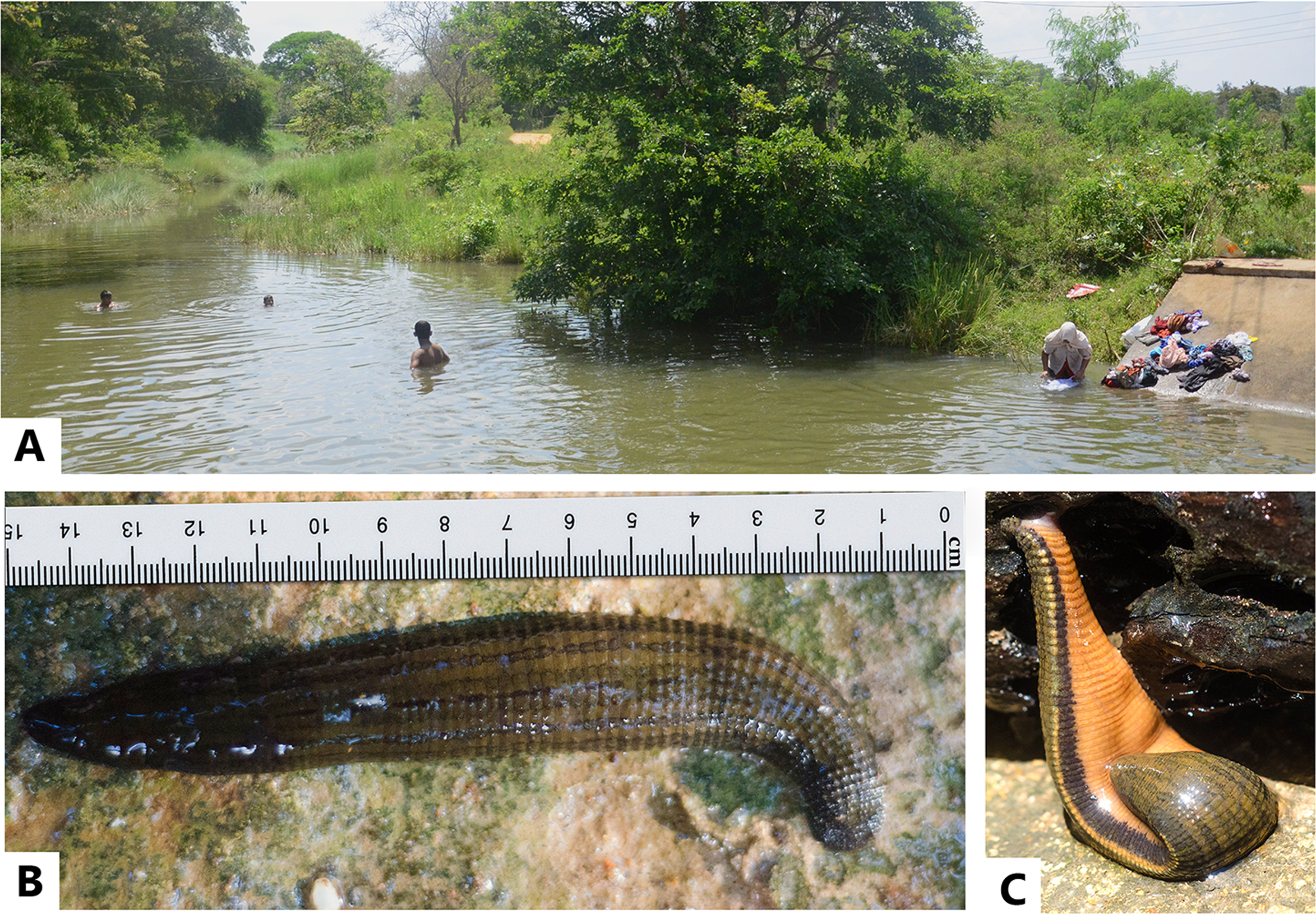
A, Yoda Ela, an ancient manmade irrigation canal. B, Dorsal side of the leech is dark greenish brown with a distinct black dashed line in the middle and 2 dark gray lines on each side. The side of the body is yellow with intermittent black spots. C, Ventral aspect of the leech is dark yellow without any distinct marks.
On examination, the patient was mildly pale and her vital signs were normal. A gynecological examination did not reveal any signs of external injury suggestive of child abuse or trauma. The site of bleeding was on the anterior edge of the intact hymen. A dressing pad soaked with 0.9% saline was kept on the bleeding site, after which the active bleeding slowed. All vital signs were monitored throughout, and slight bleeding was evident for nearly 10 hours. The patient’s hemoglobin was 10 g/dL and her clotting profile was normal. On the second day she was clinically stable and was discharged.
The live leech was examined under natural light and tentatively identified as Hirudinaria manillensis by the external features of the fresh water habitant (Figure, B, C). The leech was released into its natural habitat on the request of the child and her relatives.
Leech bites and their consequences are important in wilderness and travel medicine. Leech bites on various body locations—including body orifices and internal body cavities such as the vagina, uterus, rectum, urethra, urinary bladder, nasal cavity, nasopharynx, oropharynx, esophagus, trachea, bronchus, and even peritoneal cavity—have been reported. 1 –4 Complications of leech bites may range from minor bleeding to profound hypovolemic shock. 2
Premenarchal and postmenopausal bleeding as a result of a leech bite bears tremendous gynecological and medicolegal importance as it is an often-missed differential diagnosis in management of vaginal bleeding in patients with unnoticed leech bites.
All leeches have a large posterior sucker to attach themselves to the host and a small anterior sucker containing the mouth with which they make the wound. Land leeches can penetrate the thick skin of the extremities with their powerful muscular jaws, whereas the aquatic leech can only feed on soft tissue because of its weaker jaws. 1 Although aquatic leech bites are less common, these leeches attach to mucous membranes and enter the orifices of the body to feed and cause severe morbidity in humans by obstructing a viscus or causing severe anemia or persistent hemorrhage leading to shock.
After detachment of the leech, the wound can bleed for hours (the mean time is approximately 10 hours but can be long as 7 days4,5) owing to the wide range of anticoagulants and enzymes in the leech’s saliva, such as hirudin, platelet-activating factor antagonist, and collagenase. Leech saliva also contains substances that cause anesthetic effects, preventing detection of its bite. 6 Unlike land leeches, which detach spontaneously after a blood meal, aquatic leeches remain attached to the host for prolonged periods of time, causing complications. 1
Several cases of vaginal bleeding caused by leech bites in patients in different settings are reviewed in the Table. Almost all the cases were reported from the tropics and subtropics and occurred after a swim or bathing in fresh water. Prolonged vaginal bleeding was the main presenting feature in most of the cases, and the vaginal wall was the most common site of leech bite, followed by the vulva and, in 1 report, the uterus. None of the reviewed cases have authenticated the leech species, probably because of lack of expertise in taxonomy among medical staff.
Review of literature of cases of vaginal bleeding following of leech bite
NR, not reported; NRA, not reported in abstract.
Diagnosis of a leech bite is made with the patient’s history and clinical examination; however, in a few cases, the leech was accidentally found while investigating the bleeding. In most of the cases, leeches in body cavities were removed either by applying an irritant or by extracting the visible leech with surgical instruments such as plain forceps. A widely used irritant is 0.9% saline, although salt water, vinegar, and tobacco water have also been used to dislodge leeches from their attachment. Manual removal of the leech was attempted in a few cases by applying a local anesthetic agent to the leech to paralyze it. 5, 13 Although access to the vaginal cavity can be easily gained in parous women using a speculum, removal of a leech in a young girl with an intact hymen is challenging. Nevertheless, a catheter can be inserted through the hymenal opening to irrigate the vagina.6,8 If these methods fail, examination under anesthesia may be performed to extract the leech (using surgical or endoscopic forceps) by visualizing the vagina with a nasal speculum. 6
Leeches should not be forcefully removed as this may cause their jaws to remain in situ, facilitating further bleeding and infection. There are 2 reports of leech intrusion into the uterus and the peritoneal cavity that warranted curettage and laparotomy, respectively.2,11 Supportive treatment is vital after leech removal, namely packing the bleeding site and administering fluid or blood transfusions and antibiotics as necessary.
Leech bite–related hazards can be prevented by measures such as wearing tight, thick swimwear or underwear, especially when traveling and swimming in leech-infested regions. Using repellants such as diethyl toluamide (DEET), dimethyl/diburyl phthalate (DMP/DPB), or indalone on clothes and skin further facilitates protection against leeches. 1
Although they are rare, leech bites should be considered as a possible cause of vaginal bleeding in children and postmenopausal women. Travelers visiting tropical and subtropical countries where leech infestation is common should take necessary precautions to avoid possible health hazards.