





Abstract

To the Editor:
Deliberate self-harm by poisoning is a major public health problem in Sri Lanka and in many other developing nations in the world. 1 Compared with the use of pesticides, plant poisoning—with the exception of yellow oleander—is less common in Sri Lanka. 1 The strychnine tree (Strychnos nux-vomica) is an ubiquitous plant on the island but poisoning with seeds is rarely reported.1,2 Strychnine causes rapid onset of life-threatening muscle spasms after ingestion. 2 We report a case of Strychnos nux-vomica ingestion with development of symptoms after 12 hours, resulting in death within 30 minutes.
A 23-year-old man with no premorbidities presented at 7:30
At 10:20
Within a few minutes, before further intervention, a similar type of generalized muscle spasms developed for the second time; they lasted longer and became more severe, causing cardiac arrest. Cardiopulmonary resuscitation with chest compressions was given with great difficulty because of the increased muscle tone and the posture. The patient’s cardiac arrest did not respond to basic and advanced life support measures. Finally, after 30 minutes of continuous cardiopulmonary resuscitation and following the advanced life support measures protocol, the team decided to cease the resuscitation attempt. At postmortem examination, the brain, lungs, and liver were congested. The stomach was empty, and the intestine was normal. Sections of the brain, liver, kidneys, heart, pancreas, spleen, and stomach showed no microscopic abnormalities.
Strychnine, an alkaloid found in the seeds of Strychnos nux-vomica is used in baits to kill rodents. It is a highly potent antagonist of glycine at receptors in the spinal cord, brain stem, and higher centers.2,3 Normal glycine action is neuromotor inhibition; therefore, blockage of this inhibitory action results in the excessive motor neuron activity in strychnine poisoning.2,3 The strychnine tree is a deciduous tree native to Sri Lanka, India, and many countries in Southeast Asia. Strychnine fruit, which turns from green to orange when ripening, contains roughly 5 discoid and grayish seeds approximately 1 inch in diameter (Figure). A seed contains 1.3% to 1.5% strychnine and as much as 1.5% brucine. If swallowed and not masticated, a seed will pass through the body without harm. 4
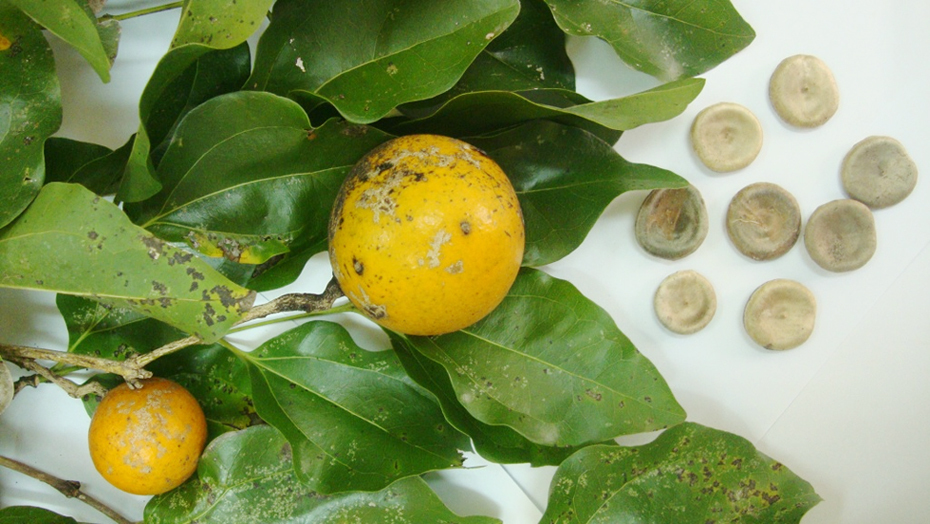
Leaves, nuts, and seeds of Strychnos nux-vomica.
Our patient was asymptomatic for many hours after ingestion. Because he refused to give any history until he became symptomatic, gastric decontamination was not attempted as a part of management. However, the dangers of gastric lavage in places where there is limited experience or ability to control the airway have been established, and the sensory stimulation of such procedures may provoke seizures in cases of strychnine intoxication.2,5 There may have been an opportunity to administer activated charcoal to this patient as he remained asymptomatic for hours, possibly owing to delayed absorption of strychnine from the intestine. Development of very severe muscle spasms was rapid and did not allow for proper management. Basic airway management and intubation could have been done with the earliest evidence of muscle spasms, and muscle paralytic agents such as pancuronium or rocuronium would have been used. In this case, we admit that the dose of intravenous diazepam was inadequate, and intubation and cardiopulmonary resuscitation became extremely difficult because of muscle rigidity.
Control of muscular spasms with parenteral benzodiazepines is considered essential to the management of strychnine intoxication. 2 This case highlights the importance of managing strychnine poisoned patients with higher doses of diazepam, early intubation and ventilation, and use of muscle paralytic agents. The patient’s strong decision to commit suicide may be why he concealed ingesting the poison. In general, muscles spasms of strychnine poisoning develop within 20 to 30 minutes after ingestion.2,3 Delayed absorption of strychnine from seeds of Strychnos nux-vomica may explain the unfortunate events of this case.