





Abstract

To the Editor:
The use of the i-STAT1 Analyzer (Abbott Point of Care Inc., Abbott Park, IL) in wilderness settings has become more common over the last few years. Uses include health and safety monitoring 1 as well as data collection for endurance-related research. 2 Because it was designed for use in the hospital setting, it is not surprising that its use in the wilderness is fraught with problems. Personal communications with other research teams, as well as the anecdotes of our own team, relate difficulty with keeping the unit within the required temperature range of 61°F to 86°F (16°–30°C). Outside this strict window of temperatures, the unit ceases to operate, and displays a message indicating the unit’s temperature is out of range.
We have heard tales of researchers sheltering underneath cars and other objects capable of creating shade, and we would like to describe 2 methods we use for keeping the i-STAT1 Analyzer within range while using it in high temperature environments. One we adopted from the long experience of the military and of desert dwellers. The other is a modification of the method by Backer et al, 1 who utilized an insulating pack with an enclosed cold pack from a freezer to keep both the machine and the cartridges cool.
During a recent event in the arid, hot environment of northern Arizona (78°F [25.6°C], average humidity 29%) we experienced difficulty using the device within our medical tent (99°F [37.2°C]). To bring the unit into range, we used the low relative humidity and endothermic properties of evaporation to lower the machine’s temperature by 10°F (5.5°C) within 5 minutes. To accomplish this, we used a thin cotton handkerchief or bandana that had been soaked with room temperature water and wrung out once. We then wrapped the machine like a burrito and set it on the ground within the tent. After 5 minutes, we turned on the device and found it to be within range. This technique worked several times as needed (Figure 1).
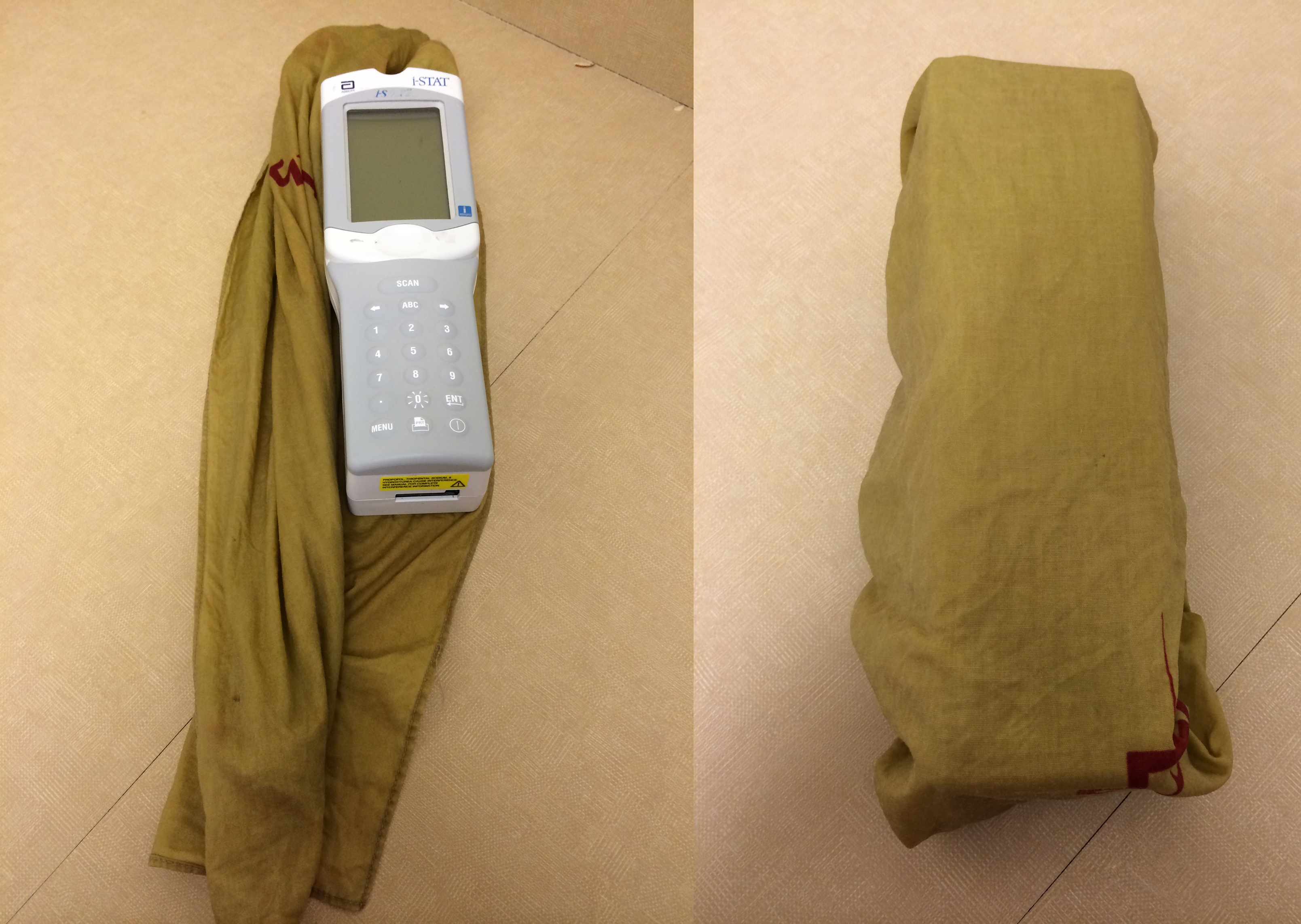
The device being wrapped in a damp bandana.
During another recent event in the humid, hot environment of the Brazilian jungle (95°F [35°C], average humidity 83%), we similarly experienced difficulty with using the device owing to temperature out of range. To bring the unit into range, we utilized the endothermic properties of a chemical cold pack and simple conduction to lower the machine’s temperature 6°F (3.3°C) within 5 minutes. To accomplish this, we activated the chemical cold pack and nestled the machine on top of it. After 5 minutes of thermal conduction, the machine’s temperature was found to be within range. This technique also worked several times as needed (Figure 2).
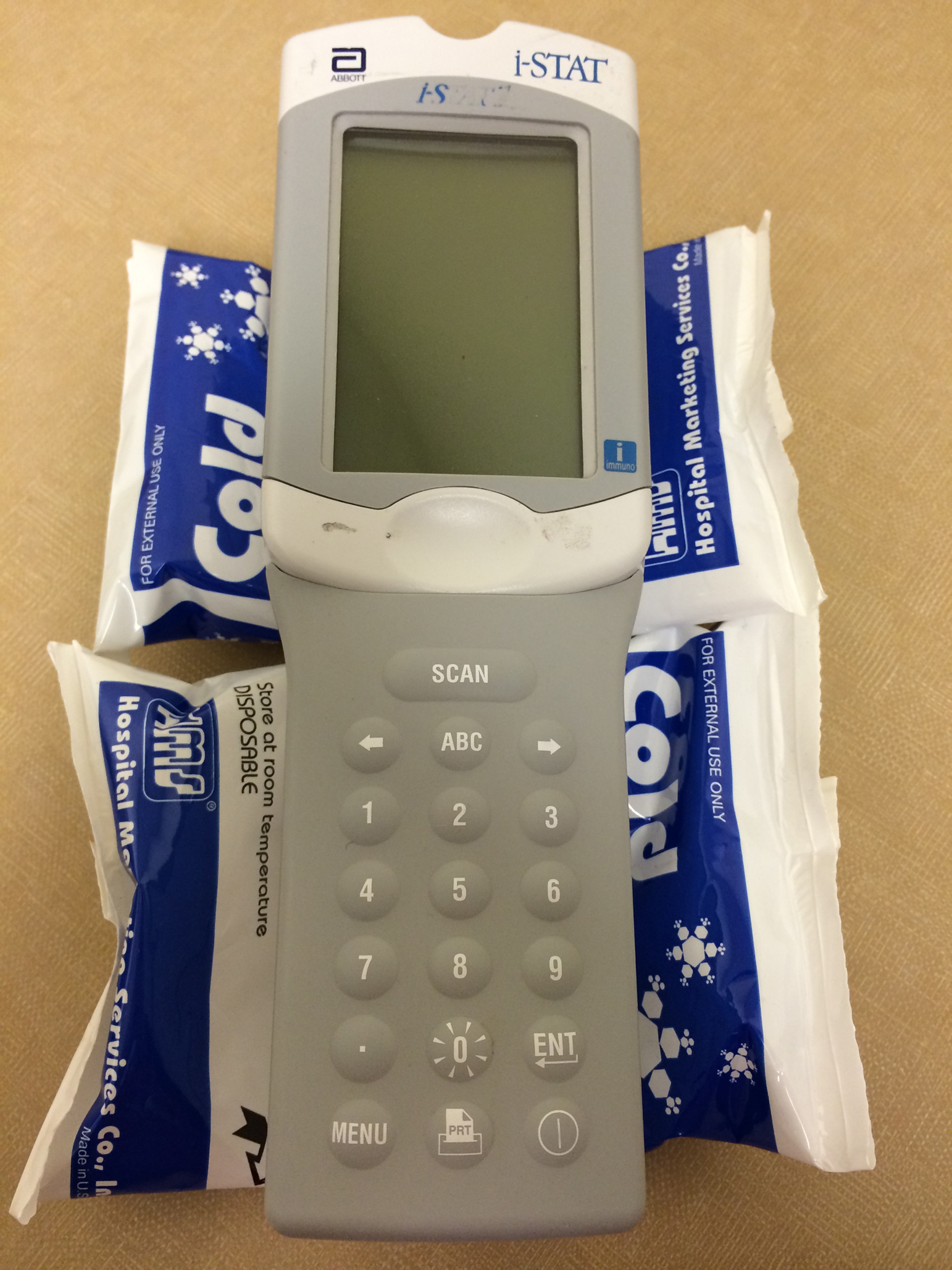
The device cradled in 2 chemical cold packs. During our event, we used a single larger cold pack.
Evaporative cooling, used in swamp coolers or desert coolers, works because water has a large heat of vaporization. The heat of vaporization is “the quantity of heat that must be absorbed if a certain quantity of liquid is vaporized at a constant temperature.” 3 In our use of evaporative cooling, heat energy from the iSTAT1 Analyzer was absorbed by the water molecules on the damp cloth and used to transform those water molecules from the liquid phase to the gas phase. The evaporation caused a net cooling effect as heat energy was pulled away.
Harnessing the thermodynamic properties of the environment, we were able to successfully use the i-STAT1 Analyzer within both a desert and a jungle environment to accomplish our needs of checking event participant’s serum electrolytes for educational purposes. Backer et al 1 caution that the cartridge electrodes are sensitive to temperature as well. We kept cartridges out of direct sun and heat, and would like to reinforce with readers the need to protect the integrity of the cartridge temperature as well. Although not novel technology, we believe this to be the first report of utilizing these techniques for maintaining i-STAT1 Analyzer functionality, and humbly wish to share them with the wilderness medicine community. Further testing and review by the manufacturer are required, and we do not specifically endorse the use of these techniques for critical clinical applications.
Footnotes
Acknowledgement
We thank Abbott for lending us an iSTAT1 analyzer unit. No funding was received, and this letter was not solicited by, or discussed with, them.