





To the Editor:
The following is presented to illustrate a unique outdoor injury that the wilderness provider may encounter. The Gulf Coast sturgeon (Acipenser oxyrinchus desotoi) is a large fish that can grow to weigh 200 to 300 pounds and up to 9 feet long. Gulf Coast sturgeons were listed as a threatened subspecies in 1991 in accordance with the Endangered Species Act of 1973. 1 The Gulf Coast sturgeon population has been experiencing natural growth, 2 and there have also been recent efforts to increase the population by a combined recovery and fishery management plan by the US Fish and Wildlife Service. 3 The majority of these fish, generally found in Florida, are in the Suwannee River-biologists estimate 10,000 to 14,000. Sturgeons are an anadromous fish, which means that they live in salt water and come into freshwater rivers to breed. Sturgeons generally come into the Suwannee River in Florida around March and stay until October, when they return to the ocean. 3 Unfortunately, this is a common time for recreational boaters to be using the river for fishing, swimming, or other leisure activities. In addition, sturgeons are known for their ability to jump out of the water, frequently jumping up to 6 feet in the air (Figure). There are many theories as to why the sturgeon jump, but no clear reason has been identified. 4
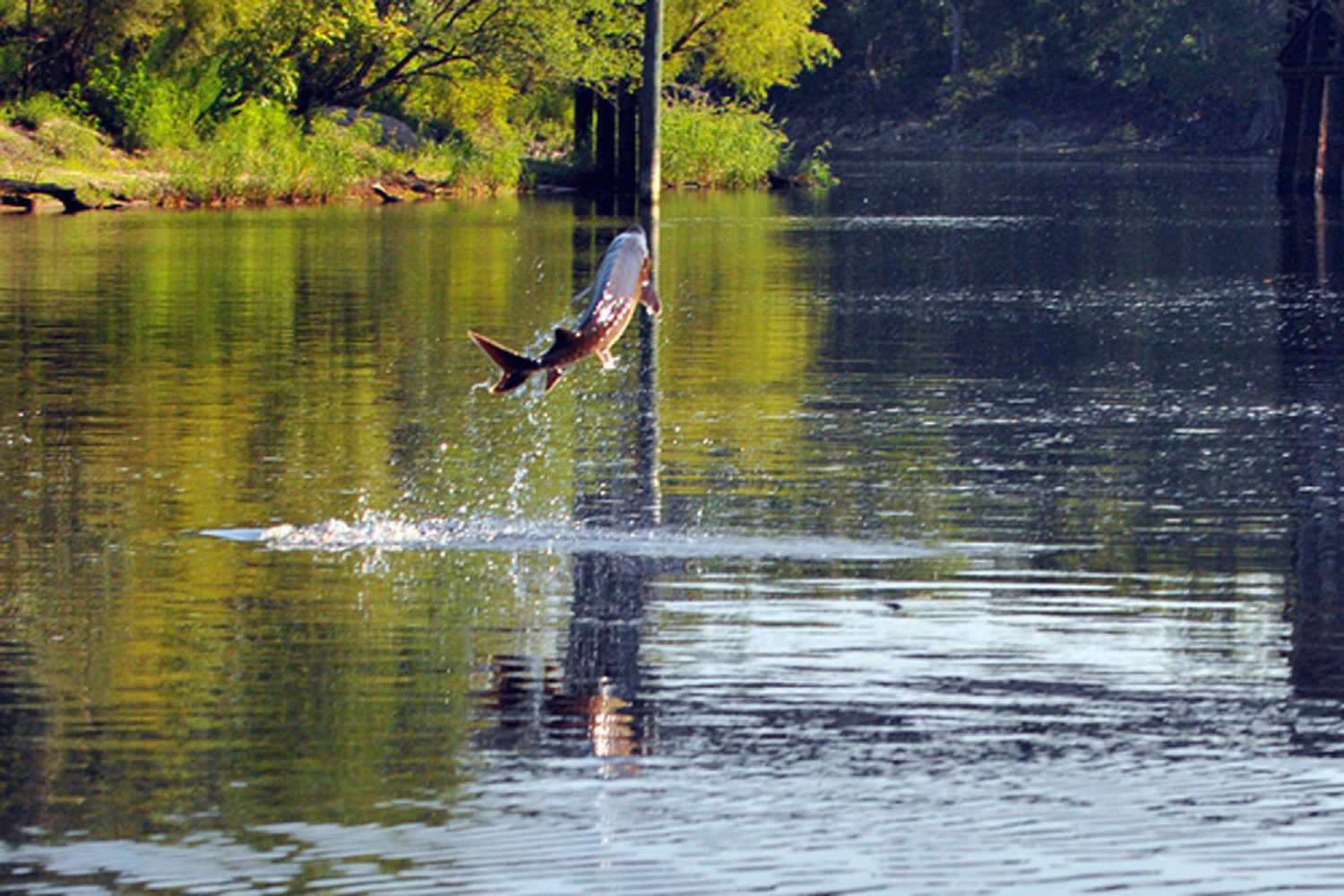
Gulf sturgeon leaping in the Suwannee River, Florida.
Sturgeon-related boating collisions have caused numerous documented injuries on the Suwannee River in Northern Florida. Some of the injuries are caused by direct impact with the jumping fish, and others are caused when the fish jump out of the water and boats crash while trying to avoid the large fish. 5 This case describes the results of one patient's encounter with a jumping sturgeon and demonstrates that these types of encounters can be extremely dangerous.
A 32-year-old woman presented to the Emergency Department (ED) with no reported medical problems. She had been boating with her husband and son on the Suwannee River, traveling approximately 25 to 30 miles per hour, according to the husband. A large sturgeon jumped out of the water and hit her directly in the chest. According to the family's visual estimation, the fish was approximately 4 feet long and weighed 70 pounds. The patient was knocked out of the boat and into the water, where she was unconscious for 1 minute; her husband jumped out of the boat and saved her from drowning.
Upon presentation to the ED, the patient had bilateral upper arm pain and deformities to both arms. She also had blood in her mouth and had several broken teeth. She was alert and oriented and appeared to be uncomfortable, but was hemodynamically stable. The physical examination found a large lip laceration, multiple missing teeth, and a small amount of dried blood in the oropharynx. She had abrasions over the chest, and the chest was tender on both the left and the right side. Bilaterally, the proximal portions of her arms were swollen and appeared to be deformed. She was neurovascularly intact distal to the injuries, and there were no obvious abdominal or leg injuries. The patient's chest radiograph in the ED showed a right clavicle fracture, a right second rib fracture, and a left first rib fracture with no pneumothorax present. A focused assessment with sonography for trauma was negative. Radiographs of the arms showed displaced humerus shaft fractures of both the right and the left arms. A computed tomography scan of the head, neck, chest, abdomen, and pelvis revealed a maxillary alveolar process fracture and a 1-cm liver laceration.
The patient recovered well. She had plastic surgery repair of her complex facial lacerations, and oral and maxillofacial surgery to repair the dental injuries. On her third hospital day, she underwent open reduction with internal fixation of both the right and the left humerus. A psychiatry consult evaluated the patient for her ability to cope with the traumatic event. She was doing well by her seventh day in the hospital and was discharged.
The Florida Fish and Wildlife Conservation Commission (FWC) reports 32 incidents of direct injury caused by the Gulf Coast sturgeon since 2006, when they began keeping official records (Table). The number does not include several serious incidents that resulted from boat collisions with other boats or shorelines to avoid hitting the fish. In addition, minor collisions are likely not coming to the ED at all or not reported to the FWC.
Annual boating injuries caused by jumping sturgeon
A public campaign is now ongoing on the Suwannee River to make everyone aware of the dangers of the fish. The Fish and Wildlife Conservation slogan for the incidents is 'Go Slow on the Suwannee' with the hope that boaters will have more reaction time in addition to less serious injuries at low speed. Signs asking boaters to be aware of the jumping sturgeon have been posted at all Suwannee River boat ramps, and 'Go Slow' decals are handed out to remind boaters to go slow while traveling on the river. There are also signs, similar to deer-crossing signs on the interstate highways, at common fish collision sites. Even with all of this education of the public, there is still a significant number of collisions. A speed limit has been proposed on the Suwannee River (similar to speed limits on other rivers in Florida to protect manatees), but many local residents oppose this, as they argue that it makes recreational boating less enjoyable.
As the population of sturgeon continues to increase through conservation efforts by the FWC, and the popularity of boating increases as well, collisions could increase in number. 3 The population of sturgeon may also begin to increase in other river basins near the Gulf of Mexico, and this local phenomenon may become more widespread. Continued close monitoring of the situation will be necessary, as it could worsen in the future.
Footnotes
Acknowledgements
Special thanks to all the information provided by Karen Parker, Public Information Coordinator, Florida Fish and Wildlife Conservation Commission.