






Abstract
Upper limb injuries are a common occurrence in snowboarders, and these may be reduced by wearing wrist guards that transmit the force of the fall across the forearm. We present a case of a 26-year-old man who experienced a displaced left radial and ulnar fracture related to wearing a wristwatch while snowboarding. The wristwatch acted as a fulcrum around which the arm was fractured, serving as a stress riser that focused the force of the fall. The fracture was treated using open reduction and internal fixation.
Introduction
“Time,” according to the late hiker and writer Alfred Wainwright, “is intended to be spent, not saved,” and a growing number of people are choosing to spend their time in winter months skiing and snowboarding. The wearing of a wristwatch is still a commonplace method of time-keeping in modern day life, and there is virtually no risk associated with wearing one. There is much research on the risk prevention strategies used to reduce injury while participating in such sports (ie, the increasing use of helmets in winter sports). However, there is almost no evidence behind the often anecdotal risk of fracture caused by wearing a wristwatch while skiing or snowboarding.
We present the first documented case of a distal radial and ulnar fracture as a consequence of wearing a wristwatch while snowboarding and the evidence behind wrist-protection methods.
Case Report
The patient is a previously healthy 26-year-old man, who presented with a markedly displaced closed left distal radial fracture along with a concurrent fracture of the ulna after a high-impact fall snowboarding. The patient fell onto a backward outstretched hand with an extended wrist. There was immediate deformity of the left forearm and parasthesia in the superior radial nerve distribution. Wrist protection was not being worn, but the patient was wearing a tight-fitting wristwatch on his left forearm underneath his gloves. There was no previous injury to the limb. Clinical examination revealed a vascularly intact hand with movement possible in all fingers, although reduced sensation throughout the thumb and index finger was noted. There was an obvious deformity proximal to the wristwatch along with soft tissue swelling and no tenderness associated with the elbow and radial head. The fracture was initially manipulated under hematoma block, and definitive reduction was achieved through open reduction and internal fixation.
Initial radiography of the arm was performed with the wristwatch in situ, and the level of the fracture is just proximal to the watchstrap as seen in the Figure. It appears that the wristwatch acted as a fulcrum for the force transmitted through the arm during the fall.
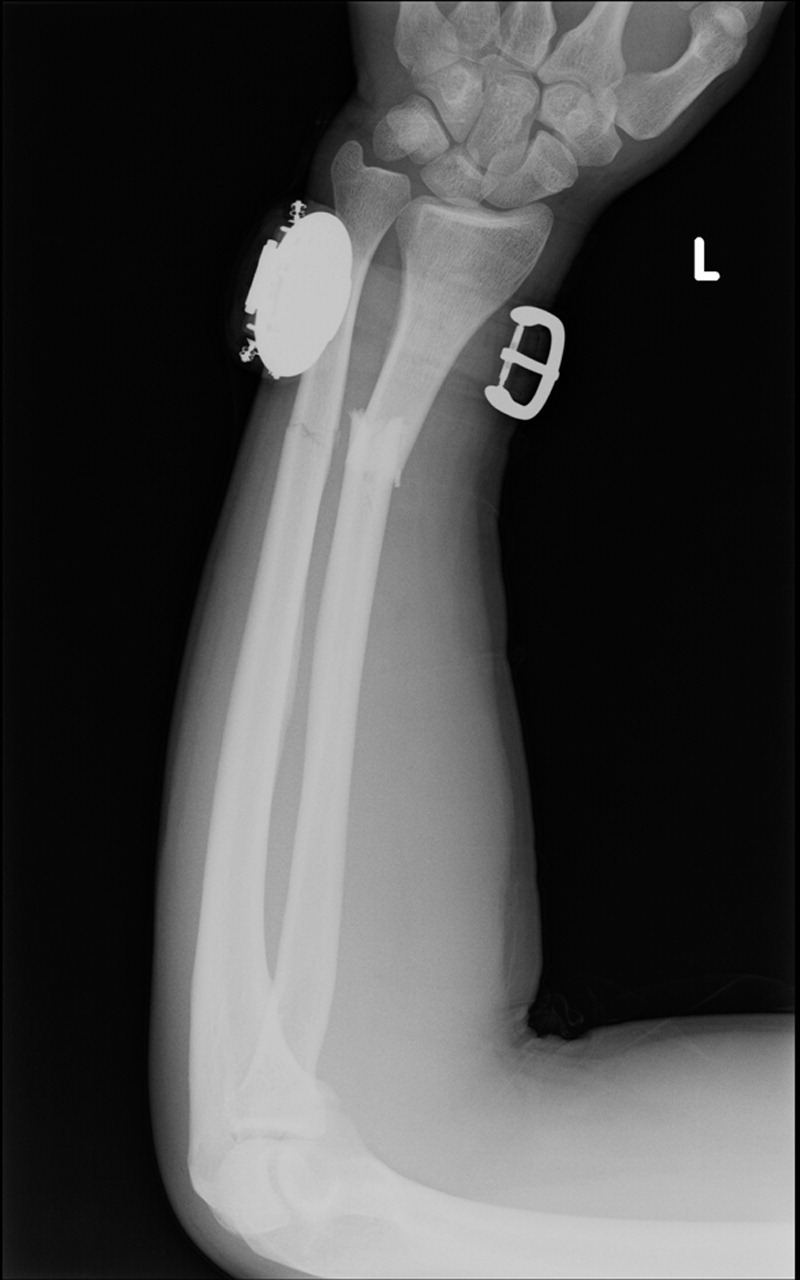
Radiograph of the subject's arm, demonstrating the fracture proximal to the watchstrap.
Discussion
Winter sports are becoming an increasingly popular pastime, and injury is always a possibility when skiing and snowboarding. It is well documented that the majority of snowboard injuries occur in the upper extremity, with 32% of injuries, and up to 50% of severe snowboard injuries affecting the wrist. This is often associated with having both legs fixed and a mechanism of loss of balance leading to a fall onto outstretched arms with hyperextension of the wrist. 1 It is thought that the majority of snowboard injuries are a result of impact as opposed to torsion, which occurs with knee injuries in skiers. In snowboarders, upper limb problems predominate. 2
The senior emergency department consultant at a tertiary centre thought that these forearm fractures may have been a result of wearing a wristwatch. The theory behind this is that the watch acts as a fulcrum or “stress riser” in the forearm. There appears to be only one other such injury in the literature, that of a 14-year-old boy with a segmental fracture of the distal radius and a fracture of the ulna. The mechanism of that injury was a nonskiing simple fall onto an outstretched left hand while wearing a large metal wristwatch. It was noted that the position and configuration of the segment of radius correlated with the external position and shape of the wristwatch, 3 with the distal segment correlating to the position of the wristwatch. It was presumed that the watch had acted as a stress riser and led to the characteristics of the fracture, a stress riser being any defect or any materials that concentrate stress in a certain area, which can then lead to deformation or injury.
The benefit of wrist protection through the use of wrist guards has been well researched and is recommended, with a reduction of forearm injuries between 52% and 87%. 4 The design of the wrist protector should be such that it absorbs the impact of a fall and can transmit it over the forearm, passing it over the wrist. Wrist protectors may however present some risk, as it is acknowledged that a wrist protector that is too short can lead to fracture at its proximal end, as the impact is only transmitted to the distal end of the forearm. 5 This was well described by Cheng et al, 6 who reported that “The splint and distal forearm may act as a single unit to convert the impact from the level of the wrist to a torque moment, with the fulcrum located at the proximal border of the splint.” Here, the edge of the wrist protector is acting as a stress riser, concentrating the force over the distal forearm, leading to fracture. We believe this mechanism may be implicated when a wristwatch is worn skiing and the participant falls onto an outstretched arm. We believe it is likely that the watch held the distal radioulnar joint in place. All the forces were transmitted proximally, leading to the fracture as described. If there were no watch in place, some of the force from the fall could have been transmitted into supination and extension, leading to the standard distal radius fracture with displacement proximally and dorsally.
The wristwatch can act as a fulcrum and focus the force of the impact on the distal end of the forearm, which leads to a fracture configuration correlating to the external position of the wristwatch, as seen in the radiographs of the injury to our patient. This was also demonstrated in the radiographs of the 14-year-old boy noted by Yewlett et al. 3
Through observing the injury to this patient, we propose that the wearing of a wristwatch while skiing or snowboarding can lead to distal forearm fractures similar to injuries seen while wearing a wrist guard that is too short. It is recommended, therefore, that wearing a wristwatch while skiing or snowboarding is not advised as it could lead to fracture of the distal forearm as a result of a fall on an outstretched hand.