





To the Editor:
Recently, a case of a bather injured by a billfish in shallow coastal water in southern Brazil was reported in Wilderness & Environmental Medicine. According to the authors, this so-called unusual attack was caused by the swordfish Xiphias gladius (Xiphiidae). This case was reevaluated based on the victim's interview and incorrect identification of the billfish, which was probably induced by the picture available at that time and the misleading information provided by the Lifeguard Troops.
On the morning of February 2nd, 2008, Mr Donizete Pereira (male, 1.67 m, 90 kg, 44 yr) was injured by what was believed to be a swordfish Xiphias gladius (Xiphiidae). The accident occurred in Matinhos, Southern Brazil, while the victim was swimming at about 15 m from the shoreline, in 1.5 m of water. The victim was attacked 3 times by the fish and suffered multiple injuries from the fish's bill, including a puncture wound on his left knee. 1
Based on the examination of a picture taken by Mr Donizete Pereira on the day of the accident, the fish that caused the accident was actually identified as a white marlin Tetrapturus albidus (Istiophoridae) (see Figure). Despite the fact that fishes of these families may be mistakenly identified due to the similarity of overall body shape, members of Istiophoridae can be easily differentiated from Xiphiidae by having 2 caudal keels (instead of one), very narrow pelvic fins (instead of no pelvic fins), and the dorsal fin extending over much of its body length, sometimes resembling a sail. The white marlin is an oceanic, pelagic, and highly migratory species found mainly in the mixed layer of equatorial and tropical waters of the Atlantic Ocean. 2 This species can reach 300 cm of total length and 93 kg of weight, and feeding habits include mostly fish and squid.3,4
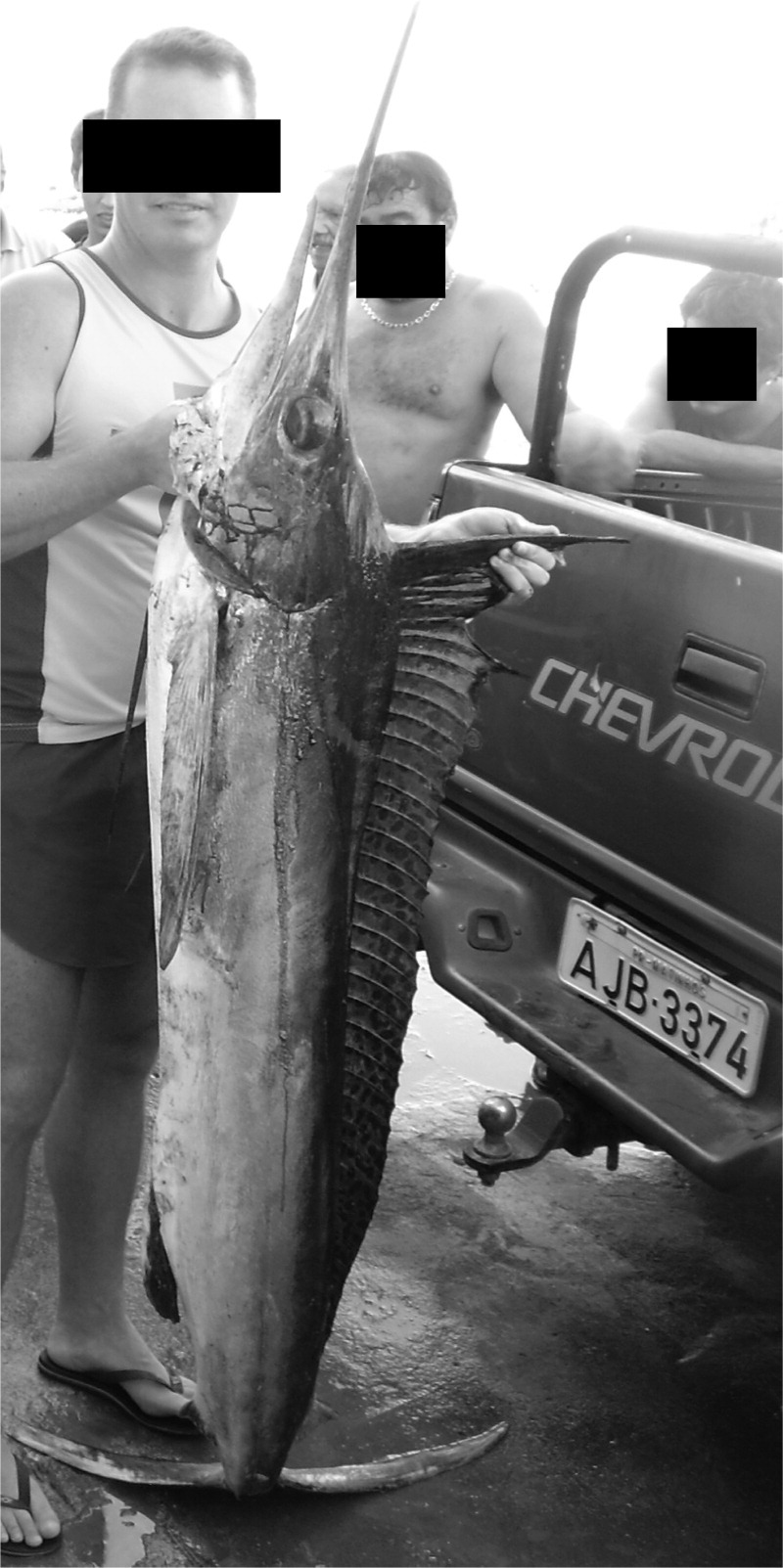
The white marlin T. albidus that caused the injury upon a swimmer in Matinhos beach, southern Brazil.
Hypotheses for the accident include the proximity of the fish to the beach, the stress to which the fish was submitted when threaded in shallow waters, and the victim's attempt to get closer to the animal to protect his children, who were also in the water near the fish. 1 Despite these hypotheses, definitive conclusions about the accident could not be made based on an interview by one of the authors, present with Mr Pereira during his hospital treatment. According to Mr Pereira, the beach was crowded because of the Brazilian carnival holiday, and the accident occurred while he was swimming into shallow waters, trying to get closer to the animal. Although T albidus is notorious for driving its rostrum into animate and inanimate objects, using the pointed premaxilla to stun prey fish by slashing back and forth, they are considered nonaggressive fishes, as are other billfishes, and direct contact with humans is very rare. 5 Because of that, we believe that this was a single incident and definitive conclusions about the unexpected accident cannot be made without considerable speculation as to how they occurred and the motivation of the animal.
Footnotes
Acknowledgments
The authors would like to thank Mr Donizete Pereira for providing information on the accident as well as a photographic record. Fish identification was kindly provided by Dr Teodoro Vaske Júnior (Santa Cecília University).