






Abstract
The aim of this descriptive case study was to use an ambulatory biosensor system to capture data in real time in a harsh environment and to obtain continuous physiological measurements during an ascent of Argentina's Mt Aconcagua, the highest point in the Western Hemisphere. Between the 5800-m-high camp and the 6962-m summit, a 41-year-old male with previous high-altitude mountaineering experience was measured for minute-by-minute heart rate (60–154 beats/min), respiration rate (2–42 breaths/min), skin temperature (11.7–36.1°C), and core temperature (36.9–38.7°C) (1240 min of data: 417 min rest/sleep; 643 min ascent; 180 min descent). All of the measured variables were significantly correlated with each other (p < 0.01). There were incidences of “open leads” and “recovered data,” indicating the potential for some aberrant data; however, data exist for each minute of the 1240 minutes of collection, and the values are within the expected physiological ranges. This study demonstrates the potential application of telemetry to monitor physiological variables during high altitude mountaineering.
Introduction
There is a wealth of information available about human physiology at high altitude. An entire chapter in exercise physiology texts is usually devoted to this topic. However, the majority of information available about humans exercising at extreme altitude has been obtained from studies done in the artificial environment of a hypobaric chamber. Typically, high-altitude field studies include data collected only under resting conditions or have involved some type of contrived or unnatural event, such as the classic study by Pugh et al 1 during which participants performed a maximal oxygen consumption test on an exercise bike at 7440 m on Mt Makalu. However, recent technological advances now make it possible to make ambulatory measurements in extreme environments; thus, physiological variables can be measured in mountaineers in real time as they are climbing.
Mt Aconcagua (6962 m), the highest point in the Western and Southern Hemispheres, provides an ideal location to track physiological variables during an ascent to extreme altitude. During the 2007 to 2008 climbing season, there were 4548 permits issued for summit attempts. 2 Although the most common climbing routes are not technically challenging, the summit success rate is low. Pesce et al 3 observed a 65% success rate over a 1-month period; however, various Internet sites suggest that only about 40% of climbers reach the summit, and veteran guide G. Benegas estimates the success rate to be no more than 30% (conversation, September 2010). Despite the popularity of climbing this peak and the obvious physiological challenge of reaching the summit, there are limited human physiology studies documenting this effort. Pesce and colleagues 3 administered a retrospective questionnaire to climbers in an effort to identify characteristics that were predictive of summit success. More recently, Snyder et al 4 monitored the ventilatory responses of 2 climbers during sleep at the various camps on Aconcagua. However, there has never been a study to assess the physiological demand of climbing Mt Aconcagua. Thus, the purpose of this descriptive case study was to use a telemetry system to continually record ambulatory data on several physiological variables (heart rate, respiration rate, skin temperature, and core temperature) during an ascent of Mt Aconcagua.
Methods
Participant
The participant was a 41-year-old male with previous mountaineering experience. He had been on more than a dozen expeditions above 6000 m with a previous altitude record of 7045 m. He had been residing at moderate altitude (1382 m) for 2 years prior to this expedition. The ascent was voluntary and self-funded. No medication of any kind (eg, acetazolamide) was taken during the expedition. The study was reviewed and approved by the Institutional Review Board of Utah State University.
Procedures and Location
The expedition departed from Mendoza, Argentina (750 m) on January 31, 2008 with the first day of trekking on February 1. The trekking commenced from Penitentes (2600 m) and followed the Vacas valley for 3 days to a base camp at Plaza Argentina (4200 m). Two higher camps were established at 4950 and 5800 m. The mountain was climbed expedition style; there were multiple carries to the higher camps, and several days were spent at each camp to aid in acclimatization. The final ascent to the summit was via the Polish Traverse route.
Prior to the summit attempt while at high camp (5800 m), a wireless electrocardiogram (ECG)-signal processor (VitalSense-XHR, Philips Respironics, Bend, OR) was applied to the chest with 2 ECG pads to monitor heart rate and respiration rate. A dermal patch (Philips Respironics, Bend, OR) was applied to the dorsum of the left hand to measure skin temperature, and an ingestible capsule (Jonah™ capsule, Philips Respironics, Bend, OR) was swallowed to measure core temperature. Minute-by-minute transmissions from the ECG-signal processor, the dermal patch, and the ingestible capsule were integrated and stored to a monitor (VitalSense Integrated Physiological Monitor, Philips Respironics, Bend, OR) (see Figure 1) worn around the participant's waist. Heart rate, respiration rate, skin temperature, and core temperature were monitored continuously through the night at high camp, during the ascent to the summit, and during the descent back to high camp. The climber pressed an event marker button on the monitor defining the transitions from tent to ascent and then descent.
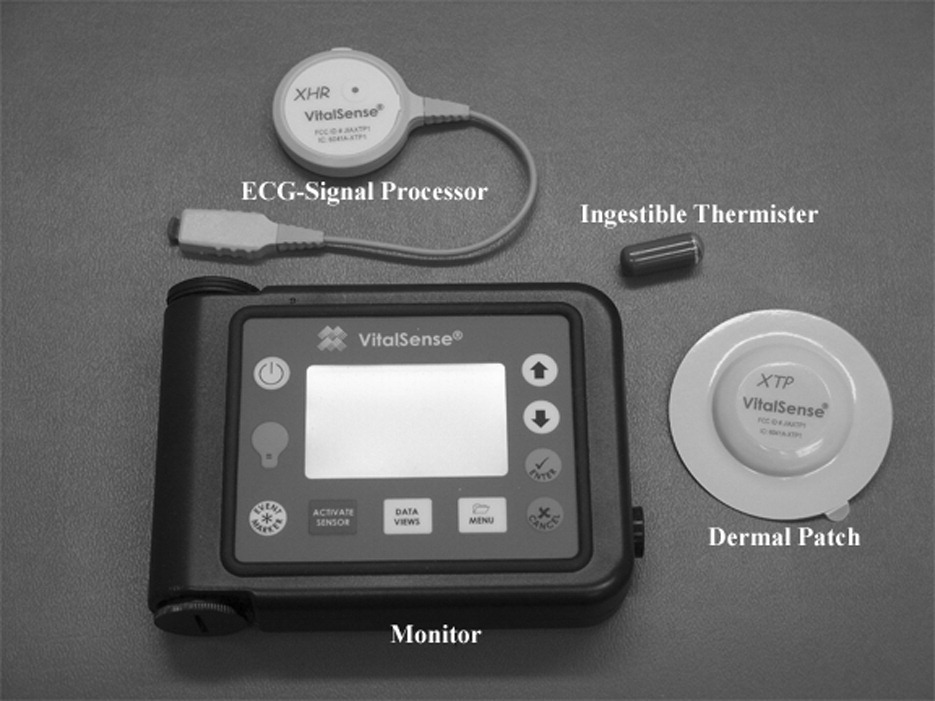
Components of the ambulatory monitoring system.
Statistical Analysis
The minute-by-minute data were categorized into rest/sleep, ascent, and descent segments and means ± SD were calculated. Significant relationships between measured variables were identified by Pearson product-moment correlations. The Statistical Package for the Social Sciences (SPSS, version 17.0, IBM, Chicago, IL) was used for all statistical analyses.
Results
The expedition spanned 16 days with the summit being reached on day 12. A total of 1240 min of minute-by-minute data for heart rate, respiration rate, skin temperature, and core temperature were obtained between the 5800-m-high camp and the 6962 m summit (see Table 1). This included approximately 417 min of data from inside the tent prior to the summit attempt, 643 min of data during the ascent and while on the summit, and 180 min of data during the descent. Heart rate and respiration rate during the ascent and descent were about double their respective rates while at rest inside the tent. On average, the skin temperature during the ascent and descent was about 10°C cooler than while at rest in the tent, and the core temperature did not vary by more than 1.77°C throughout the data collection. Heart rate, respiration rate, skin temperature, and core temperature were all significantly correlated to each other (p < 0.01).
Mean ± SD and range of minute-by-minute data from 5800 m to 6962 m and return
There was a value associated with each physiological variable assessed for each minute of the 1240 min of data collection; there were no missing data when considering minute averages. However, there were 389 reports of “open leads,” indicating a momentary disconnect, creating a potential inconsistency between some individual data points. If the monitor was briefly out of range of a sensor and a data point was missed, the data point could be recovered with the next recording. There were 78 reports of “recovered data.”
Discussion
Rarely has ambulatory, real-time recording occurred during mountaineering. Pomidori et al 5 monitored arterial oxygen saturation for 24-hour periods during a trek to 5050 m, and Woods et al 6 implanted loop recorders subcutaneously to assess ambulatory ECG recordings up to 6325 m. Sonna et al 7 were able to obtain usable core temperature data on 6 military mountaineers during an expedition to Mt Sanford (4949 m) in Alaska, and Satava and colleagues 8 were able to track heart rate, skin temperature, and core temperature in 3 climbers making their way through the Khumbu icefall (5500 m) on Mt Everest. However, the current study provides the first known published account of ambulatory recording of several physiological variables simultaneously during mountaineering at altitudes as high as 6962 m.
Unfortunately, the ambulatory monitoring system used in this study was not validated against established laboratory methods for the study participant. Although there are no peer-reviewed studies validating the XHR sensor used to measure heart rate and respiration rate, the manufacturer provides validity data of R2 = 0.97 for ECG-compared heart rate during treadmill exercise and R2 = 0.82 for CPAP-compared respiration during cycle ergometry. 9 The heart rates and respiration rates observed during the ascent and descent were within the expected physiological range for a person of this age exercising at a moderately hard intensity at high altitude. The range of heart rates for this Aconcagua climber is similar to those reported for climbers in the Khumbu icefall (5330–6000 m). 8 Likewise, the observed respiration rates of 35 to 45 breaths/min for long periods of time were expected for an ascent from 5800 to 6962 m. Close inspection of the data revealed 1 stretch of time that the respiration rate fell below 8 breaths/min for 17 continuous minutes while the subject was sleeping. It is unknown whether this was a failure of the monitoring system or the result of altitude-related sleep apnea; however, there were no reports of “open leads” during this time period, suggesting that the data are accurate. Sleep apnea is fairly common at high altitude, 10 and Snyder et al 4 reported that both climbers in their study experienced periodic breathing at the high camp on Aconcagua.
The telemetric core temperature monitoring system described in the present study was previously validated against a rectal probe. 11 As expected, skin temperature varied widely while core temperature remained stable during the expedition. Other researchers that have used ingestible thermisters to measure ambulatory core temperature in mountaineers have reported ranges similar, but slightly greater, to what was observed for the climber in this study.7,8 The range for skin temperature during summit day on Aconcagua was more than double that reported for 3 mountaineers climbing through the Khumbu icefall. 8 The larger range observed in the present study could be attributed to many different factors such as a greater fluctuation in environmental conditions or a different placement of the dermal sensor. The dermal sensor was on the dorsum of the hand in the present study, but Satava et al 8 did not report the placement in their study. A placement on the trunk, for example, would likely account for a narrower range of skin temperature values.
The climber had to shave the dorsum of his hand and part of his chest for the placement of the dermal patch and ECG electrodes, but the VitalSense monitoring system was easy to use and operate. The weight of the monitor was not excessive, about 200 g, and it fit into a protective pouch on a neoprene waist belt that also kept the unit warm. The waist belt had to be worn a bit higher when wearing a backpack so as not to interfere with the pack's belt. The system ran continuously for the duration of the data collection (> 20 hours) on 1 AA lithium battery.
Several changes and additions to the monitoring system would improve its utility for mountaineering research. First, although there is an “event marker” button on the monitor that is useful for denoting significant events or time periods during data collection, it is not practical to use this button for frequent changes in status. For example, it was not possible to partial out frequent rest periods from the time spent climbing; thus, the ambulatory ascent data were contaminated by rest, thereby reducing the mean data for respiratory rate and heart rate during the ascent. The integration of an accelerometer and/or global positioning system (GPS) would solve this problem and greatly enhance the data recording capability by allowing researchers to identify when a climber was active or where he was located during a specific set of data points. Second, the dermal patch is too large and inflexible to be placed on a digit. The creation of a small flexible dermal patch that could be wrapped around a finger or toe would make it more apt for frostbite risk assessment. Finally, the addition of an arterial oxygen saturation sensor or the measurement of tidal volume and minute ventilation via respiratory inductive plethysmography, similar to the ambulatory system described by Windsor and Rodway, 12 would expand the research and monitoring potential of the VitalSense system.
Despite these shortcomings, the biosensor system appeared to work, as there was continuous monitoring for over 20 hours, and the results were within the physiological range expected. This demonstrates that it is possible to continually monitor a climber's physiology at high altitude even while ambulatory. In addition to the obvious application as a field research tool, biosensor monitoring could potentially help expedition physicians and guides keep abreast of a climber's physiological status at any moment and take appropriate action if necessary.
Conclusion
Similar descriptive studies of high altitude physiology have been done in the simulated environment of a hypobaric chamber, but rarely are these variables measured in the field while the participant is ambulatory. Although this is only a case study and the results cannot be generalized to other mountaineers, this study provides a reference for the physiological demands and changes that occur when ascending to 6962 m and demonstrates that the recording of ambulatory data in the harsh environment typical of high altitude mountaineering is possible.
Footnotes
Presented in poster format at the Southwest American College of Sports Medicine meeting, November 14, 2008, San Diego, CA.
The cost of disposable supplies was funded by the Utah State University Human Movement Science Program.
Acknowledgments
The author thanks Philips Respironics for loaning their physiological monitoring system for this study. Also, a special thanks to climbing partners Luis Gonzalo and Dennis Wasserman who helped to make this expedition a success.