






Abstract
Objective
To evaluate the accuracy of Internet information regarding the prehospital care of venomous snake bites.
Methods
Two major search engines were used to identify 48 Web sites regarding 6 prehospital treatment options for snake bite (removal of constrictive devices, ice, heat, electric shock, incision, and suction). Web sites were evaluated for their quality using the Health on the Net (HON) seal and Journal of the American Medical Association (JAMA) benchmarks.
Results
Of the 48 Web sites reviewed, 26 (54.1%) contained inappropriate recommendations. The remaining 22 Web sites were appropriate regarding all modalities addressed. Among the Web sites reviewed, inappropriate treatment recommendations included: suction (14); ice (6); incision (4); electric shock (1). Five Web sites that met all 4 JAMA benchmarks and the HON seal included 3 inappropriate treatment recommendations. Conversely, the 5 Web sites that met none of the JAMA benchmarks nor included the HON seal included only 2 inappropriate treatment measures.
Conclusion
This study highlights the variety of misinformation available on the Internet regarding prehospital care of snake bites, and the unreliability of the HON seal and JAMA benchmarks as markers of accuracy. As the Internet becomes an increasing source of medical information for both the public and clinicians, the importance of accurate Web sites becomes imperative. Clinicians and lay people should be aware of the high variability of Internet information regarding snake bite prehospital care.
Introduction
Venomous snakes exist on all 7 continents except Antarctica. 1 North Americans suffer approximately 45 000 snake bites each year with about 8000 bites from venomous species. 2 In the past, a variety of prehospital modalities primarily based on customary practice or folklore rather than sound scientific data were advocated to prevent the spread of venom. These practices include incising the bite site, applying suction to the wound, and administering electrical shocks. 3 Research has demonstrated that the majority of these prehospital treatments are ineffective, and many may be potentially harmful.1,3 In 2007 Boyd et al published an article in Wilderness and Environmental Medicine reviewing the current literature on first aid care for snake bite. 1 This article's recommendations for prehospital care of snake bites were consistent with those of the American Red Cross and American Heart Association (ARC/AHA) recommendations for first aid.1,4 Boyd et al also reported that increased harm can result from ice, incision, suction, heat, or electrical shock.1,4
Previous studies reviewing the Internet for medical information regarding other topics, such as infertility, head and neck cancer, and methotrexate treatment, have reported high variability in the accuracy of available information. 5 –7 These studies are alarming due to the high use of the Internet by the public. For example, a poll in 2001 demonstrated almost 100 million adults regularly use the Internet to gain medical information. 8 However, this situation does not pertain solely to the general public. Sigouin and Jadad reported that 64% of family physicians, 72% of nurses, and 100% of the oncologists in the study used the Internet for medical advice. 9 Since both the general public and health care professionals are utilizing the Internet for advice on patient care, we sought to review this advice and compare it to current guidelines regarding the appropriate prehospital management of snake bite.1,3
Methods
An Internet search for both “snake bite treatment” and “snake bite first aid” was completed using the 2 search engines
The content of all remaining 48 sites was assessed for each of the following 6 treatment modalities: removal of constrictive items, ice, heat, electrical shock, incision, and suction. Support “for the modality,” “against the modality,” or “not addressed” was documented for each site regarding each treatment modality and compared with recommendations regarding the appropriateness of the treatment as described by Boyd et al 1 (Table 1).
Prehospital snakebite management appropriate and inappropriate therapies 1
Removal of constrictive items (beneficial). Any items such as watches, rings, or clothing near the bite should be removed to prevent a tourniquetlike effect. 1 This tourniquetlike effect can worsen local tissue damage via vascular compromise.1,10
Ice (not beneficial). Traditionally, ice was recommended for its theoretical benefit of decreasing humeral response and enzyme activity.11,12 However, further evaluation revealed that ice actually worsens the severity of tissue damage. 1 ,13,14
Heat (not beneficial). Heat was originally theorized to increase local blood flow with the intent to disseminate venom and decrease local tissue necrosis.13,14 Animal models failed to demonstrate any efficacy of this modality and found that heat potentially worsens local tissue damage. 1 ,13,14
Electrical shock (not beneficial). The concept of electrical shock originated in 1986 from the jungles of the Amazon. 15 Since 1986, basic science has been unable to demonstrate an effective pathophysiological mechanism for care of snake bite via electric shock. 16 –19 Additionally, case reports have demonstrated the danger of electrical shock therapy for snakebites.20,21
Incision (not beneficial). Incision combined with suction was once considered the standard of care. 22 Incision, now, is felt to place the patient at greater risk than potential benefit. Incision can damage underlying structures, introduce infection, and create significant bleeding. 22
Suction (not beneficial). Initially intended to remove venom from the wound site, suction devices have been demonstrated to create local tissue injury without significant venom extraction. 1 ,3,4,22 Suction devices also impair the natural wound healing process. 1 ,3,22
Each Web site was also assessed for the 4 Journal of the American Medical Association (JAMA) publishing benchmarks: authorship, references, date of last update, and disclosure of conflict of interest. Based on this system, sites meeting 3 or more JAMA benchmarks were viewed as higher-quality Web sites, and those meeting 2 or less JAMA Benchmarks were viewed as lower-quality Web sites. 23 In addition, each Web site was evaluated for the Health on the Net Seal (HON). This nonprofit organization reviews health information Web sites with an 8-point code of conduct (Table 2) that must be met to display the Health on the Net Seal. 23 This distinction has been suggested to be the oldest and most well-known quality label of Internet health information. 23
Health on the Net Code
Results
Forty-eight Web sites were reviewed for their recommendations regarding 6 potential treatment options for a venomous snake bite. All sites addressing the modalities of heat and removal of constrictive items were in agreement with current evidence-based literature recommendations by Boyd et al and ARC/AHA for snakebite first aid regarding these issues (Table 1).1,4 Multiple Web sites, however, recommend other inappropriate therapies regarding snakebite prehospital care: 6 recommended use of ice, 4 recommended incision, 14 recommended use of suction, and 1 recommended electric shock (Figure).
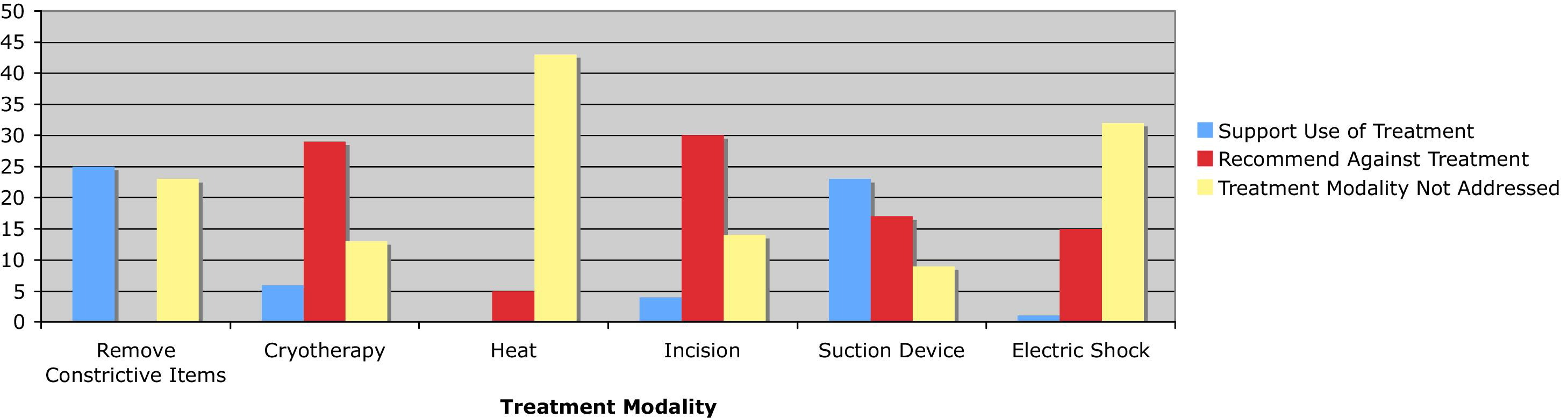
Web site recommendations for snake bite first aid.
Overall, 22 Web sites were correct in all treatment modalities addressed. No Web site supported greater than 4 improper treatment modalities. Four Web sites recommended 2 to 4 inapropriate prehospital treatments (Table 3).
Number of Web sites with corresponding number of inaccuracies
Web sites were evaluated by the number of JAMA benchmarks they met combined with display of Health on the Net Seal (HON seal). Five Web sites met all 4 JAMA benchmarks and included the HON seal. Of these 5 Web sites, 3 recommended use of suction. Five Web sites met none of the JAMA benchmarks nor included the HON seal. Of these 5 Web sites, 2 recommended use of suction. The majority of the Web sites met 3 out of 5 measures with regards to the JAMA benchmarks and the HON seal (Table 4).
Correlation of inaccuracies and Web site quality
Web site quality is defined as the number of Journal of the American Medical Association (JAMA) publishing benchmarks met by each website plus the presence of a Health on the Net (HON) certification seal. Category 5 indicates the highest quality (all 4 JAMA benchmarks met plus a HON seal).
Discussion
More than half of the Internet sites reviewed contained inappropriate information regarding the prehospital treatment of venomous snake bite, making the chances of being exposed to correct treatment information essentially equal to a coin toss. Of further concern was the fact that no correlation was observed between the accuracy of the information presented and the quality of the Web site as assessed by 2 accepted medical Internet quality seals.
With approximately 8000 bites from venomous snakes per year in the United States, it is critical that patients receive appropriate prehospital care. 2 A key to appropriate care is proper education/knowledge. As demonstrated in previous research, both clinicians and patients have become reliant upon the Internet for components of their knowledge and education. 8 This study unfortunately highlights the variety of misinformation available on the Internet regarding prehospital care of snake bite.
With increasing reliance upon the Internet for information, entities such as JAMA and the nonprofit organization Health on the Net have attempted to develop standards for evaluating Web sites for their quality. In this study, inaccuracies still plagued sites that met high-quality standards by both JAMA and the HON seal. Inability to rely on these screening tools for Internet education regarding snake bite prehospital care adds complexity to Internet education for both clinicians and patients.
The data search in this study included MedlinePlus.gov, an Internet Web site created in 2004 by the American College of Physicians and the National Library of Medicine to provide patients with reliable unbiased health information.
24
This traditionally respected source is often relied upon to contain the most up-to-date information when addressing medical topics such as snake bite prehospital care. However, this site supported the use of suction. Two other reputable sources of Internet information, the Food and Drug Administration (
As the available data regarding prehospital care of snake bites have increased, sound scientific practices have replaced traditional remedies in snakebite treatment. Many people use the Internet as a source of medical information and with increasing availability of wireless Internet in the prehospital areas; the importance of accurate Web sites for both clinician and lay person education becomes imperative. Use of government and academic Web sites and/or screening tools such as the HON seal and JAMA benchmarks in theory provides clinicians and lay persons with more accurate data regarding medical care. However, lay people and clinicians should be aware that, as demonstrated in this study, these Web sites may not contain accurate medical information.
Limitations
There are limitations to our findings. Web site quality was measured by only 1 individual evaluating each Web site. If the same data were acquired by another individual, the data could be subjected to some interobserver analysis to assess the reliability (precision) of the measurement. Additionally, only the first 25 “hits” of 2 major United States search engines were utilized, which limits the generalizability of these results to all Web sites. The external validity of the data could be enhanced if international search engines were also evaluated. Not all modalities of treatment of snake bites (eg, safety, communications, and transport) were evaluated within this study, which could further vary the accuracy of the Web sites.
Footnotes
No offprints prints are available from the author.
Presented at the 2009 WMS Wilderness Medicine Conference and Annual Meeting, Snowmass, CO.