






Abstract
The author describes his experience following 2 bites to his hand by the same green palmsnake (Philodryas viridissimus) on the same day, and reviews the literature on bites from rear-fanged species of the genus Philodryas. Though this genus has long been thought to include the most venomous colubrid snakes in the Americas, the author's bites were relatively asymptomatic. Fatalities caused by Philodryas seem to be lacking in the primary literature, but mild to moderate symptoms do result from envenomations by at least 2 species. Medical researchers are urged to obtain accurate species identifications and to carefully report symptoms and fatalities from bites of colubrid snakes.
With the exception of a few rear-fanged genera, the largest family of snakes, Colubridae, was long considered nonvenomous. Recent biochemical and DNA studies have revealed evidence for an early origin of venom in snakes (∼100 million years ago), including all colubrids, and a previously undocumented diversity among “colubrid” snake venoms. 1 -4 It is therefore important to describe the effects of bites by colubrid snakes, especially those rear-fanged species already suspect of possessing venom gland secretions that might be harmful to humans.
At least 29 genera of rear-fanged snakes occur in South America, but relatively few envenomations resulting in severe pathological symptoms have been reported. 5 Five species of Philodryas, a large genus of about 16 species, have been reported to cause human envenomations, with fatalities allegedly occurring from the bite of at least 1 species, P olfersii. 6 These are fast-moving, slender, greenish snakes whose behavior is somewhat similar to North American racers and whipsnakes.
More is known about the structure of the venom apparatus, composition of the venom, and effects of envenoming for P olfersii than for any other Latin American colubrid, 5 but published accounts of ophidism are rare in Philodryas viridissimus, a closely related species easily confused with the similar-looking P olfersii. Greene 7 stated that “Bites from 2 species of South American green racers (P olfersii, P viridissimus) have resulted in severe symptoms in humans, and there are recent reports of a fatality caused by the latter species in Brazil.” Here I report my symptoms after being bitten twice by P viridissimus, and I review and evaluate published records for ophidism in P viridissimus and the genus Philodryas.
Case Report
About 1215 hours on November 11, 2006 I was visiting the Acawaio Amerindian village of Wayalayeng adjacent to the Ataro River in the Potaro-Siparuni District of Guyana, South America, when villagers hailed me to capture a snake they had cornered in an abandoned agricultural site under sparse, knee-high groundcover consisting mostly of bracken fern (Pteridium aquilinum). Although men pointed directly above the spot under a mashed-down fern plant, I did not catch sight of the approximately 100 cm total length, bright green snake until it began dashing away. I later identified it as one of the South American green or lora snakes, specifically the green palmsnake, P viridissimus (5 digital photographs of it and the bite wounds have been deposited in the Florida Museum of Natural History, UF-150186, accessible at
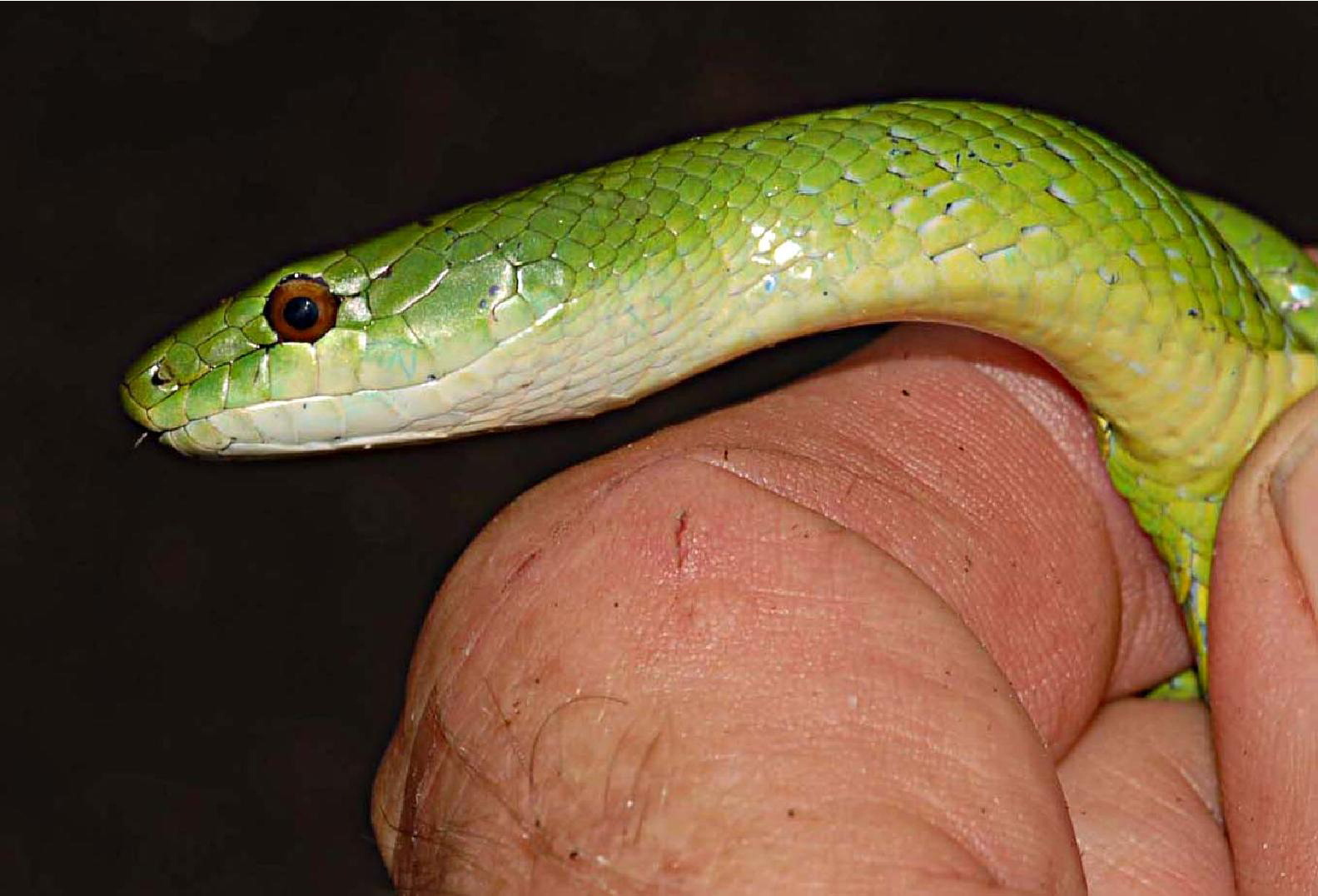
Green palmsnake (Phylodryas viridissimus), ∼1.0 m total length, Potaro-Siparuni District, Guyana.
Realizing it was not a venomous viperid, I lunged for it and caught the snake at midbody with my left hand. Immediately the snake became defensive and got the base of my left thumb in its mouth and would not let go. The snake's head moved forward as far as it could push it, tilted the head slightly upwards, and then pulled its maxillary fangs backward into the flesh and made alternating lateral head movements causing the elongate teeth to penetrate as deeply as possible. The 2 wounds were located on the palmar side below the proximal joint into the subcutaneous tissue over the pollicis brevis muscles (Figure 2). In removing the snake, I was careful not to grasp it by the sides of the head to avoid forcing more venom into the wounds. I used a small stick to pry the snake's nose upward and caused it to release my hand. The duration of the bite was 15 to 30 seconds. The 2 pinprick wounds bled freely for about 20 seconds and then stopped. At 1226 hours, within 10 minutes of the bite, I started off on a 5-hour hike with a 16-kg daypack over flat, rainforest terrain. During a rest break in the walk at about 1330 hours, I was bitten a second time by the same snake. It made the same movements with its head, deeply sinking its maxillary fangs into the left side of the distal joint of my right index finger (Figure 3). Having experienced minor symptoms from the first bite, I removed the snake following the second bite by grasping its head between my thumb and index finger, which could have forced more toxic saliva into my wound. The removal appears in the 2007 documentary film entitled “Legends of the Lost World” produced by Angus Yates and the North Face. It was firmly affixed to my finger for 5 to 10 seconds. The second day I walked 9.5 hours uphill all day. I was then a 118-kg, 65-year-old male. No first aid was administered.
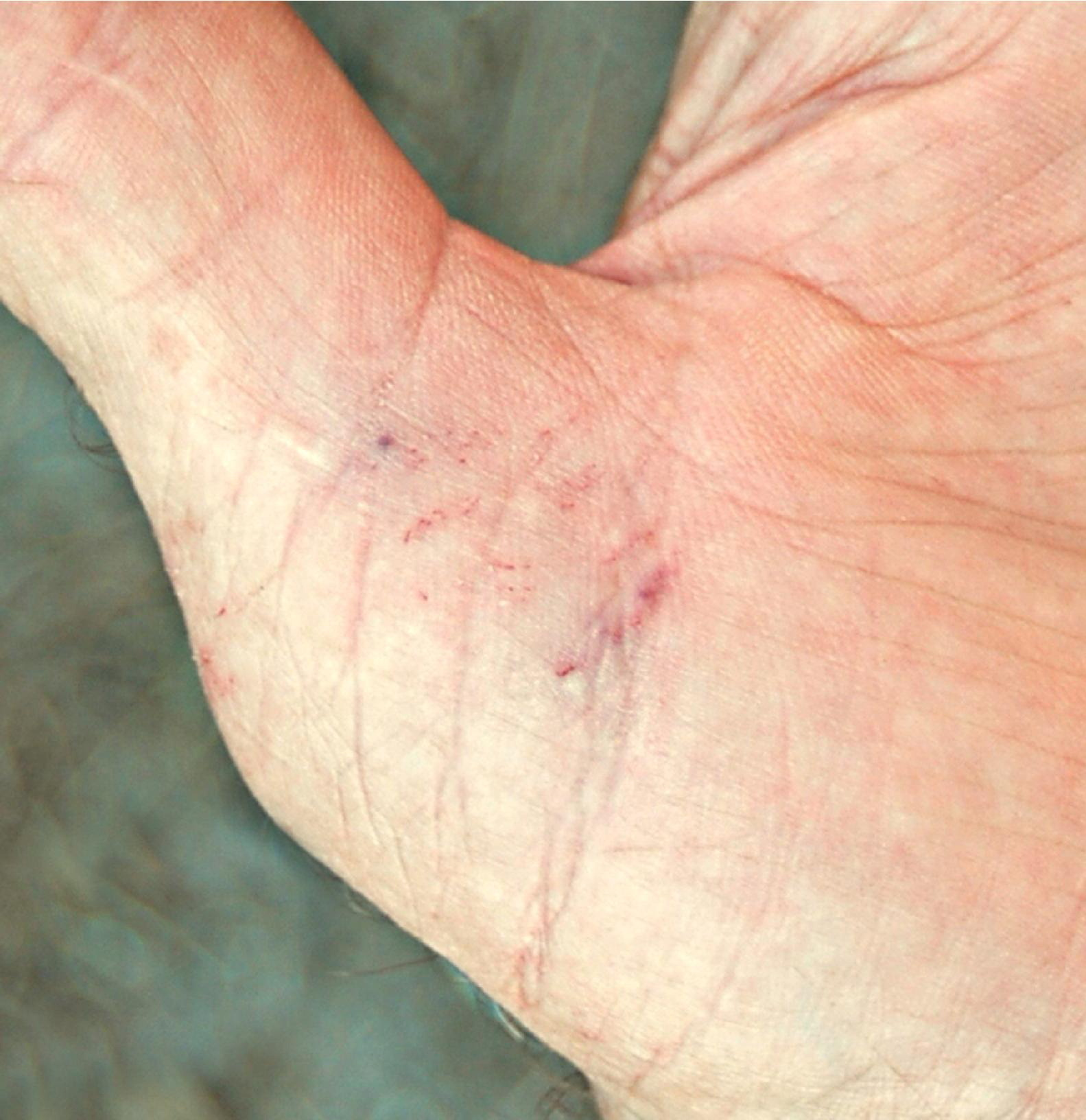
Impression of maxillary and palatine teeth of the green palmsnake at the base of my thumb, 1 hour postbite. Entry punctures of the rear fangs are visible as darker wounds. The right rear fang may have punctured my hand more than once.
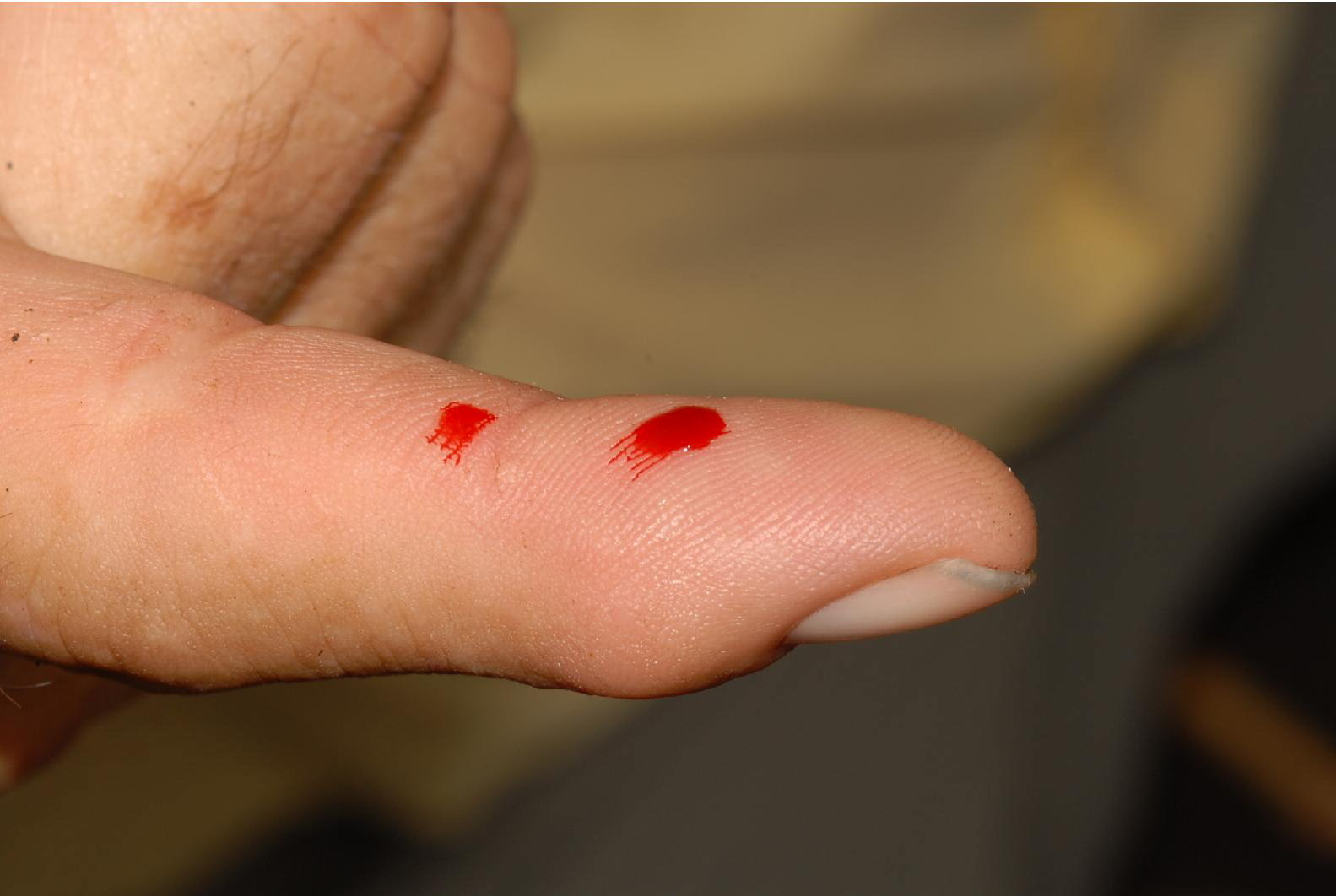
Site of second bite from the same green palmsnake (Phylodryas viridissimus) about 1 hour after first bite (see Figure 1). The snake worked its rear fangs into my finger by pushing its open mouth as far forward as it could and then wriggling its head back and forth to assist puncturing. Wounds bled freely for about 20 seconds.
Symptoms of the bites were as follows. 1) During the first bite, I felt only pinprick-like sharp pains of the enlarged maxillary and dentary teeth. 2) After the snake was removed from my hand, I experienced a dull, slightly itching ache from the 2 wounds of the maxillary teeth, from deep in the flesh, not superficially. This was a very mild ache, hardly noticeable unless I thought about it, and lasted for about 30 minutes. 3) For a day and a half afterward, during the long walk, the policis brevis muscle deep in the base of my thumb under the site of the maxillary teeth marks was slightly sore when massaged. No other symptoms from the first bite were experienced. I experienced no other symptoms from the second bite other than the slight pain from the initial wounds and bleeding for about 20 seconds following the removal of the snake (Figure 3). The wounds from both bites vanished 24 hours post-bite, and I was unable to see where the fangs had penetrated. The 2 bites were no more severe than dozens of other bites I have experienced from New World colubrids, including many rear-fanged species (eg, Leptodeira annulata, Leptophis ahaetulla, Spilotes pullatus, Oxybelis aeneus, Oxybelis fulgidus).
Herpetologist William Lamar also experienced symptomless bites from P viridissimus, but he did not believe the rear fangs came into play (written communication, January 11, 2007). A photograph of the hand of herpetologist John Cadle illustrated the bite of a Peruvian P viridissimus that caused considerable edema, pain, and discoloration.5,8 There was also a case involving a female clerk in a Fairfax, VA, pet shop. While showing the snake to a potential buyer, it latched onto her inner wrist. Attempts by pet shop personnel to remove the snake might have milked the glands into the wound. Swelling was severe and resulted in compartmental syndrome, leading to fasciotomy and debridement, which left her arm somewhat deformed and with reduced use (William Lamar, written communication, January 11, 2007).
The alleged fatality caused by P viridissimus mentioned by Greene
7
should have been attributed to P olfersii (written communications, January 11, 2007 and April 13, 2009), but I have been unable to find primary literature documenting this or any other human fatality caused by a snake of the genus Philodryas. Moreover, an envenomation by P viridissimus on a Venezuelan man
9
was actually caused by P olfersii. Apparently the authors misidentified the snake (William Lamar, written communication, January 20. 2007). The effects were: “… burning pain and minimal bleeding which stopped in a few minutes. Pain persisted 50 minutes later, when an intense oedema of the middle finger developed. Then local swelling enveloped the middle finger and adjacent areas of the index and ring fingers. Two hours after the bite, the palmar and dorsal surface of the hand was completely swollen and several small petachiae [sic] appeared on the middle finger. One day after the bite, swelling was extended onto the wrist and the anterior region of the forearm. At this time strong ecchymosis was seen around the middle finger. We could not observe signs of general envenomation. Recovery occurred 3 days after when swelling and petachiae [sic] totally disappeared.”
9
A review of 43 cases of P olfersii bites found no published information supporting fatal cases and concluded that severe envenoming is infrequent in this species. 10 Bites of P olfersii and P patagoniensis can be mildly to moderately toxic, producing symptoms of local pain, swelling, erythema, and ecchymosis, but systemic symptoms such as an effect on clotting ability have not been documented. 11 Obviously, making proper species identifications is critical in reporting the results of snakebites, as well as making objective evaluations of symptoms. Because of the ease of misidentifying species of Philodryas and the absence of medical case histories describing fatalities from species of this genus, I urge medical professionals to evaluate colubrid snakebites very carefully, taking care to obtain correct species identifications and only report well-documented symptoms and fatalities resulting from envenomations.
Symptoms reported for envenomations by P viridissimus are none to very slight (this report) or mildly venomous. 5 I was bitten well enough by this snake to have been envenomated, but my symptoms were minimal and the bite posed no danger to my health. Many reasons could explain such variation in snakebite symptoms. First is geographic variation in venom content including toxicity, 5 ,12,13 especially in a snake that ranges broadly across northern South America. Second, the snake that bit me might have depleted its venom from recent feeding or defensive strikes. Third, the method of removing the snake's head (using a stick to pry up its nose versus squeezing the head) could be important if pressure on the salivary glands produced more venom, although in my case both techniques were used. However, I was careful not to jerk the snake's head from my hand, preventing lacerations caused by its sharp teeth. Venom in the saliva of these snakes might be more effectively and abundantly washed into lacerations rather than the pinpricks of their small teeth. Other factors might be at play such as the snake's health, victim's health, body size of the snake in relation to a large victim, dose, and in colubrid snakes, a very poorly developed venom delivery apparatus (as opposed to Viperid snakes that have evolved special glands and muscles that force venomous secretions through hypodermic, needlelike fangs).
I hesitate to downplay the potential danger of P viridissimus bites, because so many factors affect the severity of a snakebite. Considering 1) that some species of Philodryas can produce mild to moderately severe symptoms (P olfersii, P patagoniensis); 2) that P olfersii and P viridissimus are quite similar looking and easy to misidentify, especially when rapidly slithering away; and 3) that a wide-ranging species such as P viridissimus might exhibit considerable geographic variation in venom toxicity, any fast-moving, slender green snake in South America should be handled with caution.
Footnotes
Acknowledgments
The author thanks William Lamar for confirming snake identification, and he and Harry S. Greene for reading early versions of the manuscript and assisting in locating pertinent references. This study was conducted while making the documentary film, “Legends of the Lost World,” produced by Catch and Release Communications Rush HD and the North Face Expeditions, under appropriate permits from the government of Guyana. The snake and video segments showing the bites are in the film.