






Abstract
Dear Sir,
Feline populations need to be limited through contraception and sterilisation; feral cats can harbour vectors of transmissible diseases or kill birds or other mammals. 1,2 Surgical contraception is the most widely adopted procedure for pet population control in Europe; however, some owners are reluctant to adopt this solution. Some elect to try a chemical contraception in their male pets by using gonadotropin releasing hormone analogs or bisdiamines. 3–5 One drug that is sometimes empirically used for suppression of male behaviour is cyproterone acetate. Cyproterone acetate is a steroid anti-androgen that specifically blocks the effects of androgens in all the target organs by preventing the binding of 5-α-dihydrotestosterone to the cytosol receptors of the cell. 6 Neither cyproterone nor other cyproterone-based drugs are approved for veterinary use, however, cyproterone acetate is used by many cat fanciers as a tom-cat contraceptive or as a tranquilliser during exhibitions. We report two male cats that developed mammary cancer after different times from treatment with this drug.
Case 1, a 16-year-old male intact domestic shorthair presented for sudden onset of respiratory distress. At physical examination the cat was depressed, dehydrated (5%), his body temperature was 37.2°C, and a surgical scar was present in one mammary chain. Chest radiographs showed diffuse metastatic pattern. Despite the placement of the patient in an oxygen cage, the cat died of acute respiratory failure 1 h after the presentation for the emergency. The owner reported that the cat had received two shots of cyproterone acetate at the empiric dose of 25 mg intramuscularly 15 days apart at the age of 5 years for contraception purposes. The cat developed mammary carcinomas on the breast of the left side of his abdomen, at the age of 11 that were excised.
Case 2, a 14-year-old male domestic shorthair presented for a large mammary mass (6 cm diameter) and three additional nodules (0.5 cm diameter each) located on the right side of his abdomen. Physical examination was otherwise unremarkable. The owner reported that the cat had, since adulthood, been given half a pill of cyproterone acetate followed by another half 5 days later during the period of heat (every 6 months) for 10 years. The nodules appeared at the age of 10 and remained stable or slowly grew over the remaining 4 years. The cat had surgical excision of the nodules and was discharged on antibiotics (amoxicillin 20 mg bid for 7 days). Its histopathology report diagnosed ductal carcinoma (Fig. 1). In consideration of the aggressive behaviour of this neoplasm in male cats, 7 additional chemotherapy with carboplatin or anthracyclines was proposed and declined by the owner. The cat had chest radiographs every 3 months for 1 year, then the patient moved to another city and was lost to follow-up. At that time the cat had no clinical or radiological evidence of metastatic spread.
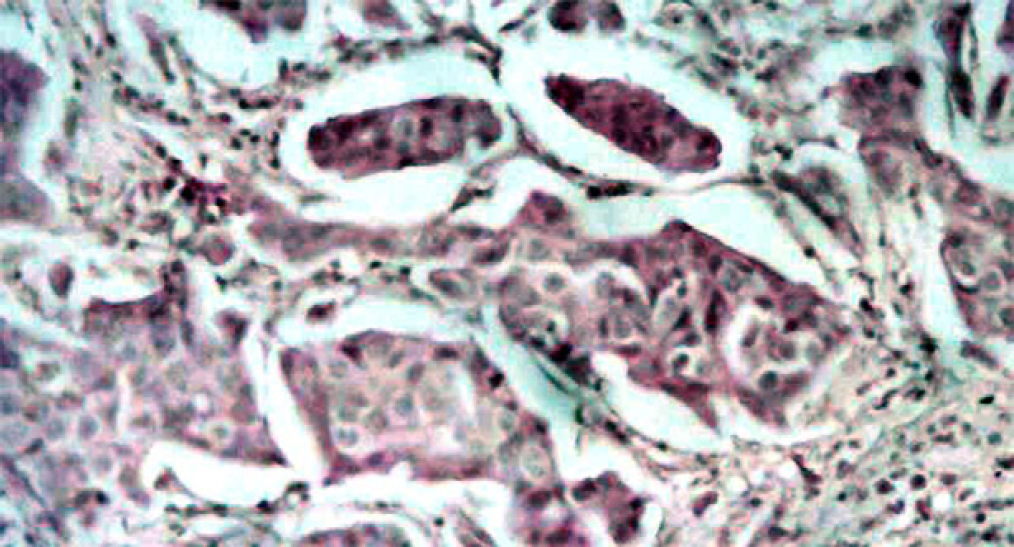
The histopathological appearance of the tumour in case 2. The neoplasm consist of ductal structures formed by atypical round to polygonal cells and peripheralised, compressed, atypical basophilic nuclei.
The use of cyproterone acetate for contraception/behavioural control is difficult to determine due to its employment by cat fanciers rather than veterinarians. However, in another article the development of gynaecomastia in a tom-cat was described. 8 The mechanism of action of cyproterone acetate on the mammary glands of male cats is still unknown, however, it has been reported in a congress communication to have a gestagenic effect 9 that could contribute to the hyperplasia and secondary malignant transformation of the breast tissue. Moreover, cyproterone acetate has been occasionally associated with the development of gynaecomastia and breast cancer in men treated for prostatic malignancy. 10 The development of breast cancer in male cats is complex, as it can happen without the cyclic hormonal exposure experienced by female cats. In a previous article 7 it has been shown that one third of male cats that had malignant mammary tumours had a history of exposure to progestins, however, as per our patients, without a control population it is difficult to identify this as a risk factor.
In conclusion, more non-steroidal methods of contraception should be evaluated in the future to provide alternatives to surgical castration.