





Abstract
Dear Editors, — I was very pleased to read the recent Editorial in JFMS, ‘Brachycephalia — a bastardisation of what makes cats special’, 1 and the scientific study which prompted it. 2 It is so good to see representatives of the veterinary community take a stance on the issue of the health of the modern-type Persian. In my opinion this has been a neglected cat welfare concern for the past 30 years. So many cats have suffered — and still do — from a twisted perception of what a Persian cat should look like.
In my opinion the big responsibility for the ‘devolution’ of the Persian lies with the cat clubs and judges at cat shows. For decades they have awarded and encouraged breeders to strive for increasing levels of ‘overtyping’. (The latest trend, I notice, is the ‘rising of the nose’, where it apparently is desirable that the bottom of the nose-leather is above the lower eye rim.) But there are also the many vets in the ‘vet check-in’ at cat shows who accept the modern Persians and let them pass.
I do hope the Feline Advisory Bureau/European Society of Feline Medicine will ally itself with the cat welfare/rescue community and put pressure on the cat fancy to revise their policies (standards, judging and registration practices) -especially the big federations FIFe (Federation Internationale Feline), TICA (The International Cat Association), and CFA (The Cat Fanciers’ Association). FIFe, incidentally, is the only federation with a standard that is open to interpretation -that is, does not specifically dictate the flat face, although the judges interpret the standard to be so.
As the Editorial points out, the Persian is not the only breed where overtyping can be seen — the reason being that these extreme ‘types’ win awards and accolades at cat shows. I see this trend in many breeds … However, I think it is doubtful that change will come from within the cat clubs. Unfortunately, among breeders of these cats there is a general denial of any problems and too many vested interests.
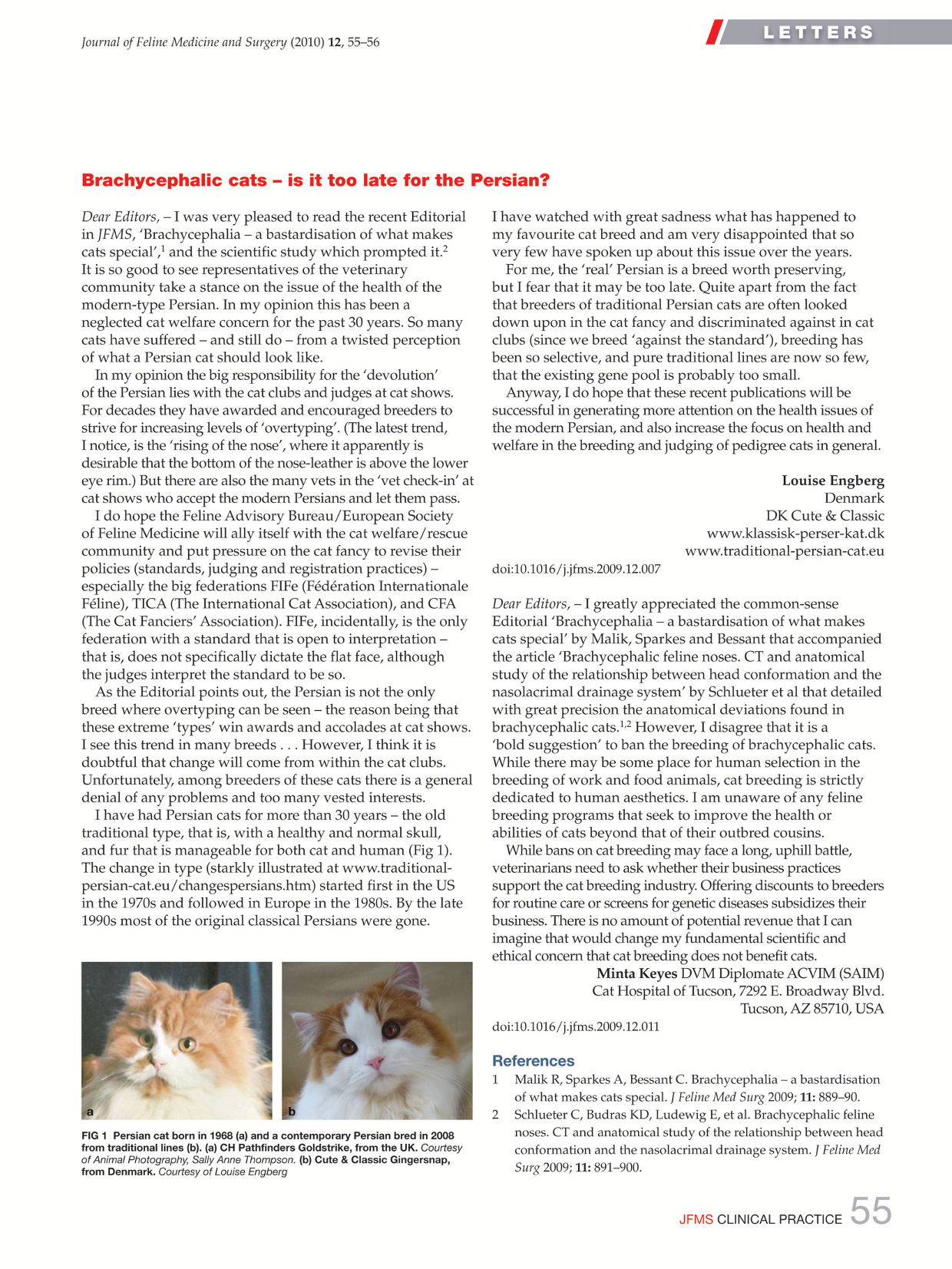
I have had Persian cats for more than 30 years — the old traditional type, that is, with a healthy and normal skull, and fur that is manageable for both cat and human (Fig 1). The change in type (starkly illustrated at www.traditional-persian-cat.eu/changespersians.htm) started first in the US in the 1970s and followed in Europe in the 1980s. By the late 1990s most of the original classical Persians were gone. I have watched with great sadness what has happened to my favourite cat breed and am very disappointed that so very few have spoken up about this issue over the years.
For me, the ‘real’ Persian is a breed worth preserving, but I fear that it may be too late. Quite apart from the fact that breeders of traditional Persian cats are often looked down upon in the cat fancy and discriminated against in cat clubs (since we breed ‘against the standard’), breeding has been so selective, and pure traditional lines are now so few, that the existing gene pool is probably too small.
Anyway, I do hope that these recent publications will be successful in generating more attention on the health issues of the modern Persian, and also increase the focus on health and welfare in the breeding and judging of pedigree cats in general.