




Abstract
Two surveys were carried out to investigate how antimicrobials are used in cats in Finland. Information was retrieved from 419 prescriptions and 311 questionnaire sheets concerning antimicrobial treatment for feline patients. Infected wounds, skin disorders and urinary tract infections were the most common reasons for antimicrobial treatment in cats. Compliance with prudent use guidelines was good. β-Lactams such as amoxycillin and amoxycillin with clavulanic acid were frequently used. Fluoroquinolones were used judiciously. The median length of treatment was 10 days for most conditions. Diagnosis was mainly based on clinical signs, and bacteriological culture and sensitivity testing was rarely performed. This study provides basic descriptive information on how antimicrobials are used in cats and that could help when revising guidelines for the condition-based use of antimicrobials in animals.
Antimicrobials are the most commonly used group of veterinary medicinal products in companion animals. 1,2 Treatment options for various infectious conditions are widely discussed in textbooks, articles and conference presentations but there is only a limited number of studies carried out on treatment practices and whether they are in line with guidelines for judicious antimicrobial use. Odensvik et al 3 published wholesaler's statistics on antibacterial drugs prescribed for dogs and cats, while Holso et al 4 studied treatment practices by investigating antimicrobial prescriptions for cats provided from pharmacies. Weese 5 reported on how antimicrobials had been prescribed for dogs and cats at a veterinary teaching hospital during a 10-year period. Hill et al 6 published results from a survey on small animals with dermatological conditions.
Prudent use guidelines issued by the American Association of Feline Practitioners in 2001 state that each practitioner needs to carry out the necessary diagnostic tests to reach an accurate clinical diagnosis. When opting for antimicrobial therapy, veterinarians should strive to optimise therapeutic efficacy, minimise resistance to antimicrobials, and protect public and animal health. 7 Finnish authorities have provided national veterinary prudent use guidelines and recommendations for condition-based antimicrobial use in animals. The first recommendations were issued in 1996, and in 2003 they were revised to form national guidelines for antimicrobial use in animals. 8 Specific recommendations are provided for infectious diseases in cats and dogs that are based on published data, expert opinions, and national microbiological and susceptibility data, and that take into account which medicinal products are available for use in animals in Finland. In order to be able to evaluate the level of compliance with and the usefulness of the guidelines, more information on treatment practices and condition-based use of antimicrobials in cats is needed.
In our study we used two methods for recording the condition-based use of antimicrobials in cats in order to cover a larger proportion of the feline patients in the country. First, we carried out a retrospective cross-sectional survey of prescriptions for cats that were treated at the largest small animal hospital in Finland (survey 1). Secondly, a prospective questionnaire survey involving veterinarians from all over the country was carried out (survey 2).
Materials and Methods
Survey 1
A retrospective cross-sectional survey was carried out on prescriptions for cats during a 6-month period (November–April) at the Small Animal Veterinary Teaching Hospital of Helsinki University (YES). Approximately 14,000 small animals are treated annually at the teaching hospital. The animal hospital is the only veterinary teaching hospital in Finland and serves as both a first-opinion and as a referral hospital. All patient documentation is computerised and, therefore a computer search can be made by selecting the desired variables.
Information collected from electronic prescriptions included the patient identification number, animal species, diagnosis, brand name and generic name of the antimicrobial drug, the dosage and length of treatment. Both per-oral and local antimicrobial preparations prescribed for cats were included in the study. Antimicrobials administered during hospitalisation were not recorded. The information was collected in spreadsheets (Microsoft Excel, version 9.0) and all missing data were manually retrieved from the patient records. A detailed descriptive analysis on antimicrobial use for cats was then performed.
Survey 2
Usage data from practising veterinarians were collected in a prospective cross-sectional questionnaire survey. The method is described in detail by Thomson et al. 9 The questionnaire was modified from one previously used for collecting data on antimicrobial usage for humans. 10 Participants were randomly selected from the member database of the Finnish Veterinary Association. The sample population (n=681) comprised 79% of all actively practising veterinarians (n=858) and the sampling was weighted in order to obtain representative proportions of different practices in both cities and in the countryside.
In addition to the collection of basic background information on the practitioner, the veterinarians were asked to fill out a detailed questionnaire for each patient that received antimicrobial therapy during a 1-week (7-day) period in May. Information that was collected included the animal species, diagnosis and diagnostic measure(s) used. These parameters were pre-coded and could be transferred directly into a database. Text fields containing information on which antimicrobial drug had been administered or prescribed and the prescribed length of treatment were coded accordingly; the first digit(s) showed the antimicrobial substance, next digit the formulation and the last digit whether the preparation used was a human or a veterinary product. A descriptive analysis of the distributions of antimicrobial use in cats with different indications was performed. Both SAS (version 9.1, SAS Institute Inc, Cary, NC, USA) and Microsoft Excel (version 10, Microsoft Corporation, Redmond, WA, USA) software were used for data analysis.
Results
Survey 1
During the study period 1693 cats were treated at YES. Of these patients, 419 (25%) were prescribed antimicrobial treatment. Per-oral treatment was prescribed in 83% of the cases (n=347) and local treatment in 17% (n=72) of the cases. The most common indications for per-oral treatment were urinary and genital tract infections (n=106; 30%), followed by skin, ear and wound infections (n=83; 24%), and respiratory tract infections (n=51; 15%). Local treatment (n=72) was frequently used in eye infections (n=36; 50%) or skin, ear and wound infections (n=31; 43%).
Amoxycillin alone (n=192; 55%) was by far the most commonly used antimicrobial for all conditions. Amoxycillin with clavulanic acid and cephalexin (n=80; 23% and n=38; 11%, respectively) were also frequently used. Doxycycline was used in 17 cases, mostly for respiratory tract infections and eye infections (88%). Fluoroquinolones were used in six cases, which comprised 1.7% of the prescriptions. No second-, third- or fourth-generation cephalosporins were prescribed. The distribution of antimicrobial agents used for different conditions is illustrated in Fig 1. Azithromycin was used in three cases of respiratory infections. For these patients the length of treatment was the longest of all indications and drug use ranged from 17 to 33 days. For all other conditions and antimicrobials, the median length of treatment was 10 days (range 5–14 days).
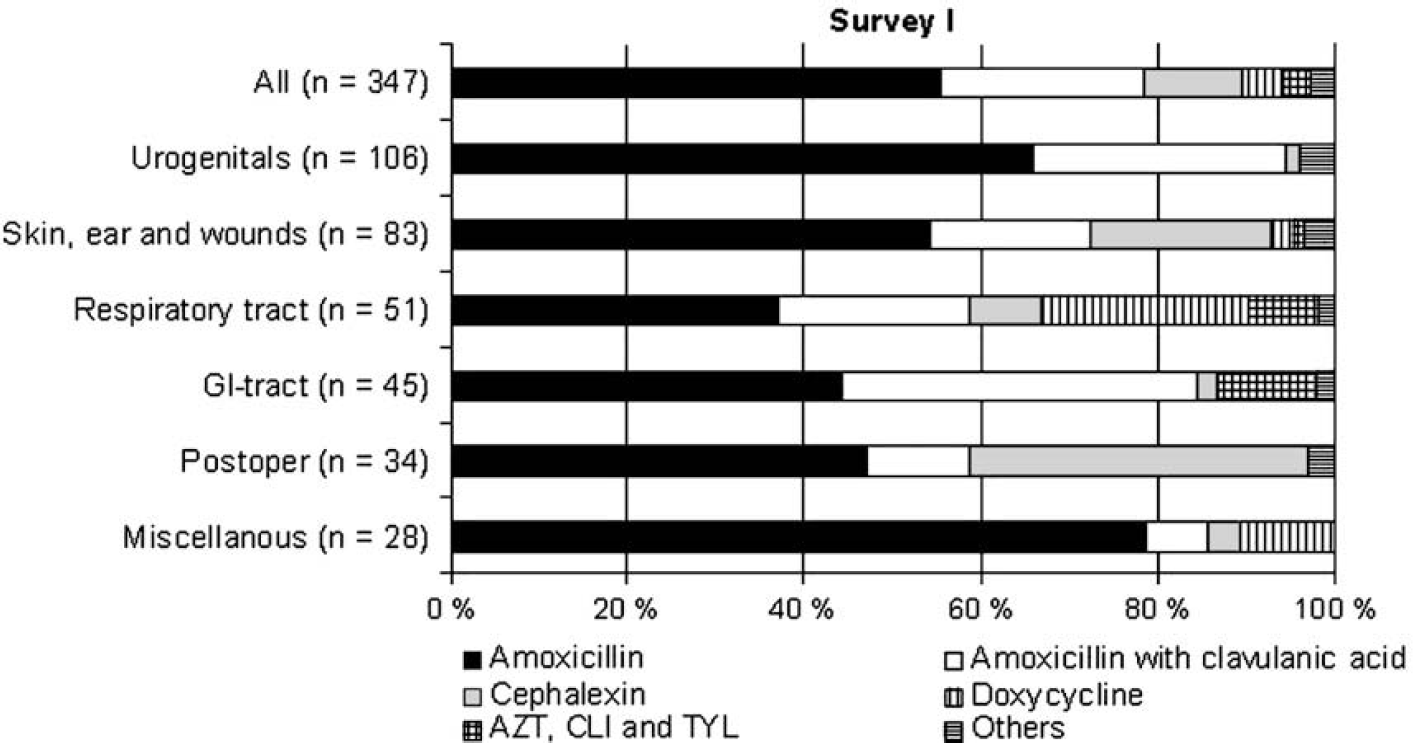
Distribution of the condition-based use of per-oral antimicrobials in cats. Results from a retrospective cross-sectional survey at the Small Animal Veterinary Teaching Hospital of Helsinki University (survey 1). AZT=azithromycin, CLI=clindamycin, TYL=tylosine. Others include enrofloxacin, metronidazole and trimethoprim–sulphonamide.
The vast majority of the preparations used were veterinary medicinal products, as only 3.6% (n=15) of the preparations were antimicrobials registered for human use.
Survey 2
A total of 262 veterinarians responded to the survey, giving a response rate of 38%. A total of 2850 questionnaires were completed. The animal species most frequently treated with antimicrobials were cattle (n=1308), followed by dogs (n=989), and cats (n=311; 11%).
Cats were most commonly treated for skin disorders, mainly traumatic wounds and abscesses (n=96; 31%). Amoxycillin was used for over half of the cats (n=50; 52%) and amoxycillin with clavulanic acid for one third of the feline patients (n=32; 33%). Thirty-eight cats (12%) were treated due to urinary tract problems, mostly with amoxycillin or amoxycillin with clavulanic acid (37 and 42%, respectively). Three cats (8%) received enrofloxacin for urinary tract problems. All conditions included, fluoroquinolones were used in five cats (1.6%). The prescribed length of treatment ranged from 3 to 15 days. No treatments over 15 days were prescribed for any condition.
Pre-operative medication was frequently used when performing castration and spaying. Of a total of 66 patients, 64 (97%) received pre-operative medication consisting of benzylpenicillin (n=49; 77%), amoxycillin with clavulanic acid (n=13; 20%) or amoxycillin (n=2; 3%). Ten spayed cats (15%) were prescribed antimicrobials postoperatively. Amoxycillin with clavulanic acid was used for 60% of them (n=6).
Figure 2 illustrates the distribution of per-oral antimicrobials used for various conditions. Eye infections (n=14) were only treated locally and mainly with fusidic acid (n=7) or chloramphenicol (n=5). Skin and ear disorders were treated locally in nine cats (9%). Preparations registered only for human use were used in 3.9% (n=12) of the cases.

Distribution of the condition-based use of per-oral antimicrobials in cats. Results from a prospective cross-sectional questionnaire survey (survey 2). Others include doxycycline and metronidazole.
The diagnosis was based on clinical signs in 72% (n=224) of the cases. Bacteriological culture and sensitivity testing were performed in seven cases (2.2%). A suspected urinary tract infection was the reason for performing a bacteriological culture in 6/7 cases reported. However, no information was available on the results of the culture. For 77 (25%) cats treated with antimicrobials, no diagnostics were reported to have been carried out. Of these, 33 involved prescriptions given by phone. The majority of these cats suffered from an infected wound (n=13) or urinary tract problems (n=10). Diagnostics were also not performed on 38 cats undergoing elective surgery such as castration or spaying.
Discussion
Following prudent use guidelines is considered as good veterinary practice. The aim of the guidelines is to promote use of appropriate antimicrobial therapy and to minimise the development of resistance. Therefore, knowledge of treatment practices is valuable and frequent follow-up is needed in order to be able to do comparisons between treatment practices and antimicrobial resistance.
The results from these surveys demonstrate that infected wounds, skin disorders and urinary tract infections are the most common reasons for antimicrobial treatment in cats. It is a cause of concern that bacteriological culture and sensitivity testing are rarely used for diagnostic purposes. However, the empirical choice of an antimicrobial agent complies fairly well with the national prudent use guidelines. 8 β-Lactams were frequently prescribed. Drugs such as fluoroquinolones and third- and fourth-generation cephalosporins, which should be reserved for serious infections, 11 were rarely, if at all, used.
For infected wounds and skin disorders, benzylpenicillin and amoxycillin were used in 54% (survey 1) and 52% (survey 2) of the cases, respectively. Amoxycillin with clavulanic acid was used in 18 and 33% of the patients, respectively. These results are similar to those reported by Hill and coworkers in 2006 in the UK. 6 According to the Finnish prudent use guidelines, 8 benzylpenicillin and aminopenicillins are first-line drugs for the treatment of bite wounds and skin abscesses. Amoxycillin with clavulanic acid is a second-line drug.
Urinary tract infections were also commonly diagnosed and mainly treated with β-lactams. Urinary tract infections in cats are seldom caused by bacteria but more often by underlying causes such as non-obstructive idiopathic cystitis, urethral plugs or urinary calculi. 12 However, contrary to the guidelines, feline lower urinary tract disease is on many occasions treated with antimicrobials. Some relief of clinical signs is often noted after the initiation of antimicrobial therapy; however, the relief noticed might be biased, as the condition often resolves itself because of treatment of the underlying cause.
Fluoroquinolones are recommended as a second-line treatment for otitis media, severe pneumonia, peritonitis and pyelonephritis. In surveys 1 and 2, six (1.7%) and five (1.6%) cats, respectively, received fluoroquinolones. No particular condition was overrepresented. In an earlier study where prescriptions distributed via pharmacies in Finland were reviewed, fluoroquinolones were most often prescribed for urinary tract infections and were used in 4.6% of the feline patients. 4
Both the prudent use guidelines given by the American Association of Feline Practitioners in 2001 and the Finnish national guidelines state that proper diagnostics should be performed before starting antimicrobial treatment. When evaluating the diagnostic measures in survey 2, the results were a cause for concern. Bacteriological culture and sensitivity testing were performed in only seven cases. Most veterinarians based the diagnosis on clinical signs alone and the accuracy of the empirical choice of antimicrobial could not, therefore, be evaluated. Furthermore, in 25% of the cases no diagnostic tests were reported to have been carried out. Approximately half of these were prescriptions given by phone, which could explain the lack of diagnostics. The other half comprised patients undergoing clean elective surgery such as castration or spaying. In these cases the reason for antimicrobial treatment was prevention of an infection and, therefore, there was no need to perform any diagnostic measures. In survey 1 it was not possible to compare the performed diagnostics with the diagnosis the antimicrobials were prescribed for.
Regardless of the antimicrobial agent used, the median length of treatment was 10 days for most of the conditions. This can be considered excessive in many cases of acute uncomplicated infections. 13 There have, however, been few attempts to determine the optimal length of treatment for cats. For example, cats suffering from chronic respiratory infections are often treated with a wide variety of antimicrobials and for long periods of time. 14 However, in many cases the signs are relieved while the treatment is ongoing but reappear whenever medication is discontinued. 15 Cats also suffer from idiopathic skin conditions such as the eosinophilic granuloma complex and feline chin acne. These conditions are difficult to treat and before reaching the correct diagnosis and beginning effective treatment the cats are often treated with antimicrobials. 16
Overall, the results from the two surveys were quite similar and compliance with guidelines was good. However, performing the necessary diagnostics was clearly the weakest point. In order to be able to fully evaluate whether the antimicrobial agent used for a certain condition was correctly chosen, results from bacteriological culture and sensitivity testing are needed. Education on proper sampling techniques and improving laboratory services are important in order to increase the number of bacteriological cultures performed when treating infectious diseases in animals. Regular follow-up of treatment practices should also be carried out, as the market for available antimicrobial drugs is continuously expanding and changing.
Footnotes
Acknowledgements
In performing the retrospective survey the authors thank Pekka Tulonen, who provided technical assistance with the hospital database (software available at  ). The Finnish Ministry of Agriculture and Forestry requested and financed the prospective cross-sectional survey. The authors thank Dr Ulla-Maija Rautakorpi for help in designing the questionnaire and planning the study. We also thank Hannu Rita and Helena Korpelainen for statistical expertise and the Finnish Veterinary Society for allowing the use of the National Veterinary Register. The data management was supported by a grant given by Eläinlääketeollisuusry, a member group of Pharma Industry Finland.