






Abstract
Internationally, large populations of feral cats constitute an important and controversial issue due to their impact on cat overpopulation, animal welfare, public health, and the environment, and to disagreement about what are the best methods for their control. Trap-neuter-return (TNR) programs are an increasingly popular alternative to mass euthanasia. The objective of this study was to determine the population characteristics of feral cats admitted to large-scale TNR programs from geographically diverse locations in the United States. Data from 103,643 feral cats admitted to TNR programs from 1993 to 2004 were evaluated. All groups reported more intact females (53.4%) than intact males (44.3%); only 2.3% of the cats were found to be previously sterilized. Overall, 15.9% of female cats were pregnant at the time of surgery. Pregnancy was highly seasonal and peaked between March and April for all of the groups. The average prenatal litter size was 4.1±0.1 fetuses per litter. Cryptorchidism was observed in 1.3% of male cats admitted for sterilization. A total of 0.4% of cats was euthanased because of the presence of debilitating conditions, and 0.4% died during the TNR clinics. Remarkably similar populations of cats with comparable seasonal variability were seen at each program, despite their wide geographical distribution. These results suggest that it is feasible to safely sterilize large numbers of feral cats and that the experiences of existing programs are a consistent source of information upon which to model new TNR programs.
The population of unowned feral cats in the United States is suspected to rival that of the owned cat population (73 million in 2002) (Levy 2004). Internationally, feral cats constitute an important and controversial issue because of their impact on cat overpopulation, animal welfare, public health, and the environment, and to disagreement about what are the best methods for their control.
Attempted control of feral cat populations by trap-neuter-return (TNR) is an increasingly popular alternative to mass euthanasia. TNR programs humanely trap, anesthetize, sterilize, and return the cats to their colonies (Slater 2004). Sterilized feral cats are often identified by removing the tip of one ear (Cuffe et al 1983).
In light of the large numbers of feral cats that exist, TNR programs must maximize the number of cats they sterilize if there is an expectation to reduce their population. Awareness of the characteristics of the target cat population and its predicted seasonal variations would allow TNR program managers to plan for the most efficient use of veterinary time and resources. For example, routine castrations require less time and equipment than routine ovariohysterectomies. Sterilization of pregnant females and cryptorchid males requires more surgical supplies, time, and expense than routine surgeries.
The objective of this study was to determine the population characteristics of feral cats admitted to large-scale TNR programs from geographically diverse locations in the United States during all seasons of the year.
Materials and Methods
Because both owned and unowned cats are frequently free-roaming without identification, the line is often blurred regarding classification of loosely owned outdoor cats, tame strays, and unsocialized feral cats (Levy and Crawford 2004). For the purpose of this study, feral cats were defined as any unowned free-roaming cat, regardless of a wild or tame socialization status.
Data for this study were collected from seven large-scale non-profit TNR programs located in the south, south-west, and north-west regions of the United States. The organizations included the Arizona Cat Assistance Team (AzCATs), the Feral Cat Coalition (FCC), the Feral Cat Spay/Neuter Project (FCSNP), the Hawaiian Humane Society (HHS), Operation Catnip of Gainesville (OCFL), Operation Catnip of Raleigh (OCNC), and the San Francisco Society for the Prevention of Cruelty to Animals (SFSPCA). Some of the programs conducted most surgeries during intermittent large clinics in which more than 100 cats were sterilized in a single day (AzCATS, FCC, OCFL, OCNC), whereas others performed most sterilization surgeries as part of ongoing daily operations (FCSNP, HHS, SFSPCA).
The locations, time frames of data collection, and total number of cats admitted to the programs during the study period are presented in Table 1. The primary treatments routinely provided to the cats are described in Table 2. In addition, supplemental treatments were often provided depending on the indications for individual cats or at the discretion of the caretakers. The TNR programs collected data monthly including the number of cats admitted, sex, sterilization status, pregnancy status, prenatal litter size, and cryptorchidism. The rate of euthanasia due to the presence of debilitating conditions and the number of unexpected deaths on the day of surgery were also recorded. The SFSPCA also tested a majority of cats for feline leukemia virus (FeLV) and feline immunodeficiency virus (FIV) infection. All data were collected and analyzed retrospectively.
Location, data collection time frame, and number of cats admitted to each of 7 feral cat trap-neuter-return programs in the United States

Veterinary treatments routinely performed on feral cats treated at seven independent trap-neuter-return programs in the United States
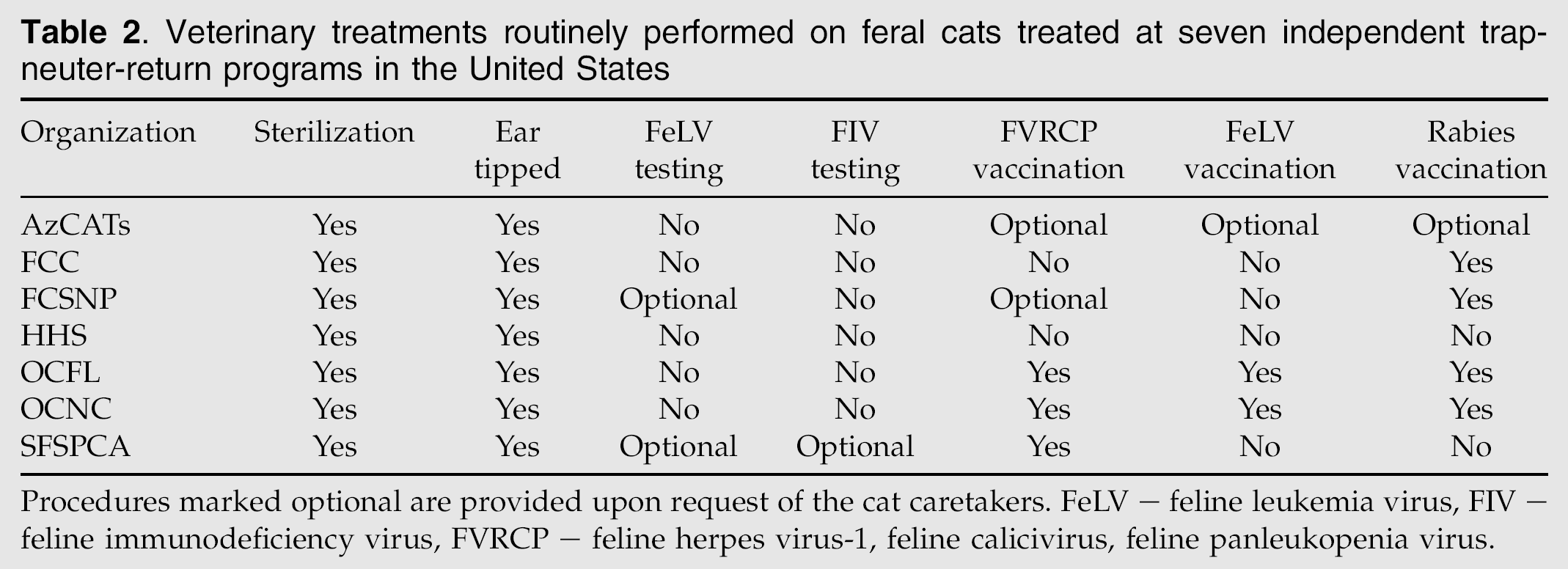
Procedures marked optional are provided upon request of the cat caretakers. FeLV – feline leukemia virus, FIV – feline immunodeficiency virus, FVRCP – feline herpes virus-1, feline calicivirus, feline panleukopenia virus.
Results
The seven TNR organizations provided data on a cumulative total of 103,643 feral cats over variable time frames from 1993 to 2004. All seven groups reported more intact females (53.4±2.2%, range 50.9% to 56.5%) than intact males (44.3±1.9%, range 41.3% to 46.5%). Only 2.3% of the cats admitted were found to be previously sterilized (Table 3).
Characteristics of 103,643 feral cats admitted to seven trap-neuter-return programs in the United States
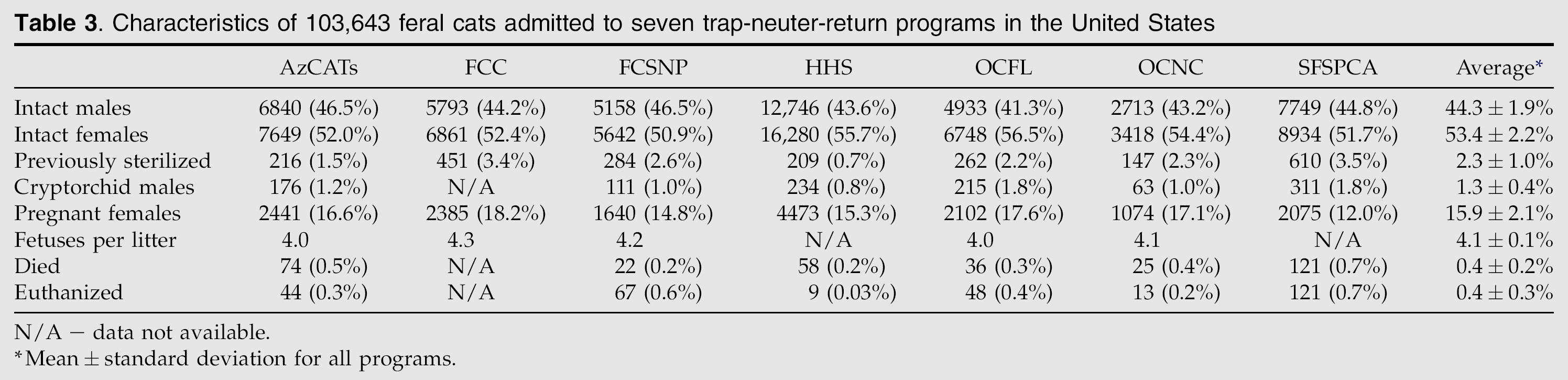
N/A – data not available.
Mean±standard deviation for all programs.
Overall, 15.9% of female cats were pregnant at the time of surgery (Table 3). Pregnancy was highly seasonal and peaked between March and April for all of the groups (range 36.8% to 58.0% of females) (Fig 1). All of the groups reported their lowest pregnancy rates between October and December (<3.5%). The average prenatal litter size reported by the five groups that recorded fetal counts was 4.1±0.1 fetuses per litter (range 4.0–4.3).
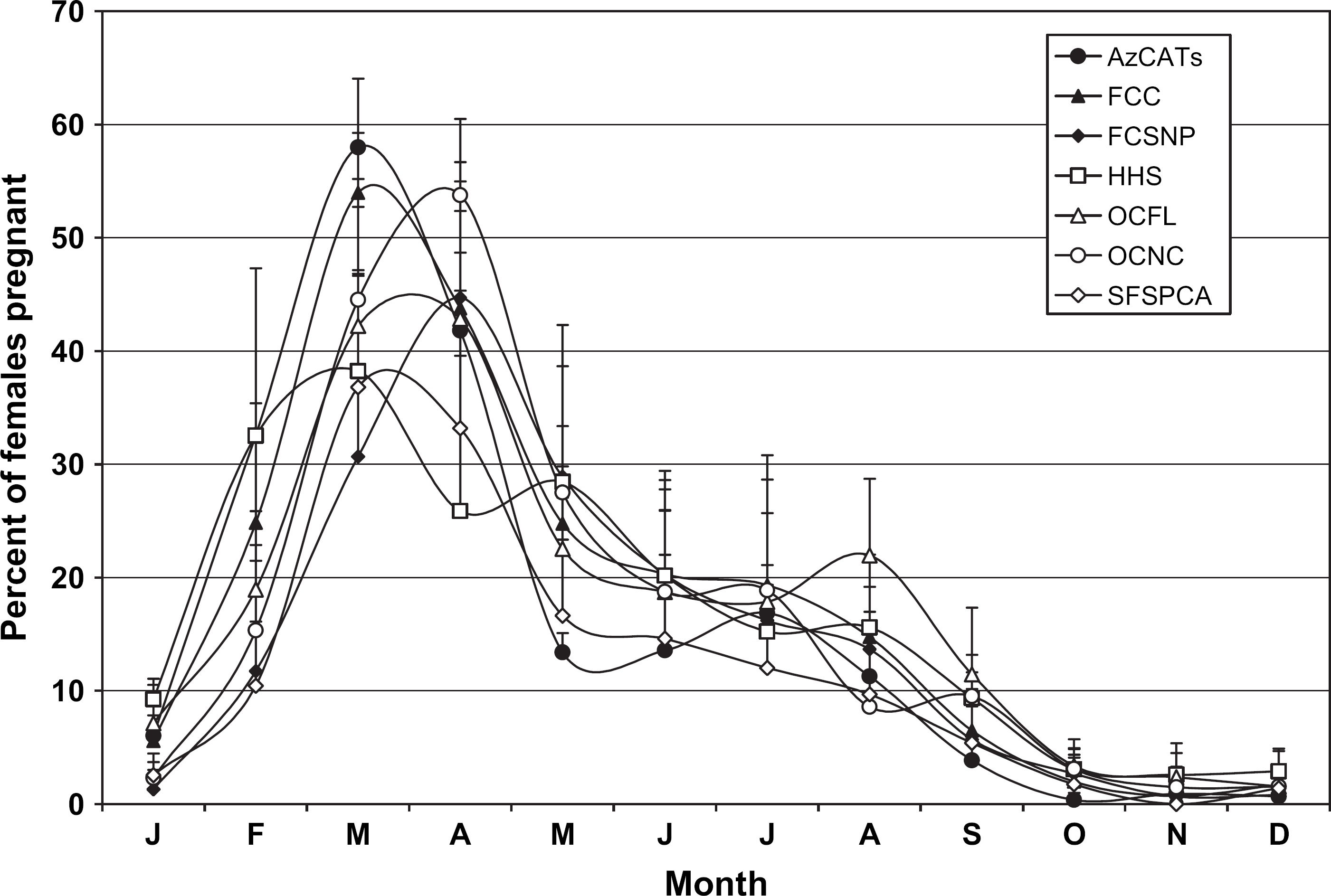
The proportion of females found to be pregnant peaked for all trap-neuter-return programs in March to April, regardless of geographic location. Data points represent the mean±standard deviation for monthly values observed at each trap-neuter-return program during the multi-year reporting period.
Six of the seven organizations recorded the presence of cryptorchidism in male cats (Table 3). Cryptorchidism, whether unilateral or bilateral, was observed in 1.3% of male cats admitted for sterilization (range 0.8–1.8%).
Only one group, the SFSPCA, routinely tested a large proportion of cats for FeLV or FIV. This group used a point-of care device which simultaneously tests for both FeLV and FIV infection (SNAP FIV antibody/FeLV antigen Combo Test, IDEXX Laboratories). Test results were available for 12,236 (70.8%) of the cats admitted to the program. Positive test results were recorded in such a way that was not possible to determine which virus was identified. Therefore, the total proportion of cats infected with FeLV and/or FIV was determined to be 5.2%, but it was not possible to discern the prevalence of each virus independently.
Overall, 0.4% (range 0.03–0.7%) of cats were euthanased because of the presence of debilitating conditions, such as neoplasia, chronic inflammatory conditions, trauma, and infectious diseases. In addition, the SFSPCA euthanased most of 5.2% of cats in its program with positive test results for FeLV or FIV. A total of 0.4% (range 0.2–0.7%) of cats died during the TNR clinics (Table 3).
Discussion
Results of this study suggest that TNR programs should anticipate the need to perform more ovariohysterectomies than castrations, as all of the organizations sampled admitted more females than males throughout the year. The consistent predominance of intact females at all participating TNR programs contrasts with reports of variable sex ratios observed in feral cat populations in the field. Feral cats caught on Macquarie Island, Australia (n=246) were more likely to be male (55.7%) than female (44.3%) (Brothers et al 1985). Cats captured on Marion Island, South Africa (n=857) had an equal distribution of females and males, regardless of season (Bloomer and Bester 1991). One report in Rome studied a population of 81 feral cats, of which 41 were females and 40 were males (Natoli and De Vito 1991), whereas another study in Rome studied four colonies of feral cats (n=158) and discovered a higher proportion of females (53.8%) to males (46.2%) (Natoli et al 1999). The reason for the consistent majority of females presenting for TNR is unknown, but may involve factors such as targeting of females for trapping by caretakers and smaller home ranges of female cats, which tend to remain closer to their colonies than males (Liberg 1984, Say and Pontier 2004).
Although pregnancies occurred year round, marked seasonal variations were observed at all locations. Pregnancy rates were lowest during the late fall and winter months of October through December and began to increase in January and February. These findings are consistent with the beginning of increasing day length in the northern hemisphere, which promotes onset of estrus in cats (Hurni 1981). Pregnancy rates sharply increased until peaking between March and April, when one-third to one-half of the female cats were pregnant. Thereafter, the proportion of pregnant cats steadily decreased. Assuming a mean gestation period of 65 days, the pregnancy rate of 15.9% found in this study corresponds with an average of 0.9 litters/year for each female cat admitted. Although previous studies have demonstrated that adult cats commonly produce one to two litters during each breeding season, an undetermined proportion of kittens included in the participating TNR programs likely lowered the overall pregnancy rate reported here (Jones and Coman 1982, Bloomer and Bester 1991, Scott et al 2002, Nutter et al 2004). The average prenatal litter size (4.1 fetuses per litter) is consistent with previous studies in which feral cats were reported to produce between 3.0 and 4.6 kittens per litter (Nutter et al 2004, Bloomer and Bester 1991). With a pregnancy rate of 0.9%, a litter size of 4.1, and a female proportion of 53.4%, the sterilization of 103,643 cats by the TNR programs could be expected to prevent the birth of 204,224 kittens in a breeding season. As feral kittens suffer an estimated 75% death rate prior to 6 months of age (Nutter et al 2004), the prevention of such births is a substantial contribution to feline welfare.
The rate of cryptorchidism (1.3%) in feral cats was similar to that previously reported for pet cats (Johnston et al 2001). Although retained testes are usually infertile, they often produce testosterone, leading to undesirable behaviors such as roaming, fighting, and urine marking. For this reason, retained testes should be surgically removed, even though the goal of sterilization is often accomplished by removing only descended testes. Grossly, the scrotum of a castrated cat is indistinguishable from a bilateral cryptorchid. The most practical method for confirming the sterilization status of anesthetized cats lacking scrotal testicles during a large-scale clinic is examination of the penis for penile spines, which atrophy within 6 weeks of complete castration (Aronson and Cooper 1967). The alternative method of serum testosterone measurement after administration of human chorionic gonadotropin (hCG) or gonadotropin-releasing hormone (GnRH) is impractical for TNR programs due to the expense and time required and the fractious nature of the feral cats (Johnston et al 2001).
Feral cats admitted to TNR programs are presented with little or no medical history. Because feral cats are unsocialized and readily bite and scratch when handling is attempted, the cats are only visually examined through the wire traps or carriers before being anesthetized. Once immobilized, the cats may be examined more thoroughly. Even though the cats were homeless and had variable access to food and shelter, few cats (0.4%) were euthanased for debilitating conditions. Despite the lack of presurgical information about the cats and the high numbers of cats sterilized at each clinic (sometimes exceeding 200 cats/day), fatal complications were low (0.4%) and occurred at approximately the same rate (0.2% to 0.7%) at each of the six programs that recorded unexpected deaths. This is similar to death rate reported for pet cats undergoing elective surgeries (Williams et al 2002). Although fatal complications are uncommon, TNR programs should have emergency protocols established and be equipped to handle medical and surgical complications.
Only one program routinely tested cats for FeLV and FIV. The overall rate of infection with either virus in the cats tested in San Francisco was 5.2%, which is similar to results previously reported for feral cats and for pet cats (Lee et al 2002, Luria et al 2004, Levy et al 2006).
In conclusion, each of the large-scale TNR programs included in this report admitted remarkably similar populations of cats with comparable seasonal variability, regardless of their wide geographical distribution. Despite differences in policies and procedures, the rates of euthanasia and unexpected deaths were low and comparable among the programs. This suggests that it is feasible to safely sterilize large numbers of feral cats and that the experiences of existing programs are a consistent source of information upon which to model new TNR endeavors.
Footnotes
Acknowledgements
The authors acknowledge Tamara Cappelson, Karen Scott, Linda Haller, Terry Paik, Jan Raven, David Stein, Bob Thomson, and Christine Wilford for their technical assistance.