





Abstract
Twenty-four adult cats were transitioned to time-limited feeding and randomized to either a dry low carbohydrate diet (LC) or a dry reduced energy diet (HC). In Trial 1 the LC and HC groups received equal amounts of food (by weight) for 13 weeks. Both groups consumed all food offered, hence the LC group received more energy/day than the HC group. In Trial 2 all cats were fed the LC diet for 12 weeks, but each group received the energy that the opposite group had received in Trial 1. In Trial 1 only the overweight HC cats (body condition score>6/9) experienced a significant change in body weight (−0.52±0.08 kg). In Trial 2, LC/Low Calorie overweight cats lost 0.62±0.10 kg, whereas, the LC/High Calorie normal weight cats gained 0.68±0.05 kg. In conclusion, body condition and energy intake but not type of diet influenced weight in this cohort of group-housed cats.
Excessive weight gain is a major problem for the pet cat population and considered the most common nutritionally related disease in this species (Lund et al 1999). Two epidemiological studies conducted in the United States in the 1990s estimated that approximately 25% of the feline population was overweight or obese based on body condition scoring (BCS) (Scarlett and Donoghue 1996, Lund et al 1999). A number of factors are thought to contribute to weight gain in pet cats. Neutering, a common practice particularly in the United States, has been found by several investigators to predispose cats to gain weight due to a decrease in energy expenditure and an increase in food intake (Flynn et al 1996, Fettman et al 1997). Indoor confinement is also thought to lead to further decreased energy expenditure because of exercise restriction. The feeding of commercial pet foods has also been implicated, as pet food manufacturers have been successful in producing highly palatable commercial cat foods. Free choice feeding of dry (extruded) cat food is a common practice, especially in multi-cat households, as it facilitates the natural feeding behavior of the domestic cat, which is to eat many small meals dispersed throughout the day and night (Mungford and Thorne 1980, Kane et al 1981). Hence, the ad libitum availability of palatable, often energy-dense dry cat foods may allow cats to consume energy in excess of their actual needs leading to progressive weight gain. Furthermore, weight control in multi-cat households can be problematic as it is often not possible to feed cats separately. Thus, it is not feasible to feed different diets to different cats or control food intake on an individual basis.
Recently, there has been speculation that the relatively high carbohydrate content of dry cat foods, typically 30–40% of calories, could also be a contributing factor to weight gain in pet cats. Low carbohydrate diets as a means of promoting weight reduction for overweight people are currently receiving much attention although the efficacy of this approach remains unproven (Bravata et al 2003). While the actual mechanism by which carbohydrate intake would facilitate weight gain in cats has not been elucidated, it is well known that feline energy metabolism is uniquely adapted to a diet that contains little, if any, carbohydrate. Whether feeding a low carbohydrate diet would protect against weight gain in cats by inducing satiety or altering metabolism has not been demonstrated, although anecdotal reports suggest this might be the case.
This study was intended to investigate two interventions meant to prevent weight gain and promote weight loss in a colony of group-housed cats. The principal aim was to investigate the effect of feeding a dry therapeutic feline diet that contained less carbohydrate than typical commercial dry cat foods. A secondary aim was to investigate the feasibility of transitioning these group-housed cats from ad libitum feeding to time-limited feeding, where access to food was restricted to 4 h a day. The impact of these interventions on body weight (BW) and body condition was evaluated.
Materials and methods
The Animal Blood Bank of the University of Pennsylvania maintains a colony of adult cats who donate blood on a monthly basis for feline patients at the Ryan Veterinary Hospital of the University of Pennsylvania. At the time of this investigation, the colony was composed of 24 male neutered domestic shorthaired cats. Eighteen of these cats ranged in age from 3 to 4 years and had been members of the colony for approximately 2 years. Another six male cats, who were approximately 1 year of age and had been neutered in the past month, were introduced into the colony at the commencement of this study. The cats had free run of two adjoining rooms encompassing approximately 33.5 m2 and were maintained on a 12-h day/night cycle. One of the rooms had floor to ceiling dividers that allowed it to be subdivided and permitted the feeding of two separate groups of cats. The study protocol was approved by the institutional animal care and use committee of the University of Pennsylvania.
The cats had been fed a commercial HC, high fiber cat food (HC: Hill's Science Diet Feline Light Adult-Dry, Hill's Pet Nutrition) (Table 1) and water ad libitum. Food was offered in multiple large bowls to provide ample access to all cats. The cat colony was gradually transitioned over 2 weeks to have food access restricted to 4 h/day. Initially, this process involved making food available in the morning and then removing any remaining food 12 h later. After 4 days, food availability was limited to 8 h/day for another 4 days before the final transition to 4 h/day access. After the cats were acclimatized to 4 h/day food access, they were randomized into two groups of 12 each based on BW, BCS and length of time in the colony. The cats in the HC group were continued on the reduced energy, high fiber diet while the cats in the LC group were transitioned to a dry therapeutic low carbohydrate cat food (LC: Purina DM Feline Formula Dry, Nestle-Purina Co) over the course of 3 weeks (Table 1). The two groups of cats were allowed to mingle except during the feeding periods. During both transition periods and throughout the study, all cats were monitored to insure that they were eating and not losing weight at a too rapid rate (>3% BW/week).
Nutrient composition of study diets a
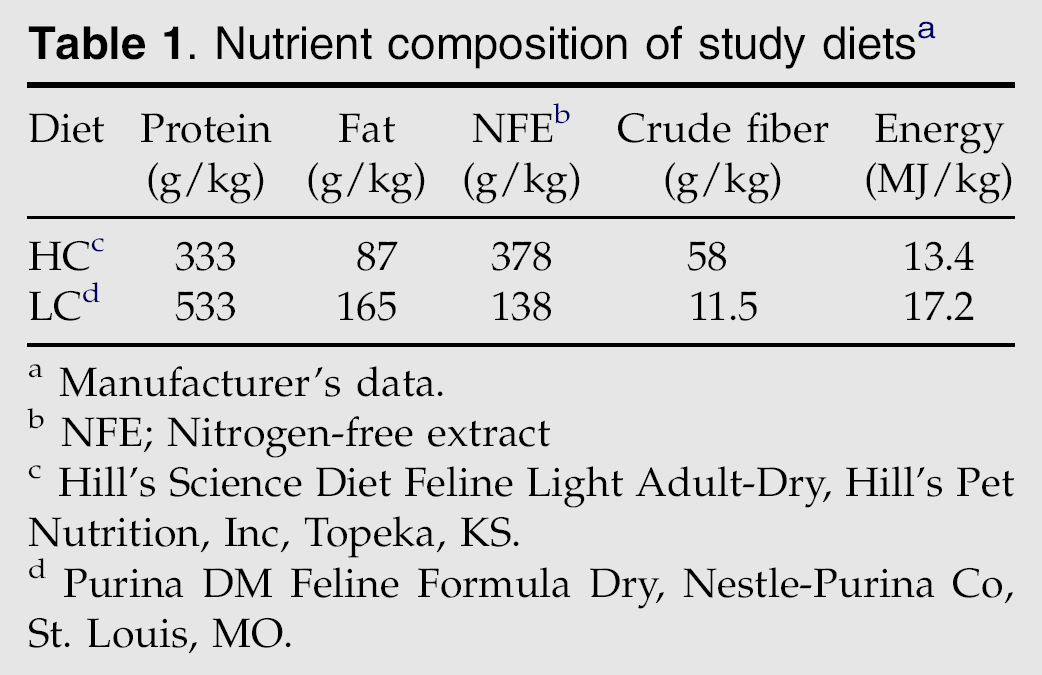
Manufacturer's data.
NFE; Nitrogen-free extract.
Hill's Science Diet Feline Light Adult-Dry, Hill's Pet Nutrition, Inc, Topeka, KS.
Purina DM Feline Formula Dry, Nestle-Purina Co, St. Louis, MO.
Immediately following the transition period, Trial 1 was begun. Both groups of cats were offered equal amounts of food, by weight, each morning at approximately 08.00 and any remaining food was removed 4 h later and weighed on a gram scale. Daily food intake for each group was the difference between the food offered and the food remaining after 4 h of access. Each cat was weighed on a calibrated scale before feeding at the same time once a week. Each cat was also assigned a BCS using a 9-point system based on assessment of body silhouette and adipose tissue by palpation at the time of weighing (Laflamme 1997). The amount of food the cats had consumed on a daily basis prior to the initiation of this investigation was unknown as they had been fed ad libitum and also the number of cats in the colony was increased by six just before the study began. Therefore, the amount of food the cats were offered each day was based on the quantity they had consumed in the 12-h period of time-limited feeding plus an additional 15% by weight. Trial 1 lasted 13 weeks.
Within 2 weeks of the onset of Trial 1 the cats were consuming all of the food that was offered in less than 4 h. Consequently, because of the difference in the energy density of the two diets, the cats in the LC group received on an average 0.703 MJ/BWkg2/3, while the cats of the HC group received an average of 0.574 MJ/BWkg2/3. This discrepancy prompted a second phase of investigation, where both groups of cats were fed the LC diet. Prior to the initiation of Trial 2, the HC group cats were accustomed to the LC diet over a 2-week period. Then this group, now referred to as the LC/High Calorie group, was offered the same amount of the LC diet, by weight, which the LC group had received during Trial 1; the result was that they received on an average 0.749 MJ/BWkg2/3. In contrast, the cats in the LC group had their food portion restricted to reflect the same amount of energy the HC group had received during Trial 1. They were renamed as the LC/Low Calorie group and received on an average 0.574 MJ/BWkg2/3. The cats were fed and monitored in the same manner as in Trial 1 for 12 weeks. Fig 1 shows a schematic representation of the study design.
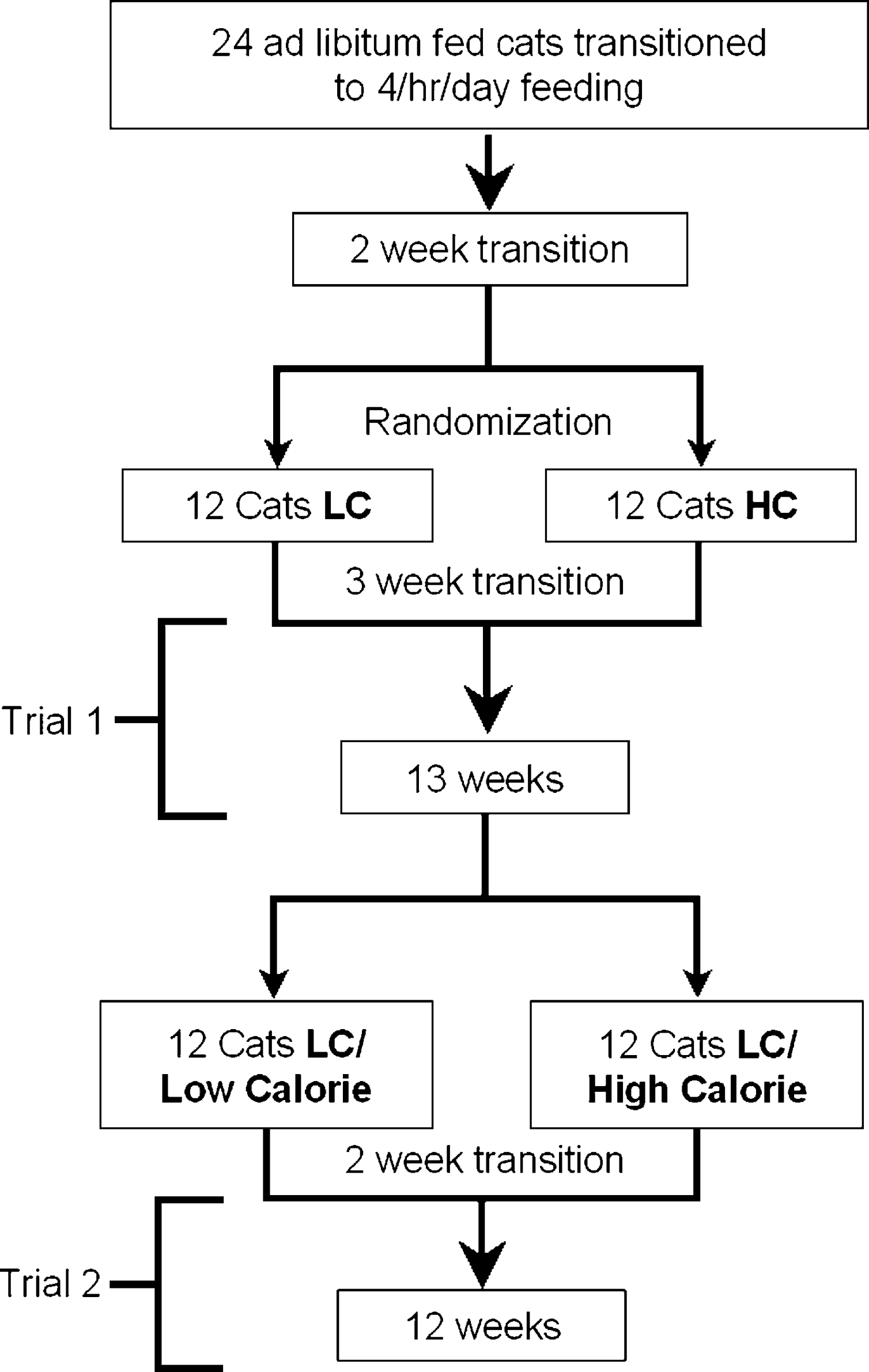
Illustration of the study design.
All analyses were performed using SAS statistical software (Version 8.2, SAS Institute, Cary, NC). To determine the appropriateness of parametric techniques, the exact test was compared to the t-test at various points of follow-up. As the P-values were close in all cases tested, the parametric techniques were deemed appropriate. To determine differences in weight between diet groups over time for both trials, an analysis of variance in repeated measures was performed. Similarly, to determine differences in weight between diet and body condition groups, a 2-way analysis of variance in repeated measures was used. Baseline differences in weight or BCS between diet groups was assessed by the Student's t-test. To assess total weight differences within a diet group or diet/body condition group, the paired t-test was used. Data are presented as mean±SEM unless otherwise noted. A probability of <0.05 was considered statistically significant.
Results
At the beginning of the investigation, the 18 cats who had been members of the colony for 2–3 years weighed 7.23±1.29 kg (mean±SD) and had a median BCS of 7/9 (range: 5–9). Based on previously recorded weights, the cats had gained an average of 0.1 kg/month up until the commencement of the investigation. The six newly introduced cats weighed 5.11±0.48 kg (mean±SD) and had a median BCS of 5.5/9 (range: 5–6). There were no statistically significant differences in BW, BCS, or time in the colony between the two diet groups at baseline (Table 2).
Characteristics of cats in the LC and HC groups at time of study entry

LC=a dry low carbohydrate diet; HC=a dry reduced energy diet.
Mean±SD.
Median (range).
During the transition to time-limited feeding cats gradually adjusted their food consumption so that by the end of the 2 weeks they were consuming greater amounts of food in 4 h than they initially did in 12 h (Fig 2). All but two cats experienced weight loss with an average loss of 1.9±1.7% or 0.13±0.11 kg of BW/week (mean±SD) (Fig 3). Only one cat lost weight in excess of 3% BW/week. The cats in this investigation appeared to tolerate this feeding practice in that they all readily adapted by eating as soon as food was made available and remained in good health throughout the study.

Change in energy consumption (MJ/day for all cats) over the course of transitioning from ad libitum feeding to time-limited feeding. Food was offered 12 h/day on days 1–4, 8 h/day on days 5–8, and 4 h/day on days 9–14.

Change in BW (kg/day for all cats) over the course of transitioning from ad libitum feeding to time-limited feeding.
At the end of Trial 1, the cats in the LC group did not experience a significant change in weight compared to baseline (−0.05±0.09 kg, P=0.61, vs baseline), whereas cats in the HC group lost 0.35±0.09 kg (P=0.03, vs baseline) (Fig 4). Additionally, the LC and HC diet groups differed from one another with regard to BW change from week 2 onwards (P=0.01 for week 2 and P<0.0001 for weeks 3–13, between group comparisons). When cats were stratified based on body condition, normal condition cats in the LC group (BCS≤6) gained 0.11±0.13 kg (P=0.43, vs baseline), while overweight cats in the LC group (BCS>6) lost 0.16±0.11 kg (P=0.20, vs baseline). These changes, however, were not significantly different from baseline for either body condition subgroup. For the cats in the HC group, the normal condition cats lost 0.1±0.13 kg (P=0.50, vs baseline) while the overweight cats lost 0.52±0.08 kg (P=0.0005, vs baseline). Only the overweight cats in the HC group differed significantly in BW change from the other three body condition/diet groups (P<0.01 for all comparisons with other diet groups) (Fig 5). Neither group experienced a significant change in median BCS from the start of Trial 1.

Comparison of changes in BW between the LC group (□) and the HC group (•) in Trial 1. The HC group lost weight (P=0.03) whereas the LC group did not experience a significant change in BW from baseline (P=0.61).

Comparison of changes in body weight between the LC group and the HC group in Trial 1 with cats stratified by body condition into normal condition (BCS≤6) and overweight condition (BCS>6). Only the overweight HC cats experienced a significant change in BW from baseline (P=0.0005). LC normal condition (□), LC overweight condition (▪), HC normal condition (○), HC overweight condition (•).
During Trial 2, LC/Low Calorie cats lost 0.37±0.12 kg (P=0.0087, vs baseline), whereas LC/High Calorie cats gained 0.24±0.11 kg (P=0.044, vs baseline). The low and high energy intake groups differed from one another with regard to BW changes from week 1 onwards (P=0.005 for week 1 and P<0.0001 for weeks 2–12, comparisons between groups) (Fig 6). When cats were stratified based on body condition, the weight of the normal condition cats in LC/Low Calorie group remained unchanged (−0.01±0.11 kg (P=0.96, vs baseline)), while overweight LC/Low Calorie cats lost 0.62±0.10 kg (P=0.0008, vs baseline). For the LC/High Calorie cats, the normal condition cats gained 0.68±0.05 kg (P=0.0007, vs baseline), while the overweight cats remained unchanged (0.02±0.08 kg (P=0.77, vs baseline)). Within the LC/High Calorie group, normal condition cats differed significantly from overweight cats with regard to BW change beginning in week 1 (P<0.0001 for all weeks, comparisons between groups). Similarly, within the LC/Low Calorie group, normal condition cats differed significantly from overweight cats with regard to BW change beginning in week 2 (P<0.0004 for weeks 2–3 and P<0.0001 for weeks 4–12, comparisons between groups) (Fig 7). Neither group experienced a significant change in median BCS from the start of Trial 2.

Comparison of changes in body weight between the LC/Low Calorie group (□) and the LC/High Calorie group (•) in Trial 2. The LC/Low Calorie group lost weight (P=0.0087, vs baseline) and the LC/High Calorie group gained weight (P=0.044, vs baseline).

Comparison of changes in body weight between the LC/Low Calorie group and the LC/High Calorie group in Trial 2 with cats stratified by body condition into normal condition (BCS≤6) and overweight condition (BCS>6). The overweight cats in the LC/Low Calorie group lost weight (P=0.0008, vs baseline) while the normal weight cats in the LC High Calorie group gained weight (P=0.0007, vs baseline). There were no significant changes from baseline in the other two groups. LC/Low Calorie normal condition (□), LC/Low Calorie overweight condition (▪), LC/High Calorie normal condition (○), LC/High Calorie overweight condition (•).
Discussion
In this investigation all cats initially lost weight when their access to food was restricted from ad libitum feeding to 4 h/day. However, they quickly adapted to the time-limited feeding and further weight changes reflected the total energy offered/day. On an average, when these cats had their energy intake restricted to the same degree, they lost weight at the same rate regardless of whether they received the conventional high fiber, low energy food or the low carbohydrate formulation. No change in BCS was noted. This was likely because the magnitude of the weight loss seen within the relatively brief duration of the trial was not sufficient for most cats to experience a change in their BCS.
It has been reported that about 25% of cats in the United States have an overweight or obese body condition (BCS>6/9) and that for cats between the age of 5 and 12 years, the prevalence of this problem increases to 45% (Armstrong and Lund 1996, Scarlett and Donoghue 1996, Lund et al 1999). An overweight or obese body condition has been associated with increased risk for health problems in cats including diabetes mellitus, idiopathic hepatic lipidosis, dermatological disorders, and lameness (Burrows et al 1981, Scarlett and Donoghue 1996).
There has been much speculation about the causes of weight gain with neutering, confinement to indoor housing, and ad libitum feeding of palatable cat food commonly cited as contributing factors. Ad libitum feeding offers convenience to cat owners, particularly in multi-cat households, and also permits a more natural feeding behavior in that cats typically eat 10–12 small meals spaced throughout a 24-h period (Mungford and Thorne 1980, Kane et al 1981). However, ad libitum feeding also permits a cat to consume energy in excess of its daily requirement. Furthermore, the ad libitum feeding method relies on dry cat foods as canned cat foods are not stabilized or preserved for prolonged exposure at room temperature. Nearly all dry cat foods are manufactured by extrusion, a process that typically makes use of a formulation containing carbohydrate in the form of starches.
To date, despite great popularity, the efficacy of low carbohydrate diets for weight loss in humans remains unproven, particularly over the long term (>6 months) (Foster et al 2003). A recent meta-analysis of 94 investigations of low carbohydrate diets in humans concluded that participant weight loss was principally associated with decreased energy intake and increased diet duration but not with reduced dietary carbohydrate content (Bravata et al 2003). Aside from the current popularity of low carbohydrate diets for weight reduction in humans, recognition that the domestic cat, due to its metabolic adaptations as a strict carnivore, has no dietary requirement for carbohydrate has led to growing speculation that conventional dry cat foods may predispose to weight gain and that a low carbohydrate diet might facilitate weight loss in this species. Potential mechanisms by which a low carbohydrate diet might facilitate weight loss in cats include the simulation of a fasting condition, whereby blood glucose concentrations are maintained through hepatic glucose synthesis (a process that requires energy) resulting in energy wasting. Alternatively some have speculated that low carbohydrate diets may promote greater satiety, thus decreasing voluntary food intake. However, the authors are unaware of any investigations of the efficacy of low carbohydrate diets for promoting weight loss or satiety in cats.
A limitation of this investigation was that the food intake of each individual cat could not be measured because the cats were group-housed and could not be fed separately. This constraint, however, is commonly encountered in households with more than one pet cat. Therefore, while this aspect of the study design limited interpretation of our observations, it did allow evaluation of the practicality and impact of time-limited feeding the various diets in a setting more analogous to multi-cat households than that of cats housed individually in cages. While this study was not designed to evaluate the impact of time-limited feeding on feline behavior, the cats in this investigation appeared to tolerate this feeding practice in that they all readily adapted by eating as soon as food was made available and remained in good health throughout the study.
Satiety cannot be assessed in a straightforward and objective fashion in animals. It can be inferred by measuring food intake in ad libitum feeding situations or measuring consumption of a test meal offered in addition to the normal diet (Jewell and Toll 1996, Butterwick and Markwell 1997, Jackson et al 1997). The cats in this study were not offered food in excess of what they were willing to consume and, therefore, we were unable to draw any conclusions about any impact of dietary formulation on satiety.
When the cats were stratified according to body condition, cats with normal BCS either maintained or gained weight depending on the amount of energy offered. In contrast, the overweight cats lost weight when their energy intake was reduced regardless of which diet was fed. Because the individual food intake of each cat was not measured, the reason for this discrepancy is not known. However, assuming that on an average, the cats were able to consume similar amounts of food during the time it was available, the overweight cats would have received fewer MJ/BWkg2/3 than the normal condition cats. While it is true that the overweight cats should require fewer MJ/BWkg2/3 because much of their excess weight is less metabolically active adipose tissue, the difference was sufficient to lead to weight loss when the total energy provided was restricted.
The study design allowed for crossover in energy intake between the two groups of cats but not diet. Neither group was fed the HC diet in energy equivalent to the amount that the LC group in Trial 1 and LC/High Calorie group in Trial 2 received. However, historically, the long-term members of the colony had gained weight on this diet when fed ad libitum. There does remain the possibility that the diet sequence may have affected our findings. While the normal weight cats in the HC group did maintain weight during Trial 1, they did experience energy restriction compared to the cats in the LC group. Therefore, it is possible that they adapted to that level of energy intake, and when their diet was liberalized, this resulted in the weight gain that was observed.
One final limitation in the study design was that the diets used were commercially available cat foods and differed in both nutrient profile and ingredients. Therefore, in addition to dissimilar carbohydrate content, these diets also contained differing amounts of protein, fat and fiber. The diets also differed in energy density. Therefore, the observations of this investigation must be viewed within the context of the diets used. Specifically formulated test diets and appropriate study design could overcome the disparity in ingredients and control for nutrient profile.
In conclusion, body condition and energy intake but not type of diet influenced weight loss in this cohort of group-housed cats. Future studies to investigate whether dietary carbohydrate intake affects food intake and feeding behavior including satiety are warranted.