






Abstract
This article details recent efforts where student innovation has been harnessed to address international needs for accessible healthcare technology, with a specific focus on global regions where the availability of needed instrumentation is rare. This article sheds insight into the history of the organization, its objectives, as well as its current progress and future roadmap.
Keywords
Kelly Shelden, a double major in biomedical engineering and global health, wanted to find a way to combine her interests and do something to help change the world. After coming across the Engineering World Health (EWH) summer institute program at Duke University, she thought of perhaps doing something bigger than just attending the summer institute—starting a chapter of the organization at her own college, Northwestern University.
Maybe it was fate. After all, what were the chances that so many of her friends would be so interested in founding a chapter at Northwestern for such different reasons? One friend, Sunitha Suresh, a double major in biomedical engineering and music cognition, was interested in the global health movement but did not know how she could help in a more local way. Another, Ismael Abdala, a chemical engineering major and native of Peru, had seen the conditions in his hometown and knew he wanted to do something at school that could reach back home. Yet another friend, Kristie Pederson, was interested in gaining technical experience outside of the classroom.
“I was looking to participate in the summer institute, and when I came across EWH, I knew there was huge potential for a chapter at Northwestern,” said Shelden.
EWH became the perfect solution for all of their interests.
“When Kelly brought up the idea to the students in our classes, there was a huge excitement—faculty were also highly enthusiastic about forming a chapter of EWH on our campus,” said Suresh.
EWH was originally started in 2001 by two professors, Dr. Robert Malkin and Dr. Mohammed Kiana, at Duke University. There are currently 18 chapters across the United States and two chapters overseas. a
Under the advisement of Professor Michael Diamond, joint appointee in Biomedical Engineering and Global Health, Northwestern University began a chapter of EWH in the Spring of 2009. Students' majors range from biomedical, mechanical, and electrical engineering, to anthropology, global health, and even biology majors. Graduate and undergraduate students combine their talents with faculty members to refurbish medical equipment for hospitals in developing nations.
“Undergraduate, graduate students, and faculty all come together and form a relationship outside the classroom while working on projects. The experience the students gain is invaluable and the projects could have a huge impact,” said Abdala.
In just two short months, the club's membership rose from 7 to 80 students. The club has become so popular so quickly that they have had to turn people away because of lack of equipment to repair.
“It's so amazing to see the amount of enthusiasm and excitement from everyone. These students are really interested in learning more about medical equipment and contributing to the global health movement. I never expected we would have to turn people away from a repair session because we ran out of things to repair!” said Pederson.
During the group's first build session, members built defibrillator testers from kits provided by the national organization. After the equipment was built, it was sent to the EWH national headquarters to be evaluated, and finally sent out to the developing nations.
“These defibrillators are important because many hospitals only have one defibrillator,” said Suresh, “and if it doesn't work, then people die when they really shouldn't—especially with the technology the world has today.”
“It's really great because students get to learn about simple circuitry, and at the same time make a product that will actually have a huge impact,” said Pederson.
The group hopes to dive into repairing equipment immediately when school begins in the fall. Potential machinery the group hopes to repair includes pulse oximeters, anesthesia machines, and nebulizers.
“These are basic and essential pieces of equipment. Each piece of equipment we repair and send to these nations could save numerous lives,” said Shelden.
Northwestern's chapter is currently in the process of making partnerships and contacts in hospitals and organizations around Illinois to obtain equipment to repair. Additionally, they are interested in forming connections with biomedical equipment companies, who could help by providing manuals and parts for their organization as well as lending their expertise in the repair process. Notably, Northwestern's chapter has partnered with Mission Outreach, a nonprofit organization in Springfield, Illinois to help fix their broken equipment. Mission Outreach focuses on the recovery and responsible redistribution of healthcare equipment and supplies to developing nations.
“It's really wonderful how we are able to really bring together organizations and help both students and the developing world and we really hope to only go up from here!” said Suresh.
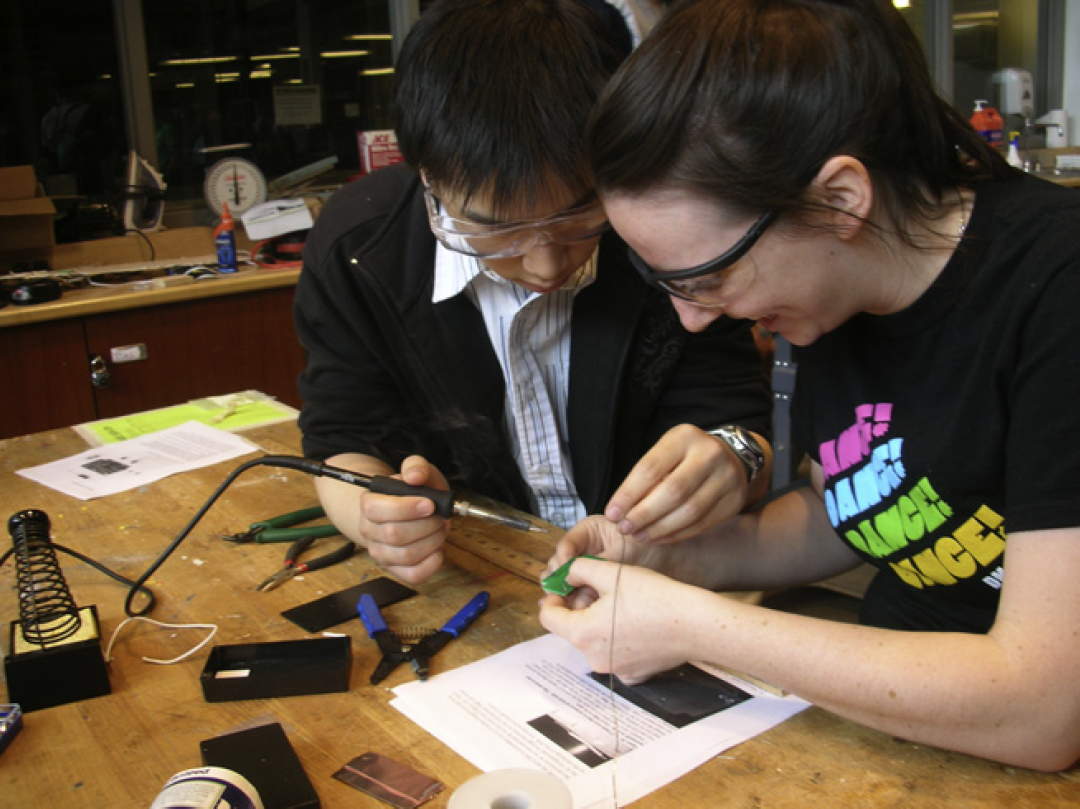
EWH members Nicholas Lau and Natalie Osterweil work together to build defibrillator testers.
Competing Interests Statement: The authors certify that they have no relevant financial interests in this manuscript.
