






Abstract
Background/Objective
Limb activation is one of the behavioural interventions to improve unilateral spatial neglect (USN). However, the effect of passive limb activation on activities of daily living (ADL) is not clear. This study examined the effect of passive limb activation by functional electrical stimulation (FES) on wheelchair driving for patients with USN, and to discuss the possibility of application of this treatment to occupational therapy.
Methods
A single subject design-baseline-intervention-baseline (ABA), was applied to 2 stroke patients with USN. Phase A' and A consisted of the wheelchair driving task only. Phase B consisted of the wheelchair driving task with FES. Each phase lasted for 2 weeks. The wheelchair driving task was maneuvering on a square passage in the clockwise and counter clockwise conditions for 8 minutes respectively, and four obstacles were set at each side. FES was applied to the affected forearm extensor muscles. Assessor recorded: 1) The distance participants drove wheelchair for 8 minutes, and 2) The number of collisions with obstacles and the wall, for 10 days.
Results
For one participant, the distance of maneuvering significantly increased in phase B (p < .05.), and USN on the cognitive test in the extrapersonal space indicated a tendency to improve after phase B.
Conclusion
Passive limb activation by FES improved wheelchair driving and cognitive performance for patients with USN. It can be used with instruction from occupational therapists to enhance the performance on ADL.
Introduction
Unilateral spatial neglect (USN) is defined as failure to orient to, respond to or detect stimulation in the affected side (
Over the past 60 years, several interventions to improve USN, including visual scanning training (VST), prism adaptation (PA), and limb activation have been reported (
As one of the popular ways to induce passive limb movement, functional electrical stimulation (FES) has been used in clinical settings.
The purpose of this study was to examine the effect of passive limb activation by FES on ADL, especially wheelchair driving for patients with USN, and to discuss the differences in the effect of passive limb activation on features of USN for application to occupational therapy.
The study protocol was approved by the Ethics Committee of Nagoya University (Ref. no: 13–608) and the Kamiiida Rehabilitation Hospital.
Methods
Participants
The participants were recruited from a Rehabilitation Hospital and screened by the following inclusion and exclusion criteria. Inclusion criteria were (a) stroke patients who exhibited USN in any of the following: the line bisection task or the star cancellation task or the copying of a flower from subtests of the Behavioural Inattention Test (BIT;
Three patients with stroke showing USN participated in the study. In regard to applying FES to the participants, permission was obtained from the medical doctors in charge. All participants had USN as described by the assessment mentioned in the inclusion criteria and agreed to participate in this research with written informed consent. One participant dropped out from the study due to the discharge. Characteristics of 2 participants are shown in Table 1 .
Characteristics of the Participants (N = 2).
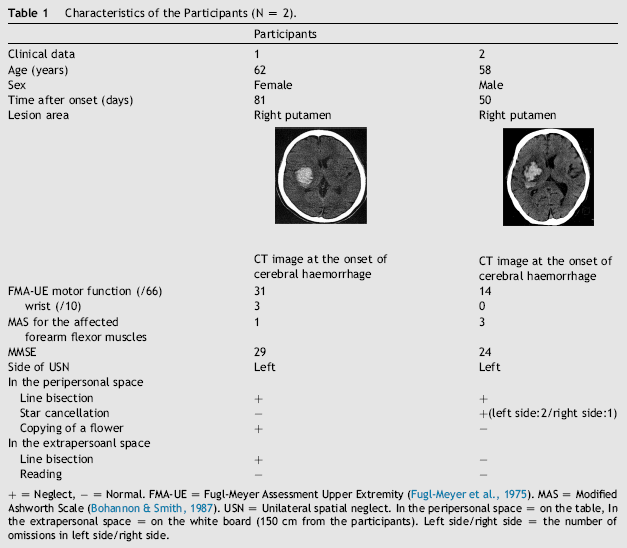
+ = Neglect, - = Normal. FMA-UE = Fugl-Meyer Assessment Upper Extremity (
Apparatus
The IVES+® (manufactured by OG Giken Co., Ltd., Okayama, JAPAN) was used as FES apparatus. FES was applied to the affected forearm extensor muscles for inducing passive movement with the programming set interval of 5 seconds in stimulation and resting alternately. The frequency of the stimulated pulse was 20 Hz, and the intensity of the stimulation was set to produce a muscular contraction. The FES was started just before the wheelchair drivingtask and was continued throughout the task. During the resting time of the wheelchair driving task, the FES was stopped.
The Wheelchair Maneuvering Task
The driving course was set referring to earlier researches (
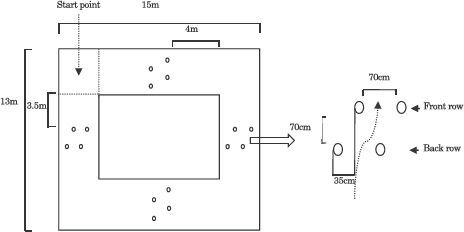
Wheelchair driving course and setting of the obstacles
If the participants went the wrong way, they were corrected. If any side of the wheelchair collided with a chair, this was counted as a collision. If the chair was moved by the collision, the assessor returned the chair to the original position after the participants passed by.
Procedures
A single system design/A baseline-intervention-baseline (ABA') design was applied (
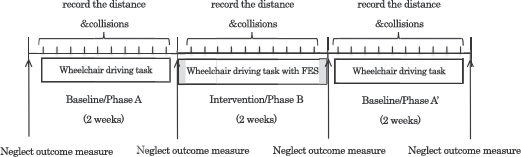
The experimental procedure
Outcome Measures
To examine the effect of passive limb activation by FES on wheelchair driving, the assessor followed participants and recorded the distance that participants drove the wheelchair during the 8 minutes (hereinafter referred to as the distance), and the number of collisions with obstacles and the wall (hereinafter referred to as collisions). The distance travelled was measured from the start point to the arrival point as a straight-line distance along the centre of the passage using a measuring tape.
As a reference, the following neglect outcome measure using the Behavioural Inattention Test (BIT) (
The line bisection task, the star cancellation task and the copying of a flower onto an A4 sheet from subtests of BIT were conducted to assess USN in the peripersonal space on the table.
The line bisection task from the BIT and the reading task were to assess USN in the extrapersonal space displayed on a white board, 150 cm from the participants. The reading task involved reading all of the letters (9 × 4 lines, 36 letters) written on a sheet and was checked for omissions. The size of the materials was modified to match for the distance from the participants.
Analysis
The data of outcome measures were plotted on a graph. The levels and slopes of the celeration line were used for visual analyses to assess the transition of outcome measures (
Results
Distance
The results were plotted in
For participant 2, in Phase A, the slope of the celeration line was 0.7 in the CW condition and 2.0 in the CCW condition. In Phase B, the level slightly increased in the CW condition, and decreased in the CCW condition compared with that of Phase A. The slope increased to 12.5 in the CW condition and 9.3 in the CCW condition. In Phase A', the level increased compared to that of Phase B for both conditions. The slope decreased to 0.1 in the CW condition and 1.8 in the CCW condition. There was no significant difference between Phase B and the other phases.
The results showed that the distance travelled significantly increased in the intervention phase, however, effects did not last after the intervention phase (A') for participant 1. For participant 2, the distance did not increase in the intervention phase.
Collisions
The results were plotted in
For participant 2, in Phase A, the slope of the celeration line was 0.4 in the CW condition and −0.1 in the CCW condition. In Phase B, the level increased in the CW condition, and decreased in the CCW condition compared with that of Phase A. The slope increased to 1.2 in the CW condition and 0.0 in the CCW condition. In Phase A', the level increased compared with that of Phase B for both conditions. The slope decreased to 0.9 in the CW condition and −0.1 in the CCW condition. There was no significant difference between Phase B and the other Phases in the CW condition. On the other hand, in the CCW condition, the results of the binomial test indicated a significant decrease for Phase B compared with Phase A' (p = .02., p < .05).
The results showed that the trend of collisions particularly decreased in Phase A and stabilised in the later stage in Phase B and Phase A' for participant 1. For participant 2, collisions did not decrease during the intervention phase in both conditions but increased for Phase A' in the CCW condition.
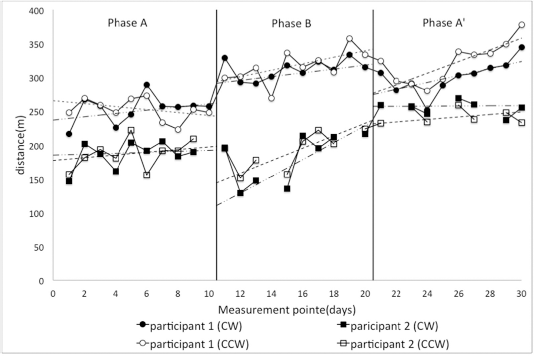
The distance participants drove the wheelchair
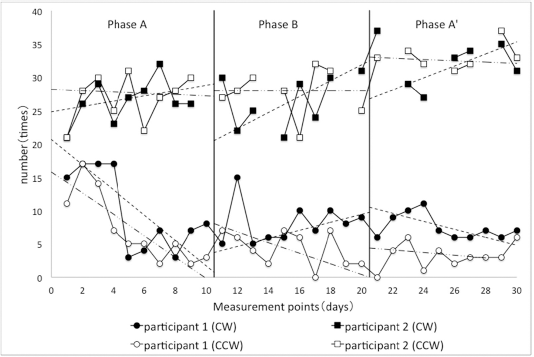
The number of the collisions with the obstacles and the wall
Neglect Outcome Measure using BIT
The results of the neglect outcome measure are presented in Table 2 . For participant 1, USN in the peripersonal space remained unchanged until the end of the Phase A'. In contrast, USN in the extrapersonal space had a trend of improvement. For participant 2, USN in the peripersonal space had a tendency to improve as time passed. However, the omissions on the star cancellation task remained unchanged in both the affected side and the sound side. This result indicated that participant 2 had neglect symptoms and general attention deficit.
The Results of the Neglect Outcome Measure Using Behavioural Inattention Test.
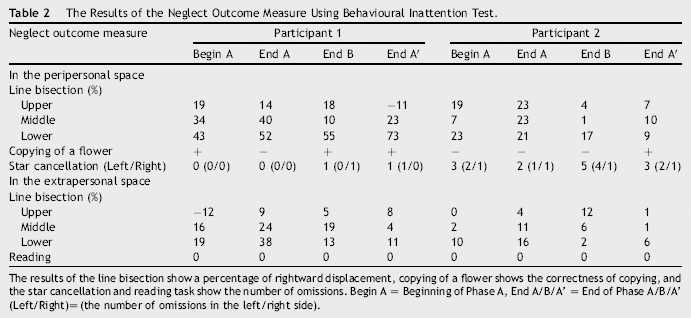
The results of the line bisection show a percentage of rightward displacement, copying of a flower shows the correctness of copying, and the star cancellation and reading task show the number of omissions. Begin A = Beginning of Phase A, End A/B/A' = End of Phase A/B/A' (Left/Right) = (the number of omissions in the left/right side).
Limb activation by FES
FES evoked contraction of wrist extensor muscles and sufficient wrist extension in participant 1, however, the evoked contraction was minimal and only slight wrist extension was noted in participant 2.
Discussion
The purpose of this study was to examine the effect of passive limb activation by FES on wheelchair driving for patients with USN and to compare the differences in the effect of passive limb activation on various features of USN. The results suggest that passive limb activation might improve wheelchair driving in some patients with USN. Two participants had different responses, therefore, the findings should be considered individually with cautions.
For participant 1, the distance travelled significantly improved after passive limb activation was applied. This improvement was different from the learning effect because the celeration line on the intervention phase significantly increased compared with that on the baseline phase. It is inferred that passive limb activation ameliorated the asymmetric spatial representation and reduce USN, especially in the extrapersonal space related to wheelchair driving. Participant 1 might aware the obstacles and the corner of the passage in far positions and perform the wheelchair driving task more quickly. The results of participant 1 indicated that USN was found in both peripersonal and extrapersonal spaces on the neglect outcome measure, and USN in the extrapersonal space had a tendency to improve after the intervention phase. Previous research also reported that passive limb activation reduced USN on cognitive tasks in the extrapersonal space (
For participant 2, the distance travelled did not increase and the number of collisions did not decrease during the intervention phase. In other words, the performance during the wheelchair driving task was not improved by passive limb activation. Participant 2 had omissions over both affected and sound sides during the star cancellation task, probably due to a general attention deficit. According to this result, general attention deficits might prevent the improvement of performance during wheelchair driving. Previous research also indicated that patient with USN and general attention deficits wheelchair driving by limb activation (
As mentioned above, the effect of passive limb activation on ADL might be influenced by unique feature of USN in each individual and the range of passive limb movement in the neglect space. Additionally, the effect of it might also depend on the behavioural tasks and the spaces carrying out. Therefore, passive limb activation should be applied considering the feature of USN and the range of passive movement on the affected limb in the neglect space, the occupations and its spaces practiced. Passive limb activation might enhance the effects of the intervention on ADL, for example, if patients with USN need to go to the lavatory or the dining room, passive limb activation by FES are applied with the intervention on wheelchair driving.
This study adopted an ABA' design and revealed the effects of limb activation on ADL for some patient with USN, however, the effects were not maintained until Phase A'. In previous research, limb activation was undertaken as three 45-minute sessions per day, 4 days a week for 4 weeks, and the effect of limb activation persisted for 1 month (
We conducted this case study and discussed the effects of limb activation by FES on manual wheelchair driving for 2 participants with USN based on hypotheses in previous studies (
Conclusion
This study examined the effect of passive limb activation by FES on ADL, especially for a wheelchair driving task among patients with USN. The results suggest that passive limb activation by FES could enhance the effects of the intervention on ADL.
Footnotes
Acknowledgements
The study was supported by the Kamiiida Rehabilitation hospital for recruitment and data collection. We acknowledge all participants in the study and the useful comments on brain Images by Dr. Yamamoto.