






Abstract
Background/Objective
Motor coordination impairment is common in children with neurodevelopmental disorders such as autism spectrum disorder (ASD) and attention deficit/hyperactivity disorder (AD/HD). The purpose of this study was to investigate the relationship between motor coordination, cognitive ability, and academic achievement in Japanese children with neurodevelopmental disorders.
Methods
Thirty-four school-age (6–12 years old) children with neurodevelopmental disorders and 34 age-matched typically developing (TD) children were recruited in this study. Correlations between the scores of the Movement Assessment Battery for Children-2 (M-ABC2) and the Kaufman Assessment Battery for Children — Second Edition (K-ABCII) that assesses cognitive abilities, and academic achievement were analyzed.
Results
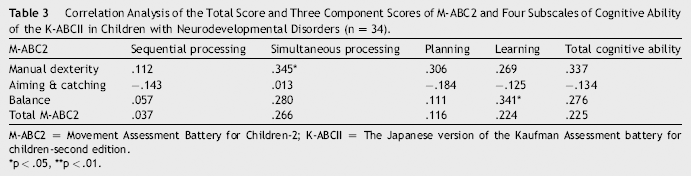
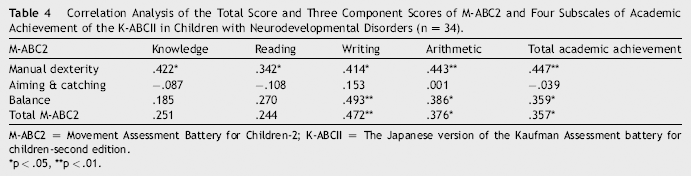
The children with neurodevelopmental disorders obtained a lower total score and all component scores on M-ABC2 compared to the TD children. In children with neurodevelopmental disorders, M-ABC2 Manual Dexterity score was significantly correlated with K-ABCII Simultaneous Processing (r = .345, p = .046), Knowledge (r = .422, p = .013), Reading (r = .342, p = .048), Writing (r = .414, p = .017), and Arithmetic (r = .443, p = .009) scores. In addition, M-ABC2 Balance score was significantly correlated with K-ABCII Learning (r = .341, p = .048), Writing (r = .493, p = .004), and Arithmetic (r = .386, p = .024) scores.
Conclusion
These findings stress that it is essential to accurately identify motor coordination impairments and the interventions that would consider motor coordination problems related to cognitive abilities and academic achievement in Japanese children with neurodevelopmental disorders.
Introduction
Neurodevelopmental disorders such as autism spectrum disorder (ASD), attention deficit/hyperactivity disorder (AD/HD), and specific learning disorder (SLD) frequently co-occur with developmental coordination disorder (DCD) (
DCD impedes the acquisition and execution of coordinated motor skills (
Motor coordination involves a series of cerebral processes including sensory input, perceptual and cognitive processing, and action production (
Recently, the relationship between motor coordination and academic achievement/cognitive abilities has been evaluated. Several studies revealed that children with motor coordination problems show poor academic achievement (
However, the relationship between specific motor coordination abilities, cognitive abilities, and academic achievement in children with neurodevelopmental disorders has been rarely investigated. Furthermore, no study has examined such relationships in Japanese children with neurodevelopmental disorders. The acquisition of literacy skills varies according to writing systems (
Thus, we conducted a study examining motor coordination problems among Japanese children with neurodevelopmental disorders and the relationship of such impairments with cognitive abilities and academic achievement in Japan. The purpose of this study was to investigate the relationship between motor coordination and both cognitive abilities and academic achievement in Japanese children with neurodevelopmental disorders.
Methods
Participants
The participants in this study consisted of 68 school-age (6–12 years old) children. Thirty-four children (30 boys and four girls) with neurodevelopmental disorders (8.97 ± 1.82 years old) were recruited through primary schools and parents' association for children with neurodevelopmental disorders based in Nagasaki Prefecture. The children were provided with special support services in resource rooms in each school. All children were diagnosed with neurodevelopmental disorders based on the Diagnostic and Statistical Manual of Mental Disorders, Fifth Edition (DSM-5) criteria (ASD: n = 17, AD/HD: n = 17). Furthermore, all children's intellectual ability was evaluated by the first author using the Wechsler Intelligence Scale for Children-IV (WISC-IV). The children's average Full Scale IQ was 90.7 ± 15.7 (range = 70–126). None of the children were diagnosed with any physical or intellectual disability other than the neurodevelopmental disorder.
To collect the reference values for motor coordination ability in children with neurodevelopmental disorders, 34 typically developing (TD) children (15 boys and 19 girls; 8.29 ± 1.4 years old) were also recruited from the primary schools in the same region. As the TD children were attending mainstream schools, they were assumed to be of normal intelligence. The teachers of these children reported no physical, psychological, or intellectual problems.
The two groups (children with neurodevelopmental disorder and TD children) did not statistically differ in age (t = 1.718, p = .091).
Instrument
Movement Assessment Battery for Children-2 (M-ABC2)
The M-ABC2 was administered to assess motor coordination impairments. This standardized test consists of eight subtests, the results of which provide a total score and three component scores: Manual Dexterity (MD), Aiming and Catching (AC), and Balance. The raw score for each subtest is converted to a standard score by using the test manual, and each component standard score can be calculated. The sum of eight subtest scores can be recorded as a total standard score. Standard scores have a mean of 10 and a standard deviation (SD) of 3. Higher standard scores indicate greater motor coordination ability. This test has three age bands, covering 3–6, 7–10, and 11–16 years. The total duration of the test was 20–40 minutes. The validity and reliability of the test were confirmed using the test manual (
The Japanese version of the Kaufman Assessment battery for children-second edition (K-ABCII)
The Japanese version (
Procedures
Parental informed consent was obtained for each child. All children were tested individually in separate rooms by researchers according to the instructions given in the M-ABC2 manual. In addition, children with neurodevelopmental disorders were subjected to the K-ABCII.
This study was approved by the ethics board of the Nagasaki University Graduate School of Biomedical Sciences (No. 15010864).
Data Analysis
SPSS Statistics (version 22.0) was used for data analysis, and the significance level was set to .05. We used Levene's test to examine whether the M-ABC2 scores had equal variance in the two groups, and found that only the Balance component scores had unequal variance. We therefore used Welch's t-test to analyze the differences in motor coordination abilities between the two groups (children with neurodevelopmental disorder and TD children).
For the children with neurodevelopmental disorders, Pearson's correlation analysis was conducted to examine the relationship between the standard scores of the M-ABC2 and the K-ABCII.
Results
Motor Coordination Abilities
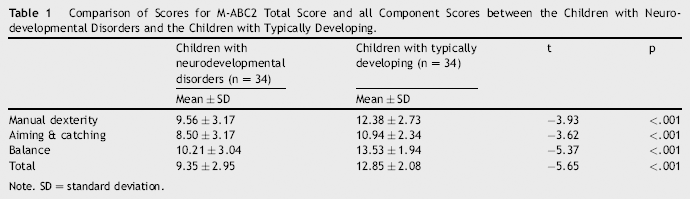
Table 1 shows the results of Welch's t-test for standard scores of the M-ABC2, the total score, and all component scores.
Comparison of Scores for M-ABC2 Total Score and all Component Scores between the Children with Neurodevelopmental Disorders and the Children with Typically Developing.
Note. SD = standard deviation.
The children with neurodevelopmental disorders had significantly lower total scores and component scores than did TD children (p <.001).
Cognitive Abilities and Academic Achievement
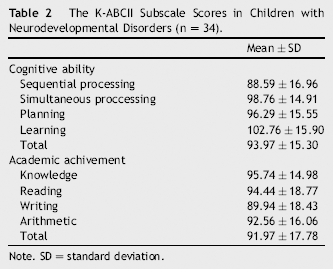
Table 2 shows mean standard scores and SDs of the K-ABCII cognitive ability and academic achievement subscales in children with neurodevelopmental disorders.
The K-ABCII Subscale Scores in Children with Neurodevelopmental Disorders (n = 34).
Note. SD = standard deviation.
Relationships between Motor Coordination and Cognitive Ability/Academic Achievement
There were no significant correlations between the M-ABC2 component scores and intelligence measured with the WISC-IV in children with neurodevelopmental disorders.
Correlation Analysis of the Total Score and Three Component Scores of M-ABC2 and Four Subscales of Cognitive Ability of the K-ABCII in Children with Neurodevelopmental Disorders (n = 34).
M-ABC2 = Movement Assessment Battery for Children-2; K-ABCII = The Japanese version of the Kaufman Assessment battery for children-second edition.
p < .05,
p < .01.
Correlation Analysis of the Total Score and Three Component Scores of M-ABC2 and Four Subscales of Academic Achievement of the K-ABCII in Children with Neurodevelopmental Disorders (n = 34).
M-ABC2 = Movement Assessment Battery for Children-2; K-ABCII = The Japanese version of the Kaufman Assessment battery for children-second edition.
p < .05,
p < .01.
Discussion
This study compared the motor coordination abilities of Japanese children with neurodevelopmental disorders to those of age-matched TD children to identify motor coordination impairments specific to children with neurodevelopmental disorders. Our results show significantly poorer motor coordination abilities in Japanese children with neurodevelopment disorders than in TD children, as assessed with the M-ABC2. This result is consistent with previous studies showing significant motor impairments in children with neurodevelopmental disorders such as ASD and AD/HD (
The results of the analyses examining the relationship between the motor coordination abilities and cognitive abilities/academic achievement in Japanese children with neurodevelopmental disorders showed a significant positive correlation between M-ABC2 total scores and K-ABCII total academic achievement scores. This result is consistent with previous studies showing that children with motor coordination problems tend to show poor academic achievement (
Interestingly, although no significant correlation between M-ABC2 total scores and K-ABCII total cognitive ability scores was found in this study, the examination of the specific relationships between the individual components showed that MD and Balance were significantly correlated with both cognitive ability subscale scores and academic achievement subscale scores of the K-ABCII.
Regarding M-ABC2 MD, the total score of MD was significantly correlated with K-ABCII Simultaneous Processing, Language, Reading, Writing, and Arithmetic. According to the M-ABC2 manual, MD subtests consist of manual tasks that require precision. Moreover, an MD component is designed to reveal how the child copes with spatial and temporal demands imposed by manual tasks. A previous study (
Regarding M-ABC2 Balance, the total Balance score was significantly correlated with KABC-II Learning, Writing, and Arithmetic scores. Several factors may account for this result. It is possible that the balance and academic skills share a common neural basis. Balance, as a motor function, is associated with the cerebellum. Since balance M-ABC2 subtests consist of static and dynamic balance tasks, the cerebellum is essential for good performance. Although the cerebellum has been considered as primarily involved in motor control, neuroimaging studies revealed that this structure also plays an important role in non-motor functions such as language, learning, and memory (
In this study, no significant correlations between M-ABC2 AC scores and K-ABCII cognitive and academic achievement subscale scores were observed. Likewise,
This study has several limitations. One of the limitations is that we did not consider several factors that may influence motor coordination and academic performance in children with neurodevelopmental disorders, such as, in particular in ASD and AD/HD, core deficits in executive function, praxis, sensory processing, and others. Therefore, future studies should consider ruling out these factors via inclusion/exclusion criteria. Furthermore, we did not have access to information about socio-economic status and other family characteristics, IQ score for children without neurodevelopmental disorders, and academic achievement data for either group. This information should be collected and reported in future studies. Additionally, these factors should be controlled in future studies to further understand the relationship between motor coordination abilities and academic achievement.
Conclusion
This study supports previous findings that children with neurodevelopmental disorders show worse motor coordination ability than typically developing children. Interestingly, this study revealed the relationship between motor coordination ability, cognitive ability, and academic achievement in Japanese children with neurodevelopmental disorders. In particular, the M-ABC2 components MD and Balance were significantly correlated with both cognitive abilities and academic achievement reflected by the K-ABCII. The findings of this study stress that it is essential to accurately identify motor coordination impairments and take into consideration their relation to academic problems among Japanese children with neurodevelopmental disorders.