






Abstract
This paper builds upon the first in the series on psychospiritual integration (PSI) and examines the concept of transformative occupations and the process of change underpinning occupational therapy from a PSI perspective. A repertoire of new terms highlighting finer distinctions in the concept of occupation will be introduced and explained, as will the dynamic for transformation inherent in the psychospiritual integration change process. Suggestions for PSI-informed occupational therapy practice will be explored.
Introduction
In my first paper on the psychospiritual integration (PSI) frame of reference (
Since my first paper on PSI has been published in 2003, after a hiatus of 13 years, this second part of the planned series on PSI is finally out. During that time, there has been a marked proliferation of occupational therapy publications centred on the concept of occupation (see e.g.
In this paper, I will be discussing in greater detail the process of transformative change intrinsic to spirituality that is linked to health and wellbeing. The transformative edge of occupation itself will be examined, outlining various ways in which dimensions of spirituality are enabled and energized in persons in the course of PSI-informed occupational therapy. The community spirituality aspect of PSI will not be the focus of this paper.
Occupations that transform
The concept of occupation has been core and central to much theorizing and clinical practice in occupational therapy, with models of occupational therapy practice moving away from emphasis on discrete skills, tasks, and activities to more holistic understandings of human occupation. Occupation pertains to the ‘doing’ dimension of human existence and involves more than mere productivity and work. Occupation is anything meaningful that people do to occupy time in the context of their environment. Seen in this light, there has been a call for occupation-focused, occupation-based, and occupation-centred assessment and intervention that places occupation at the front and centre of occupational therapy (
What is not so evident is the transformative potential of occupation, conceived more narrowly as individual or personal transformation and more broadly as social or collective transformation. To investigate this issue, we first define what is meant by transformation. What follows is a discussion on PSI-informed occupational therapy that points to new concepts of occupation – meta-occupation, non-occupation and trans-occupation – implicated in transformation at the most profound levels of human existence.
Transformative change
Change means alteration – shift from one state or condition into another. Conceptualizing change in human subjects is challenging. There can be different kinds and levels of change to be elaborated upon. First, there is what can be termed ‘level zero’ change – no change or no learning at all. Then, there is ‘level one’ or incremental change – “corrections, adaptations, modifications via flexibility and stretching within the box” (
PSI-informed occupational therapy
In my first paper, I articulated the PSI frame of reference using the template of model construction proposed by
The Canadian Model of Occupational Performance and Engagement (CMOP-E) defines the profession of occupational therapy as “the art and science of enabling engagement in everyday living, through occupation; of enabling people to perform the occupations that foster health and well-being; and of enabling a just and inclusive society so that all people may participate to their potential in the daily occupations of life” (
The three zones
The psychospiritual integration (PSI) frame of reference articulates six interpenetrating dimensions of spirituality as becoming, meaning, being, centredness, connectedness, and transcendence (
Dimensions of Spirituality in Psychospiritual Integration.
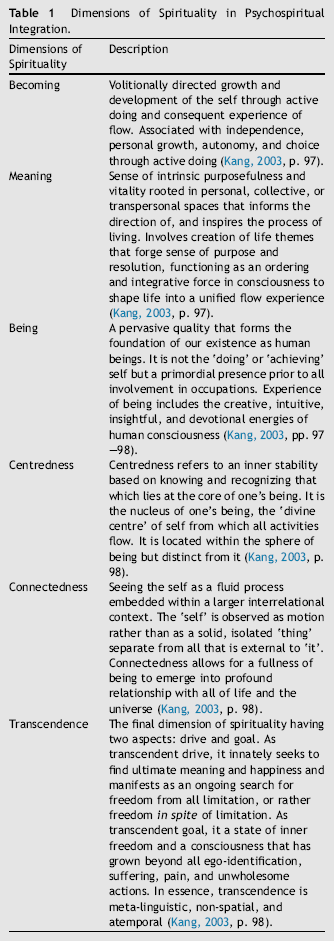
In both meaning and becoming, language and conception play constitutive roles. In other words, the making of meaning and dynamic formation of identity are inextricably tied to language articulation and conceptualization. The linguistic and conceptual frameworks that embed and hold our doings construct the edifice of personal identity and meaning as we do everyday occupations. Together, becoming and meaning form the ‘surface zone’ of spirituality, which is the common and familiar phenomenological zone that many individuals and groups can relate to.
PSI goes further to delineate dimensions of spirituality that are less tied to language and conception, and in fact, progressively transcend language and conception altogether. Dimensions of being and centredness exemplify spirituality that goes beyond word-based, concept-based, and narrative-based self. Being and centredness form what PSI calls the ‘middle zone’ of spirituality in terms of phenomenological depth and breadth. This middle zone of spirituality is the phenomenological ground out of which the surface zone emerges and into which it returns (
Beyond the middle zone lies what PSI calls the ‘deep zone’ of spirituality. The dimensions of connectedness and transcendence are located in this zone. Phenomenologically, connectedness and transcendence are characterized by infinitude of depth and breadth. The experiential parameters of these dimensions are not measurable or calculable. They are no longer contingent upon language and conception, though language and conception can play a role in some instances but not necessarily so (
These features are not all or nothing phenomena. They can manifest in persons who have experienced the deep zone of spirituality intermittently or temporarily on occasions. The nature of deep zone experiences is such that one is irrevocably transformed from the inside-out, to greater or lesser degrees, upon direct unmediated realization of connectedness and transcendence. Each instance of full realization of the deep zone purifies and transforms in profound ways the personality and character of the individual experiencing it. There comes a point when such realization-evoked transformation is complete and the person is irreversibly and unconditionally emancipated from afflictive delimitations. Such a person will embody and live out the deep zone in tandem with the middle and surface zones in wholeness and unity. Connectedness and transcendence suffuses and pervades the totality of being; its centre no longer the autonomous unchanging self but the whole cosmos free of circumference and centre; its meaning rich with love and wisdom; and its becoming no longer born of egocentric desires and compulsions but enacted in the service of all beings.
Dimensions and occupation
From PSI's perspective, there exists an inextricable link between these six dimensions of spirituality and human occupation. These dimensions conceptualized in three progressively deeper zones infuse, inspire, inform, and enliven our enactment of daily occupations. In particular, the new concepts of meta-, non-, and trans-occupation are profoundly linked to these dimensions of spirituality as illustrated in
Transformative Occupations Matched to Dimensions of Spirituality in Psychospiritual Integration.
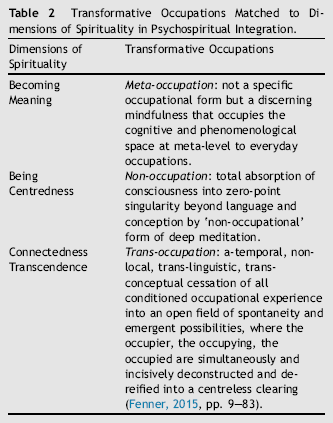
More than that, occupations – especially those in their meta- and non-occupational forms – can facilitate a profound sense of being and centredness beyond notions of self and self-agency. Such profound existential realization can be described as the experience of primordial self (
While unique and individual, our personhood is not an isolated reality ontologically cut off and separate from the web of relationships that forms our living context. Every person is constituted by their embeddedness in a matrix of dynamic relationships, even as their very being constitutes part of the web for other persons (
If connectedness forms our very personhood, then every occupation that each person enacts finds its place in myriad and infinite connections with other persons, events, and things. This sense of connectedness bears resonance with the term ‘transactive’, a concept describing the relationships between person, environment, and occupation that views occupational performance as an event constituted by mutually interpenetrating – not independent isolated –factors (
Occupations can take us beyond the realm of agential self, primordial self, and connected self to a groundless ground where all notional constructs of self become utterly ineffectual or simply and timelessly cease to exist. This deepest zone of transcendence can be arrived at via the route of occupation, but not just any occupation. Transcendence require occupations of ‘a certain kind’ – not differentiated merely in terms of this activity or that, but qualitatively in terms of how persons engage in occupations (the phrase ‘a certain kind’ borrowed from
In my first paper on PSI, I introduced the concepts of generic and spiritual occupations (
Meta-occupation
In this paper, I introduce new concepts of occupation as seen through the lens of PSI. The first is meta-occupation. Meta-occupation suggests a condition of ‘going above’ and ‘hovering outside’ occupation in an experiential and phenomenological sense. Meta-occupation is not a special or esoteric occupation accessible only to circumscribed and elite groups of individuals, but everyday occupations engaged and experienced at a meta-level. Engaging in and experiencing an occupation at a meta-level requires an ability to step aside from and outside of the matrix of occupational experience, to abide in a posture of mindfulness and clear knowing. Thus, meta-occupation does not refer to any specific occupational form but to adopting mindfully a meta-perspective to any and all occupations. A quality of doing is infused with a mindful sense of self that serves as context rather than content of experience (
Mindfulness (Pali: sati; Sanskrit: smrti) is defined here as the moment-by-moment presencing of awareness in the immediacy of experience, without emotional reactivity and judgmentalism but with responsive calm and wise discernment (
Clear knowing (Pali: sampajanna: Sanskrit: samprajanya) is a mental factor concomitant with mindfulness that enables wise discernment between skillful and unskillful states of mind (
Taken together, mindfulness and clear knowing synergistically enable the person to adopt a meta-level perspective to occupational experience, derive cognitive and meta-cognitive insights into that experience, and hone their attention away from distractibility towards profound levels of focus and flow. In short, meta-occupation is a condition of adopting a meta-perspective to occupational experience, evoking cognitive and meta-cognitive insights into that experience, and directing attention into deep focus and flow imbued with heightened malleability and pliancy. As such, meta-occupation enabled by the synergy of mindfulness and clear knowing confers the person access to that middle zone of spirituality where agency-attenuated being and centredness prevail.
Non-occupation
The second new occupational concept in PSI is non-occupation. First, I need to demarcate non-occupation in the sense it is used in PSI from the sense it is normally understood in common parlance – that of dysfunctional non-performance of and non-engagement in health-promoting occupations. Far from being a dysfunctional state, PSI's non-occupation describes a highly functional and health-giving condition. From an individual perspective, occupational dysfunction is present when one has difficulty choosing, organizing, or performing his or her valued occupations, or when occupations fail to provide quality of life or meet demands of the environment (
Non-occupation is the conditional stilling of occupational performance and engagement, not in the nihilistic or dysfunctional sense, but in a positive life-giving sense. First, a note on terminology. The term ‘conditional’ is used here to refer to the fact that stilling of occupational performance and engagement is seen as an intentional act, necessitating the assembly of varied conditions to elicit the outcome of stilling. The term ‘stilling’ refers to the temporary but profound quietening of cognitive, verbal, and behavioural activity in the context of human occupation. The terms ‘positive’ and ‘life-giving’ allude to the reality of restorative vitality, fulfilment, and joy that comes from non-occupation. This brings me to my next point on the nature and role of non-occupation.
PSI conceives non-occupation as a condition elicited by and through a very specific occupational form that can be termed attentional balancing (Sanskrit: samatha). Attentional balancing is a sophisticated yet entirely naturalistic process of settling a person's consciousness in its natural state of sheer luminosity, bliss, and non-conceptuality (
Attentional balancing as an occupational form is intrinsically contemplative in nature, designed to bring the person engaged in it to gradually release all coarse conceptual activity, emotional reactivity, and dwell single-pointedly on consciousness's very centre. While details of this pedagogy fall outside the scope of this article, suffice to say that attentional balancing requires ongoing intensive practice. While generally not a common or shared experience in our highly industrialized society, perfect attentional balance is a potential open to everyone. Anecdotal evidence suggests traditional Asian Buddhist societies as fertile grounds for the rise of attentionally-balanced contemplatives, for example in Tibet (
As such, it is postulated that deeper levels of being and centredness are becoming manifest as the everyday experience of persons immersed in contemplative occupational forms. The middle zone of spirituality begins to take precedence in the lives of these individuals. As like-minded individuals gather for group practice, support, and continuing education, new forms of intentional community centred on contemplative occupations are formed. From PSI's perspective, the spiritual latency of individuals and communities are being activated more and more powerfully as greater numbers of persons delve more and more deeply into contemplative occupational life as a matter of choice. PSI recognizes the possibility of spiritual fulfilment beyond what is normatively defined and casts its conceptual net wider and deeper to capture the farther reaches of human nature (
In summary, the enactment of attentional balancing as occupational form is the chief condition for a person entering into the condition and experience of non-occupation. As a temporary stilling of cognitive, verbal, and behavioural activity, non-occupation paradoxically evinces a depth of peace, joy, vitality, and fulfilment not commonly experienced in common everyday occupations. This fact underscores the importance and need for a new occupational category – that of non-occupation.
Trans-occupation
The third new occupational concept in PSI is trans-occupation. Trans-occupation is the a-temporal, nonlocal, trans-linguistic, trans-conceptual cessation of all conditioned occupational experience into an open field of spontaneity and emergent possibilities. Trans-occupational cessation is an ever-present reality waiting to manifest in the unconditioned awareness of the now. Trans-occupation is egoless, occupational-less occupation where the occupier, the occupying, the occupied are simultaneously and incisively deconstructed and de-reified into a centreless clearing (
Trans-occupation is not delimited to a single specialized occupation where it is enacted but is immanent in every occupation as well as non-occupation. In every instance and occupation, there is the opportunity for occupation to be self-reflexive, self-deconstructing, and self-transcending, thus opening up a centreless absent presence defying all formulae and verbalizations. Trans-occupation is immanent within all occupations. Having said that, trans-occupation is more likely to occur within the occupational form of contemplative practice than in other forms. Specifically, contemplative practice conducive to enactment of trans-occupation belongs to a category of ‘naked awareness’ meditation that is panoramic in scope, fluid in action, untethered to place or time, non-directive, and non-effortful.
Entering and resting in the sphere of trans-occupation depends not on self-driven effort but on self-releasing surrender in openness and trust. As such, trans-occupation can be enigmatically characterized as ‘being nobody, going nowhere; with nothing to gain, nothing to lose, nothing to prove, and nothing to hide’ (
One final note on the ontological status of trans-occupation. The foregoing discussion is an epistemological and phenomenological one, that is, it does not purport to make ontological claims of what transcendence is. In other words, PSI does not state whether and how transcendence and trans-occupation truly exist in their own right –whether they are real, objective, self-authenticating entities or not. Rather, PSI is saying that any statement we can make about transcendence, trans-occupation (and anything for that matter) is inextricably bound up with linguistic and conceptual reification that in a sense constitutes them. Hence, PSI and all its constructs including transcendence and trans-occupation are dependently designated, nominally constructed, and contextually bound within the shared matrix of language and conception that frames them (
Enabling change in occupational therapy
Clinical application of PSI in occupational therapy is founded upon the transformative change process alluded to earlier in this paper. To recapitulate, transformative change in PSI is nothing short of awakening to a new world, where a new order of transcendent meanings and way of being has replaced the old order of self-focused, self-occupied, self-driven existence. A radical reorientation of one's life away from mundane concerns towards trans-mundane existence ensues, characterized by nondual integration, wholeness, unfettered freedom of spirit, diminution or eradication of afflictive, toxic tendencies of mind and personality. That said, there can be transformative change of varying degrees where the radical shift away from mundane to trans-mundane concerns do not take place to its fullest extent.
There can be transformative shifts in one's sense of becoming, meaning-making, and being as a result of life-changing events and the processes of occupational adaptation. Such transformative shifts testify to the power of enabling occupational performance and engagement for health and wellbeing (
To enable and elicit transformative change in persons, PSI provides an enabling pathway comprising the processes of transmission, instruction, coaching, co-presencing, and immersion. This enabling pathway is one of constant recalibration and openness, like the incessant flow of a river but with a difference. PSI views the transformative process as like a river that flows upstream to the mountain top. In a very real sense, the directional flow that transformation takes in PSI is counter to that of the mainstream, commonplace, hyper-masculinized world. PSI's transformative direction can be said to represent a counter-hegemonic stream of socio-discursive praxis (integrating theory with practice). It is a praxis that is more a quiet revolution than a violent confrontation.
In PSI's enabling pathway, five transactive (not interactive) processes co-mingle and work synergistically to draw forth deep transformation in persons. These five processes pertain to the occupational therapist's therapeutic use of self in the therapist-client relationship (i.e. transmission, instruction, and coaching); the active participation of the client in transformation (i.e. co-presencing); and the making of transformative environmental contexts (i.e. immersion). These five processes are transactive because in every instance of each, the other elements are co-present in an ecology of interpenetrating processes working seamlessly together as one.
Transmission
In the therapeutic setting that can include clinical and nonclinical contexts, the occupational therapist versed in PSI utilizes the process of transmission to kick-start transformative change in the client. The process of transmission is essentially a catalytic encounter between therapist and client whereby the meta-occupational, non-occupational, or trans-occupational consciousness of the therapist elicits a deep spiritually heightened response from the client (
A simultaneous quantum leap out of spiritual latency is made possible by transmission. Perhaps for the first time, the client leaves the density of thought- and worry-laden cloudstorm to plunge into the sky-like vastness of meta-occupation, non-occupation, and trans-occupation. Such a catalytic encounter is made possible by a concomitance of multiple factors, the chief of which is the profundity of consciousness and presence of the therapist. What this means is that the therapist necessarily needs to be familiar with meta-occupation, non-occupation, and trans-occupation on a personal level and in a meaningful way. Personal unmediated knowing of these occupations and sharp distinctive embodiments of each will enable the therapist to offer such transmission to the client to begin the journey of transformative change.
Practically, transmission involves both client and therapist being co-present in the therapeutic space set up between them. The mutual willingness of therapist and client to enter into the therapeutic process sets the scene for transmission. Behaviourally, a fluid blend of deep silence, Socratic dialogue, and contemplative inquiry can be observed. Phenomenologically, the therapist personally embodies and enacts unmediated awareness of meta-, non-, and trans-occupation as part of his or her ground of relational being and experience. Culturally, the process of transmission is profoundly salient and highly regarded in the meditative cultures of India, China, Japan, and Tibet, where master contemplatives play a quintessential role in evoking deep insights that catalyze positive transformative shifts in the consciousness of their trainees and apprentices (
Instruction
A second process in PSI's enabling pathway is instruction. On the basis of transmission, the client recognizes for the first time the hidden occupational potentials within his/her consciousness and being. Such recognition invites further exploration and cultivation in order that these new occupational experiences can be consolidated and bear fruit in everyday life. A key process to facilitate this movement of exploration and cultivation is that of therapist instruction. Again, therapist consciousness and mastery of meta-, non-, and trans-occupation is crucial for a positive instructional experience and outcome.
Specifically, instruction involves therapist informing, reviewing, guiding, and mentoring the client in the details and nuances of meta-, non-, and trans-occupation. This would entail instructing in occupational skills of mindfulness and clear knowing in particular, but also a range of skills on fine-tuning awareness that includes holding and relaxing, suffusing and pinpointing, inverting and releasing, focusing and scanning (
Coaching
The third process, coaching, entails drawing forth the client's hidden potentials for change through therapeutic rapport, listening and questioning, awakening and challenging, probing and evoking, co-creating and actualizing, reinforcing and testing (
Ultimately, this new narrative is constructed and shaped on the basis of transformative enactment of meta-occupation, non-occupation, and trans-occupation. In particular, trans-occupation has the greatest potential to disrupt a person's taken-for-granted assumptions about reality and life, and cause a dramatic rupture of old worldviews, beliefs, attitudes, and habitual tendencies. A whole new narrative may emerge from such trans-occupational rupture that changes every aspect of life for the person. Coaching them through this radically reorienting process would take a therapist skilled not only in coaching but deeply artful in the therapeutic use of self for coaching change.
Co-presencing
The fourth process of co-presencing involves both therapist and client in a mutual creative space of mindful presence and sensing. Presencing is a term inclusive of both presence and sensing (
In occupational therapy, transformative change can be sustained by means of therapist-client co-presencing where both parties enter into that creative nondual space of quiet mutuality. Quiet because of meta-occupational and nonoccupational awareness of both therapist and client creating a space of silent cognizance. Mutuality because two persons are simply present with each other just as they are, in a mutual gaze of attentiveness and connectedness. In such co-presencing, there is an openness to new possibilities and unseen futures that call forth new ways of thinking, feeling, and doing from both therapist and client.
Furthermore, by virtue of the therapist co-presencing with the client, the transformative impact of client's meta-occupational, non-occupational, and trans-occupational experience is reinforced and enhanced. In a sense, co-presencing can be seen as an ongoing flow of transmission from therapist to client even as the client's new awareness feeds into that of the therapist to augment the effects of presencing.
Immersion
The fifth process, immersion, relates to the adaptation, alteration, or creation of transformative environments for optimal realization and sustenance of transformative change. Physical, social, cultural, psychological, and spiritual factors are involved in the making of such transformative environments.
Immersion serves to enhance, reinforce, and embed PSI's transformative processes in the everyday lives of clients receiving PSI-informed occupational therapy. Apart from the spatial adaptation, alteration, and creation of transformative environments, immersion as a process also has a temporal component. Temporally, immersion involves having clients reside in a transformative environment for an extended period of time that can range from one full day to several days or a week up to several months on end. An example of such transformative environments would be retreat centres set in quiet, natural, and scenic locations with or without a rich spiritual or sacred history. It is hypothesized that such environments particularly suited to contemplative and meditative occupational forms are key to assimilating and consolidating meta-occupational, nonoccupational, and trans-occupational learnings, relearnings, and unlearnings.
Conclusion
The PSI frame of reference for addressing spirituality in occupational therapy acknowledges and valorizes hidden dimensions of human occupation in consonance with the six layers of spirituality that PSI identified. Becoming, meaning, being, centredness, connectedness, and transcendence are facets of spirituality that find expression in occupational performance and engagement. New concepts of meta-occupation, non-occupation, and trans-occupation give epistemic and praxiological space for deeper understandings and experience of these six layers. Particularly, layers of being, centredness, connectedness, and transcendence gain salience and significance when viewed in light of these new occupational concepts. The role of the occupational therapist as transformative change agent is emphasized, enacted through the five PSI processes of transmission, instruction, coaching, co-presencing, and immersion. The relevance and value of PSI-informed occupational therapy, a critically reflexive and counter-hegemonic discourse fashioned in postmodernity, will only be seen with the passage of time and accumulation of testimony from contemporary occupational therapy practice on the ground.