






Abstract
Objective/Background
The aim of the paper was to investigate the leisure time physical activity (LTPA) among Polish employed and unemployed women in light of meeting the World Health Organisation (WHO) recommendations and analysed its relationship with employment status. The concept of personal responsibility for a healthy lifestyle plays in the modern times a crucial role here and is an integral part of the prevention process (including the necessity for LTPA).
Methods
A sample (n = 527) of Polish women was surveyed by the long form of International Physical Activity Questionnaire (IPAQ-LF), with statistically significant differences between variables (intensity and duration of the activity vs. employment status), in the model being verified by chi-square testing. Multi-variable logistic regression analysis was performed to find the relationship between socio-demographic criteria and the amount of exercise recommended by WHO. The relationship between LTPA and the amount of exercise recommended by WHO was assessed using the log-linear analysis.
Results
Over one-third of the respondents did not engage in any LTPA (employed –- 38.6 and unemployed –- 36.6%). Employed women engaged in vigorous exercises more often (18.2%) than those who were unemployed (5.8%). The amount of LTPA undertaken by the majority of respondents (58.7% employed and 65.2% unemployed) was not sufficient to maintain their health owing to lack of walking, moderate and vigorous LTPA.
Conclusion
Polish women nowadays (regardless of whether they are employed or not) still do not engage in a sufficient amount of LTPA to maintain their health. Intervention programme in both groups is needed.
Introduction
Gender are determinant factors in undertaking physical activity in leisure time (
However, it is noticeable that modern times bring changes into women's lives. In developing societies, it is the most educated, working and urban women who are moving ahead to achieve a status equal to their male counterparts (
Due to significant societal changes, it is expected that health promoting behaviours among women will also change. This, in turn, yields the need for further research in the area of women's physical activity. Their way of spending leisure time is particularly important from the societal point of view. A previous study shows that only about 15% of their energy consumption is spent on leisure activities, while about 85% is spent on non-leisure activities (
Methods
Procedures
The survey conducted in April 2014, using a computer-assisted personal interview technique (CAPI), was commissioned by the Ministry of Sport and Tourism of the Republic of Poland and conducted by GfK Polonia. It covered a representative sample of 1020 Poles (15 years old and over), which reflected the structure of the adult Polish population in gender, age, education, number of people in the household, macro-region and place of residence, according to the Local Data Bank of the Polish Central Statistical Office. The sampling frame was provided by the Department of the State Central Register and Computer Networks of the Polish Ministry of the Interior and Administration.
The respondents were selected using the proportionate stratified sampling. Fifty-five strata were obtained as a result of crossing macro-regions (9) with classes of place of residence (7). In the second step, 170 municipalities were independently drawn from 55 strata, with probability proportional to the number of residents aged 15 years and older. In the third step, for each of the 170 municipalities, 6 addresses were drawn independently. Each of the respondents was contacted personally, interviewed, and was constantly monitored and checked.
The study was approved by the Committee of Ethics in Science of the Polish Academy of Sciences, Poland (Authorization Number KEwN/60/2014).
To fulfil the methodological requirements, several procedures have been implemented. Firstly, the full survey was preceded by a pilot (n = 12), which confirmed the correctness of the sampling procedure and intelligibility of the questionnaire. Secondly, the sampling procedure included not only the first-best respondents, but also the substitute respondents of identical characteristics (sex, age, municipality) that were included in the sample in case of refusal. Refusal rate was negligible (<1%, n = 8). After three attempts to contact respondents with no responses, they were immediately replaced with the substitute respondents.
The interviews were conducted by trained interviewers who delivered the questionnaire in a simple and standardized way. The Polish version of the International Physical Activity Questionnaire (IPAQ) was used as a research tool (
In this study, only data from the domain of leisure-time physical activity were used. Respondents above 15 years old (n = 527) were asked to give the following information regarding their physical activity in the leisure time during the last 7 days:
vigorous physical activity (i.e. aerobic activity, running, fast cycling, fast swimming),
moderate physical activity (i.e. cycling at a regular pace, swimming at a regular pace, tennis),
walking continuously for at least 10 min (not counting walking to and from work).
For the collected data, average energy expenditure of each activity (MET-min/week) was calculated by multiplying the MET assigned to it (vigorous – 8 MET, moderate –4 MET, walking – 3.3 MET) by the number of days of performance during a week, where MET corresponds to oxygen consumption during rest and equals to 3.5 ml O2/kg of body mass per minute (
The authors followed the IPAQ Research Committee guidelines on data cleaning and processing. In cases with “don't know”/“refused” or where time or day were missing in the data, the case was removed from analysis. Outliers were excluded in all cases where cumulative total time of walking and overall moderate activity were greater than 960 min (16 h/day). The group of women who reported 0 days per week in all types of activity was considered as inactive.
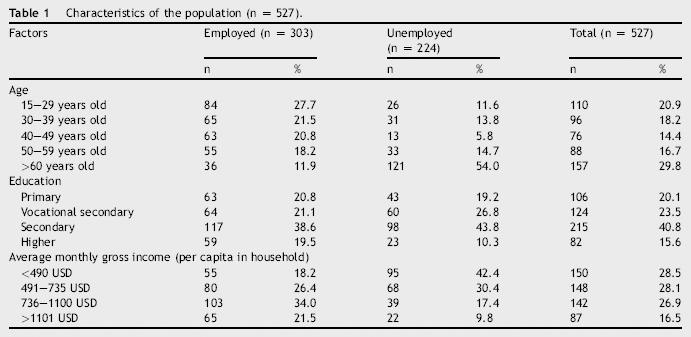
The sample consisted of 527 participants. Detailed characteristics of participants can be found in
Characteristics of the population (n = 527).
Data analysis procedure
The statistical analyses were run in IBM® SPSS® Statistics, version 21. The descriptive statistical analysis was used for the characteristics of the dependent variables in terms of Mean (̄x), Standard Deviation (SD±) and Medians (Me). The Kolmogorov–Smirnov test was used to verify if the data were normally distributed (the verified variables included vigorous and moderate physical activity and walking, in MET-min/week). Since the assumption of normality for given dependent variables was violated (alpha level at 0.05), a non-parametric test (U-Mann Whitney) was used for further analysis. In order to investigate the differences between the types and duration of physical activities undertaken by women with different work status, the Chi2 test was used (p < 0.05). Multi-variable logistic regression analysis was performed to find out the relationship between socio-demographic variables (age, education, income, place of residence and employment status) and the amount of exercise recommended by the World Health Organization (WHO) (moderate physical activity ä150 min/week or vigorous physical activity ä75 min/ week, or the equivalent combination of moderate and vigorous activity) (
Results
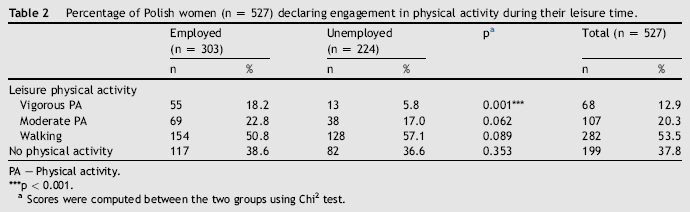
The results show that over one-third (37.8%) of the respondents (n = 527) did not engage in any physical activity in their leisure time. Among those Polish women who were physically active in their free time, 53.5% undertook walking, 20.3% engaged in moderate and 12.9% in vigorous physical activity (
Percentage of Polish women (n = 527) declaring engagement in physical activity during their leisure time.
PA – Physical activity.
p < 0.001.
Scores were computed between the two groups using Chi2 test.
A multivariable logistic regression was performed to predict meeting WHO recommendations by taking up adequate dose of LTPA from selected socio-demographic criteria (age, education, income, professional status, place of residence). Although the analysis showed that the model was statistically significant (Wald z = 27.3; p < 0.001), the “pseudo” R estimates indicated that it explained between 14.2% (Cox & Shell R2) and 19.2% (Nagelkerke R2). The only significant predictors were age (Wald z = 12.0; p < 0.05) and professional status (Wald z = 19.7; p < 0.05). However, 15–29-year-old women are the odds of meeting the WHO recommendations 3.2 higher than in the group of those over 60 years old (Wald z = 5.1; p < 0.05). This study has been confirmed by numerous authors so far. As far as professional status is concerned, the unemployed women were 3.3 less likely to meeting WHO recommendations (Wald z = 4.7; p < 0.001) than the other groups. Therefore, the authors found it crucial to investigate intensity, frequency and duration of their LTPA in comparison with the employed ones.
Employed women engaged in vigorous exercise more often (18.2%) than those who were unemployed (5.8%) (Chi2 = 17.5, p < 0.001).
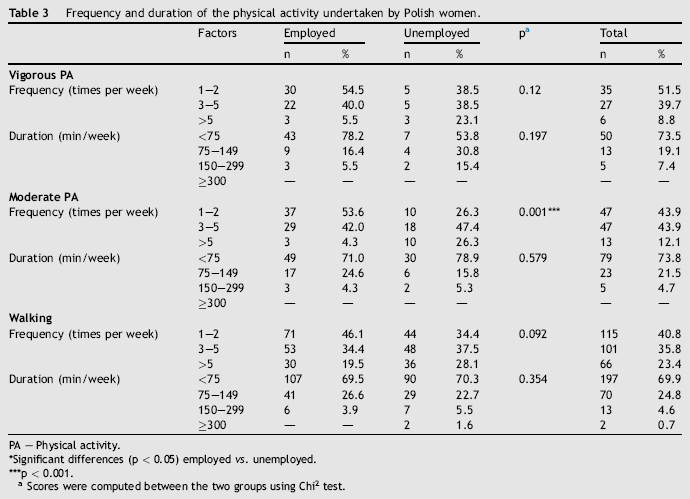
The analysis of the frequency and duration of undertaken physical activities did not yield significant differences between employed and unemployed Polish women when vigorous activity and walking were considered (
Frequency and duration of the physical activity undertaken by Polish women.
PA – Physical activity.
* Significant differences (p < 0.05) employed vs. unemployed.
p < 0.001.
Scores were computed between the two groups using Chi2 test.
However, there was a significant difference between the groups of respondents when the frequency of moderate physical activity was taken into account (Chi2 = 14.1, p < 0,001). It appears that more employed women engaged in activity of this intensity 1–2 times per week (53.6%) than those who were unemployed (26.3%). However, the former group rarely undertook moderate exercise >5 times per week (4.3%) unlike the latter group (26.3%).
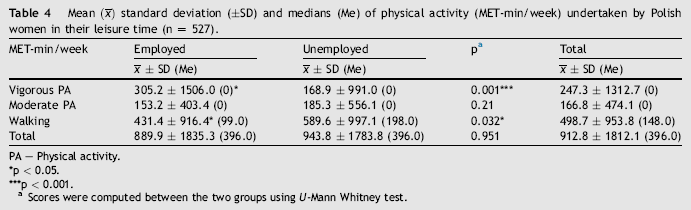
The analysis of the average energy expenditure of the leisure time physical activity for Polish women (MET-min/ week) yielded significant differences between the investigated groups of respondents for vigorous activity and walking (
Mean (
PA – Physical activity.
p < 0.05.
p < 0.001.
Scores were computed between the two groups using U-Mann Whitney test.
Based on the frequency, duration and MET-min/week for all three levels of physical activity intensities, it was possible to predict if the women taking part in the study are able to achieve the
Engagement in physical activity that determines meeting the recommended PA norms for maintaining health by Polish women (n = 527). Odds ratio (OR) and 95% confidence intervals are included in the table.
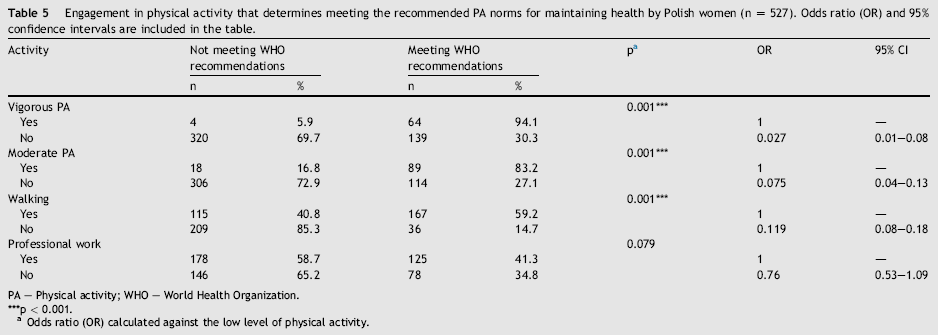
PA – Physical activity; WHO – World Health Organization.
p < 0.001.
Odds ratio (OR) calculated against the low level of physical activity.
Discussion
When modern Polish women are put in the spotlight, it appears that they are in control of their lives: competent and professional in their careers and family lives (
Physical activity for women, just like for men, is an important part of health and recreation (
The results of this study show that employed women engage in vigorous physical activities more often (18.2%) than those who are unemployed (5.8%) (p < 0.001), which is in line with the findings of
Engagement in vigorous exercise increased the possibility of meeting the recommended physical activity amount 37-fold (OR = 0.027), whereas the lack of moderate activity increased the risk of inactivity 13-fold (OR = 0.075) (8-fold for lack of walking (OR = 0.119)). The researchers would like to highlight that sufficient LTPA is crucial in preventing the metabolic syndrome (MetSyn). Non-physically active women are at high risk of MetSyn across all OCPA groups (
Therefore, not only is the type of activity important, but the duration, frequency and intensity of the physical activity should be analysed. Previous work by Nowak drew attention to the differences in leisure time activities between working and permanently passive Polish women (
The results of the frequency of undertaken physical activity (both vigorous activity and walking) did not show significant differences between employed and unemployed women. Vigorous exercise was undertaken 1–2 times per week (51.5%), 3–5 times per week (39.7%) and 5 times per week (8.8%). For comparison, 21.2% of women are vigorously active (>20 min/day >3 days/week) according to 2003 BRFSS (
Although according to previous studies, walking is the most popular form of activity among women (particularly those with lower fitness level) (
In the case of moderate physical activity, fewer unemployed Polish women (26.3%) undertook exercise of this intensity level 1–2 times per week than their employed counterparts (53.6%) (p < 0.001), but they engaged in moderate activities more than 5 times per week more often than the employed women (26.3 vs. 4.3%, respectively).
The duration of vigorous and moderate physical activity, and walking did not differ between employed and unemployed Polish women. As many as 73.5% of women declared vigorous exercise lasting less than 75 min per week, 19.1% 75–149 min per week and 7.4% 150–299 min per week. These fractions were 73.8%; 21.5% and 4.7% for the moderate activities, and 69.9%; 24.8% and 4.6% for walking.
The average energy expenditure of the overall physical activity for Polish women was 912.8 ± 1812.1 (Me = 396.0) MET-min/week (vigorous average energy expenditure: 247.3 ± 1312.7 (Me = 0) MET-min/week, moderate average energy expenditure: 166.8 ± 474.1 (Me = 0) MET-min/week, and walking: 498.7 ± 953.8 (Me = 148.0) MET-min/week). This expenditure was much lower than that of Norwegian women (ä12 years of education: 1389; <12 years of education: 1024 MET-min/ week) (
The MET-min/week of Polish women was significantly higher for the vigorous physical activity (p < 0,001) among employed (305.2 ± 1506.0; Me = 0) than unemployed women (168.9 ± 991.0; Me = 0). The opposite pattern was observed for walking (employed: 431.4 ± 916.4; Me = 99.0; unemployed: 589.6 ± 997.1; Me = 198.0 MET-min/week).
The potential limitation of the current study is a self-reported PA, which causes substantial overestimations of declared activities (
Conclusion
Polish women nowadays (regardless of whether they are employed or not) still do not engage in a sufficient amount of physical activity in their leisure time to maintain their health, therefore, intervention programmes in both groups are suggested. Programmes promoting physical activity should be developed by taking into account the level of intensity, frequency and duration of exercises. The fact that employed women engaged more often and more enthusiastically in vigorous activities than unemployed women may be an indication of further studies. The duration of the activities, regardless of their type, does not differentiate the investigated groups.
Footnotes
Acknowledgements
The research was conducted by GfK Polonia and commissioned by the Ministry of Sport and Tourism of the Republic of Poland.