






Abstract
Objective/Background
To review the evidence of rehabilitation interventions for the management of poststroke hand oedema.
Methods
We conducted a systematic review of research articles in electronic databases published in English between 1999 and 2015. Two investigators working independently retrieved articles from the Cochrane Central Register of Controlled Trials, SCOPUS, Taylor & Francis Online, Wiley Online Library, CINAHL, Springer (MetaPress), ScienceDirect, PubMed, SAGE Journals Online, EBSCO, and Web of Science. Only controlled trials with outcome measures and interventions for poststroke hand oedema were included. Three investigators critically appraised the selected studies using the Physiotherapy Evidence Database Scale.
Results
Of the 189 articles identified, nine (5 randomized controlled trials, 3 nonrandomized controlled trials, and 1 crossover controlled trial) were selected. These studies are heterogeneous in terms of design and types of intervention for poststroke hand oedema. The interventions reducing hand oedema are Lycra pressure garments with glove splints, bilateral passive motion upper-limb exercises, laser therapy, and acupressure. However, due to these studies’ short intervention periods and the fact that hand oedema is not their primary outcome measure, it is not possible to draw a firm conclusion on their clinical significance for managing poststroke hand oedema.
Conclusion
Further study needs to focus solely on interventions for poststroke hand oedema and their long-term effects. No conclusion can be made on the most effective management of poststroke hand oedema until much more evidence is available.
Introduction
Poststroke hand oedema occurs in 37% of individuals who experience a chronic stroke and in up to 18.5% of individuals with acute stroke (
Methods
Search strategy
This systematic review included articles from 1999 to 2015 found on the following electronic databases/data sources: the Cochrane Central Register of Controlled Trials, OneSearch—a central electronic search engine covering 10 databases including SCOPUS (Elsevier API), Taylor & Francis Online, Wiley Online Library, CINAHL, Springer (MetaPress), ScienceDirect, PubMed, SAGE Journals Online, EBSCO, and Web of Science. The titles and abstracts of the articles among the search results were assessed for relevance by two independent investigators. Additional search methods included using Google Scholar and manually searching the reference lists of full copies of all relevant articles identified. The keywords used were stroke, hand oedema, and hand swelling.
Selection criteria
Strict inclusion criteria were applied as follows. Only controlled trial studies (i.e., randomized controlled trials [RCTs], non-RCTs, crossover controlled trials) whose full text was available and published in English, and which included outcome measures for poststroke hand oedema and interventions to manage it were included in this review. The study population included adults at all stages of stroke. Studies on the prevalence, aetiology, and assessment of poststroke hand oedema and systematic reviews were excluded.
Assessment of Methodological Quality
The selected studies were classified based on the Oxford Centre for Evidence-Based Medicine level of evidence (
Results
Study selection
The initial search strategy identified 189 articles on the Cochrane Central Register of Controlled Trials (n = 21), OneSearch (n = 166), Google Scholar (n = 1), and by manual search (n = 1). Two independent researchers reviewed the titles and abstracts of these articles and excluded 180. The main reasons for exclusion were that the studies focused on the prevalence, aetiology, and assessment of poststroke hand oedema; were duplicates; or were not relevant to the management of poststroke hand oedema. Both reviewers agreed that nine of the articles satisfied the criteria and were suitable for full review. A Preferred Reporting Items for Systematic Reviews and Meta-Analyses (PRISMA) flow diagram showing details of the search process can be found in
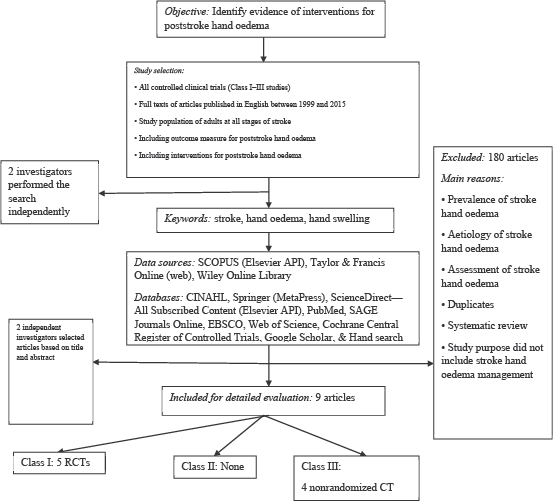
Flowchart of evidence search.
Characteristics
Nine studies were selected for systematic review (
PEDro Scale.
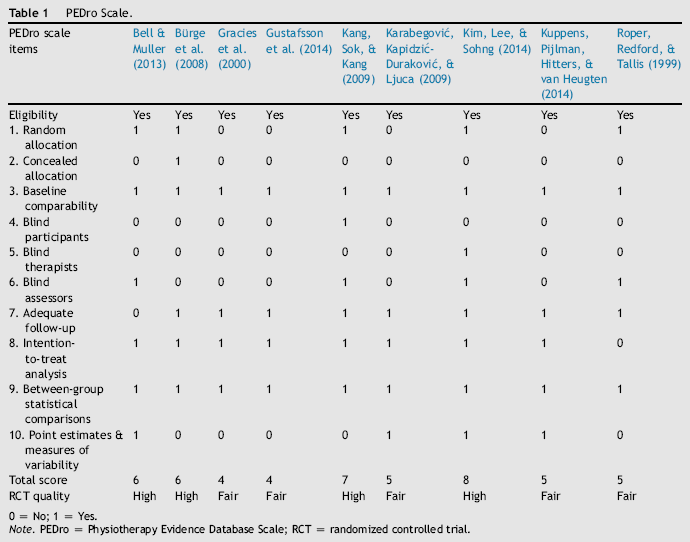
0 = No; 1 = Yes.
Note. PEDro = Physiotherapy Evidence Database Scale; RCT = randomized controlled trial.
The studies compiled in this review represented 424 participants, with samples ranging from eight to 206 participants. The mean age of participants ranged from 55.2 years to 74.5 years. One study recruited patients in the acute stage of stroke (
Characteristics of the Participants Recruited to Each Study.
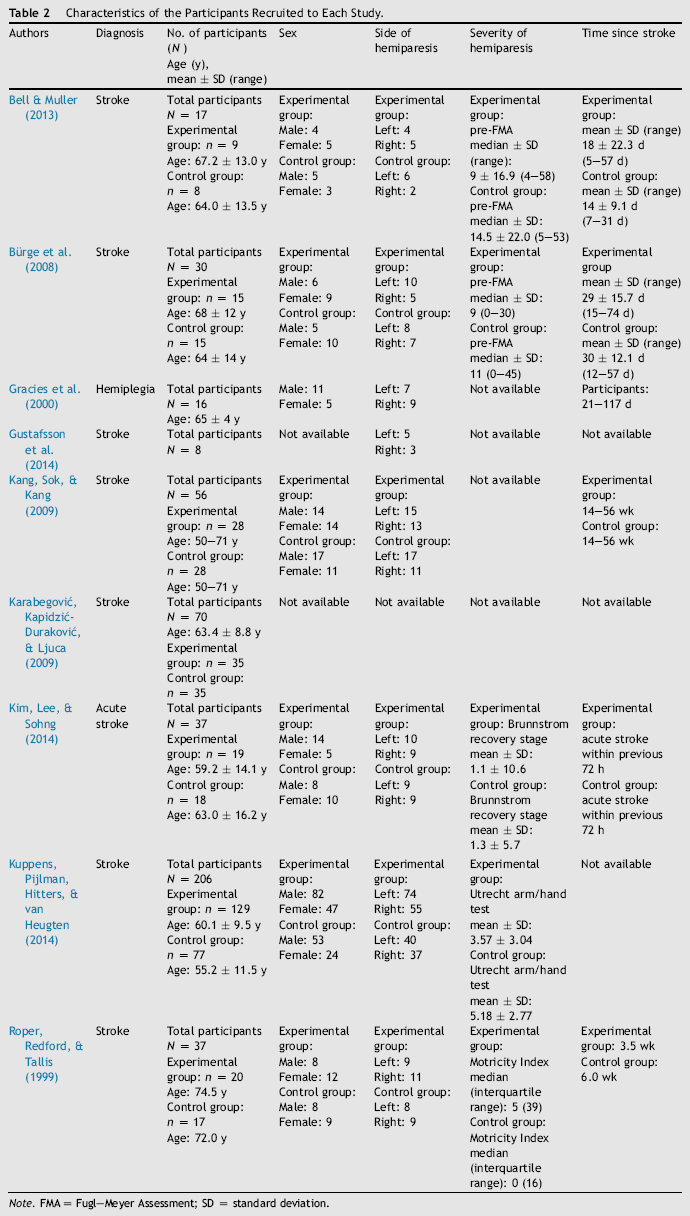
Note. FMA = Fugl–Meyer Assessment; SD = standard deviation.
The outcome measures used for poststroke hand oedema were circumferential measurements using a measuring tape or jeweller's ring measurement device and measuring hand volume using a volumeter. The upper-limb sites used for circumferential measurements were the metacarpophalangeal joints (MCPJs) and the wrist joint (
Summary of Studies Investigating the Use of Different Interventions for Poststroke Hand Oedema.
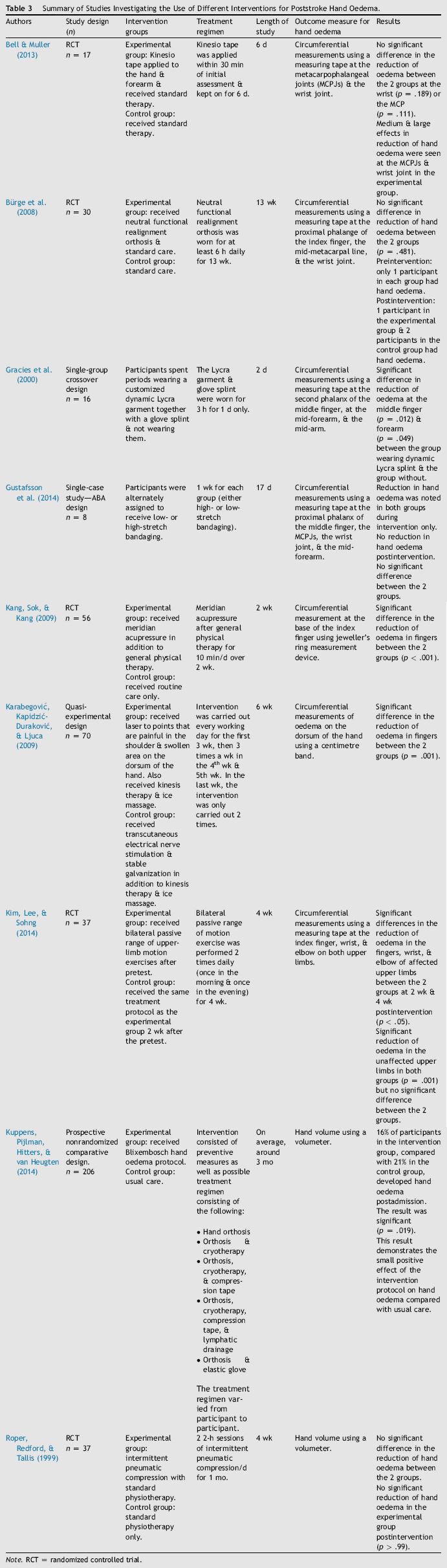
Note. RCT = randomized controlled trial.
Interventions for Poststroke Hand Oedema
Compression therapy
Two RCTs and one crossover controlled trial investigated the effect of compression therapy on the management of poststroke hand oedema (
In a more recent study,
The efficacy of high- and low-stretched compression bandages was investigated by
Orthosis
Three studies investigated the effects of orthosis on poststroke hand oedema. The first was an RCT (
The participants in the experimental group of the RCT study by
In the single-subject crossover trial study by
The participants in the experimental group of the nonrandomized comparative trial by
Mobilization
The RCT by
Contemporary therapies
Laser therapy.
A quasi-experimental study by
Acupressure.
An RCT by
Discussion
Effectiveness of Interventions for Management of Poststroke Hand Oedema
The interventions that show significant treatment effect in reducing poststroke hand oedema are the Lycra garment with glove splint, bilateral passive range of upper-limb motion exercises, laser therapy, and acupressure. However, because the intervention period for the Lycra garment with glove splint was only 3 hours, the significance of the study may not be translatable into clinical practice due to its small changes (
The interventions demonstrating nonsignificant treatment effect are bandaging, intermittent compression, kinesio tape, neutral functional realignment orthosis, and hand realignment orthosis. The nonsignificant effect of intermittent compression on hand oedema might be due to inadequate treatment parameters or the fact that the patients did not receive the full treatment regimen (
Limitations of the studies chosen
Most of the studies were not double blinded, which may have reduced their quality. Only four of the nine studies investigated hand oedema exclusively (
Limitations of the systematic review
One of the limitations is that, due to the diversity of rehabilitation interventions and the limited evidence for each, the findings of this review cannot serve as a clinical guide to the management of poststroke hand oedema in the literature.
Conclusion
Occupational therapists are commonly involved in the management of poststroke hand oedema in hospitals or convalescent institutions. However, no firm conclusion on their clinical effectiveness in managing poststroke hand oedema can be drawn at this stage. More research is needed in this area. Future work should focus solely on interventions for poststroke hand oedema and the long-term outcomes of poststroke hand oedema management. The effectiveness of contemporary interventions such as laser therapy and meridian acupressure on poststroke hand oedema should also be investigated as they show promising results.