






Abstract
The Kazakh poet Abai Qunanbaiuly (1845–1904) today enjoys a dual legacy as the father of modern Kazakh literature (as distinct from its oral tradition) and also as an enlightener who translated the Russian classics into Kazakh and acted as a vital bridge between the two cultures. Much of Abai's reputation owes its existence to the twentieth-century author, critic, and scholar Mukhtar Auezov (1897–1961), whose biographical writings on the poet formed the standard narrative of his life and work. Initiated in 1937, the year of the Pushkin centennial celebrations in the Soviet Union, Auezov's literary canonization of Abai hinges on the poet's acquisition of the Russian language and his transformative encounters with Russian-language texts – most notably among them, Pushkin's
Keywords
Introduction: The unknown Kazakh
In the spring of 2012, in the wake of Vladimir Putin's controversial re-election to a third term as President of the Russian Federation, the swelling anti-government protest movement in Moscow galvanized around a most unusual focal point: a statue of the nineteenth-century Kazakh poet Abai Qunanbaiuly (1845–1904) on the central boulevard of Chistye Prudy. Most Moscow protesters were initially oblivious to the man's identity – opposition leader Aleksei Navalnyi urged people via Twitter to gather at the “monument to that unknown Kazakh” (
Abai, who, in the true fashion of a cultural icon, is known by his first name alone, enjoys a dual legacy in Kazakh culture. First, he is known as the father of modern Kazakh literature, as well as a vital bridge from the Kazakh oral tradition to the national, written one. He is also known as an enlightener, who translated the classics of Russian literature into Kazakh and provided an important point of contact between the two cultures during the Russian conquest in the late nineteenth century. In a collected works volume commemorating the 150th anniversary of Abai's birth, a mere three years after Kazakhstan gained its independence, the country's newly elected president Nursultan Nazarbayev neatly summarized Abai's significance in Kazakh culture. He lauded the poet's work as “a true reflection of the Kazakh people's mentality and existence,” characterizing Abai as the epitome of the Kazakh nation's “bitter struggle for freedom, independence, and the preservation of national pride” (Akhmetov, 1994: 2). In the same volume, the critic Z. A. Akhmetov pointed out that although Abai “reviled” Russian colonization, he viewed Russian culture as a “window” to the world. Akhmetov then drew a familiar analogy to describe Abai's legacy: “just as Pushkin was Russia's spiritual father, so too did Abai become the founder of Kazakh culture” (Akhmetov, 1994: 23). Yet evaluations of Abai's life and work were not nearly as laudatory in the pre-Stalin era. Providing a blunt contrast to the worshipful words of the Kazakhstani president, a Soviet scholar remarked in 1923 that, “the Russian book awakened [Abai's] poetic soul,” and “if not for the powerful [
The path of Abai leads through Pushkin
Abai was born into an aristocratic Kazakh family in 1845 in a rural area outside the Russian colonial outpost of Semipalatinsk, where Fedor Dostoevskii would go on to spend several life-changing years in exile in the 1850s.
1
He received a customary Islamic education, first from a village mullah, then at the
The area around Semey (formerly Semipalatinsk) is significant in Kazakh history— it is not only the home of Abai and his Soviet biographer Mukhtar Auezov, but it was also the epicenter of the Kazakh intelligentsia in the early twentieth century as well as the headquarters of the separatist party Alash Orda and the short-lived Alash Autonomy (whose history was repressed in Soviet times), and finally as the site of the Soviet government's secret nuclear testing facility, the Semipalatinsk “Polygon.” After years of environmental devastation, the Polygon became an important site of the Kazakh fight for self-determination, as the center of the Nevada-Semipalatinsk anti-nuclear movement.
This is a common narrative in Soviet multinational literature, in which a young 19th century writer at the periphery of the Russian Empire is exposed to progressive ideas through the mentorship of exiled Russian intellectuals, and is then inspired to become the founder of a national tradition. One well-known example in the Azeri context is
In Abai's lifetime, the Kazakh literary language was only beginning to be formed. Beginning in the 1860s, the first Kazakh materials were printed in the Tatar intellectual center of Kazan'—the location of the nearest Arabic-script printing press. See Isabelle Kreindler, “Ibrahim Altynsarin, Nikolai Il'minskii and the Kazakh National Awakening,”
The first published assessment of Abai's work appeared in the journal
Gulnar Kendirbaeva discusses Abai's reception as a “poet of a new type” among the Kazakh intelligentsia during his lifetime and immediately following his death in “We Are Children of Alash…” The Kazakh Intelligentsia at the Beginning of the 20th Century in Search of National Identity and Prospects of the Cultural Survival of the Kazakh People,”
The Abai legend – and with it, the basis for the Kazakh literary tradition as we know it today – was carefully cultivated in the early Soviet period by the Kazakh writer and literary scholar Mukhtar Auezov, who was a younger distant relative hailing from the same region. The major episodes of Abai's life story, as well as most published editions of his work, were the result of Auezov's exhaustive efforts to document, preserve, and propagate his forebearer's legacy. Auezov began this project in the prerevolutionary era, but it was not until the late 1930s, after returning home from a stint in the GULAG on charges of “bourgeois nationalism,” that Auezov's work gained widespread renown. In 1937, at the height of the Stalinist purges as well as the union-wide Pushkin jubilee celebration, Auezov brought his renewed efforts to the Soviet reading public with an article strikingly titled “How Tatiana Sang in the Steppe,” which featured Abai's translations of excerpts from Pushkin's
Mukhtar Auezov, “
The success of
Several passages of “The most valuable thing to me, and to our people, is knowledge and enlightenment … And these things are in the hands of the Russians. And if the Russians give me that treasure, which I sought my whole life in vain, how could they be distant from me, how can they be alien?” (Auezov, 2004 vol. 1: 364–365)
7

By rendering the alien familiar and the distant close, the “treasure” of enlightenment triggers a personal transformation in Abai. As the medium of enlightenment, it is the Russian language that makes this transformation possible. Auezov spends several chapters detailing Abai's process of teaching himself Russian, and the momentous change in consciousness that takes place as a result of his contact with the Russian book. While books in Chagatay,
8
Persian, and Arabic invite Abai into the “flowering gardens,
Soviet historians of Central Asia re-cast Chagatay, the pan-Turkic literary language of Central Asia, as “Old Uzbek.” Notably, the language appears as “Chagatay” in the Kazakh version, but as “Old Uzbek” in the Russian translation. See Auezov trans. Sobolev 1950: 293.
Along with Chagatay, which Abai read freely, there lay Arabic and Persian books, which were more difficult for him, and Russian books, which were harder still. […] Russian books uncovered before his eyes the secrets of the waters, sands, and deserts of Central Asia, Iran, Arabia, and the life of their large, commercial cities. What interested Abai most of all was the contemporary life of these countries. As he read, he made detailed notes on the caravan routes and waterways, about big cities and bazars. All of this knowledge was indispensible for a traveler setting out to these far-off regions today. (Auezov, 2004 vol. 2: 3–4) 9
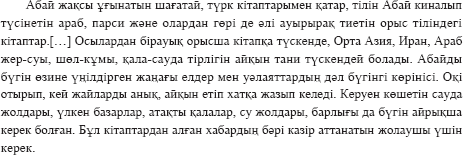
Although Abai laments that he missed the chance to learn Russian as a child, Russian books soon become his “inseparable friends” and he begins to collect them with great care in spite of his fellow villagers, who react to the strange, impenetrable Russian writing with superstitious fear:
[W]hen they noticed that the book opened from the left and that its pages were illustrated, and when they looked closer and saw the level, steady flow of Russian lines instead of intricate Arabic letters – they recoiled from the book in shock, and fell silent on the spot. (Auezov, 2004 vol. 2: 396)
10

Here Auezov's description of the “level, steady flow of Russian lines” takes on additional significance in light of the novel's historical context – at the time the first volume was published in the early 1940s, the Stalinist campaign to institute the Cyrillic alphabet for the languages of Central Asia was well underway, supplanting the Latinization campaigns of the 1920s and 30s. This is but one component of what David Brandenberger calls a “major ideological about-face” in the Stalin era, in which Russocentric notions of Soviet power came to replace earlier internationalist principles (Brandenberger, 1999: 68). Michael Smith points out that in the years following the Second World War the Russian language was upheld as “the object of popular veneration, a sacred relic of the war against fascism and a living symbol of the might and right of the victorious Russian people,” with the nineteenth-century poet Alexander Pushkin as its best-known representative (Smith, 1998: 164).
Pushkin's own monumental significance at this time in Soviet history is examined in depth by Stephanie Sandler (2004, 2006) and, most recently, Jonathan Platt in his 2016 study
The Stalin-era refashioning of Pushkin into a Soviet cultural icon sheds light on Abai's own rise to the status of Kazakhstan's national poet, and both of these processes are intertwined in Auezov's biographical novel. Abai's formation as a poet and intellectual is solidified when he discovers Pushkin for the first time – not initially through All winter Abai surrounded himself with aides, textbooks and dictionaries, sitting just above the Russian books. In the spring, when it seemed that the light of a new world was revealed to him, he took hold of Pushkin. He began with prose and, reading it with delight, he felt that he understood absolutely everything. It was The deep spiritual satisfaction and particularly acute sense of life around him, which Abai now possessed, were caused by the encounter with this book: the book turned out to be like a fellow traveler you happen to meet on the road, and who suddenly becomes unexpectedly close friend. Abai had never experienced such joy. Today was a justification of his long seclusion, a justification of his departure from all the household chores and conversations: he found the passage he had been seeking for years in an attempt to reach the other shore, and he finally crossed over. (Auezov, 2004 vol. 2: 117–118)
11
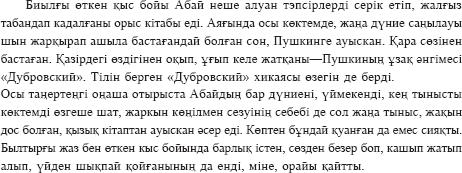
This triumphant encounter with Pushkin marks two psychological changes: first, Abai's recognition of the familiar in the foreign; but also his recognition of the inevitable “becoming-other” in the process of seeking out and understanding the foreign. The metaphor of motion, in which the Russian language enables the subject to “cross over” to the other shore, illustrates this momentous change in perspective. This process echoes Pushkin's own statement, quoted by Katerina Clark in her study of the Soviet novel, that translators are “the post-horses of civilization” (2000: 52).
However, with this breakthrough of “crossing over” and recognizing one's self in the other, Abai's problems of identification are just beginning. Despite finding and recognizing Pushkin as a fellow traveler, he still longs to convince his own people to cross over with him. For this endeavor, he appeals to one of the most iconic Russian characters of all: Tatiana, the heroine of Pushkin's novel in verse
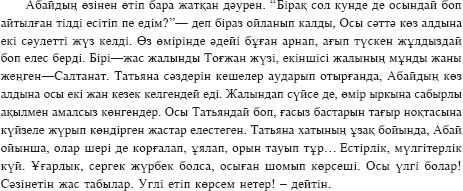
In this way the image of Pushkin, the ostensible father of all Russian literature and a symbol of Russian imperial prowess, is twice displaced and “disoriented”: first, within the narrative frame of Auezov's novel; second, on the level of the novel's Russian and Kazakh readership in the Stalin era. On both levels, Abai's encounter with Pushkin triggers the entextualization of Kazakh literature as described by Dubuisson (2009). Yet, crucially, this encounter echoes Russian literature's own entextualization a century earlier, emblematized by the work of
Tatiana, the young aristocratic woman who loves, loses, and famously rejects the eponymous hero of
Foreshadowing the struggles over national identity formation in the Soviet era, one of the central issues surrounding Tatiana's letter is language. French was the preferred language of communication for educated members of the Russian upper classes in the early nineteenth century, and although Pushkin was no exception in this regard, he was an advocate for the development of a uniquely Russian literary language and a corresponding literary tradition that would rival any in Europe. Throughout
Chapter 3, stanzas 26 and 27: Еще предвижу затрудненья:/ Родной земли спасая честь,/ Я должен буду, без сомненья,/ Письмо Татьяны перевесть./Она по-русски плохо знала,/ Журналов наших не читала/ И выражалася с трудом/ На языке своем родном,/ Итак, писала по-французски…/ Что делать! повторяю вновь:/ Доныне дамская любовь/ Не изьяснялася по-русски,/ Доныне гордый наш язык/К почтовой прозе не привык. […] “Не все ли, русским языком/Владея слабо и с трудом,/ Его так мило искажали,/ И в их устах язык чужой/Не обратился ли в родной?
Chapter 3, stanza 31: Письмо Татьяны предо мною;/ Его я свято берегу,/ Читаю с тайною тоскою/ И начитаться не могу./ Кто ей внушал и эту нежность,/ И слов любезную небрежность?/ Кто ей внушал умильный вздор,/ Безумный сердца разговор,/И увлекательный и вредный?/ Я не могу понять. Но вот/Неполный, слабый перевод,/ С живой картины список бледный/ Или разыгранный Фрейшиц/ Перстами робких учениц.
That the “pale copy” of Tatiana's letter would go on to become one of Russian literature's most memorable texts is a testament to the generative power of the interrelated acts of reading, writing, translating, and interpreting, as well as their dynamic role in the process of nation building. By asserting himself in the text as curator, translator, mediator, editor, and commentator, Pushkin's narrator lays bare the calculated deployment of mediation that is necessary in order to create the appearance of seemingly spontaneous and authentic emotional expression, as well as to embed that expression in meaningful cultural context. The resulting entextualization of Tatiana, in both a literal and metaphorical sense, paved the way for the development of Russian national idea throughout the literature of the nineteenth century. This process culminated in the Pushkin jubilee of 1880, in which the best-known luminaries of Russian literature gathered to assess the poet's legacy, to take stock of how far their tradition had come, and to speculate about its future (Clayton, 1985). Fedor Dostoevskii used the event as a platform to advocate a messianic view of Russian identity and destiny, with a controversial speech that proclaimed Tatiana to be “the apotheosis of a Russian woman,” possessing a “strong character, strongly standing on her own ground” as well as a rare instinct for “where and what is truth.” Thus, “in
Не такова Татьяна: это тип твердый, стоящий твердо на своей почве. Она глубже Онегина и, конечно, умнее его. Она уже одним благородным инстинктом своим предчувствует, где и в чем правда, что и выразилось в финале поэмы. Может быть, Пушкин даже лучше бы сделал, если бы назвал свою поэму именем Татьяны, а не Онегина, ибо бесспорно она главная героиня поэмы. Это положительный тип, а не отрицательный, это тип положительной красоты, это апофеоза русской женщины, и ей предназначил поэт высказать мысль поэмы в знаменитой сцене последней встречи Татьяны с Онегиным.
With this historical legacy and myth-making function in mind, the text of
The alchemical nature of this coalescence of the universal, the national, and the fragmentary did not escape Pushkin's immediate literary heirs in the 19th century, as can be seen in Dostoevskii's 1880 commemoration speech. Declaring that “there has never been a poet with such universal sympathy as Pushkin,” Dostoevskii identifies the “nearly perfect” and “miraculous” ability of the poet's spirit to reincarnate “into the spirit of foreign nations.” Yet at the same time, Pushkin's miraculous connection with the universal enables the expression of “national Russian power” and “the national quality [
[…] не было поэта с такою всемирною отзывчивостью, как Пушкин, и не в одной только отзывчивости тут дело, а в изумляющей глубине ее, а в перевоплощении своего духа в дух чужих народов, перевоплощении почти совершенном, а потому и чудесном, потому что нигде ни в каком поэте целого мира такого явления не повторилось. Это только у Пушкина, и в этом смысле, повторяю, он явление невиданное и неслыханное, а по-нашему, и пророческое, ибо… ибо тут-то и выразилась наиболее его национальная русская сила, выразилась именно народность его поэзии, народность в дальнейшем своем развитии, народность нашего будущего, таящегося уже в настоящем, и выразилась пророчески.
At this point Homi Bhabha's allegory of the “fortuitous discovery of the English book,” which he uses to foreground a theoretical discussion of British cultural imperialism, lends insight into the exceptional and possibly “miraculous” textual relationship between Auezov, Abai, Pushkin, Tatiana, and their respective literary traditions (Bhabha, 2004, 145–146; 149). Bhabha situates the allegory as a ubiquitous tale among the colonizers of the British Empire, in which an English book – usually the Bible – appears in the “wild and wordless wastes of colonial India, Africa, and the Caribbean” and “installs the sign of appropriate representation: the word of God, truth, art, creates the conditions for beginning, a practice of history and narrative.” In this way the English book becomes “an insignia of colonial authority and a signifier of colonial desire and discipline.” But even as its signifying power is accepted, the book is also refashioned in the hands of the colonized, as Bhabha demonstrates with an 1817 account from British India, in which a small community outside of Delhi discovers the Bible and accepts it as the word of God, but only after translating it, recopying it, and subsuming it entirely into their own local religious practice. Thus, “the institution of the word in the wilds is also an
In his 2011 study
Above all, the historical and ideological context of Auezov's biography, along with his deliberate implementation of Pushkin's commentary on the Russian vernacular and Russian national identity, becomes crucial to understanding Abai's encounter with the Russian colonizer's book. As one of the few members of the Kazakh intelligentsia to survive the purges of the 1930s (but only after serving two years in prison for his affiliation with “bourgeois nationalists”), Auezov found himself in a position of unprecedented responsibility – and authority – over the fate of Kazakh literature's nineteenth-century progenitors (Dzhuanyshbekov, 2007, 4–5). “How Tatiana Sang in the Steppe” and
The twenty-first century finds Abai undergoing yet another wave of makeovers, this time cast in the pantheon of national founding fathers for the independent republic of Kazakhstan. This process is manifested through film, stage, and television adaptations of his biography and literary works, new state-subsidized publications and translations of his works, educational materials, and the appropriation of his name and visage to mark spaces of state power: postage stamps, currency, place names, names of educational institutions, federal holidays celebrated in his honor, and even on public memorials in central Moscow. 17 In fact, the mass commemoration of Abai has elevated him to the status of a near-religious figure in contemporary Kazakhstan (Dubuisson, 2009, 38). Thus, taken as a whole, the Abai legend corresponds to Bhabha's characterization of the miraculous encounter with, and appropriation of, the English book in colonial India: “at once, a moment of originality and authority.” Yet the question remains: at what cost? The “originality and authority” employed by Auezov in forging the Abai legend – the foundation of the Kazakh literary canon – was also necessarily an act of erasure, exclusion, and revisionism. If we view the formation of the modern Kazakh canon as a story in its own right, a narrative, driven by institutions and power under Stalin, the “miracle” of the Russian book easily gives way to disenchantment. Who is left out, rendered subaltern, in the wake the Abai legend? What other voices were drowned out by Tatiana's voice as it rang across the steppe?
For a study on the larger process of signification involved in elevating historical figures to national symbols in Central Asia, see Diana Kudaibergenova, “‘Imagining Community’ in Soviet Kazakhstan. An Historical Analysis of Narrative on Nationalism in Kazakh-Soviet Literature,”
Conflict of interest
None.
Acknowledgments
I wish to thank Adeeb Khalid for his feedback on an early draft of this paper, and I also wish to express my gratitude to Michael Hancock-Parmer for his 2012 blog post on Registan.net, “Abai – the Historical Figure,” which not only inspired this study but also raised many central questions about Abai's life and legacy that are deserving of further scholarly attention. Research for this project was made possible by funding from the ULCA Dissertation Year Fellowship and the US Department of State Title VIII Research Scholar program.