






Abstract
What has been the reaction of Kazakhstan toward the rising power and influence of Russia since 1994? This paper uses the concept of soft-balancing, specifically analyzing economic issues using Stephen Walt's balance of threats approach, in an analysis of Kazakhstan's relationship with Russia. It examines instances of Kazakhstan's internal and external economic soft balancing efforts vis-à-vis Russia to explain how it used economic tools to protect its energy security from Russia.
After 1991, which marked the collapse of the Soviet Union, the newly independent countries of the former Soviet Union – the Commonwealth of Independent States (CIS), including Kazakhstan, needed to create an institution that could tackle economic and energy problems in the region. I argue that the Eurasian Union idea promoted by the president of Kazakhstan, Nursultan Nazarbayev, was a skillful attempt to simultaneously maintain a close cooperation with Russia and to soft balance against Russia's influence through collaboration with other CIS countries. However, that initiative failed and did not have the intended economic soft balancing effect.
When Russia started asserting its economic and political power over the Central Asian and Caspian regions, Nazarbayev once again resorted to the economic soft balancing policy, but this time by relying on outside players. Part 2 of this article discusses two cases of such external economic soft balancing efforts: participation in the Baku–Tbilisi–Ceyhan (BTC) pipeline project, and the economic cooperation with Turkey as part of a free trade zone. The BTC pipeline project and the close economic cooperation with Turkey ended up being a more productive soft balancing effort than the earlier Eurasian Union initiative.
Keywords
Introduction
In 1991 the collapse of the Soviet Union and the formation of new states on its former territory was a historic turning point. However, Moscow has not abandoned its attempts to maintain influence over its former territories. During the Yeltsin period, the nature of interactions between Russia and the Central Asian countries, including Kazakhstan, was based on the postulate of “preserving its influence in Central Asia by any means” (Mesheryakov, 2014) and “if not as a global power, at least as a Eurasian power” (Malashenko, 2013, p. 21).
This was especially dangerous for Kazakhstan, which is the only Central Asian state sharing a long border with Russia, and the only Central Asian state whose sovereignty and territorial integrity were threatened by the presence of ethnic Russians in its northern regions. A number of researchers have commented on the serious nature of the ethnic situation, which has been a national threat. 1
For instance, Pinar Ipek claimed that there was a potential threat to Kazakhstan's territorial integrity from ethnic Russians (Ipek, 2007, p. 1180). Another researcher, Olivier Roy has emphasized the weight of the Russian presence in Central Asia as being the result of Russian neo-imperialism, and discussed the presence of substantial numbers of Russian military on the border, as well as Russian irredentist claims over territory in northern Kazakhstan (Roy, 2000, p. 190). Marlene Laruelle and Sebastien Peyrouse have also looked into the influence of Moscow on Central Asian states, arguing that these states “have become ‘victims’ of Russian – and Chinese – authoritarian pressures” (Laruelle & Peyrouse, 2013, p. 14).
Nevertheless, there is no significant literature on the energy threat emanating from Russia. Being both major producers and exporters of raw materials, Kazakhstan and Russia are competitors for foreign markets. In the early 1990s, Kazakhstan opened joint ventures with foreign capital, which enabled the country to find new markets. Starting on the path of political, economic self-development in 1994, Kazakhstan developed and defined an independent economic strategy as a sovereign state (Kazakhstan, 1994, p. 22). Nazarbayev held that the export of raw materials and energy resources was important for the economic development of Kazakhstan (Nysanbaev & Dunaev, 2010, p. 14). However, as Kazakhstan is landlocked between Russia and China, it did not have any option but to export its oil through Russian territory. Aware of this fact, Russia tried to dictate the terms of price along their own lines and volumes supplies of Kazakhstan's oil, which will be discussed in detail in Section 2.1. Therefore, to protect its energy security, Kazakhstan started to diversify its export routes through the Baku–Tbilisi–Ceyhan (BTC) pipeline and Kazakhstan–China oil pipeline Atasu–Alashankou. By diversifying its energy export routes, Kazakhstan not only decreased its dependence on Russian oil pipelines, but started to compete with Russia for foreign markets. For instance, Kazakhstan joined the BTC pipeline to compete with Russia for the European market and had a lot of deals with China to earn its place in the sun before its competitor Russia. According to the Kazakh scholar Laumulin, “Threats to the economic independence of Kazakhstan include economic factors which would weaken security, (…) which would limit Kazakhstan's presence in foreign markets” (Laumulin, 1997, pp. 116–117).
Thus, Kazakhstan had to protect its security from the threat posed by Russia. In this paper, I argue that the Kazakhstan government was very concerned with protecting its energy security from Russia, which had attempted to limit the diversification of Kazakhstan's oil routes and cut off Kazakhstan's efforts to bypass Russian territory. As Alexander Cooley noted, for Kazakhstan “happiness is multiple pipelines” (Cooley, 2012, p. 9). The government of Kazakhstan was aware that it needed an economic tool that would allow for balancing and at the same time strengthen its economic and political position. This tool is called soft balancing, and with its help Kazakhstan worked to strengthen its own capacities.
Over the past years, analysis of soft balancing has played a critical role in understanding the behavior of weaker states toward more powerful states. Advocates of the concept of soft balancing offer a wide range of definitions. Some have described soft balancing as a policy that pursues alliances to obtain outcomes against the will of a dominating power (Walt, 2005, p. 126). Others emphasize the nonmilitary tools weaker states use to delay, frustrate, and undermine stronger states (Pape, 2005, pp. 7–45; Paul, 2005, pp. 46–71). Critics argue that the theory lacks the consideration of alternative explanations for a state's behavior vis-à-vis a hegemon's actions (Brooks & Wohlforth, 2005, pp. 74–75). They hold that it is not a new concept, that the same behavior occurred in earlier periods, and it is no more than a normal diplomatic exchange, and not a response against the unipolarity of a hegemon (Lieber & Alexander, 2005, p. 139). However, the purpose of this article is not to argue for or against the soft balancing theory, but rather to examine if the theory can explain Kazakhstan's strategy vis-à-vis Russia.
In this article I will apply Stephen Walt's balance of threats approach in combination with his soft balancing theory, according to which states “join alliances to protect themselves from states or coalitions whose superior resources pose a threat” (Walt, 1987, p. 18). Walt identifies four factors that determine how threatening a state is perceived by others, which are aggregate power, geographic proximity, offensive power and aggressive intentions by a stronger state (Walt, 1987). Building on this, I would define the following factors as significant in understanding whether a state might become an energy threat: competition over foreign markets and dependence on foreign countries’ oil pipelines to export their own oil. Kazakhstan has a geographical proximity with Russia and they are members of many common organizations, which make the soft balancing policy based on Paul and Pape's definition, 2 difficult to apply. In his book, which looks at soft balancing, Walt argues that collaboration with others helps to improve one's own bargaining position in global negotiations, irrespective of the issue, to gain privileges from greater powers (Walt, 2005, pp. 126–129). Therefore, through economic cooperation with Turkey, Kazakhstan could improve its position at the bargaining table when dealing with Russia.
According to Pape and Paul, soft balancing policy uses international institutions, economic statecraft, and diplomatic arrangements to oppose a hegemonic power. For details on soft balancing, see Pape (2005, pp. 7–45) and Paul (2005, pp. 46–71).
Although Walt's soft balancing theory provides the conceptual foundation for this study, Stephen Walt's soft balancing theory needs to be modified to fit the case of Kazakhstan. According to Walt, “states may balance externally, by combining their capabilities with others, or they may balance internally, by mobilizing their own resources in ways that will enable them to resist stronger states effectively. Or they may do both. In any case, the goal is the same: to ensure that a more powerful state (or coalition) cannot use its superior capabilities in ways that the weaker side will find unpleasant” (Walt, 2005, p. 120). In this framework, Kazakhstan would be seen to be using both types of balancing, which are called internal soft-balancing and external soft-balancing. However, I argue that there is another kind of internal balancing, which could be done within a larger transnational organization, using the Eurasian Economic Union as an example. Weaker states can bring a stronger state into the organization and bind its influence through common legitimacy and other constraining tools as a means of keeping the stronger state under control. To highlight the legitimacy of this example, I draw attention to the initiative for the establishment of Eurasian Union proposed by the President of Kazakhstan, which was an attempt to control Russia within this organization through cooperation with CIS countries. Yet the Eurasian Union initiative failed because the majority of the CIS countries feared losing their sovereignty. This question is analyzed in the first part of this paper.
Since Putin has come into power, the foreign policy of Russia has changed from a global to a regional focus. Russia began to build up its military, economic and political potential in the Central Asian region, which has led to the emergence of such organizations as the Collective Security Treaty Organization (CSTO) and the Customs Union. In the initial phase of the Customs Union, Kazakhstan started to lose out the organization, while over the next few years Russia increased its influence in the energy and other sectors. To decrease the strong influence of Russia, Nazarbayev once again resorted to soft balancing, by forming strong bonds of cooperation with such outside actors as Turkey. The BTC pipeline, which bypasses Russian territory, has been vital to Kazakhstan improving its bargaining position with Russia, which has led to an increase in Kazakhstani oil transit through the Russian Caspian Pipeline Consortium (CPC). Moreover, by diversifying its routes, Kazakhstan can strengthen its energy security. In effect, Kazakhstan was able to gain some leverage in its relationship with Russia, which is discussed in more detail in Section 2.
Economic strategy plays an important role in this balancing act. This paper studies and analyzes the economic approach of soft balancing policy used by Kazakhstan in its relationships with Russia, and attempts to explain the benefits of the economic tools that could be employed for pursuing its energy interests. This paper is significant because there has so far been no research conducted on the application of soft balancing theory in the case of Kazakhstan.
Nazarbayev's Eurasian Union initiative
The state of the global economy and geopolitical processes in the world has brought about another trend – the need for integration, especially in the case of CIS countries, which hold a unique geopolitical and geographical position. On the one hand, CIS countries needed the union to protect their interests in the complex global world, surrounded by the European Union, Association of Southeast Asian Nations (ASEAN), as well as countries to the south, such as Iran, Afghanistan, India, which are sometimes described a potential tinder box of unrest. On the other hand, President Nazarbayev's 3 main foreign policy goal has been to use economic soft balancing to weaken Russia's influence in the region and to attract investment from abroad, especially Europe.
Came to power in December 1991, the start of independence of Kazakhstan, and in April 2011, Nazarbayev was re-elected to another five-year term.
Kazakhstan, like other CIS countries, in the face of the geopolitical situation, has been forced by to consider the positive and negative sides of globalization processes. Positive aspects can be characterized as – modernization and development of the economy, expanding horizons, while the negative include – loss of culture, inequality, poverty, the threat of terrorism and drug trafficking. These ideas were presented by Nazarbayev in his book The Critical Decade (Nazarbayev, 2003a), in which the author reveals the dilemma that arises when faced with globalism, analyzes the problem of threats to national security, the spread of extremism and terrorism in the country. Kazakhstan, at that time, was not only a young state, but also a weak one in terms of economics due to the sudden break down of economic relations with CIS countries, which the people carried the burden of. It was a difficult period in the history of the state. It was necessary to find a new way, a happy medium.
Thus, in 1994, Nazarbayev proposed the creation of a Eurasian Union, to include former Soviet states, based on the model of the European Union. His concept was based “on voluntary, equal integration into the political and economic co-development of the post-Soviet states” (“Ofitsial'nyi sayt Prezidenta,” 2014). Initially, this initiative had only limited success for the reason that, as Dugin argues in his book The Eurasian Mission of Nursultan Nazarbayev (2004), during that time, a lack of awareness of major world processes meant that the political class in Russia and in CIS did not adequately grasp the meaning and intent of the project, with liberals rejecting it due to financial concerns and nationalists opposing it because of nationalistic concerns (Dugin, 2004).
Such outlooks were present in other CIS countries, but as there were differing degrees of willingness to cooperate, they had to look for other, closer forms of cooperation (Kononovich, 2004) that in the end led to the signing of the Agreement on Free Trade Area on April 15, 1994 by the Presidents of Azerbaijan, Armenia, Georgia, Belarus, Kazakhstan, Kyrgyzstan, Moldova, Russia and Ukraine.
However, this process has advanced very slowly; it was not until October 18, 2011, that a Treaty on Mutual Trade Area was signed in Saint Petersburg after a meeting of the Council of Heads of Governments of the CIS countries (“Dogovor o zone,” 2011). In recent years, the idea has been revived, and the Eurasian Economic Union has been in effect since January 1, 2015. There has been considerable doubt and opposition toward the initiative among the former Soviet states, but Nazarbayev used the concept of Eurasianism to persuade the doubters of the benefits of creating a Eurasian Union.
When and why did Nazarbayev made the proposal?
Many observers have linked Nazarbayev's initiative to create a Eurasian Union with a lecture he delivered at Moscow State University (Sultanov, 2010). However, Nazarbayev actually mentioned the need to create a new integrated union as a “trial balloon” during a visit to the United Kingdom a week before his Moscow talk. Speaking at the Royal Institute of International Affairs on March 22, 1994 in London, Nazarbayev said: “The development of the post-Soviet area is now defined by two trends: the formation of the national statehood, and the move toward the integration of CIS countries” (Bisenbaev, 1994).
Among the CIS countries, Kazakhstan was one of the most tightly integrated into the Soviet economy. Kazakhstan's mineral wealth was based in single-enterprise towns dependent on production chains which involved suppliers and end-users elsewhere in the former Soviet Union. The whole oil industry in western Kazakhstan relied on Russian pipelines (Pomfret, 2005). Nazarbayev said of this situation, “The export of energy resources is the most important income for our governments. Therefore, in the interest of all member states, there is a need for a single export policy system for the CIS countries” (Nazarbayev, 2003b). Nazarbayev wanted to use a united export policy system to offset the influence of Russia when it came to energy resources. He noted, “I have called for the establishment of a ‘Eurasian Union’ having studied the experience of different integration organizations, in particular the European Union” (Nazarbayev, 2004).
Therefore, in April 2004, his suggestions to attract CIS countries into joining a Eurasian Union were as follows (from an April 2, 2004 speech of Nazarbayev, 2004):
Integration must only be pragmatic, based primarily on economic feasibility; Integration can be multileveled and have different speeds in accordance with the economic development of each member-country; Collective regional security must be assured; Integration must be voluntary.
4
Nazarbayev explained voluntary in this sense as: “This is a principle point. Different scenarios of forced integration are good only at first glance. If regional organizations were really based on the principles of the ‘Iron Curtain,’ economic autarky, and today's globalization would easily breakdown such barriers. Any integration that is not completely voluntary is going to be quickly destroyed. Real integration can only be achieved if it is based on a voluntary system, with the respective states having a clear understanding of each member state's national interest.”
It appears that the main motive for the initiative was to achieve equal partnership between Russia and the other post-Soviet countries. Nazarbayev hoped that the Union could help create a balance in regard to Russian power through the presence of binding supranational authorities that can act freely, as in the European Union. In this regard, for many countries, including Kazakhstan, the process of internal soft balancing might become critical, especially in terms of entry into the Eurasian Union. To prove the use of internal soft balancing toward Russia within a Eurasian Union and its effectiveness, I will analyze the idea of the European Union as Nazarbayev put forward in his Eurasian Union initiative.
Initially, the idea of the European Union was to prevent wars breaking out between states and to promote justice. The decisions made by the European Union would be binding upon its member states (Damian & Adam, 2007). This approach, known as the “Schuman Declaration,” presumes that integration must be gradual and provide the merger of integral interests on the basis of economic unification (Munte, 2008). Former Prime Minister of Kazakhstan, Akezhan Kazhegeldin, said in a speech in 1996:
The dynamic interaction between the leaders of France and Germany set the course for European unification and in the process avoided the oppression of one country over another, as well as the possibility of one country gaining greater rights ahead of another. Experience in the international arena shows that differences in economic development and the level of consumption between developed and developing countries can create deep antagonism that can be further fueled by rich countries exploiting the poor (Kazhegel'din, 1996).
By studying the history, economy, political system and the future prospects of the EU, we can see the use of internal soft balancing. Internal soft balancing is aimed at reducing the role of individual states within the framework of integration, unification and supranational community, as is evident with the case of Germany. Kazhegel'din commented that there was an imbalance in Russia's relationship with Belarus and Kazakhstan, and further pointed out that Yeltsin made a remark in Minsk stating that Russia was at the epicenter of relations between CIS countries (Kazhegel'din, 1996, p. 9). It seems such point of views exist even today. Thus, Shkvarya in his article, “Russia in the integration processes in the post-Soviet area: modern features” (2009), wrote that the CIS's trade and integration processes are primarily linked with Russia, and that as such despite the leaders of CIS countries holding a flexible and multi-vector policy, Russia still has the potential to strengthen its position in the post-Soviet area (Shkvarya, 2009).
However, in 1991 the leader of Kazakhstan, Nazarbayev, declared that “Kazakhstan will not be anybody's underbelly” (Kazhegel'din, 1996, p. 9). This notion is clearly evident and consistent in his approach nowadays. Kazakhstan has been actively involved in integration processes since independence. The country's first move toward integration was its involvement with the Commonwealth of Independent States (CIS), which was established on December 21, 1991, and then in 1999 Kazakhstan entered the Eurasian Economic Community, and in 2003 – the Common Economic Space. Nazarbayev's integration projects did not involve the incorporation of one country into another and considered the options of agreement, which provided for strong supranational structures objectively diminishing the political opportunities of any one country. This principle was embedded in the concept of the Eurasian Union as a basic postulate (Kazhegel'din, 1996, p. 9). According to Nursultan Nazarbayev, the main principles of the integration at all stages should be based on economic cooperation, despite the efforts of Russia to strengthen the political component of the integration. The economic component of Eurasianism from Kazakhstan's point of view should be based on the ideological foundations of the European Union (democracy, market openness, equality) and is contrasted with Russian perception of “openness.” Kazakhstan needs Russia to find new markets, and the Eurasian Union is the path to modernization of Kazakhstan, the introduction of new and innovative technologies that will allow Kazakhstan to provide an internal soft balancing through its economic development. The future of the Eurasian Union depends on Kazakhstan and Belarus. Being the special components of the Eurasian Union, they force Russia to change the strategy, which should correspond to such concepts of union as “innovative project” and “equal union.”
Factors that prevented the implementation of internal soft balancing
When considering Nursultan Nazarbayev's initiative to create a Eurasian Union, it is necessary to mention the rejection of his idea by some CIS countries, which delayed the time of integration for nearly 20 years. According to the President Nazarbayev:
The idea of the Eurasian Union was launched by a clear understanding that CIS could not be the only form of integration in the post-Soviet area. The project was based on the awareness that in the coming years, the CIS countries will not be able to enter into developed economic blocs as equal partners. And this has happened. The overly optimistic expectations of such incredible breakthroughs in economic zones with such different technology and infrastructure are evident today (“Evraziyskii Soyuz,” 1996).
The CIS member-states had different approaches to integration processes. The foreign policy of such countries as Turkmenistan and Uzbekistan until now has emphasized the bilateral relations without joining the unions and associations with supranational authorities. One of the obstacles in the development of integration within the CIS was the issue regarding the role of states in decision-making by consensus, which hindered the development of integration processes. Negative aspects of the CIS, according to experts, are “its formlessness,” its unclear agenda and the freedom of implementation or non-implementation of CIS summit decisions” (Nikulichev, 2002). Nazarbayev claims that CIS countries, in terms of their economies, were damaged by inconsistencies in export commodity policy (“Evraziyskii Soyuz,” 1996). This problem has led to an understanding of the establishment of the association as the Customs Union, which was created by Russia, Belarus and Kazakhstan in 1995. The Customs Union became the basis of integration of these countries. As noted by Vladimir Putin, “the Customs Union has boosted turnover by 50% to 66, 2 billion dollars” (Putin, 2014). For the CIS countries that took the opposition position, it became obvious that the Eurasian Economic Union is a regional association of three quarters of industrial, and two thirds of agricultural production of the whole CIS (Isingarin, 2001). Despite old Soviet thinking that is an attempt to reestablish the Soviet Union prevented the use of internal soft balancing.
In addition, the new idea of Eurasian Union provoked two different kinds of negative reactions. Some Russian commentators feared it would lead to a loss of the country's influence. The Russian journalist Vitaliy Portnikov noted that many in the Russian political establishment had a negative position toward the Eurasian Union idea as it means the “end of the inequality within CIS and a push against the influence of Russia” (Portnikov, 1994). Conversely, smaller Central Asian states feared the initiative would cause them to lose their independence. President Saparmurat Niyazov of Turkmenistan was reported to have rejected the initiative as “doubtful and contradictory, with the danger of recreating the Soviet experience” (Aziya, July 1994, №28).
Because of opposition like this, the first 1994 initiative to create a new integration association failed and resulted in a smaller scale economic integration, called the Common Economic Space of five countries, Kazakhstan, Belarus, Kyrgyzstan, Russia, and Tajikistan on February 26, 1999. Nevertheless, this opposition was related to the old concept of Eurasianism, whereas Nazarbayev's Eurasianism was about achievement of economic benefits through economic cooperation among all CIS countries, an open field for attraction of investments in the economy of the partner-states, to strengthen their security and balance the influence of Russia.
Individual statements of the opposition within the CIS have not stopped the process of integration. Nazarbayev has actively contributed to the signing of a Treaty on the establishment of the Eurasian Economic Community on October 10, 2000 in Astana. It addressed issues of cooperation and the abolition of customs duties within the member-states. The next step was the signing of the Joint Statement of the legally binding Customs Code of the Customs Union on July 6, 2010. In 2012, Kyrgyzstan joined the Customs Union. Nursultan Nazarbayev (2009) in his article “Eurasian Economic Union: Theory and Reality” announced the next steps of integration.
The Common Economic Space became a reality, which was created on December 8, 2010. As a result, 17 official documents were signed that regulated the Common Economic Space (Nazarbayev, 2009). To regulate the processes of integration, the presidents of three countries signed the Declaration on Eurasian Economic Integration and the Treaty on the Eurasian Economic Commission on November 18, 2011. On January 1, 2015, the Eurasian Economic Union – a new geopolitical “pole” of the modern world began (“Evraziyskaya ekonomicheskaya integratsiya,” p. 7). Nazarbayev believes that this union will initiate cooperation with Western countries, which will lead to an increase of foreign investment in Kazakhstan.
Nazarbayev's Eurasianism and the stages of economic integration
Nazarbayev used established ideas of Eurasianism as a way of gaining support among other CIS countries. However, his concept differed from the classic concept of Eurasianism as espoused by the 20th century Russian philosopher-founder of Eurasianism and linguist Nikolai Trubetzkoy who published on Russia's superiority over European culture (Trubetzkoy, 1997). Nazarbayev in contrast emphasized that his Eurasianism is based on equality rather than Russian domination, and downplaying the animus against the West.
Nazarbayev's basic idea of Eurasianism, as elucidated in his book The Strategy of Independence, held that “The Eurasian Union is a union of equal independent states, aimed at the realization of the national interests of each member-state and developing each state's integration capabilities” (Nazarbayev, 2003b). In addition, Nazarbayev offered to carry out the Eurasian integration on the principle of “equal partnership of all member-states, following common rules without any periphery or center.” His idea is far from the “imperialist Eurasianism,” in which “integration” would be supported by armed force. Kazakhstan renounced nuclear weapons, banned nuclear testing, and participates in multilateral regional security organizations. Nazarbayev's Eurasian integration supposes profit for each participant. This differs significantly from empires, where there is always a main beneficiary, while the rest suffer (Verkhoturov, 2010, pp. 272–275). Another difference between classical Eurasianism and Nazarbayev's 1994 version is the absence of an animosity toward the West. Nazarbayev promoted active interaction with Europe. He noted: “The participation of the Western countries in the integration processes in Eurasia could be beneficial for Kazakhstan” (Verkhoturov, 2010, p. 276). In 1999, three countries of the Customs Union (Kazakhstan, Russia and Belarus) were encouraged (driven) to conclude an Agreement on the Customs Code and the Common Economic Space, to proceed towards the construction of a common market. On May 23, 2000, in Minsk, the leaders of the Customs Union countries (Belarus, Kazakhstan and Russia) supported Putin in the formation of an efficient economic organization, which was called the Eurasian based on a suggestion from Nazarbayev. A few months later, on October 10, 2000, an agreement was signed concerning the formation of the Eurasian Economic Community (EAEC). Since its formation, the Customs Union has ceased to exist. The main purpose of the Eurasian Economic Community was to ensure free trade and the formation of the Common Economic Community. This required the revision of customs duties, tariffs, and subsequently a new Customs Union was created in 2006, which operates a common customs tariff. In July 2010, the Unified Customs Code was introduced, and in July 2011, Customs inspections were imposed within the Union. On November 18, 2011, the Declaration on the Common Economic Space was signed, and on May 29, 2014, the Treaty on the establishment of the Eurasian Economic Union was implemented. What factors stimulated this process? First of all, the growth of mutual trade, which amounted to over $64.1 billion in 2013 (94.5% compared to 2012) and $13.2 billion (87, 4%) for the 1st quarter of 2011. Total GDP in 2012–2014 increased from $2.3 trillion to $2.7 trillion (“Istoriya ekonomicheskoi integratsii,” 2014).
The basis of the Eurasian Economic Union as an economic union is based on the classic model of integration as described by the American economist Bela Balassa (Balassa, 1975), which has 5 stages of international economic integration from the lowest to the highest:
Free Trade Zone Customs Union Common Market Economic Union Full Economic Integration
Kazakhstan in the framework of the Eurasian Union relies on:
Its competitive advantage to attract investments and coordinated financial policy; Lower commodity prices by reduction of transport costs; An increase of production by increasing demand for goods; An increase of the market and recoupment of new technologies (Ageev, Bayshuakov, & Kuroedov, 2007).
With regard to benefits for Kazakhstan in the Eurasian Union, first of all, an increase of transit-transport potential and the possibility of access to the Russian market, with further diversification of the economy of Kazakhstan. We should not forget that the Kazakh–Russian economies are tightly integrated. Thus, Deputy Director of the Institute of Eurasian Studies, Zhanat Momynkulov notes that the “Eurasian Union is a temporary integration process and after the entry of Kazakhstan to the WTO and the integration of the international economic environment, the effect from the union will decline. This is due to the fact that our economies are mutually competing” (Momynkulov, 2014). One of the problems to be solved is the difference in economic development. For example, in Russia (“Ministerstvo Finansov Rossiyskoi Federatsii,” 2014) and Kazakhstan (“Ezhemesyachnii analiticheskii otchet,” 2014) exports prevail over imports, but in Belarus (“Ministerstvo Inostrannih Del Respubliki Belarus”), the opposite is true (“Godovoy Doklad,” 2013). Investments could be long-term measures, as well as joint projects of the three countries. Sergei Glazyev, Advisor to the President of the Russian Federation, noted that the main task is to fill the common economic space with investments (“Evraziyskii soyuz sozdayot,” 2014). In the framework of the International Investment Forum, which was held on September 20, 2014 in Sochi, the Director of the Department of Industrial Policy of the Eurasian Economic Commission V. Maltsev noted that the development of industrial parks in the Eurasian Economic Union can attract foreign investments (“Edinaya Ekonomicheskaya Komissiya”). This direction is being actively developed in Kazakhstan too. Kazakhstan is developing active cooperation not only with countries of the Eurasian Union, but also with Western countries to gain the foreign investments from them.
While working toward a Eurasian Union on one hand, Nazarbayev also tried to improve his country's economic independence by trying to attract foreign investment. After independence, Kazakhstan's oil companies and processing plants were in critical condition. Due to lack of financial resources, many Kazakhstan enterprises went bankrupt. To revive the energy sector, Nazarbayev went on the offensive to attract investments. In 1996, he established the State Committee on Investments. In 1997, he formulated a Law on State Support of Direct Investment, and established priority sectors for attracting domestic and foreign direct investments (Nazarbayev, 1997, p. 12).
To reduce the dependency on Russia, Nazarbayev worked to create a favorable environment for foreign investors. After independence, the main factor in the formation of foreign policy of Kazakhstan was geopolitical: its lack of access to the open seas, geographical proximity to Russia, China, and the Islamic world, and its location in the heart of Eurasia gave the country a possibility of acting as a link between the East and the West within the Eurasian continent. Nevertheless, due to global changes, foreign policy of Kazakhstan has shifted more in the direction of economics. The evidence for this is the Foreign Policy Concept of the Republic of Kazakhstan for 2014–2020, approved by the President Nursultan Nazarbayev on January 21, 2014 (“Ukaz Prezidenta RK,” 2014). In this document, it is written that the multi-vector policy has become more heavily influenced by pragmatism and realism, the desire to maintain a balance between the big powers in the international arena and protect national interests. The Republic of Kazakhstan will deepen the comprehensive strategic partnership with Russia, China, the United States, European countries, Japan, Korea, Turkey and Iran, and will give priority to widen international relations with other countries to attract foreign investments and new technologies. The result of this policy was to increase the share of foreign investments. The total volume of foreign direct investments into the economy of Kazakhstan amounted to $180 billion. According to the Director of the Foreign Trade Department of the Ministry of Economy and Budget Planning of Kazakhstan Alia Alimbetova “our country is amongst the most attractive in the world for foreign investments” (Akhmetbekov, 2014). In addition, she added that the major investors in Kazakhstan are the Netherlands, Germany, USA, UK, France, Italy, Russia, China, Canada, Switzerland and Japan. According to Alimbetova, “the main trade partners of Kazakhstan are the EU countries (41% of the total), Russia (17. 9%), China (17%), Switzerland (4.1%), Ukraine (3.3%). Turnover from these countries by the end of 2013 amounted to about $ 132 billion for Kazakhstan.” (Mukhtarov, 2014).
The main bulk of investments (58. 8%) is directed to the development of industry in Kazakhstan. There has also been a 3.4 times increase of foreign investment into the manufacturing industry. The real growth of investment into fixed capital grew by 8.5% in Kazakhstan, and in Russia by 0.1%. One of the measures to attract foreign investment into Kazakhstan is the reduction of the refinancing rate, which was reduced from 7% to 5.5%. This rate is the lowest among the countries of the Eurasian Economic Space (Investitsii, 2013). As we can see, Kazakhstan uses foreign investment to advance industry, the development of transport, and by doing so, reduces its dependence on the Russian economy. In support of this trend, recent data show that investments in fixed capital into Kazakhstan in the January–August 2014 period amounted to 3.699 trillion Tenge, which is 5.7% more than during the same period in 2013 (Kapital, 2014).
Sagintayev has suggested that the multi-vector policy ensures that there is nothing in the Eurasian Economic Union Treaty preventing new agreements being formed with third countries and international organizations. He goes on to note that export increased by 10.3% and that within the manufacturing sector, the volume of FDI increased by 37.5% (“Evraziyskaya integratsiya pozvolila,” 2014). As we can see, Kazakhstan used foreign investments as a transitional mechanism to activate external soft balancing. In the second part, I will examine Kazakhstan's use of external soft balancing as a way to counterbalance Russia's power.
Kazakhstan's external soft balancing policy vis-à-vis Russia
As said before, the weaker states can balance a stronger power by collaborating and forming a union with other countries. However, as Nazarbayev's vision of the Eurasian Union remained far off, and attempts of the internal soft balancing against Russia were unsuccessful, Nazarbayev decided to change his approach and focus on the “external soft balancing” efforts to offset Russia's political power. The external soft balancing typically refers to an economic cooperation of a weaker state with outside actors to counterbalance the power of a strong neighbor. Based on realist theories of world politics, Stephen Walt argues that states join each other to balance against the hegemonic power and he supports his argument with the words of Kenneth Waltz:
‘As nature abhors a vacuum, so international politics abhors unbalanced power. Faced with unbalanced power, some states try to increase their own strength or they ally with others, to bring the international distribution of power into balance.’ States may balance externally, by combining their capabilities with others to ensure that a more powerful state (or coalition) cannot use its superior capabilities in ways that the weaker side will find unpleasant” (Walt, 2005, p. 120).
I have organized the study of two specific cases by first analyzing the premises behind Kazakhstan's decision to join the BTC project, and by exploring additional export oil transit systems, followed by the discussion of the BTC project and such alternative export oil transit systems as part of Kazakhstan's external soft balancing policy vis-à-vis Russia, as well as Russia's reaction. Then, I focus on a second case study, looking at Kazakhstan's external soft balancing measures vis-à-vis Russia (i.e., Kazakhstan's attempt to bring in Turkey as a member of the Kazakhstan–Russia–Belarus customs union).
Premises for Kazakhstan's decision to look for alternative oil export infrastructures, such as the BTC pipeline that bypass Russia
Russia has been the principal foreign policy partner of Kazakhstan since the collapse of the Soviet Union in 1991. In 1992, Kazakhstan and Russia signed an Agreement of Friendship, Cooperation and Mutual Assistance (Tokaev, 2008, p. 14). These two countries, the largest powers in the CIS region, are the co-founders of the Eurasian Economic Community (EurAsEC or EAEC). They also collaborate under the auspices of the Collective Security Treaty Organization (CSTO), the Shanghai Cooperation Organization (SCO), and the Conference on Interaction and Confidence-Building Measures in Asia (CICA). The two countries also participate in multilateral negotiations on the legal status of the Caspian Sea. One of the main areas of the Kazakhstan–Russia collaboration is oil transit. According to an IMF report, over half of Kazakhstan's total exports comprise oil exports, and oil production represents one-ninth of Kazakhstan's gross domestic product (Coronel, Rozhkov, & Raman, 2011, p. 27). However, Kazakhstan has had to rely primarily on Russia for such oil exports.
On June 7, 2002, Kazakhstan and Russia signed an Agreement between the Government of the Russian Federation and the Government of the Republic of Kazakhstan on Oil Transit, which gave Russia the ability to significantly control the oil that Kazakhstan exports transported through Russia. According to Article 5 of the agreement, “The destination and amount of Kazakhstan's oil transit will be determined by the Russian authorities […], and approved by the congruent decision of the Government of the Russian Federation” (The Embassy of the Republic of Kazakhstan in the Russian Federation, 2013).
Recently, however, Kazakhstan has been exploring other oil transit options to gain more independence in its oil exports (Dautov, 2007, p. 12), thereby raising Russia's level of concern regarding the possibility of losing its influence over Kazakhstan, with its wealth of oil, uranium, and other valuable natural resources. The Russian political analyst Tomberg suggests that the notion of Kazakhstan becoming a major independent energy-exporting country that pursues its own interests is Russia's greatest concern (Tomberg, 2007). This, in its turn, is resulting in growing tensions between Russia and Kazakhstan. A Kazakh expert, D. Satpaev, noted on this point, “There is no long-term a strategy for the future bilateral partnership [between Russia and Kazakhstan] as there are still significant tensions and short-sightedness exist between the two countries” (Satpaev, 2007). In the Russian newspaper, Nezavisimaya Gazeta, V. Panfilova noted that Kazakhstan was looking for new oil export opportunities to bypass Russia. Panfilova has quoted the Minister of Oil and Gas of Kazakhstan U. Karabalin speaking at the Government Hour in Parliament, as saying “Kazakhstan will have to consider different options. The main traffic caused by sanctions against Russia will be in the Caspian direction through Azerbaijan” (Panfilova, 2014). In January–February 2014, the quantity of transported oil via BTC reached 489.5 thousand tons (Butyrina, 2014). Limited Liability Company “Kazmortransneft” provided for an increase in shipments of oil to 400 thousand tons per month, which is evidence of Kazakhstan's policy to use the BTC as a tool for reducing dependence on Russia. The significance of this pathway is even more evident in light of new geopolitical events. In Baku on September 20, 2014, the signing of the Contract of the Century was held, while at the same time the foundations for the Southern Gas Corridor were laid out (“V Baku sostoyalas’,” 2014). At this meeting, the President of Azerbaijan Ilham Aliyev said: “The diversification of routes in order to maintain energy security along the pipelines – is a joint activity of producing and transporting to and from consumer countries.” Later on September 29, Nazarbayev and Aliyev noted: “There is the potential for further development of relations and expansion into different areas” (“Azerbaydzhan i Kazakhstan,” 2014).
The Baku–Tbilisi–Ceyhan (BTC) project
In November 2002, the Kazakhstan's oil company, “Kazmunaigaz”, and the State Oil Company of the Azerbaijan Republic initiated negotiations on Kazakhstan's potential participation in the BTC project. The BTC pipeline was built to transport oil from the Caspian to the Mediterranean Sea for shipment to the West. It was opened on May 25, 2005, at the Sangachal Terminal near Baku by President Ilham Aliyev of the Azerbaijan Republic, President Mikhail Saakashvili of Georgia, and President Ahmet Sezer of Turkey, with President Nursultan Nazarbayev of Kazakhstan, and the United States Secretary of Energy Samuel Bodman also in attendance (“Giant Caspian oil,” 2005). Initially, this project was boosted by the US to ensure that neither Russia nor Iran developed a monopoly over pipelines from the Caspian region (Morningstar, 2003).
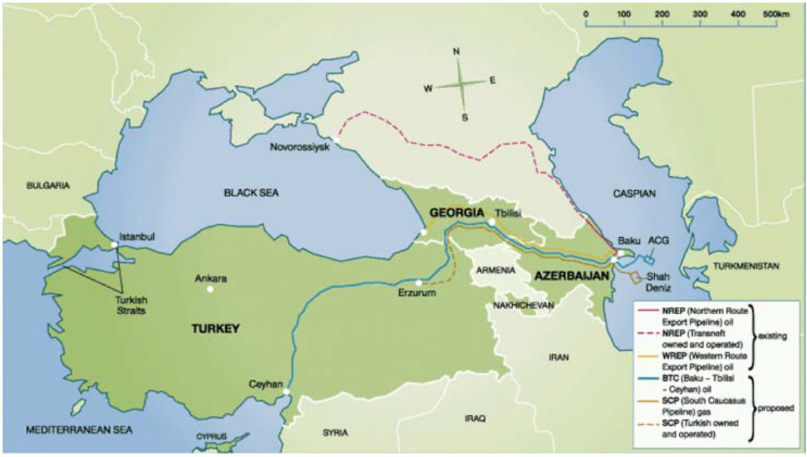
In 2006, the Agreement on the Promotion and Support of Oil Transportation from Kazakhstan to International Markets through the Caspian Sea and Azerbaijan by means of the BTC pipeline (“Heydar Aliyev Heritage,” 2010) not only opened up a new way to export Kazakhstan's energy, but also fostered a close relationship with Turkey. In addition, as well as supporting the BTC project, Kazakhstan asserted its independence from Russia and solidified its “multi-vector” foreign policy.
This caused a wave of serious concern over Russia's role. Although the Baku-Ceyhan pipeline through Georgia probably could increase the possibility of the Russian export earnings going up as a result of the reduction of congestion in its own export pipelines, as was pointed out by Paul Gregory, a Professor of Economics at the University of Houston, in the September 7, 2008 issue of The Washington Times. Russia was also at risk of losing its strong “political stranglehold on the Western markets” (Gregory, 2008). As it was further noted in the RussCasp Working Paper (Guliyev & Akhrarkhodjaeva, 2008, p. 6):
[t]he West has promoted transportation projects that would carry Caspian energy bypassing the Russian territory, such as the BTC, whereas Russia has used its power to keep almost all Central Asian energy exports under control and to prevent any major shift in Central Asian energy exports. The region, thus, has been a playground for Russian-Western rivalry over the access to the vast Caspian resources and control of the exporting routes.
Hence, from the very beginning, Moscow showed its irritation and displeasure over the construction of the BTC pipeline, a pipeline that would bypass Russian territory. Russia argued that the pipeline would be unprofitable and that Kazakhstan should use the Russian pipeline system instead (“Rossiya proigrala nefteproekt,” 2005). However, in spite of Russia's negative forecasts with respect to the viability of the BTC pipeline, in July 2006, the BTC pipeline was successfully put into operation, pumping over 25 million tons of oil annually. In 2008, the capacity of the BTC pipeline was increased by up to 50 million tons, which created strong competition to the Russian oil transportation system thereby severely undermining Russia's attempts of dominating the oil transportation routes from the Caspian region (Dautov, 2007, p. 12).
Consequently, fearing the loss of its political and economic influence over Kazakhstan, with its vast volumes of oil from the Caspian Sea reserves, Russia decided to soften the previously “agreed” conditions of the Kazakhstani oil transit through Russia by signing the Protocol Between the Government of the Republic of Kazakhstan on November 18, 2009 and the Government of the Russian Federation on Amendments to the Agreement of on Oil Transit on June 7, 2002 (The Embassy of the Republic of Kazakhstan in the Russian Federation, 2013). The protocol contemplated a survey on the prospects for increasing the carrying capacity of the Atyrau (Kazakhstan)–Samara (Russia) oil pipeline from 15 to 25 million tons of oil per year for transportation in the direction of the Black Sea or the Baltic Sea or in the direction of the western border of the Russian Federation (The Embassy of the Republic of Kazakhstan in the Russian Federation, 2013).
It could be argued that the softening of Russia's oil export control measures in response to Kazakhstan's decision to participate in the BTC project exemplifies a successful use on the part of Kazakhstan of external soft balancing measures vis-à-vis Russia. In effect, Kazakhstan was able to gain some leverage in its relationship with Russia.
In addition to the BTC pipeline, which was a westbound oil transportation alternative, Kazakhstan started collaborating with China on the construction and utilization of an eastbound oil pipeline that would also bypass Russia (Overland & Kjaernet, 2011, pp. 137–138). The energy-rich Kazakhstan has been exporting its crude oil to China through the newly built Atasu–Alashankou pipeline since 2006.
Eurasian Union
Russia's efforts to exert influence over Kazakhstan and keep it under control were not limited to oil exports controls. Another way in which Russia attempted to establish its dominance and control over Kazakhstan, and other CIS countries, was through the Eurasian Union – a significantly modified version of the Eurasian initiative originally proposed by Nazarbayev.
In October 2011, Vladimir Putin – then Russia's prime minister, and now the president of Russia, revealed an initiative to establish a Eurasian Union of the former Soviet countries (Saari, 2011) in the hope of continuing to maintain control over the post-Soviet region using mass media. He promoted the meaning of “Eurasianism,” downplaying the Russia-centric nature of the term. Putin might have also hoped the initiative would enhance his credibility in the upcoming Presidential elections.
The Russian newspaper, Izvestiya, published an article by Vladimir Putin, “The New Integration Project for Eurasia – A Future that is Born Today,” in which he argued that, on the basis of the Customs Union and the Eurasian Economic Community, there was a chance to unite the countries of the CIS, which could be a major player in the international arena, with Russia as the “heartland.” Putin claimed that his proposed Eurasian Union would not be a re-creation of the Soviet Union, but rather an integration of countries and that it would be an “economic, political and value-based” union that reflects modern realities (“Novyi integratsionnyi proekt,” 2011).
Aleksandr Dugin, a political scientist and a leading ideologist on the creation of a Eurasian empire, suggested that the strengthening of Russia's influence on the CIS countries was an important step in Russia's foreign policy. He noted that the instigation of the joint economic projects between Russia and the CIS countries on the public and private levels, as well as state control of big private businesses were necessary to create a program in accordance with Russia's geopolitical interests (Dugin & Dobrenkov, 2010).
While the reasons for Russia's desire to create Eurasian Union seem to be clear, the reasons for Nazarbayev's agreement to join a Russia-centric Eurasian Union were not unequivocal. There were different opinions regarding the rationale for Nazarbayev's decision to agree to join the Eurasian Union. According to one opinion of Kanat Berentaev, the Deputy Director of the Center for Public Policy Research, the development of economic cooperation in the post-Soviet era is a necessity and Kazakhstan had no other choice if it wanted to avoid becoming a peripheral state. Berentaev wrote: “Kazakhstan is now facing an ambiguous choice: will it try to preserve its formal sovereignty, at the risk of being marginalized in world development, or will it be actively involved in the integration process?” According to Berentaev, the potential for joint scientific, technological, and resource production could help Kazakhstan to be one of the major actors in the world economic system, competing on an equal basis with the United States, the countries of the Eurozone, and China (Berentaev, 2012, p. 8).
The preservation of sovereignty is the main issue for Kazakhstan. In 2012, in Yalta, a conference was held “Eurasian vector of development: Problems and Prospects”. Talking about the supranational institutions, Oganesyan gave an example of the article written by young researcher Mirzahanyan, called “Supranational: from Europe to Eurasia”, where Mirzahanyan raises the issue of sovereignty and supranational (Oganesyan, 2012, 10). Next, Galina Povazhnaya writes that Russia should actively use ‘soft power’ in Eurasia through its policy toward Eurasian Economic Union member-states (Povazhnaya, 2012, pp. 11–17). In this regard, Kazakhstan faced a problem: to enter into a Eurasian Economic Union, but without losing its sovereignty, while directing efforts to survive in a difficult geopolitical situation. Unfortunately, Kazakhstan had an unfavorable experience in the Customs Union. After the establishment of the Customs Union, which increased economic efficiency only for the Russian businesses, Kazakhstan's balance of trade deficit rose. In 2012 it was in the negative, at around $12,000,000 (Kudaibergenov, 2013).
Export and Import of Kazakhstan and Belarus within the Customs Union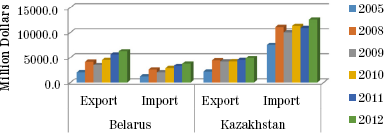
The Kazakhstani government also started realizing that Putin's Eurasian Union idea, despite its loud joint interest and common good proclamations, was simply a means for implementing Russia's hegemonic ambitions.
In fact, I strongly believe that the Customs Union and the Eurasian Economic Union in the form proposed by Russia were meant, not only as tools for expanding economic influence, but also as a means of establishing political influence over Kazakhstan and the Central Asian region. Russia used Belarus as a doorway into Eastern Europe, and is using Kazakhstan as a doorway into Central Asia and China. Since 2014, Russia exports up to 7 million tons of oil through the Kazakhstan pipeline (Atasu–Alashankou) (Karsybekov, 2013).
In Chapter 4 of Bykov's book, National Interests and Foreign Policy, it is noted that “the projection of national interests on foreign policy is interpreted through pragmatism to adapt to the changing global environment” (Bykov, 2010). Considering that it is difficult for Kazakhstan to count on full beneficial cooperation within the framework of the Eurasian Union, it is necessary to use other unions because Kazakhstan's economy is smaller than Russia's economy. Thus, Kazakhstan's interests are not fully taken into account. Nursultan Nazarbayev once again resorted to external soft balancing to counterbalance Russia's overpowering influence by initiating talks with Turkey on joining the Customs Union and subsequently the Eurasian Union. This is discussed in further detail below.
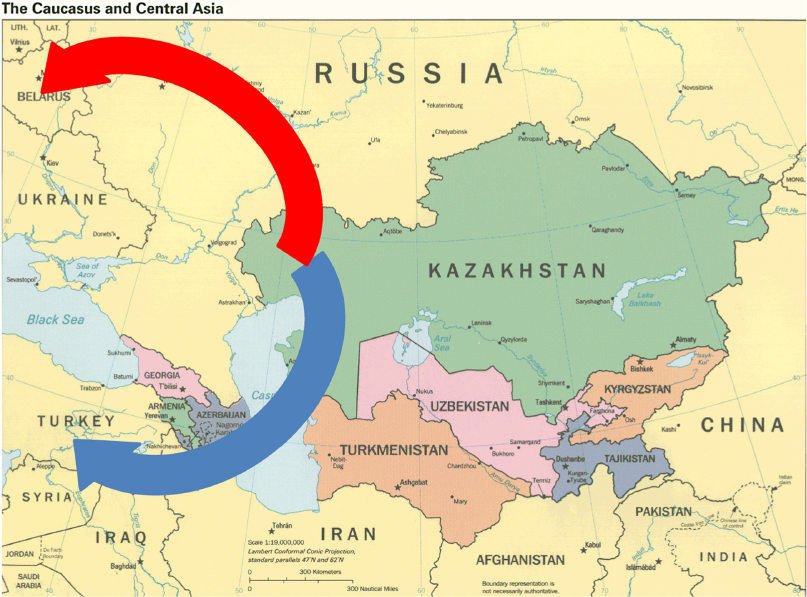
Firstly, why did Nazarbayev choose to turn to Turkey to counterbalance Russia? This decision can first be explained by Turkey's geopolitical location. From a strategic point of view, Turkey is located at an intersection of the North-South and East-West transport corridors lying in close proximity to the countries of Eastern Europe, Eurasia, and the Middle East. Moreover, the choice could be explained by the current tense relationship of Turkey and Russia as a result of Turkey's restrictions on the right of passage for the Russian tankers seeking passage through the Bosporus and Dardanelles (Vasiliev, 2010, p. 2) in an attempt to minimize the oil transportation traffic through the Straits.
Most importantly, Turkey is a major competitor of Russia in the Black Sea region. Turkey and Russia have considered their influence in the Black Sea region as central to their status as regional powers in the post-Cold War era (Tanrisever, 2012, pp. 2–8). In Turkey, the Black Sea has come to be viewed increasingly as a shipping corridor that could open up alternative transportation and trade routes to Eastern and Northern Europe, as well as to the Caucasus and Central Asia (Vasiliev, 2010, p. 2). Oktay F. Tanrisever argues that while Russia's policy toward Turkey aims at increasing Ankara's ‘dependence’ on Moscow in strategic areas, such as energy, Ankara's policy toward Moscow seeks to promote a greater ‘interdependence’ between these countries in question.
Another important concern for Russia, in Tanrisever's opinion, was the energy issue that created the basis for regional rivalry with Turkey. The position of Russia has been to try to keep the post-Soviet states in the Caspian Sea region (i.e., Kazakhstan, Turkmenistan, and Azerbaijan) under its sphere of influence by making them dependent on Russia's transportation systems for oil and gas exports (Tanrisever, 2012, pp. 2–8). However, Turkey and Russia have encountered profound disagreements over transportation routes for the hydrocarbon energy supplies of these post-Soviet states in the Caspian Sea region (the Baku-Novorossiysk, Baku–Tbilisi–Ceyhan, and Nabucco pipelines).
There are also other issues – outside of the scope of this article – fueling the rivalry between Russia and Turkey, including Turkey's support for the territorial integrity of Georgia, and the resolution of the Nagorno-Karabakh conflict in favor of Azerbaijan (Markedonov & Ulchenko, 2011).
Another potential reason justifying Kazakhstan's choice of Turkey is that it is the fourth biggest foreign investor in Kazakhstan after the US, South Korea, and the United Kingdom. Turkey is number one on the list of countries with the highest number of companies that have invested foreign capital in the Kazakhstan economy (Kanbolat, 2011). Moreover, as the result of Nazarbayev's visit to Turkey in October 2012, the Kazakhstan Bank of Development and Eximbank of Turkey signed a Memorandum of Understanding for the opening of a credit line of $250 million. In addition, Kazakhstan and Turkey signed a plan to implement New Synergy joint economic programs aimed at increasing bilateral trade from $3.3 billion in 2011 to $10 billion in 2015. Even prior to this initiative, the economic partnership between the two countries has been steadily increasing. For instance, if in 2010 the trade turnover amounted to $1.85 billion, in 2011 it rose to $3.3 billion. Turkey has invested, from 1993 to 2012, up to $1.8 billion into Kazakhstan's economy (“Nachalsya dvukhdnevnii ofitsial'nyi,” 2012). Additionally, Turkey invested $263 million into the development of oil and gas fields in Kazakhstan (Chebotarev, 2014). The Turkish capital is involved in LLP “Kazakhturkmunai,” which extracted 227.468 thousand tons of oil in 2010.
In addition to all of the above, Kazakhstan and Turkey have similar approaches to many international and regional issues, as well as the common roots in language, history and culture. Based on ethno-cultural affinity and practical considerations, Kazakhstan chose to follow the Turkish model of development to overcome its economic problems during the initial stages of its post-Soviet independence. Kazakhstan has also made genuine contributions to the organization of the Summits of the Heads of the Turkic Speaking Countries and played an important role in the foundation of the Cooperation Council of the Turkic Speaking Countries (Turkic Council) and the Parliamentary Assembly of the Turkic Speaking Countries (“Relations Between,” 2015). In 2008, a protocol was signed in Antalya at the establishment of the Parliamentary Association of Turkic-speaking countries (“V Antalii podpisan Protokol,” 2008). The first summit of ‘The Cooperation Council of Turkic Speaking States’ was held on October 21, 2011 in Almaty, which also saw the approval of the Declaration, which defined the principles and directions of Kazakhstan's cooperation with Turkey and Azerbaijan.
In light of the foregoing reasons, Kazakhstan from the very beginning of its development of bilateral relations with Turkey considered Turkey as a counter-balancing power to Russia. Accordingly, the choice fell on Turkey as a candidate to open up a free trade zone in the Customs Union as an attempt to simultaneously counterbalance Russia's influence within the union and to gain a strong ally within the Customs Union framework. On July 21, 2014, Turkey offered to establish a free trade zone with the countries of the Customs Union. This was announced by Minister of Economic Development of the Russian Federation Aleksei Ulyukaev (“Turtsiya predlozhila otkryt’,” 2014). Talgat Mussabekov, the senior analyst of the Agency of the Return on Investment Research noted, “the creation of a free trade zone for Turkey with Customs Union is a positive signal for Kazakhstan, because of the potential market for Kazakh exporters, and the increase in vectors and centers of power in free trade zone with Russia and Belarus.” The existence of Turkey will provide more opportunity for Kazakhstan to maneuver in the negotiation process (“Kazakhstan vyigraet ot sozdaniya,” 2014).
Conclusion
This paper has attempted to understand what Kazakhstan's reaction was toward the rising power and influence of Russia in the region. Kazakhstan is the second largest country in the post-Soviet territory; it possesses vast energy reserves and is in close proximity to Russia. As such, Kazakhstan is compelled to employ soft balancing policy to keep the overpowering influence of Russia in check, while at the same time maintaining cooperation and a close working relationship with its neighbor.
The case studies discussed in this article show that weaker states can counterbalance the strength and clout of powerful nations through collaborating and forming unions with other states. However, the internal soft balancing efforts concerning the growing influence of Russia, which were undertaken as part of the Eurasian integration initiative proposed by Nazarbayev in 1994, proved unsuccessful. In contrast, some of the subsequent external soft balancing efforts in respect to Russia's overpowering influence, for example, participation in the BTC pipeline project and turning to Turkey as a potential partner and ally in the Customs and Eurasian Unions, seem to have already reaped more fruitful rewards in keeping Russia from gaining dominance in the Central Asian and Caspian regions. Furthermore, the BTC pipeline, which bypasses Russian territory, is the most prominent example of Kazakhstan's success in improving its bargaining position with Russia, as it was there that Kazakhstani oil transit increased through Russian CPC (Caspian Pipeline Consortium). Furthermore, if Kazakhstan was to diversify its routes, the country could strengthen its energy security.
This paper has sought to demonstrate that soft balancing theory can explain the strategy of opposition that Kazakhstan has employed vis-à-vis Russia, that is to say that a theoretical framework can help clarify empirical findings. There has been no research conducted into the application of soft balancing theory in the case of Kazakhstan regarding the “Eurasian Union,” therefore, this article can function as a significant contribution to the as yet understudied field.
Acknowledgements
The author gratefully acknowledges the in-depth analysis and helpful comments from two anonymous reviewers and the editor Bora Kim of the Journal of Eurasian Studies. The author also thanks the invaluable insights and the kind help of Professor Nobuo Okawara and Professor Andrew Reed Hall. Last, but not least, the author would like to thank her colleague Hiro Hayashi for proofreading the article, and her colleague Zhannah Voukitchevitch for invaluable suggestions and comments.