





Abstract
As demonstrated in this paper, Japan over the years has grown to become the leading ODA provider in Central Asia (CA). ODA has served as a foreign policy tool and as the most significant tool for maintaining cooperation ties. Although the focus of Japan's ODA assistance over the years has been on East Asian countries, CA is growing to become another frontier for more proactive Japanese policies.
The Japan-supported initiatives of recent years tend to favor more pragmatic cooperation schemes. As is exemplified by water-related assistance in Uzbekistan and support for local capacity building in Kyrgyzstan, Japanese assistance of a more focused character can better contribute to development both in these societies and in the region in general. These types of initiatives can successfully complement government-to-government assistance schemes and Japanese investments into large scale projects. The focus on local communities will also ensure that beneficiaries of the Japanese assistance projects will include not only governmental institutions but also the general public at large.
Keywords
Introduction
Japan is searching for its own mode of engagement in Central Asia. Japanese efforts to effectively engage CA countries started with the time of CA states’ independence, including such initiatives as PM Ryutaro Hashimoto's Eurasian (Silk Road) Diplomacy (1996–1997), Keizo Obuchi's mission to Eurasia even before he became PM, Junichiro Koizumi's Central Asia plus Japan Forum initiative (2004), visit by PM Koizumi to Uzbekistan and Kazakhstan in 2006, Taro Aso's initiative called Arc of Freedom and Prosperity (2006) as well as CA tour of PM Shinzo Abe of October 2015 (Dadabaev, 2013, 2014; Rakhimov, 2014).
Japan's standing in the region has strengthened significantly in the decade after the collapse of the Soviet Union in that Japan has provided large contributions, both in terms of Official Development Assistance (ODA) and financial loans to regional countries. 1 However, there is an understanding both in Japan and majority of Central Asian countries that the potential for cooperation between Japan and Central Asian countries is not being fully and properly realized. The impact of its assistance and cooperation programs often falls short of the expectations by Central Asian governments and the general population.
For a number of recent examples, see Dukha (2007), Uzreport.com Business Information Portal (2007), and Mamytova (2007). For a general description and data, see Yagi (2007).
What can Japan do to make its involvement and ODA assistance in this region more effective? What are the factors that influence these cooperation frameworks? These are the questions that are examined in this paper.
This paper is divided into six main parts. First, it will describe how the Official Development Assistance scheme came to become a tool of Japanese foreign policy. The second part will then argue that Japan's ODA was an important developmental tool for engaging CA countries. The third section analyzes how Japanese engagement is perceived by the general public in the region. For this purpose, the social polling outcomes of the Asia Barometer for 2005 will be compared with a similarly worded poll that was conducted in 2015 by the Ministry of Foreign Affairs of Japan to demonstrate the public expectations regarding Japanese involvement in this region. The fourth part details the Japan Human Development Center initiative as a pillar of Japan's human capacity development scheme. And the last two sections focus on Japanese initiatives which benefit both governments and general public in Kyrgyzstan (One village–One product program) and Uzbekistan (Water Users Association support). This paper concludes by hypothetically suggesting more focused and narrower project-based approaches to engaging CA countries for greater efficiency in Japan's involvement in CA.
In conducting bilateral and multilateral cooperation, Japan uses Official Development Assistance as a tool that helps Japan achieve its goals and simultaneously aims to assist developing countries to achieve the tasks in their developmental agendas (see Bobrow & Boyer, 1996; Orr, 1990; Yasutomo, 1989-1990). Japan has grown from being a country that was extended assistance in its post-World War II reconstruction to becoming a top donor to developing countries in the 1990s. In Japan's becoming such a donor, the primary mission of the country's assistance (aside from its own interests) to developing nations was to offer both financial stimulus for development and a model of development that would enable these countries to move from the ranks of economic assistance recipients to the ranks of countries that can sustain their development without external financial assistance. Japanese interests were mainly focused in Asian countries because Asia was conceptualized as the region of primary interest to Japan. Therefore, its ODA assistance has also been mainly channeled to Asian countries (see Togo, 2005, p. 317). The composition of Japan's ODA assistance has long consisted of the ratio of 70% bilateral aid to only 30% assistance channeled through multilateral institutions. Many observers and practitioners connect this ratio to the idea that the heavier emphasis on bilateral aid works for both the donor and the recipient, presumably creating a better image for the donor country and also offering a clearer picture of the donor country's goals (Togo, 2005, p. 331; also see Bobrow & Boyer, 1996, pp. 105–6).
Japan's Ministry of Foreign Affairs divides the ODA development process into stages. The first stage is classified as system development, from 1954 to 1976, when the system of overseas assistance was set in tandem with World War II reparations. The second stage dates from 1977 to 1991 and refers to systemic expansion, during which Japan assisted with basic human needs and grassroots projects. The third stage was the period of policy and philosophy enhancement, dating from 1992 to 2002, when the ODA charter was adopted, which prioritized certain sectors for assistance and identified multiple (bilateral, regional) levels of assistance. This was the period when many policy makers emphasized the need for qualitative changes that symbolized moving away from simply providing large volumes of ODA assistance to offering assistance that would make a difference in the development of Asian countries. The final period in ODA's development is the period when the new challenges (human security, peace maintenance, terrorism, etc.) appeared that required adopting the ODA schemes. This period dates from 2003 to the present. 2 The ODA charter was also renewed during this period, emphasizing Japan's responses to newly arisen issues. This period also demonstrated that as Japan attempted to adjust itself to new challenges, it also attempted to redefine its international image under conditions when its economic might was weakened (Government of Japan, Ministry of Foreign Affairs, & Economic Co-operation Bureau, 2003).
For the MFA's periods of classification, refer to Ministry of Foreign Affairs of Japan (n.d.).
The official start date of Japan's ODA is October 6, 1954, when Japan became a part of the cooperation plan titled the Colombo Plan, the first agreement of which concluded with India in 1958. 3 In addition, the World War II defeat also had consequences for Japan in that it was obliged by the San Francisco Peace Treaty to pay reparations for postwar reconstruction and development to the Asian countries that sought these payments. Some of these reparations were paid in services and goods from the Japanese government, which had an impact on the way ODA assistance schemes were structured in the following years. In particular, some of the aid assistance was referred to as “tied” assistance and referred to the recipient's obligation to purchase Japan-produced goods and services as a part of the assistance package (Togo, 2005, p. 320). In 1957, Prime Minister Kishi reaffirmed Japan's commitment to improving its ties with neighboring countries and assisting these countries to improve their welfare. In addition, it was assumed that this move would to lead to developing Japan's economy (Matsuura, 1981). In the years when Japan's economy recorded high economic growth, the country established an agency that was primarily responsible for supervising Japan's assistance and cooperation, namely, the Japan International Cooperation Agency (JICA), in 1974. JICA was charged with supervising and implementing technical cooperation and grant assistance. Prime Ministers including Tanaka and Fukuda also maintained high levels of ODA assistance to Asian countries. This culminated in the adoption of the so-called Fukuda doctrine in 1978, which pledged full support for ASEAN countries and significant financial assistance (Yasutomo, 1989-1990, p. 492).
The Colombo Plan for Cooperative Economic and Social Development in Asia and the Pacific was conceived at the Commonwealth Conference on Foreign Affairs held in Colombo, Ceylon (now Sri Lanka) in January 1950 and was launched on 1 July 1951 as a regional intergovernmental organization that would further the economic and social development of the peoples of South and Southeast Asia; see http://www.colombo-plan.org/history.php.
In 1978, Japan also announced a plan to double its ODA in three years in the First Medium-Term ODA Target. During PM Ohira's administration, the government announced its intention to play a more proactive role in multilateral international institutions and defined foreign aid as a major instrument for achieving this task. Since then, every PM of Japan has entertained the idea of Japan's becoming “an active creator” (Bobrow & Boyer, 1996, p. 101). At the end of the 1970s, the Ministry of Foreign Affairs (MOFA) defined Japan's interests in providing ODA using rhetoric on the importance of interdependence and preserving peace and stability. 4 The use of Japanese economic aid has been limited to nonmilitary purposes, and Japan has attempted to compensate for its inability to contribute to international efforts through military means by providing economic assistance to the countries in conflict-prone regions (Yasutomo, 1989-1990, p. 494). In 1988, the Takeshita administration announced increased Japanese ODA assistance (Yasutomo, 1989-1990, p. 491). This increase implied diversifying ODA recipients and expanding regional representation in the Japanese assistance programs. This meant including larger countries in the Middle East, Africa, South America and Oceania while Asia still remained the main area of Japan's ODA focus. Therefore, gradually, Japan's ODA assistance gradually became a tool of Japan's foreign policy representation overseas.
In 1978 MOFA published “The Current State of Economic Cooperations and its Outlook: The North-South Problem and Development Assistance” and in 1980 “The Philosophies of Economic Cooperation: Why Official Development Assistance,” see Togo (2005, p. 334).
In the mid-1990s, as if to reflect on the economic stagnation in Japan's economy, the country's government considered reducing ODA economic aid. PM Hashimoto first announced reducing aid by 10% and called for additional reductions and the need to reconsider the impact of economic aid for Japan's economy.
Furthermore, in the years after 2000, the government of PM Koizumi reconsidered the ODA charter while more strongly emphasizing the importance of Japanese interests in proving ODA assistance. The new ODA charter also called for increased efficiency in Japan's assistance schemes, which was important for both Japanese taxpayers and ODA recipients abroad.
Japan's ODA is structurally divided into bilateral and multilateral assistance provided to developing nations. The bilateral assistance is normally granted by the Japanese government to the governments of developing nations and is categorized into grants-in-aid with no interest rate, technical assistance aid or grants-in-aid to NGOs. In most cases, this assistance is administered by the Japan International Cooperation Agency (JICA). Although Japan's assistance to developing countries is decreasing because of the country's slow economic growth, it still remains among the world's leading powers that offer assistance to developing countries.
There are three main categories of Japanese ODA assistance that are extended to receiving countries. As was mentioned above, these are yen-based loans and grants, no-interest grants-in-aid and technical assistance.
The purpose of yen-denominated loans is to support economic and social infrastructure development in the receiving country. These loans have frequently been requested and used by receivers to construct airports, electricity-generating stations, and dams. In terms of social infrastructure development, these loans have been used to finance medical development projects as well as underground water infrastructure development and education projects.
No-interest grants-in-aid have been mostly used in the least developed countries in the fields of medicine, poverty eradication, agricultural development and provision of basic human needs.
The projects that have received no-interest grants-in-aid in Central Asia and the Caucasus have been mostly related to these fields as well as to education and human development.
Technical assistance projects mostly consist of those that involve dispatching experts in a particular field from Japan to a receiving country to build that country's foundations of expertise in strategically important fields. In addition, these types of funds have also been used to train various specialists in both recipient countries and Japan, and these funds have also been used to fund in-depth studies of certain challenges faced by ODA receiving countries to identify the underlying causes of these problems and establish strategies for resolving them. In the region of CA and the Caucasus, these funds have been used to send Japanese experts to CA as well as to support legal, medical, energy and agricultural infrastructure development projects and to support the activities of Japan centers in the region (Table 1).
Organisation for Economic Co-operation and Development's Development Assistance Committee (DAC) member-states’ assistance to countries of Central Asian and Caucasus.
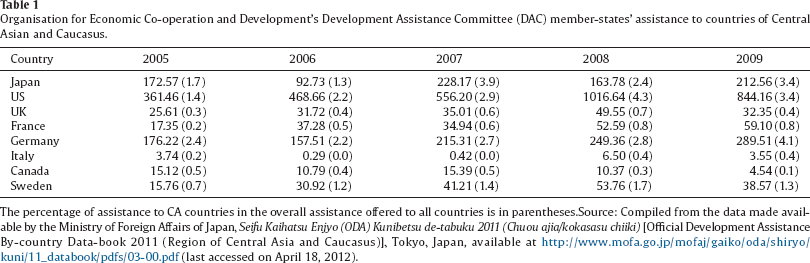
The percentage of assistance to CA countries in the overall assistance offered to all countries is in parentheses.
Source: Compiled from the data made available by the Ministry of Foreign Affairs of Japan, Seifu Kaihatsu Enjyo (ODA) Kunibetsu de-tabuku 2011 (Chuou ajia/kokasasu chiiki) [Official Development Assistance By-country Data-book 2011 (Region of Central Asia and Caucasus)], Tokyo, Japan, available at http://www.mofa.go.jp/mofaj/gaiko/oda/shiryo/kuni/11_databook/pdfs/03-00.pdf (last accessed on April 18, 2012).
In the first years following the collapse of the Soviet Union, Japan indicated a considerable long-term commitment to helping Central Asian nations in their first steps of nation-building. These were conducted within the framework of various Japanese initiatives in CA such as Eurasian Diplomacy (1996–1997), CA plus Japan initiative (2004) and Arc of Freedom and Prosperity (2006) (Dadabaev, 2013). The assistance projects of the most significant impact were in the fields of humanitarian relief, infrastructure development and technical assistance, which are partly based on grant allocations and partly on policies to generate economic opportunity. These are the much-needed projects for providing equipment (PCs, projectors, etc.) for local educational institutions, making educational grants, and granting technical assistance to agricultural producers, to name only a few. The achievements of Japanese engagement in CA are often considered striking and unquestionable, in terms of their necessity, their grant totals, and the number of projects conducted. 5 Japan has also contributed to the CA development through a substantial financial support for projects ranging from infrastructure development related to the transport of goods and services, to tourism (Table 2). 6
For an interesting analysis and outline of the achievements of Japanese policy in Central Asia, see Yagi (2007, pp. 13–16).
Japan primarily provided assistance with modernizing infrastructure such as airports and related facilities. Some of these transportation facilities remain inefficient and largely underused; see Ibragimov (2008).
Central Asian countries’ exports/imports to and from Japan.
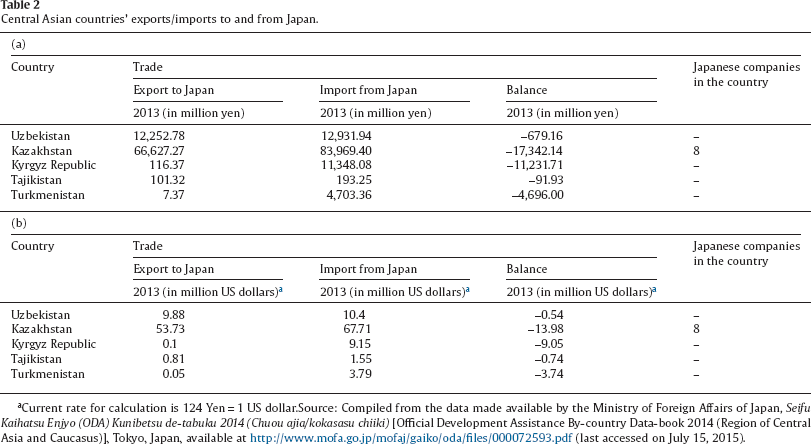
Current rate for calculation is 124 Yen = 1 US dollar.
Source: Compiled from the data made available by the Ministry of Foreign Affairs of Japan, Seifu Kaihatsu Enjyo (ODA) Kunibetsu de-tabuku 2014 (Chuou ajia/kokasasu chiiki) [Official Development Assistance By-country Data-book 2014 (Region of Central Asia and Caucasus)], Tokyo, Japan, available at http://www.mofa.go.jp/mofaj/gaiko/oda/files/000072593.pdf (last accessed on July 15, 2015)
Japan has implemented a range of projects designed to improve people's standard of living through community development and support programs in the most impoverished parts of the country. The primary purpose of these programs was to empower local communities and enhance their profit-generating capacity in areas that were historically developed in those communities, as documented in Japanese International Cooperation Agency (JICA) documents (Proekt, 2011). Such programs were based on a model introduced in Japan itself, namely, “one village–one product” (Isson Ippin). The main purpose of these activities is to identify the capacity of each participating community and a product each community produces that may enjoy significant market demand. This process is typically advanced through a cooperation and co-funding scheme between JICA and local governments. As a rule, the Japanese provide short-term training, information on distribution techniques, and some financial assistance to facilitate production of an advantageous product that has the potential to generate profits and employment in each community. In the period since independence, several dozen Kyrgyz communities have been involved in these types of grass-roots assistance programs. Examples include the facilitation of rare-herb collection and marketing, honey production and distribution, and the development of local craft workshops. The schemes in the Issuk-kul Oblast (Province) of Kyrgyzstan are particularly well known.
In other cases, Japan provided much needed assistance for Water Users Associations and their formation as described in the sections below, using partly the case of Kyrgyzstan and heavily building on empirical data of Japanese involvement in Uzbekistan.
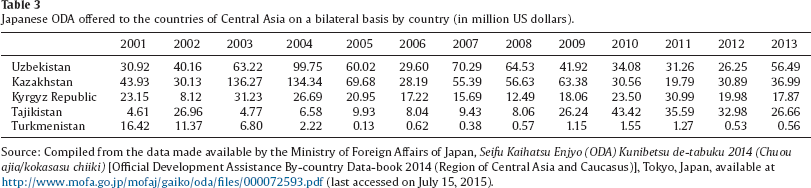
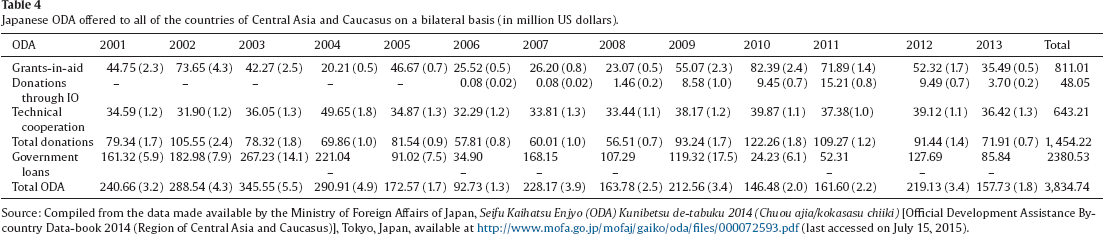
Japanese ODA is instrumental in all of the economic development and humanitarian projects. 7 The Japanese government defines as the primary purposes of ODA disbursements the following: humanitarian assistance, increasing the economic interdependence of different markets, and bolstering environmental preservation. The main principles for disbursement eschewed the use of ODA for military purposes or to promote conflict. Instead, it was primarily aimed at economic development, with an emphasis on environmentally friendly, sustainable development models; enhancing peace and stability around the world and to contain and prevent the development of weapons of mass destruction; and promoting democratization, the transition to market economies, and respect for human rights in the recipient countries (Tables 3 and 4).
For details on Japanese ODA and changes to it, see Söderberg (2002). Also, see Furuoka (2007).
Japanese ODA offered to the countries of Central Asia on a bilateral basis by country (in million US dollars).
Source: Compiled from the data made available by the Ministry of Foreign Affairs of Japan, Seifu Kaihatsu Enjyo (ODA) Kunibetsu de-tabuku 2014 (Chuou ajia/kokasasu chiiki) [Official Development Assistance By-country Data-book 2014 (Region of Central Asia and Caucasus)], Tokyo, Japan, available at http://www.mofa.go.jp/mofaj/gaiko/oda/files/000072593.pdf (last accessed on July 15, 2015).
Japanese ODA offered to all of the countries of Central Asia and Caucasus on a bilateral basis (in million US dollars).
Source: Compiled from the data made available by the Ministry of Foreign Affairs of Japan, Seifu Kaihatsu Enjyo (ODA) Kunibetsu de-tabuku 2014 (Chuou ajia/kokasasu chiiki) [Official Development Assistance By-country Data-book 2014 (Region of Central Asia and Caucasus)], Tokyo, Japan, available at http://www.mofa.go.jp/mofaj/gaiko/oda/files/000072593.pdf (last accessed on July 15, 2015).
Nonetheless, several cautionary lessons can be drawn from Japan's involvement in the CA region. First, on the basis of previous Japanese economic and humanitarian engagement, one can conclude that the improper identification of fields of cooperation will cause Japanese involvement to be inefficient, irrespective of the volume of financial resources devoted to such projects. In addition, Japanese engagement seems to have a larger and more significant impact in the region when it aims to assist in developing local capacities, as opposed to emergency or short-term humanitarian assistance schemes. Capacity building (in forms that generate benefits for individuals to an equal extent to those enjoyed by governments) implies empowering local populations to generate wealth. Therefore, improving local capacities for societal development is more efficient, because this approach also implies a degree of sustainability after Japanese assistance ends. Humanitarian assistance projects of the type Japan has provided (technical, medical, etc.) largely duplicate those run by international or national organizations. 8
Author's field research findings during the “Survey on Agricultural and Rural Development based on Population Issues” in 2003 with the Asian Population and Development Association (APDA). Some results of the survey (without the interviews cited in this article) are available in printed form in Japanese and English. For the English-language version, see Asian Population and Development Association (APDA) (2003) and Asian Population and Development Association (APDA) (2002).
There seems to be an understanding within JICA and other aid agencies of the Japanese government that priority should go to projects that ideally help establish production or service cycles that local actors will be able to maintain on their own. 9 Moreover, the projects currently underway in the region reflect Japan's limited resources and a mutual awareness of the need to support initiatives that cannot be managed by local governments and non-governmental institutions alone. 10
In an interview with a Japanese Embassy official in a Central Asian country, the author was informed that current Japanese government policy regarding the provision of technical assistance is that contracts are granted on a competitive basis. Local contractors are given the same privileges as Japanese contractors. It was also emphasized to the author that local contractors are preferred in certain situations, because using local suppliers makes providing technical assistance easier and more sustainable in the long term. The only concern in this case is that local contractors are frequently not completely familiar with the documentation procedures and proper formalities for participating in tenders for contracts and they do not always have the capacity to provide the necessary equipment. This inadequacy puts foreign-based and Japanese companies in a better position, resulting in the situation referred to in the paper. Author's personal communication, Embassy of Japan, March 2008.
One example of these projects is the support for and training of the members of the Water Users’ Associations in Uzbekistan. For details, see JICA materials on Mizu Kanri Kaizen Projekto [Improvement of the Water Management Project] (Tashkent: JICA, 2011). The project is still active.
On par with Japan's interests in the region, Central Asian leaderships and public societies have considerable expectations for Japan. In particular, leaders of regional countries would like to see the Japanese government more actively encourage direct investment by Japanese corporations and companies, especially in the fields of energy resource development and the transportation of these resources. In this sense, the interests of regional countries and their Japanese counterparts coincide in that both sides want to see an intensification of business and trade ties. Additionally, there is an expectation of Japanese support through the Central Asia plus Japan scheme for strengthening regional integration, creating a common market in the region, and promoting regional cooperation in water management. In return for Japan's assistance, the leaderships of Central Asian countries have continuously and consistently expressed their support for Japan's bid for permanent UN Security Council membership and joined in supporting Japanese concerns about the situation on the Korean peninsula.
These expectations from Central Asian leadership for Japan contrast with the general public's confused attitude toward Japanese initiatives in the region. On the one hand, Japanese involvement is accompanied by relatively significant public support among populations in Central Asia. In autumn 2005, the University of Tokyo conducted the Asia Barometer poll throughout Central Asia. In Kazakhstan, 40 percent of respondents thought that Japan has had a good or rather good influence on their country (10.4 percent, good; 30.3 percent, rather good).
In Uzbekistan, the numbers who considered Japanese influence to be good or rather good stood at 52.2 percent (15.9 percent and 36.3 percent, respectively) (Figs. 1–4). 11
For the results of the Asia Barometer project regarding Central Asia, see Dadabaev (2004, 2005, 2006, 2007a, 2007b). For the full 2005 data set, see Inoguchi (2008). For the 2003 data set, see Inoguchi, Basanez, Tanaka, and Dadabaev (2005).
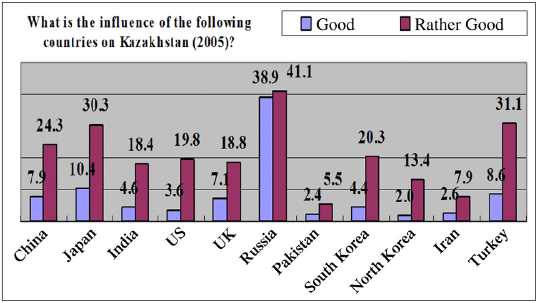
What is the influence of the following countries on Kazakhstan (2005)?
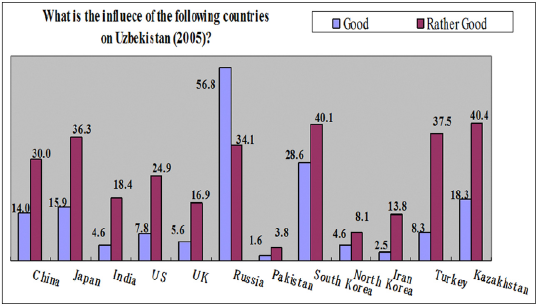
What is the influence of the following countries on Uzbekistan (2005)?
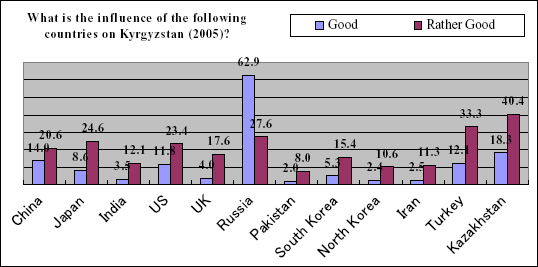
What is the influence of the following countries on Kyrgyzstan (2005)?
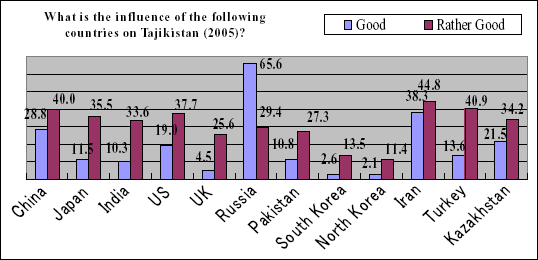
What is the influence of the following countries on Tajikistan (2005)?
However, Russia received ratings of 80 percent good or rather good in Kazakhstan (38.9 percent and 41.1 percent, respectively), and in Uzbekistan, Japan ranked third after Russia (56.8 percent and 34.1 percent) and South Korea (28.6 percent and 40.1 percent). These higher ratings can be attributed to Russia's proximity and historical linkages and the large resident minority groups of Russians and Koreans in Central Asia. In addition, aggressive Korean industrial and business expansion in the region, increasing labor migration to Russia and increasing economic ties with China have added to the popularity and awareness of Central Asian countries about contributions to their economic development from countries other than Japan.
Nevertheless, in 2015, a similar poll conducted by the Ministry of Foreign Affairs of Japan found that CA can be considered a Japan-friendly region, with the majority of its population feeling strong or relative closeness to Japan, as seen in Figure 5.
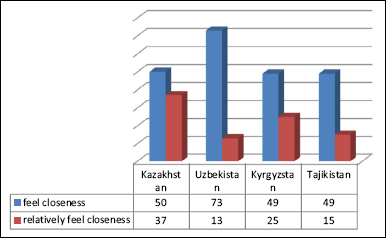
Do you feel closeness to Japan?
When asked what makes people feel close to Japan, the responses mainly centered around notions of Japan's being attractive because of its level of economic development, its culture and the high quality of goods produced there, as seen in Figure 6. Additionally, the country's long Asian history and its certain rules and cultural traditions that compared with those in CA also contributed to the feeling that there was closeness between Japan and CA.
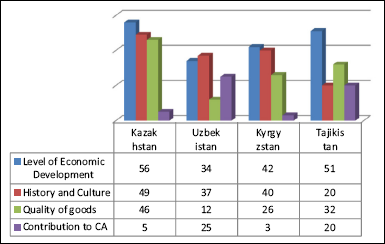
Why do you feel closeness to Japan?
Among the qualities that attract the general Central American public toward Japan and the Japanese people, the majority of those who were asked highlighted personal qualities such as the Japanese being polite, neat in work, punctual and responsible as the primary image of the country (Figs. 6 and 7).
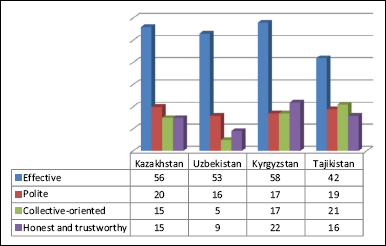
What do you think of the Japanese people?
Mainly because of this sympathy toward Japan, the majority of respondents considered their countries’ relations with Japan to be good (Uzbekistan 79%, Tajikistan 56%, Kyrgyzstan 52%, and Kazakhstan 59%) or rather good (Uzbekistan 13%, Tajikistan 24%, Kyrgyzstan 23%, and Kazakhstan 42%). Such views may represent awareness of the current state of affairs and also reflect wishful thinking and the respondents’ desires to consider their countries as being Japan-friendly (Fig. 8).
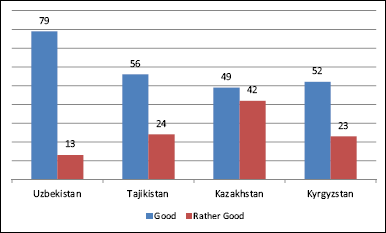
How do you evaluate your country's relations with Japan at this moment?
Although extensive Russian influence in the region is understandable and to some extent even unavoidable, the strong performances of China and South Korea and their popularity not only among the leadership but also among the general public can primarily be explained not through their historical ties but largely through their economic expansion into the region and their contribution in generating economic wealth and lifting the population's living standards. A number of plants that produce products ranging from automobiles to electric devices and household appliances throughout the region have made a large impact on the public's perception of these countries (Figs. 9, 10).
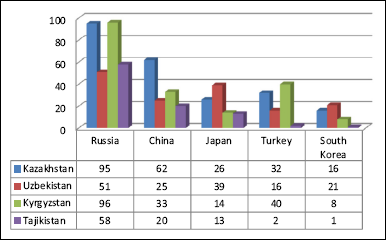
Which country do you think is currently the most important partner?
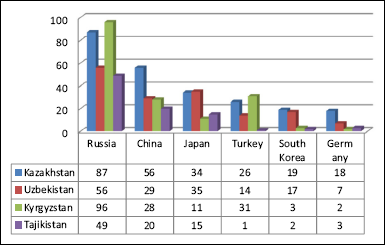
Which country do you think is going to be the most important partner for your country?
The Japanese competitive advantage in comparison with Russia, China and other countries is that it is considered to be impartial and that Japanese motivations to enter CA are not connected to the neocolonial images of Russia or China. Because of its distance from the region and the general image of the Japanese as being more honest and punctual and generally contributing to CA development, the mood among the general public toward Japan is more welcoming and friendly, as demonstrated by the following answers to a recent survey (Figs. 11, 12, 13).
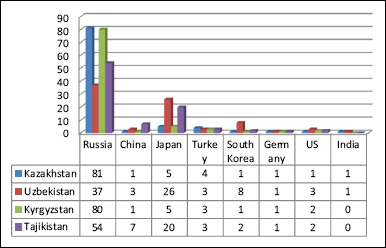
Which country do you think is the most trustworthy?
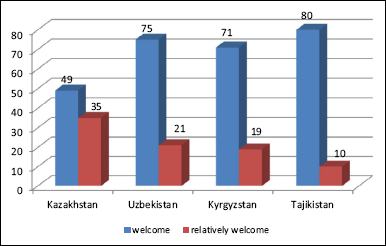
Would you welcome the entrance of Japanese companies into your country?
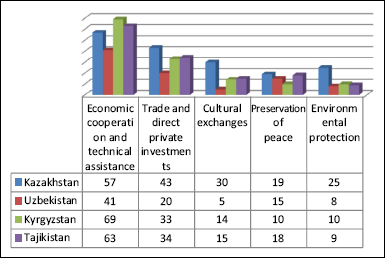
Among the listed areas, which are the ones to which you would like Japan to contribute to develop your country and region?
Despite these expectations of the general public and the welcoming attitude toward Japanese business, the penetration into CA by these companies has been slow. The reasons for this slow penetration primarily rest with CA governments because they have been slow and not sufficiently flexible to provide proper legal protection to foreign investors, establish mitigation mechanisms and enact laws regarding economic activities.
However, there are also additional factors behind the low level of Japanese economic penetration, namely, the hesitancy of Japanese businesses, which can be explained by the slow decision-making processes in Japanese corporate culture and government agencies, a lack of relevant information, and the CA countries’ lack of the type of infrastructure Japanese companies typically expect when they invest abroad. This assessment is supported not only by scholars but also by career diplomats who are actively involved in implementing Japan's CA policy (Kawato, 2008, p. 16). This slow penetration has meant training an excessivenumber of individuals in the Japanese language, but the limited employment opportunities eventually produced doubts about the usefulness of this type of education and spurred a decrease in interest. One result was a vicious cycle for these programs because the low efficiency levels and decreasing numbers of students together discouraged Japanese authorities from beginning new programs, often leading them to question the need for Japan-focused or Japan-initiated programs in the CA region. 12
During an evaluation hearing on the Special Program for Central Asian countries at the Japanese Ministry of Education, Science Sports and Technology, the committee members questioned the necessity of such programs conducted in Central Asia, September 2011.
As was indicated in the previous section, the capacity development initiatives of the Japanese government serve as a good background for assisting Japanese companies to enter CA markets. As was explained in the section on Japan centers, these training centers and language courses were initially established to bolster Japanese initiatives by encouraging local leaders to support, among other goals, more intensified economic interactions. However, the lack of economic ties between Japan and these states and the hesitancy on the Japanese side (in both economic circles and the government) to play more active roles in this region make the political and cultural initiatives incomplete. PM Abe during the tour of CA in October of 2015 attempted to encourage Japanese businesses to participate in CA economies as well as to secure support for them from CA governments.
This again brings to light the importance of redefining the fields and how Japan participates in the region's development. Functionalist approaches may be useful in further enhancing Japan's standing in the region. Such thinking might help Japan in formulating regional penetration policies with higher degrees of effectiveness and that would have a greater impact on the lives of the general population. Such support for a more focused approach to supporting CA capacity building can be seen in the PM Abe-announced support, during his visit to CA in 2015, for several educational initiatives like those in Turkemistan on the Japanese participation in a buld-up of Japan-supported University and in Uzbekistan on establishment of Youth Innovation Center to be sponsored and run jointly by Japan and Uzbekistan. The examples of the Japanese assistance through Japan Centers, through OVOP initiative in Kyrgyzstan and Water Users Association in Uzbekistan can be representative of the kind of activities which are expected of Japan and which benefit CA general public.
Another case involves Japan-initiated educational programs. The education provided by Japanese institutions is a very important part of the capacity-building process. One of the pillars of Japan's educational activities in theregion is the Japan Human Resource Development Centers in these countries, which provide Japanese language classes and classes on Japan's expertise in business development and which assist local educational institutions in providing Japanese education and language training.
In addition, the promotion of cultural interactions among the general public was considered a step toward smoother political, economic, and social cooperation between Japan and its CA counterparts. One tool for fostering this mutual understanding was establishing cultural centers and regularly holding cultural events in Japan and CA to introduce the cultures of these societies to one another. Just as certain Japanese educational institutions focus their studies on CA, the Japanese government established Japan Centers for Human Development and supported Japanese Studies departments across CA. These were tasked with introducing Japanese culture and fostering the development of Japan-friendly attitudes among future policy makers and practitioners in the region.
A typical example is the center established in Tashkent in August 2001. The Japan Center for Human Development in Uzbekistan was established based on an agreement between the governments of Uzbekistan and Japan that concluded in October 2000. The main purpose of this center is to enhance mutual understanding and strengthen friendly relations between the two countries through communicating a variety of information and introducing the culture and language of Japan. The center's activities focus on Japanese language courses and assistance to various institutions in language training. In addition, another important facet is business courses that include Japanese trainers with certain backgrounds and experience in corporate environments who are specifically invited from Japan to teach these courses. Other activities include computer literacy classes for those with disabilities, including the deaf and hearing impaired, events promoting cultural exchange with the participation of Japanese center staff, such as book sales, classes in Shodo, open seminars, film demonstrations, exhibition of toys from all corners of Japan, classes on ikebana, origami and karaoke, tea ceremonies, digital camera use, Japanese cuisine, and playing traditional instruments. Similar activities are held in Japan centers established within university premises in Almaty and Bishkek.
The creation of the Japan centers was often in contrast to the similar institutions created by other countries that were interested in increasing their “soft-power” potential. These are exemplified by China's Confucius Institute, German's Goethe Institute, the British Council and other similar organizations. Although the essence of these institutions’ activities may differ to some extent, their essential goals are the same, representing their respective cultures and countries and creating positive images tied to their national interests. It should be noted that the Japan centers’ Japanese courses became an important tool for increasing the number of people who were proficient in Japanese, some of whom were later recruited to become language trainers and teachers.
These centers often offer language training, an introduction to Japanese culture, and vocational training. The latter primarily focuses on business management courses and promoting small- and medium-scale entrepreneurship. At the center in Tashkent, the admission is competitive: three times as many individuals apply as there are available spots. This is significant, especially because those who are admitted must pay a rather high fee of US$800–$1000 for a five-month course. These classes have produced 140 graduates per year, totaling nearly 800 people. 13
Figures are based on information provided during the author's interview with a high-ranking official at the Japan Center for Human Development in Tashkent on May 26, 2011.
The centers have been very successful in their first decade of operation, with the numbers of CA students fluent in Japanese, working for Japanese businesses, and attending Japanese universities spiraling to unprecedented levels. Since the center in Tashkent was established, the average number of monthly visitors (including both those who enrolled in center courses and those who visited it to use the library and PC/video equipment) increased from 2331 in 2001 to 5933 in 2011. The average number of visitors per year increased from 4662 in 2001 to a peak of 74,045 in 2007, which decreased to 62,395 visitors in 2010 but still remains high. 14
Figures are based on information provided during the author's interview with a high-ranking official at the Japan Center for Human Development in Tashkent on May 26, 2011.
In addition, the number of people in CA societies who regard Japan as contributing to their countries’ development grew to the extent that Japan was considered a leading country in this respect, as demonstrated in the survey data in the next section of this paper. This evidence again demonstrates that Japan's commitment to promoting mutual understanding with the people of CA has had a positive impact, thus contributing to developing Japanese soft power in these societies.
However, Japan faces certain challenges in promoting its culture and language in CA. The first concerns the impact of the Japan Centers for Human Development, which has experienced a decline in public interest in recent years as exemplified in both Uzbekistan and Kazakhstan. Although Japan actively established and promoted the centers and similar institutions for many years, the applicability of the information received at these institutions is increasingly being questioned. This has arisen because Japanese companies and institutions that represent Japanese economic interests in CA are not yet as numerous as those from other countries (China, South Korea, etc.). 15 Therefore, the opportunities for the graduates of the Japan centers, Japanese language departments, and business courses to apply their knowledge while working with the Japanese business community are rather limited. As noted above, Japanese foreign policy goals in CA and the region's significance for Japan are poorly defined, which is another factor that is slowing Japan's economic and political penetration there. As a result, many graduates of Japanese language departments and courses at the Japan centers have ended up in local tourism industries, which benefited from an increase in Japanese tourism in the initial years following the collapse of the Soviet Union. The graduates went to Japan to receive their education and found employment there or were forced to look for unrelated jobs. Those who were educated in Japan often found themselves overqualified for local work, as exemplified by medical doctors who were trained in Japan and then had to work in poorly equipped CA clinics.
Centers exist in Tashkent (Uzbekistan), Almaty (Kazakhstan) and Bishkek (Kyrgyzstan).
The issue of supporting community-based initiatives has always ranked high on the agenda of international donor institutions due to the assumption that support to the communities would have a direct impact on the well-being of the population. In this regard, Japan has also implemented a number of projects aiming to provide empowerment to people at the community level to have a direct opportunity to improve the livelihoods of people. As mentioned above, one such project is the “one village–one product” assistance scheme in Issyk region of Kyrgyzstan, which is an ongoing project.
The role of JICA in the process of implementing the OVOP has been a complicated one. On the one hand, it was the task of JICA to encourage and facilitate the process of creating OVOP participating groups. On the other hand, it was also the task of JICA not to over-patronize participants so that participants feel a sense of responsibility for the outcomes of this project. In addition, the final aim of JICA was to accomplish the task of making these groups self-sustainable after the end of the project.
The role of JICA in this project, therefore, was limited to the following functions. First, JICA provided financial assistance necessary for setting up the production cycle. Second, JICA organized training that was deemed necessary for people who have never had any experience in organizing production on their own. Third, JICA also provided training for marketing skills and an initial marketing study for those who considered starting their own production so that these individuals could learn about the potentials of establishing such productions cycles and groups. For those intending to launch a production of felt products, there was a special training devoted to the issues of production and packaging of such products. Additional training was devoted to improving the quality of the products. These trainings were supervised by the instructors dispatched from Japan. All of the trainings were conducted in the locations where the production cycles were to be established, providing both expertise and practical advice. JICA also assisted members in negotiating the possibility of selling their products in the shops in Bishkek and other areas.
OVOP implementation chart
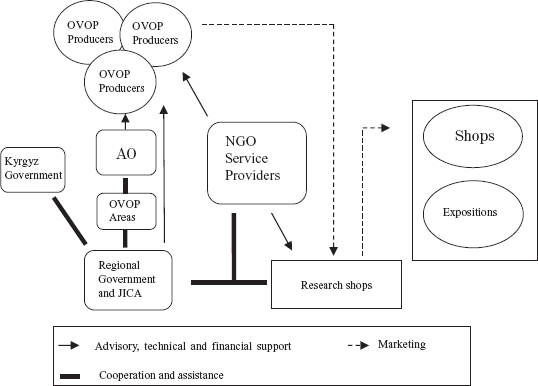
In terms of management of the OVOP scheme, JICA's counterpart in this project was the administration of the Issyk Kul region. For the purposes of managing this project, JICA published a manual for prospective and current members, which explained the purposes of the OVOP implementation not merely as an economic enterprise but also as a community-building initiative, which is expected to lead to confidence building and enhancing initiative among community members through joint economic activity.
The initial mission to define the needs and importance of such a project was launched in 2003 in Kyrgyzstan in cooperation with the State Commission on Architecture and Construction and the State Service of Geodesy and Cartography under the title “The Study on Integrated Development Plan of Issyk-Kul Zone.” The study was conducted from 2003 to 2006 and aimed to reveal the prospects for developing the Issyk Kul region's potential in terms of both tourism and sustainable community development (JICA, 2006). As a result, this study developed a proposal in which four main areas were identified as crucial for sustainable development of the Issyk Kul region. These four areas were community empowerment, agricultural rehabilitation and recovery, development of touristic potential and investment, and safeguarding environmental security.
Among these four areas, the one targeting community empowerment was identified as a priority area for Japanese ODA support. Assistance to this initiative was extended under the overall goal of assisting economic growth-generating projects and was launched in 2006.
Introduction of the OVOP scheme in Kyrgyzstan was not a conceptually new practice for JICA. Prior to Kyrgyzstan, this scheme of community empowerment has been introduced in other countries, such as Thailand, Vietnam and Cambodia. Initially, the OVOP was a scheme practiced in the Oita prefecture in Japan. The main idea of the OVOP scheme is that communities would receive assistance in enhancing their capacity to produce, develop and market products that they can successfully develop to generate profit and sustain their community life.
In rural Kyrgyzstan, the issue of providing support to producers in remote areas with non-existent or weak producer associations and poor infrastructure and to local residents in encouraging them to find and develop a product that would allow them to successfully sustain their lives is crucial (JICA, 2006). Therefore, this project attempted to organize members of certain communities in the Issyk Kul area into producers of certain goods for which local environment or traditions serve as competitive advantage (JICA, 2006).
After the first steps of the project were completed and these groups launched their products, 60 more groups were added as participants in the project. At the follow-up stage to the first phase of the project, the process of developing an Issyk Kul brand was launched. The brand was registered with the national authority for brand registration, and its product line was expanded to include not only jams and dried fruits but also products from leather, wood and stone. In addition, to promote exports of these products, JICA conducted a competition among the OVOP projects conducted internationally. As a result, the OVOP projects from Kyrgyzstan and Kenya were selected as partners for the Japanese brand Muji, enabling them to merchandise their products using Muji's network (Ryohin Keikaku Co., Ltd). In 2011, during the MUJI Christmas Market event alone, OVOP producers received orders for 10,000 items produced in Kyrgyzstan. Since 2011, such events have been taking place annually.
The second phase of the OVOP project in Kyrgyzstan is designed to last from January 2012 to 2015 with the participation of 60 groups that participated in the first phase of the project. If successful, this example might lead to further enlargement of the project to include more participating members. In some unsuccessful cases, however, the project members left the OVOP project after they lost further interest in it.
Japanese support to the Water Users Association (WUA) building strategy
One of the main points in the agenda of reforming an agricultural sector is the issue of how to address buying and selling land, which are prohibited in Uzbekistan largely because of the unresolved issue of water privatization. One of the initiatives undertaken to address these issues in Uzbekistan was the creation of Water Users Associations, which were initially government-subsidized, as an alternative to government-run water-distribution schemes. These schemes remain under heavy government control, but they are now more accessible to local water consumers, offer larger self-governance incentives for local agricultural producers and involve a higher level of local community participation in the alleviation of water shortages. The overall aim is to decrease water consumption in several stages. The first stage would be accomplished through a reduction of unproductive water losses (which currently cause at least 20% of the total water uptake). A later stage would be accomplished through higher technologically advanced forms of irrigation, which require an improvement of financial capacities of both the Government and water users (Dukhovnyi, 2003, p. 17).
The final goal of creating Water Consumers Associations is two-fold. First, it is to reduce the level of water consumption. Second, this measure is not simply to provide agricultural producers with water but rather to create an institution through which local producers themselves can facilitate their own effective consumption and accumulation of excess water and accomplish the task of enriching their own land.
By helping establish such a system, Japan aimed to stimulate local agricultural producers to use less water and at the same time reduce the burden of governmental control over this sector of agriculture.
One of the main problems of such associations is that they are critically under-funded. Small and medium-sized agricultural producers such as farmers or dehkans are not yet able to cover all of the costs related to the installation of new technology, maintenance and extension of existing water networks. They do not draw sufficient profit from their production to make investments in the water distribution network. As a result, these associations are effective in using existing water distribution networks but are not self-reliant because they still receive funding from the government.
The joint Uzbek–Japanese project aimed to improve water management, starting with the pilot WUAs in the target areas, by improving the training systems within the Basin Irrigation System Management (BISM) and the Irrigation Systems Department. As part of the project, the appropriate technologies for water distribution and maintenance of irrigation and drainage facilities were designated to be disseminated to the pilot WUAs.
What was intended within the project was first to strengthen the training system for WUAs in locations in which farmers have never experienced this type of system of water management. Second, the project attempted to strengthen the capacity of WUA staff members. Third, the projected attempted to provide expertise not only for WUA operations but also for maintaining the irrigation and drainage facilities that were overlooked in the years after the collapse of the Soviet Union.
The project started with the Tashkent Region (under Chirchik-Ohangaran Basin Irrigation System Management), the Syrdarya Region (under Lower Syrdarya BISM) and the Djizak Region (under Lower Syrdarya BISM). Japan committed to a 300 million Yen investment for these activities, providing 4 experts who were dispatched for long-term assignments and 6 experts who were dispatched for short term assignments to oversee these activities. The Japanese government also delivered equipment worth 70 million Yen and provided for local operation costs worth 110 million Yen and operational costs of 7 million Yen (161,825,000.00 Uzbek Som), exclusively for offices and facilities at the Project Office at Tashkent and offices and facilities for pilot WCAs.
The Japanese engagement, which aimed to develop grass roots capacity building for WUAs, has had both achievements and shortcomings. First, the evaluation of the outputs of the project indicated that although the indicators set at the beginning of the training have been achieved, the capabilities of BISM and ISD staff have not yet been satisfactory to the point of being able to run a WUA sustainably and independently. In terms of tangible outcomes, the Project has developed training modules for the improvement of technical and managerial skills of WCAs, with 7 textbooks and 3 additional manuals in addition to preparing a number of trainers. Although the training was conducted in 194 training sessions and attended by a cumulative total of 570 staff of the pilot WUAs, the extent to which these individuals can apply their knowledge must be further assessed.
Second, the training for water measurement was successfully conducted, with participants learning how to monitor water allocations and register water supplies for their respective WUAs. However, when checked for compliance with the training criteria for keeping records, many of those who attended training did not keep the proper forms once they returned from training to their duties, thus necessitating further supervision of proper record keeping of water supplies in the cropping season.
Third, the training provided expertise in how to make plans for irrigation and drainage maintenance and repairs. Although at the level of training, the majority of those participating displayed a fair level of ability to draft and properly define irrigation and drainage facilities repairs and maintenance, these plans were properly implemented only in a limited number of cases. Nine of the 27 plans for canal repairs were actually implemented and completed. Eight plans were only partially implemented, and 10 canals were left completely unattended.
Fourth, the goal of capacity building for maintenance of WUA functioning was partially achieved. The indicators of the collection rate of water and other service fees and of the implementation of water distribution could not fully reach the defined targets due to logistical problems related to the non-implementation of irrigation and drainage facilities.
Although the outcome's success was limited, the overall effect and importance of these activities can be characterized as very high because this project provided expertise to farmers that has never before been available to them. In addition, the indirect effect of the project is that the expertise provided to farmers is projected to be transmitted to those who were not part of the training by word of the mouth, thus multiplying the effect of the training.
There have also been positive effects from the Project on the agricultural production and economic conditions of the farmer beneficiaries and on the reduction of salinity problems. There have been positive changes in terms of the organizational and financial aspects of the pilot WCAs. Social changes were also noted by the beneficiaries, such as increased trust in WCAs by the members, closer relationships with ISD officials, and favorable recognition by and increased support from local authorities such as khokimiyat. Spontaneous diffusion of technologies such as flume repair to other WCAs in the vicinity was also reported. Thus, a highly positive effect is expected from the Project. In fact, there was no negative effect of the Project reported or observed as of the time of the Evaluation.
Conclusion
As demonstrated in this paper, Japan over the years has grown to become the leading ODA provider in Central Asia. ODA has served as a foreign policy tool and as the most significant tool for maintaining cooperation ties. Although the focus of Japan's ODA assistance over the years has focused on East Asian countries, CA is growing to become another frontier for more proactive Japanese policies.
As described above, a number of Japanese initiatives have in general brought positive development to CA and are highly valued by the CA public. This appreciation is transmitted both at official meetings and also frequently at the ordinary public level, as indicated by public survey data from 2005 and from 2015. Yet as seen from respondents’ answers, there is tremendous potential for Japanese penetration into the CA region, primarily through cultural and economic diplomacy. Unfortunately, this potential is not yet being used to accomplish this task. In this regard, more focused, targeted, functional approaches might hypothetically assist in making the Japanese engagement in CA more efficient and result oriented.
The potential areas of cooperation both within the region and with partners from outside of the region include stimulating economic development, resource development and utilization, and water-management policies and strategies. These areas in particular are considered to impact the long-term economic sustainability and interstate security in CA.
The Japan-supported initiatives also tend to emphasize narrower, more specific approaches to cooperation both with and in Central Asia. As was outlined above, these primarily include cooperation in energy resource transportation and production as well as support for community-based water, educational and sustainable development-related projects. This is also a clear move in favor of more pragmatic cooperation in this region. As is exemplified by water-related assistance in Uzbekistan and support for local capacity building in Kyrgyzstan, Japanese assistance of a more focused character can better contribute to development both in these societies and in the region in general. These types of initiatives can successfully complement government-to-government assistance schemes and Japanese investments into large scale projects. The focus on local communities will also ensure that beneficiaries of the Japanese assistance projects will include not only governmental institutions but also the general public at large.