






Abstract
This paper challenges the mainstream social scientific approach that emphasizes “moral inferiority” in corruption and bribery in Central and Eastern Europe. We argue that in many cases, people participate in informal organizational resource exchanges not because of immorality or greed but rather because of powerful external forces. By using the case of contemporary Hungary to support this argument, this paper provides a systematic analysis of such imperatives. The findings of 50 in-depth qualitative interviews suggest that two main imperatives can be distinguished; macro-level social and meso-level organizational forces. Macro-level forces may be linked to historical paths, Hungary's socialist and pre-socialist social conditions, and its post-socialist welfare state development. Meso-level organizational forces are more general phenomena and can be found in many other countries in the world. Moreover, there are numerous categories within each theme. Some of them represent normative imperatives, while others are more material structural forces.
Introduction
Post-socialist Central and Eastern Europe (CEE) is often labeled by Western scholars as a “highly corrupt” realm outside modern and civilized Western-style democracies (Shore & Haller, 2005: 3–4). According to this notion, the main reasons of corruption in the “developing world” are moral inferiority and the lack of “social discipline” (Sajó, 2002: 9–10). This paper challenges this universal understanding of post-socialist corruption and claims that informal transactions to exchange organizational resources in the region should not be considered as primarily a matter of individual morality or character. These transactions are complex and should not be seen as a general or single phenomenon. In this paper I argue that in many cases such informal behavior is the result of structural arrangements that manifest themselves as imperatives on individuals. The main goal of this paper is to map out the varieties of such external forces by using rich empirical materials. I use the case of Hungary, a country that has led the way of ‘Europeanization’ in the post-socialist bloc, to support my argument. The findings suggest that even in democratic and relatively well-to-do Hungary, people face strong external imperatives to get involved in everyday informal transactions.
Based on qualitative empirical data (50 in depth-interviews) this paper identifies two patterns, macro-level social and meso-level organizational structural forces, that ordinary citizens face. The first one may be linked to historical paths, Hungary's socialist or even pre-socialist social conditions and its post-socialist welfare state development, while the second, organizational pattern and the related subcategories may be similar to those found in many other parts of the world. By using conceptual “additions” from existing social scientific literature, combined with a detailed qualitative perspective, this paper provides an understanding of informal and illicit practices in post-socialist CEE deeper than the over-simplistic “moral inferiority” approach. The two research questions of this paper are: What are the main types of imperatives that “force” people to participate in informal exchanges of organizational resources in contemporary Hungary? What are the possible explanations of the existence of such imperatives?
This article is organized as follows. The second section provides the conceptual framework of the paper. The third section (methodology) discusses the sampling and data gathering strategy of the study and shows how the empirical data was analyzed. It also deals with some drawbacks of snowball sampling, used for this study, and other potential weaknesses of this type of qualitative research. In the fourth and fifth sections I present the main findings of the study. Finally, the conclusion summarizes the results and attempts to place the main findings in a broader social and historical context.
Conceptual preliminaries
In a very general sense, informal economic practices are defined as activities that are not ‘regulated, monitored or controlled directly or indirectly by the state’ (Routh, 2011: 211). In this case “formal” is defined in terms of state institutions and “informal” is simply just outside of the state's regulatory regime. In contrast to this approach, I try to capture the “formal-informal” dichotomy at the organizational level. This study defines “formal” activity as tasks, roles and resource transfers assigned by formal organizational authorities and regulated by formal rules within an organization. Such activities are fostered and coordinated in order to achieve the organizations’ official goal (Puranam, Alexy, & Reitzig, 2014). This paper focuses on cases when people informally exchange formally allocated organizational resources. The “re-distribution” of these resources should be considered, at minimum, as the violation of rules of the focal organization. However, since society wide codified norms are typically reinforced by internal organizational rules (Martin, Lopez, Roscigno, & Hodson, 2013), in many cases the informal organizational resource exchanges, examined in this study, also break the society's universal rules.
In the literature there is a gift-bribe debate, in which activity, viewed as gift giving by anthropologists, are regarded as corrupt by NGOs and international institutions (Morris & Polese, 2014; Polese, 2008; Rose-Ackerman, 2010). The activity I discuss in this paper has similar characters to gift giving, because of the norm of reciprocity and the absence of moral violation of norms from local perspective. However, the fact that actors exchange organizational resources that they do not own clearly distinguishes this behavior from pure forms of gift giving when actors exchange things belong to them. The presence of organizational resources, usually counter-gifts, in the exchange may help to clarify such ambiguity and distinct informal exchange of organizational resources from typical gift giving.
The activity discussed in this paper is traditionally understood as corruption or bribery, both in terms of political science, sociology and organization studies conception, and in a lay context. However since many of my respondents found such behavior legitimate and appropriate, from their perspective it was not necessarily defined as “corrupt.” In other cases, my interviewees saw the inappropriateness of their behavior, but had to obey much stronger social forces that somewhat legitimated or at least made their rule-breaking act ethically neutral (Humphrey, 2002: 128).
Dominant social scientific approaches often use a framework to analyze corruption with strong moralistic and ethnocentric undertones (Anders & Nuijten, 2008). These scholars treat corruption in more developed Western countries as something exceptional, caused only by a few “rotten apples” while they claim that the structural corruption in the less developed parts of the world is the result of society wide moral inferiority. The hardworking and sober West is contrasted here with deceptive, savage and lazy East. This social-pathological approach views corruption as a cancer, harmful and dysfunctional. By analyzing corruption at the level of transactions this view argues that individuals participate in such exchanges because they are greedy and want to maximize their personal profit (Banfield, 1975; Rose-Ackerman, 1978; Shleifer & Vishny, 1993). However, the social-pathological approach rarely considers the actors’ social context, past and current relationships, and their complex normative preferences.
Of course, some studies have confirmed less voluntary forms of corruption. Here people participate in corruption not because of greed and profit maximization but because of external imperatives. For example, in several cases the payment is demanded rather than offered because corrupt individuals, usually public officials, use their authority and their monopolistic control over resources to force ordinary citizens to pay bribes (Granovetter, 2007). Other studies have considered less individual forms of constraints, norms in rule-breaking behavior. According to such models, the willingness of participants to violate rules reflects lenient social norms that people internalized in the countries where they grew up (Barr & Serra, 2010; Fisman & Miguel, 2008: 82–94). In these cases local actors do not see their activity as deviant or unusual but rather something as unquestionable part of their everyday life. For example, empirical studies confirmed that most patients in Hungary feel obliged to give informal payment for health care even if the doctor does not ask for anything (Gaál, 2006).
This paper delves deeper inside into such external imperatives and focuses on transactions when economic reasoning was not the major motivator but rather actors were somewhat compelled to engage in illegal exchange. The main goal of this study is to create a typology of this specific form of informal exchanges when actors’ behavior is constrained by external social forces. However, external imperatives are never entirely external. Rather they influence individual behavior via personal relationship structures. Such constraints are not static “social facts” but should be seen as constant processes, continuously constructed, reconstructed, and altered during interactions with other people (Emirbayer, 1997). This study tries to capture these imperatives through personal narratives about actual informal transactions.
In social sciences there is an analytic distinction made between symbolic segments of social forces including cultural, normative or institutional elements and other, “more materially constrained levels and imperatives of the social system” (Alexander & Smith, 1993). These two types are often referred in macro sociology as ideational and material structural forces (Adler & Borys, 1993; Collins, 2005: 133; Hinings & Tolbert, 2008: 475–476; Lincoln & Guillot, 2006). My study applies this distinction to argue that these two forms of imperatives, institutional and material forces, should also be separated in the analysis of informal exchanges.
Methodology
I conducted 50 in-depth interviews in Hungarian in Budapest between December 2009 and May 2011. Using snowball sampling, I interviewed people from widely different social and organizational backgrounds who had themselves participated in informal and illegal transactions or at least had a direct insight into the phenomenon. Snowball sampling is an appropriate technique to identify hidden target populations, for example, members of deviant or vulnerable social groups (Becker, 1966; Goodman, 1961; Heckathorn, 1997; Lindesmith, 1968).
I conducted semi-structured interviews, using a flexible interview protocol that allowed me to tailor my research questions to each interview situation. My main goal was to collect detailed descriptions of actual transactions when people informally exchanged organizational resources. I had 10 initial starting contacts, drawing upon a deliberately wide spectrum of people from low-level private employees to top executives of national governmental organizations, based on my own social networks of friends and friends of friends.
I defined the interviewees’ social economic status based on their education and occupation. I classified as working-class those respondents who did not have college degrees and who were manual workers or low-level administrative workers. Interviewees that I described as ‘middle class’ had at least a college degree and typically held professional or white-collar jobs. Respondents whom I categorized as ‘elite members’ were top executives in either private, state owned or governmental organizations. The respondents I labeled ‘small entrepreneurs’ fit the upper scale of working class category. They are typically self-employed, small shop owners or small-entrepreneurs with very few employees, often relatives. They often financed their families directly from their business accounts. Table 1 summarizes the backgrounds of my respondents.
Social background of all respondents.
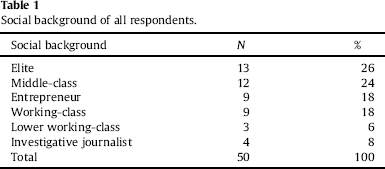
Social background of all respondents.
As the first analytical step of this study, I established discrete findings based on my interviews. Then I related my findings to each other in order to recognize categories and broader patterns. Finally I made conceptual “additions” from existing social scientific literature to my observed data (Miles, Matthew, Huberman, & Saldana, 2014: 293). Many of my findings have conceptual analog, although in different social scientific disciplines. My study follows a bottom-up or inductive analytical strategy by focusing on “the context of discovery” instead of the “context of justification” (Swedberg, 2012). Therefore this research did not start with clearly defined hypotheses nor already existing theories. I rather looked for similar behavior patterns and related categories emerged from the rich empirical data. However, in each section I tried to pick up appropriate conceptual constructs from the literature. Linking my data to these concepts, now empirically grounded in a Central and Eastern European context, helps to better understand informal practices in the post-socialist region from the viewpoint of everyday Hungarians.
I started the data analysis while interviews were still being conducted and created verbatim transcripts based on recordings. I used qualitative coding of transcripts to identify connections between the narratives and the codes (Charmaz, 2006: 43). By the end of my analysis, I had constructed a list of core categories, theoretical memos, as well as representative examples of quotes from interviews and, finally, a portrait of how different types of constraints influence actors. I use nearly verbatim quotes to illustrate my categories. This study focuses only on cases when the “sold” resources can be found at the middle or lower levels of organizations. In contrast to this phenomenon, professionally designed and managed hybrid formal/informal organizations such as of corrupt elite networks in Hungary have significantly different characteristics (Jancsics & Jávor, 2012).
Snowball sampling is not without problems. Since the actual size and boundaries of a hidden population are unknown, new respondents cannot be selected at random (Heckathorn, 1997). They are somewhat dependent on the individual and subjective choice of the previous interviewee. This selection bias obviously decreases the validity of the sample and limits the author's ability to end up with general conclusions from the sample (Faugier, 1997). Research projects relying on snowball sampling may be also stuck in close-knit subgroups and the findings could exaggerate similar features within the group while denying subjects outside the cohesive network (Griffiths, Gossop, & Powis, 1993). Although the researcher has some control to direct the sampling process, for example, by selecting among the newly suggested respondents, the above-mentioned methodological weaknesses can be only partially addressed. However after considering the tradeoff between the unique insight of a hidden population and selection biases, I believe that the benefits that the snowball method provides in this case, are clearly greater than the drawbacks.
This pattern refers to macro-level social forces. All of them are somewhat related to Hungary's long-term or more recent social development. In some cases normative imperatives shape the behavior of the actors who usually do not perceive the effects of the institutions they have created (Hall & Taylor, 1996). This means that the process of their creation and the behavior linked to them are not based on purposive human action. After people internalize social norms, they no longer recognize the social constraint of such institutionalized system as a burden but instead see it as totally normal or natural, something common to all group members (Cloyd, 1965; Granovetter, 1985). In contrast to these normative constraints, material imperatives are more visible and real. Here ordinary people are aware of the pressure that forces them to participate in informal organizational exchanges. Such constraints are related to their actual position in society.
Universalistic norms
Two categories, ‘consume more’ and ‘Robin Hood attitude,’ emerged from my data that suggest that society-wide universalistic norms, or at least norms shared by large groups of Hungarians, play a role in informal practices. Both reflect somewhat the historical context of informality in the region.
Consume more. During communism consumption had a special importance in peoples’ life. Due to the malfunctions of the socialist redistributive economy, citizens in CEE faced widespread constant shortages and even the available goods had very limited variety (Kornai, 1959). Consuming Western goods, for example wearing blue jeans, was a means of symbolic resistance against the socialist homogenization pressure and provided important identity that set somebody apart from socialism (Verdery, 1996: 28–29). More contemporary empirical research confirmed that high visible consumption as a status signal has much more importance in poor countries. The richer a society or social group, the less important visible spending becomes (Charles, Hurst, & Roussanov, 2009). My interviews suggest that consumption is still a crucial element of contemporary post-socialist life in Hungary. Strong universal informal norms pushing people to consume at higher and higher levels often overwrite more formalized and codified legal laws.
My Hungarian interviewees repeatedly compared their own living standards with those in neighboring Western European countries. They desired a level of consumption similar to that of an average Austrian or German, but they were painfully aware of their significantly lower salaries and standard of living in Hungary. Of course using informal exchanges is only one of several ways people satisfy their consumer demand in Hungary. For example, before the global financial crisis, hundreds of thousands of Hungarians had become indebted in foreign currencies and bought new apartments, cars and other consumer goods for credit. Now most of those people are heavily burdened by the skyrocketing interest payments triggered by the crisis. Since cheap credit is not available for consumption anymore, informal activities are on the rise again in Hungary. This echoes the similar pattern in other post-socialist countries that the crisis has exacerbated informal behavior (Polese, Morris, Nodelsen, & Kovács, 2014).
Other legal options to achieve high-level consumption are rather limited. For example, compared to the last two decades of socialism, people in post-communist Hungary have faced fewer opportunities for upward mobility or increased earnings. Democratic Hungary has become more and more immobile and one's parents’ social status strongly determines children's career opportunities (Bukodi, 2002). My research suggests that, in this economically-constricted post-socialist context, informal exchange has become a legitimate mobility channel for both working-class and middle class Hungarians. Because legal channels for attaining prosperity are not functioning for many people, these transactions provide a real alternative tool to express, achieve and maintain social status. Respondents explained how illicit exchanges might contribute to consumption based social status:
“In order to feel that you are in the right position in society you should change your car every two or three years … or if you do not have an LCD TV at home you are not even a human … and of course there are the ‘required’ holidays. You cannot provide all of these from your salary so you have to do something illegal to achieve such goals. But this is normal in Hungary today.” (Middle-class respondent)
Or
“If you are a youngster in Hungary, I know because I see my brother, and you earn 83 000 forint (approximately $380) a month and work at a CBA [Hungarian retailer chain] or in a shop the public transportation is 11 000 for a month. Ok, let's say you don't pay rent because you live with your parents. But you have to give them 10 000 or 15 000. So, 50 000 is left; but a pair of trendy jeans is 22 000. So buy one and 30 000 is left for a month to eat and to go out and invite your girlfriend to see a movie and to pay your cell phone bill. I don't know anybody in Budapest now who would not be corrupt in order to afford such a normal life of a young person. So, they just steal whatever they can from their workplace and sell it.” (Working-class respondent)
‘Robin Hood’ attitude. Not only the current situation nor organizational rules, but also the particular history of an exchange relation structure, may determine what is considered appropriate in illicit exchanges (Granovetter, 2007). In CEE the heritage of socialist states had a long-standing impact. Under Communism, informal and illegal activities became tolerated ways of beating the unpopular Communist system or ways of defying greedy politicians (Ledeneva, 1998). We can see that historical relationships between citizens and the ruling party also matter. These strong historical pathways still influence ordinary citizens’ perception of the state. My findings suggest that a widespread norm among many Hungarians that supports informal exchanges is the belief that cheating the state is acceptable. In my interviews, the most typical rationalization was that the state and state authorities constitute an alien body imposed on Hungarian society and since the Hungarian state steals from its own people, stealing (back) from the state is totally legitimate. Some interviewees even compared cheating the state to Robin Hood's heroic acts: robbing from the rich and giving to the poor.
“Let's say that there is an entrepreneur and he has to cheat on tax payments because he cannot pay it all. Entrepreneurs such as him have this Robin Hood feeling … and they say: this f***ing state wants to steal my money because the taxes are huge. But the state cannot mess with me because this is me who will cheat the state. I will do tax evasion, use fake receipts and so on. I know because had the same feeling when I used to be a self-employed entrepreneur years ago.” (Middle-class respondent)
Or
“The state here did not give too much to the Hungarian people. After the collapse of the communist system I did not get anything from these new ‘democratic’ governments such that I should be loyal with them. They were and still are massively corrupt. And people just think, why not; why not cheat the state?” (Working-class respondent)
Or
“I think the main point of the Hungarian history, for a very long time, has been about cheating the central power … if we wanted to survive … So, the name of the game was cheating the Turkish when they were here or cheating the Habsburgs when they were here … You could not choose the legal ways. The 1950s was the same; it was like everybody against the communist state because the state and its regulations were unpredictable.” (Middle-class respondent)
Robin Hood attitudes reveal unique characteristics of the post-communist transition and the relation between Hungarian citizens and the state. Communist public administrations were originally designed for imposition and control rather than facilitation and service (Baker, 2002; Ellison, 2007). After the collapse of communist regimes, newly emerged “law governed” states in the region quickly lost their legitimacy because of their “mafiotic” and predatory characters (Verdery, 1996: 220–227). Extortion by post-communist public officials is widespread in Central and Eastern Europe (Kotchegura, 2004; Miller, Grodeland, & Koshechkina, 2001: 83–85; Sajó, 2002), which also contributes to the fact that cheating the state is viewed as absolutely legitimate among ordinary people. In CEE, people's trust in institutions such as the political parties, the government, and Parliament is exceptionally low, compared to their Western counterparts, even more than 20 years after the collapse of communist state (Rádai & Tóth, 2010).
Rationalization is an important reinforcing mechanism that underlies normalization illicit transactions (Ashforth & Anand, 2003; Granovetter, 2007; Sykes & Matza, 1957). Robin Hood attitudes may be also seen as parts of rationalizing ideologies developed by large social groups in contemporary Hungary. One rationalization pattern that seems to be relevant here from the literature is the denial of victim when the actors believe that the target, in our case, the Hungarian state, “deserved it” because of previous unfair treatment of its own citizens. Therefore cheating the state is a form of revenge (Ashforth & Anand, 2003). My empirical data suggest another rationalization form, social weighting (Ashforth & Kreiner, 1999; Sykes & Matza, 1957) when actors, involved in informal behavior, question the legitimacy of the state, claiming that that politicians and state officers are even more corrupt than ordinary citizens and thereby stealing from them is legitimate.
Material structural imperatives
For most participants in illicit exchanges, material imperatives are more visible and real than normative ones. Such constraints are related to the actors’ actual position in society or their relation with the formal state structure. This is the realm of unequal power relationships.
I cannot afford not to violate rules. In this category, informal exchange provides the only solution for everyday problems that an actor can financially afford. For example, a person's low socioeconomic status may prevent them from purchasing goods or services at the normal market price; however, informal dealing works as the equivalent of buying at a discount. Here such exchange is a strategy of personal survival. The lowest and most vulnerable stratum of the working class is redundant workers (Portes, 2010: 88–89). They drift from one menial job to another or are simply excluded from the regular labor market. Their primary focus is on day-to-day survival and they often engage in informal and illegal economic activities. The prime characteristic of this class is its complete lack of economic power.
Several interviewees mentioned that they “cannot afford not to be corrupt.” For example, a working-class interviewee told me that some services, necessary for his everyday job, are beyond his budget. He has to choose illegal ways to obtain such services and such demand creates its supply in the informal/illegal market. Here is an example:
“OK. I'm not a corrupt guy but I can solve some difficulties … actually I have to. If my old car has to go through the yearly inspection test, I just call some friends and they find me a corrupt car inspection service. Let's say there is a crack on the windshield. An average guy like me is struggling with money problems. A new windshield is 20 000 HUF and we are not even talking about the worn tires and brake shoes. If I bribe the guy to pass my car through the inspection, it costs only 8000. I need the car every day to get to work.” (Working-class respondent)
Or
“You know we travel all around the neighboring towns … we do not work just in Budapest. Especially in the evening I drive the minivan fast because everybody wants to get home rapidly. So every two or three months they [police] catch us speeding. Thank God so far we were able to get off by bribing them. We pool our money together. It is sometimes one day's salary for two people. It is a little scary now because there is much more severe control over them [policemen] by their bosses. So they are reluctant to take the risk and receive bribes. But I have to take the risk because this [driving license] is my working tool. I cannot afford not to be corrupt (laughing).” (Working-class respondent)
Dysfunctional post-socialist institutions. Several authors argue that informal networks sometimes stem from individuals’ response to inefficient formal institutions (Ledeneva, 1998; Lomnitz, 1988; Lomnitz & Sheinbaum, 2004; Smart & Hsu, 2008). Such “private-order arrangements” are developed to substitute public-order institutions in societies where formal arrangements do not function effectively (Hillmann, 2013). My interviews also confirmed that people develop informal structures to survive in an uncertain formal institutional context. Such uncertainties have derived from the over-politicized public administration or from the weak post-socialist judicial system. The following patterns emerged from interviews with professionals and academics that worked in ministries and other public sector organizations. Here political party affiliation and sympathy determine job placements and resource allocations in almost all public institutions at both the national and local levels. Each new government, after coming to power, fires a significant portion of the administrative staff, even at lower managerial layers, and replaces them with people loyal to the party in power. This makes any individual's bureaucratic career extremely uncertain. A middle-level professional at the Ministry of Education explained this phenomenon:
“Only two of us survived the government change in our department. They kept me here because I am the only one who is capable of managing EU grants. But they fired everybody else. Even the cleaning woman was selected because of her party loyalty.” (Middle-class respondent)
In order to reduce this uncertainty, Hungarian middle class professionals cultivate reciprocal networks of influence, so that they can gain help if they fall out of favor. They do favors for one another to cement these networks. Cultivating one's network is a kind of long-term investment: participants do not usually require immediate payment for doing a favor for someone. They are content to pile up IOUs. While such informal networks can be found in any part of the world, they are more widespread in post-communist countries than in capitalist ones (Sik & Wellman, 1999).
“It is like: When somebody is dropped out of the public administration, he needs a job in the private sector. When you work for the state you obviously need contacts, ‘good’ men, acquaintances, wives, friends and friends of friends when the cleaning comes … and the cleaning has always come since 1998 when Hungary's extreme political polarization started. This is a permanent movement of people among public, private and nonprofit sector organizations. You need the safety function of this social network if you want to survive. Since you can be fired anytime, you have to give favors when you are a decision maker in order to guarantee your next job.” (Middle-class respondent)
Or
“It is an informal thing between different divisions of the [government] administration and private enterprises. Today I invite you for a beer and tomorrow you invite me to drink something. But in our case the beer is paid by the state which means it is paid by the tax payers.” (Middle-class respondent)
Post-socialist judicial systems proved to be exceptionally slow that could not guarantee rapid and unbiased resolutions of disputes (Verdery, 1996: 221–222). Interviews also confirmed the very high uncertainty in contemporary Hungarian courts. In such context entrepreneurs try to find mechanisms outside the legal system to reduce the risks of opportunistic behavior by the other contractual party.
“Listen, even a signed contract does not matter. It happened to me several times. I did the work and the contracting party said: I will not pay you; sue me if you want and maybe after eight years you can get something back. So, now I am constantly corrupting people at the contracting company because it means a guarantee for me. The guy will do everything to force his company to pay me on time because this is the only way he can get his bribe money from me. After the company pays me, I pay him.” (Entrepreneur respondent)
Companies often use their power over their suppliers and smaller firms or entrepreneurs regarding the timing of payment for completed work or services. They pay much later for the completed work than was specified in the contract. After work has already been done and a contractor has sent an invoice to its business partner, the contractor also has an obligation to pay the invoice's tax portion immediately to the tax authority. This makes the contractor's position against the more powerful partner even more vulnerable.
“Not paying on time is the most natural thing in Hungary. Firms do not always do this because they want to mess with you. They do it just because they are also waiting for money from other firms. There is long queue and there is a hierarchy in it. It is a bad and inadequately functioning system. If you want to get your money within seven days what is actually in your contract and not after six months or even later you have to bribe somebody to put your invoice before others. Or you have to give him a generous gift, an expensive concert ticket or a pass to the coolest summer festival, for example.” (Entrepreneur respondent)
Organizational-level imperatives
The second major pattern emerged from my qualitative data reflects meso-level organizational imperatives. They are probably common features of all hierarchical organizations. Here we can also distinguish normative and material forces.
Particularistic norms
Don't turn in an in-group mate. People also engage in illicit transactions when particularistic norms, related to small groups, predominate over society-wide codified norms (Schweitzer, 2004). A formal organization itself is a particularistic structure within society but there are also particularistic informal subgroups with their own goals behind the organization's formal universalistic regulatory regime (Blau, 1955: 178–182; Perrow, 2007: 29–30). In these subgroups unofficial norms regulate, reward and sanction the members’ behavior (Blau, 1955: 183–195). The enforcement of external regulations within an organization can be difficult because of insider norms, and a culture of silence and cover-up, where even honest members show solidarity with their deviant colleagues (Katz, 1977, 1979). The informal code of “don't give up another cop” is a well-known example within police forces (Kappeler, Sluder, & Alpert, 1994). The enforcement of the organization's own official regulations may be also problematic because of particularistic structures taboos on reporting fellow group members. The group can sanction the violation of this norm by harsh ostracism (Blau, 1955: 188).
Organizational insiders often socialize newcomers to the organization into rule breaking and produce a local culture in which deviation from formal rules and procedures is normal and acceptable (Ashforth & Anand, 2003; Vaughan, 1996). A local government official in Budapest told me how he was socialized in a corrupt organizational culture:
“In our office everybody knows about the others’ dirty businesses. When I started to work at the local government it was not like an occult initiation to the corrupt tribe. I just simply saw how things were going on around me. I just joined the line and that time I did not even think about it. If you are not a team player, the team gets rid of you. So, the first rule is, do not turn in a fellow colleague. There is an environment, a culture you just get in as an innocent but you quickly accept it. And of course you also immediately see that the guy next to your desk at the same position has a three times bigger car than you have and goes to the French Riviera for holiday.” (Middle-class respondent)
Material hierarchical imperatives
Gatekeepers. The literature tends to distinguish between two types of corrupt practices: collusion and extortion (Bauhr & Nasiritousi, 2011; Mishra, 2006: 191). In the case of extortion, the agent uses his/her authority to force the client to pay a bribe. My findings suggest that actors who control crucial organizational resources are able to use this ability in an illegal market. Such resources are not necessarily material ones; they can involve control over organizational decisions or even non-decisions as well as information. These acts viewed as imperatives on the client side – since to obtain whatever actions they need from an organization requires them to work through the corrupt gatekeeper. Here is one example
“If you want a driving license in Hungary, it is for sure that you have to bribe your instructor and the examiner. These two work as a team. My colleague has just taken the practice test. She bribed them because she did not want to try it four or five times. If you do not pay they bring you down … .after 30-meter-driving they just order you to pull over and you are failed. Then you have to pay the test fee again, so it is cheaper and easier to pay some bribe.” (Middle-class respondent)
However, not only individuals are gatekeepers. Corporate crime is often committed for the benefit of the whole organization or a particular department, in order to obtain contracts or reduce costs (Ashforth, Gioia, Robinson, & Trevino, 2008; Brass, Butterfield, & Skaggs, 1998; Clinard & Quinney, 1973; Trevino & Youngblood, 1990). My interviews also confirmed that not only individuals but also whole organizations can use their gatekeeper position in order to force bribes for the organization's benefit.
A young father told me this:
“Today many-many schools and even kindergartens have their own nonprofit foundations in Hungary. If you pay money to the foundation of your kids’ school and they renovate the gymnasium using that money you did something good, something noble, right? The only problem is that this is not voluntary. Because this is why your kid was admitted, if you do not pre-donate the school they do not admit your child. This is the unwritten rule; this is extortion.” (Middle-class respondent)
A building contractor and entrepreneur provided this story:
“I have been in several housing projects in Budapest's wealthiest district. The district is developing rapidly; ugly big houses have been erected there. But as a contractor you can get a building permit from the local government only if you let the government's own public firm build the roads and infrastructure around your future building. But their price is three times higher than the average market price. The officials at the local government do not even bother to use a ‘secret’ language. If you go in for a permit they tell you clearly that this is the only way to get it. The local government simply blackmails you.” (Entrepreneur respondent)
Ordered to be corrupt. My findings confirm that organizational-level material imperatives can be also result from hierarchical relationships when one's own organizational members force rule breaking. In such cases, actors participate in illicit activities because their formal superiors coerce them to act illegally. Scholars have studied what gives rise to excessive and rigid conformity to superior authority (Scheff, 1988). Milgram's (1974) famous experiments dramatized how easily normally moral people will undertake morally improper actions because they obey authority figures. However, in other cases, pressure by high-ranking corporate officials on their employees is quite direct, pushing the latter into illegal behavior. Here the fundamental source of conformity is the threat of punishment by superiors (Etzioni, 1961; French & Raven, 1960; Warren, 1968). In these “crime-coercive” situations, lower-level employees participate in rule breaking activities because of fear of being fired or punished in other ways (Needleman & Needleman, 1979).
An young HR assistant told me this story:
“My job is to collect and select the CVs the company receives. My boss told me that XY applicant is the kin of a ‘top dog’ and we have to hire that person. I was ordered to shortlist only very weak resumes, because, among them, the relative would seem like a super talent. It is a clear violation of the company's recruitment policy but what can you do in this situation? If you do not follow such orders you can be fired very quickly. So I did it.” (Middle-class respondent)
A retired financial executive explained how serious the sanctions can be:
“This kid was an EU tender expert in the finance department of the local government. Since he did not want to be part of the mayor's suspicious activities he was sacked and he was turned down from all other jobs he applied to. The mayor reached everywhere in the town. He is a talented young man but he has not had a job since then. What I see is that those in power wanted a deterrent to influence the other employees … you know, it was just like shut up for everyone in the office.” (Middle-class respondent)
In contrast to the gatekeeper types, where the actors used their ability to control organizational resources and informally forced clients to pay bribes, here the actors use the formal power system of an organization to coerce their own organizational members. Coercion is used to force informal activity down the organizational hierarchy. In most cases this shift down the hierarchy sometimes occurs because the expertise necessary for “successful” illegal exchanges only exists at lower layers. The knowledge of bookkeepers, controllers, engineers and lawyers about organizational technology is necessary to hide illegal and corrupt deals of the bosses behind normal operation (Jávor & Jancsics, 2013). In other cases, corrupt actors with higher status want to remain safely hidden, so they let lower level employees take the risks and do the “dirty work.”
Conclusion
This paper challenges the mainstream approach that emphasizes the “moral inferiority” character in corruption and bribery in CEE. My findings suggest that in many cases people participate in informal organizational resource exchanges not because of immorality or greed but rather because of powerful external forces. Informal practices constitute a very complex multi-faced phenomenon that cannot be understood simply as a result of harmful and dysfunctional social cancer. The main contribution of this study is that, based on rich qualitative data, it provides a typology and a deeper insight of such imperatives. Table 2 shows the main themes, categories, and codes emerged from the data analysis and the hierarchical relations between them.
Main types of external imperatives.

Since the data collection of the research was not based on representative sampling, this is obviously not a comprehensive typology. But at minimum it reveals some important aspects and the complexity of post-socialist informality. I have identified two main forms of external imperatives that force ordinary Hungarians to exchange organizational resources informally: “macro-level imperatives” and “organizational-level imperatives.” Both have several categories; some of them are normative social forces while others are more visible material structural or hierarchical imperatives.
Macro-level imperatives are linked to Hungary's historical pathways of post-socialist institutional development. The “consume more” category suggests that means available to satisfy consumer demands in post-socialist Hungary are limited. Mobility channels, typical in Western countries, are frozen and due to the global crisis credit is not a possible option for consumption anymore. My middle-class respondents reported increasing willingness to use informal practices in order to achieve the consumption level, supposed to be appropriate for their social status.
The “Robin Hood attitude” category emerged from the empirical data refers to the breakdown in state-society relations in post-socialism. The ‘sense of betrayal by the state’ is also confirmed by empirical studies in other post-socialist countries (Morris & Polese, 2014). However this breakdown probably constitutes longer-term pathways in Hungary. Our findings suggest that the current state-society conflict in Hungary may be tracked back to earlier periods than the 20th century's communist system. Since the occupation of the Ottoman Empire in 16th Century Hungarian people have experienced several foreign rulers and alien state administrations. Therefore the state-society conflict has burned deep into society's collective memory in Hungarian.
The “dysfunctional post-socialist institutions” category refers to significant weaknesses of post-socialist welfare states. The phenomenon when informal systems emerge to compensate for the state's withdrawal from severe welfare provisions can be found in many post-socialist countries (Polese et al., 2014). In our Hungarian cases the state cannot not guarantee adequate protection for public employees or fails to provide sufficient legal service. This uncertain formal institutional context triggers informal responses of ordinary citizens in order to reduce such uncertainties.
The second major theme of this study, “Organizational-level imperatives” contains imperatives that can be understood in a formal organizational context. These are non post-communism specific external forces. As the international literature suggests, particularistic organizational norms are well known phenomena in Western countries and all around the world. Redundant workers, the most vulnerable strata of the working class who are sometimes constrained to participate in illicit deals for their everyday living is probably not a Central and Eastern European specialty either. The two structural types, gatekeepers and superiors who order rule breaking, are embedded into organizational power structures. These phenomena can be also found in many organizations in the world.