






Abstract
This paper analyzes the coercive and legitimate forms of power in Ukraine. It describes the crisis of legitimacy in Ukraine as a contradiction between a blatantly cruel system of capitalism dominated by a few oligarchs, and the lingering remnants of a Soviet mentality. Two strategies are used by the Government to stoke the crisis. First, increased identification with ethnic or regional groups are instrumentally used by the Government to take attention from economic and class issues. Second, the incorporation of a Soviet meaning of power into the new national identity and presentation of it as core norms, believes, and values of the people of Ukraine competes with alternative Ukrainian identity concepts. The paper analyzes five main features of the Soviet meanings of power – political, social, and economic paternalism, perception of power as source of profit and violence, and the dual reality of power with the gap between official narratives of power and a real life. The process of incorporation of the Soviet concept of power into national identity is facilitated by the process of national identity formation that helped to preserve the Soviet perception of power, because of the absence of a new ideology, a lack of critical assessment of the Soviet past, an absence of the vision of outcome, an embryonic culture of democracy, and contributions of all the presidents to the preservation of the Soviet meaning of power. People justify the system as legitimate and fair for many reasons: out of historic habit and deemed moral obligations, self-interests and/or a fear of sanctions, identification with the ruler, zones of indifference, an absence of will and self-confidence, desire to support a strong leader based on ambiguity intolerance, hierarchy – enhancing ideologies, and a general tolerance of injustice. The obedience of subjects is connected with the strength of will of the subjects and the social structures of the society. In Ukraine, the society is not united, not organized, has no identity of “us”, no civic accountability, nor even any real interest in such matters. Civil society levels are very low, as reflected by limited opportunities for civic responsibility and participation and few demands from the society.
Twenty years after independence, Ukraine has yet to build a democratic society and develop a distinct national idea. Instead it rests on its Soviet past as reflected in the continuing Soviet mentality and structures. At the same time, power and wealth are concentrated in the hand of a few oligarchs placing a majority of the people below the poverty line and stripping them of rights and economic opportunities. This paper suggests that Ukrainian society is in crisis of legitimacy, resting on the contradiction between the capitalist-based monopoly of a few oligarchs and the preserved Soviet ideology. To increase its legitimacy, the Government is using both the politics of ethnic divisions and a validation of the regime based on a noxiousmix of 19th century capitalistic oppressive norms with Soviet-style norms of paternalism, infancy, and craving for a strong leader. Thus, the Ukrainian Government incorporates the Soviet-based meaning of power into the developing national identity, thereby reducing the ability of people to oppose or resist the established regime.
Starting with a short overview of the theories of power and legitimacy as well as a description of different types of power, the paper then will briefly discuss the use of coercive power by the Ukrainian government. An in-depth analysis is then offered, concentrating on the legitimacy crisis in Ukraine. The author describes two strategies used by the Government, moderating the crisis: (a) group justification and manipulation of ethnic divisions and (b) providing legitimizing ideology and system justification. The former will be analyzed through a review of the existing literature, while the latter will be discussed based on results of interviews conducted by the author. In the conclusion, a model of legitimation and moderation of similar crises will be proposed and its comparative dimensions will be discussed.
Theoretical foundations
The classic definition of power characterizes it as the ability of one party to influence the behavior of the other party and the ability of the other party to achieve its objectives (Cartwright, 1959; Deutsch & Gerard, 1955; Festinger, 1953, 1954; French & Raven, 1959; Kelman, 1958). Thus a group or individual in power can posit a threat to other groups or individuals by creating the conditions in which the superordinate group will feel inadequate to deal with a current situation or satisfy their needs. The degree of this threat depends upon the degree of power which can be exercised within the system and can be increased in stressful or ambiguous situation A person or group in power can possess two groups of values: welfare values (necessary conditions including well-being, wealth, skill) and deference values whose necessary conditions including taking into consideration power, respect, and reputation. The rest of the people are dependent upon ‘influencing power’ for the satisfaction of their needs and desires or the fulfillments of their goals. The increase of influence of the leader depends on (1) acceptance of him by a group, (2) an increase in certainty of his opinion, (3)a decrease in certainty of other opinions, (4) increased acceptance of his role, and (5) increased perception of leader as an expert. Moscovici (1984, 1988) also describes power as involving dependence and coercion against people's will, changing people's will and beliefs through norms and social consensus.
This perception of power sees it as “given”, self-perpetuating, durable, hard to change or alter by people who are dependent upon the good will, decisions, and support of government in a hierarchical system (a top down approach). It was challenged by Sharp (1973) who introduced the perception of power as something fragile. Government is dependent on people's good will, listen to their decisions, and need their support (a bottom-up approach). The sources of power includes not only resources of a ruler, including authority (a right to command or direct and be obeyed), skills and knowledge, material resources and sanctions in disposal of a ruler, but also human resources (people who obey a ruler) and intangible factors (social and psychological factor including habits and attitudes toward submission, presence of ideology, common faith, etc). Sharp (1973) emphasizes that these resources depend on obedience and cooperation of the subjects and their contributions to the established system. The view of a group as a precondition of influence rather than simply an outcome was further developed by Turner (2005).
Scholars differ in defining the types of power. The classic typology of French and Raven (1959) includes five types: (1) reward power, based on perception that a leader has the ability to mediate rewards; (2) coercive power, based on perception that a leader can produce a punishment; (3) legitimate power, based on perception of legitimate rights of a leaders; (4) referent power, based on identification with a leader; and (5) expert power, based on acknowledgment of specific knowledge or expertise of a leader. Galam and Moscovici (1995) define three types of power: institutional power as a power to dominate the group, generative power as a group's capacity for mobilizing skills and multiplying resources, and ecological power that mobilizes and directs activities toward the outside world. Turner (2005) distinguishes a power ‘over’ and a power ‘through’ approach. A power over, a control as a capacity to compel actions from people who are not convinced in the validity of the specific belief or act, has two forms: legitimate authority based on the acceptance of a right of the ruler to prescribe specific beliefs, attitudes or actions; and coercion as a power over others against their will. A power through approach includes persuasion as power to convince people in the rightness of a particular order and shared belief in validity of a ruler. Thus, despite differences in typologies, the scholars agree that a leader can have power over others by virtue of resources under her or his control or a power that results from mobilization and inspiration to follow the path outlined by a leader. The former can be defined as a coercive power and the latter as a legitimate power.
Legitimate power rests on internalized values and acceptance that a leader has legitimate rights to influence people who have an obligation to accept this influence. Sharp (1973) distinguishes three bases of legitimate power: cultural values that give leader a right to power (“eternal yesterday” (Weber, 1918/1968) including age, caste, intellect); acceptance of a social structure; and designation by a legitimate agent. Theories of justice (Adams, 1963; Homans, 1961; Lerner, 1980; Walster, Walster, & Berscheid, 1978) and theories of legitimacy of power (Blau, 1963; Dornbusch, 1975; Easton, 1965; French & Raven, 1959; Linz, Stepan, & Linz, 1978; Lipset, 1959; Weber, 1918/1968; Zelditch, 2001; Zelditch & Walker, 1984) describe legitimacy as acceptance of the structure (system of power) as “right” by both advantaged and disadvantaged groups. This acceptance results in the stability of the system of power. While the legitimacy of the system is easily accepted and supported by the members of privileged groups, members of low status groups are in conflict with the discriminating system and must deal with this incompatibility. There are several explanations of the support of the system of power by an underprivileged group.
The consensus theory states that legitimacy of social order arrives from the consensus about the group goal(s) and serves to stabilize the regime (Linz et al., 1978). Marx's “dominant ideology” hypothesis (Marx & Engels, 1845–1847/1976) states that the ruling class controls the means of mental production and to mask the conflict between classes' interests creates the predominant ideology accepted by the ruled class as a “false consciousness.” Weber (1918/1968) states that the legitimacy of norms, values, beliefs, practices, and procedures on the collective level (the concept of validity), is accepted by the people on individual level and governs their behavior. The legitimation process is a collective process of embedment of social norms and beliefs into validity of the social order; thus the stability of the regime depends on the collective process of validation by others (Dornbusch, 1975). This validation is critical for the increase of the strength of legitimation on an individual level and provides justification of the system as a whole (Zelditch & Walker, 1984). System justification theory states that in their coping with epistemic and existential sources of threat and anxiety, “members in underprivileged group will engage in various psychological processes- including social stereotyping and various forms of motivated social perception and judgment- aimed at defending the legitimacy of the social systems” (Thorisdottir, Jost, & Kay, 2009, p. 9). Thus, the legitimacy of the social order rests on the support of those who have nothing to gain from it and could benefit from other structures (Jost & Major, 2001).
Social identity theory and social categorization theory connect legitimacy to the development of a shared social identity, stating that mutual influence creates a basis of power as a capacity to persuade and/or control others to carry out one's will. Power rests on group identity reflecting the collective goals, values and beliefs of group members and social comparisons within and between groups. People interpret and evaluate power use through the lens of their salient group membership: ingroup members are considered as more representative of group goals and as more normative and persuasive (Wenzel & Jobling, 2006). Thus, political leaders become influential by employing the basic norms and ideas of social identity and increasing perception of them as prototypical. To increase his or her legitimacy, a political leader should not only be a representative of ingroup identity but also to champion the interests of this group, to form ingroup identity, and to shape the reality in the image of ingroup identity (Haslam, 2011). Legitimate authority is also “based on ingroup norms that a person, role or group has the right to prescribe appropriate beliefs, attitudes or behavior in certain areas. The group agrees (by custom, experience, or formal decision) that they ought to follow a specific person or position (that it has the role of leadership or authority) to express their collective will and short-circuit what might be futile, divisive and time-consuming arguments about what is the right course of action” (Turner, 2005, p.11). Legitimate authority empowers group members to achieve their goals by creating a power structure through which group identity and goals are realized.
Thus, legitimization of power is based on the employment, modification, and creation of specific norms and social identity that justify a particular order. To increase or stabilize their power, political leaders must utilize the prevailing meaning of social identity and shape it into desired connotations, argues here that this process of legitimization of power based on social identity requires the incorporation of the specific meaning of power and power relations between leaders and followers as a core of a particular social identity. In other words, the specific concept of power (specific connotations of chieftaincy, authoritarianism, democracy, e.g.) and power relations (specific types of paternalism, meritocracy, egalitarianism, e.g.) is integrated into the very foundation of social identity in the way that people perceive them as a core definition of their “we-ness” and a characteristic that differentiate them from others. Therefore, the resistance or opposition to power becomes a fight with one's own identity and thus almost unfeasible. Because of this cementation of the meaning of power into the foundation of social identity, the realization of power manipulations and development of potential for resistance against existing regimes by individuals themselves (Foucault, 1990) or by enlightening by intellectuals (Bourdieu, 1991) becomes extremely intricate. Further discussion will show how the crisis of legitimacy in Ukraine is created by the incorporation of the Soviet meaning of power and power relations into the developing national identity through this embedded process of social identity construction.
Methodology
Method
The main method of this research is a semi-structural interview which consists of 6 questions regarding the assessment of the current situation in Ukraine, its national identity, the politics of language and history, history textbooks and the future development of Ukraine. Each interview lasted between 1.5 and 3 h. In addition, the author used participatory observation method during several academic round-tables and political discussions, monitored major TV programs that present political discussions (Shuster Live, Freedom of Speech), and analyzed data available at the libraries and on websites of academic institutes and independent research centers.
Sample
The aim of this research was to interview people who represent “1.5 diplomacy” level: scholars, political leaders, and journalists that are active in the political sphere and have impact on political discourse. I used purposive sample of experts with elements of snowballing. For snowballing I used 7 independent entry points. In addition, 3 widely recognized experts were asked to assess the list of interviewees to insure that the sample includes major experts and equally represents all political and scientific groups. The final sample consists of 58 interviewees, 53 in Kiev and 5 in Simferopol, Crimea. Among them 7 are directors or chairs of foreign foundations, 16 are directors or leading scientists at academic institutes within the Ukrainian Academy of Science (including the Institute of Philosophy, Institute of History, Institute of Sociology, Institute of Political and Ethnographic Research, Institute of World Economy, etc), 10 are directors or leading experts at independent think tanks and research centers, 7 are faculties of the leading Ukrainian Universities, 9 are political leaders (members of Government, Deputies of Verhovna Rada (Parliament) and Directors of the Institute of National Memory and the National Institute for Strategic Studies under the President of Ukraine), and 4 are journalists. This paper represents analysis of interviews of 48 Ukrainian respondents (the answers of 10 foreign experts from Europe and the U.S. are excluded based on the aim of this paper). Gender representation is influenced by the particular nature of academic and political spheres in Ukraine: among respondents 40 are male and 8 are female.
Methods of data analysis
All answers of respondents were organized by 14 categories: (1) the nature of the Ukrainian state; (2) ethnic divisions (3) problems of development; (4) achievements; (5) a source of the national pride; (6) dynamics of identity during last two presidents: Vladimir Yushchenko and Victor Yanukovich; (7) the concept of national identity; (8) common unifying factors; (9) the roots of group divides; (10) the role of language; (11) the politics of history; (12) reactions to the change of textbooks by Dmitriy Tabachnic, the Minister of Education in Yanukovich's Government; (13) youth and (14) the future of Ukraine. The definition of each category will be discussed later in this paper. The 58 × 14 table was created to present answers of all respondents that correspond with the categories of the analysis. The respondents' narratives varied by the level of the development of each category; some categories were not always addressed by each respondents.
Crisis of legitimacy in Ukraine
The ambiguous, unstable, and vague nature of Ukrainian power has been stressed by both Ukrainian and international experts. “Part of the puzzle of Ukrainian politics, for practitioners as well as political scientists, is to figure out what constitutes power and how it can be wielded effectively” (D'Anieri, 2011, p. 29). The use of coercive power by Yanukovich's Government has been discussed at length in academic papers and international organizations reports (D'Anieri, 2011; Freedom House, 2011; Heritage Foundation & Wall Street Journal, 2011; Kuzio, 2010, 2011; Malan, 2011; Nan, 2011; Pew Forum, 2009; Transparency International, 2010; Umland, 2011). These various authors show the use of coercive power in politics, economy, control of mass media and civic society. D'Anieri, 2011 analyzes the incentives system known as “administrative resources” where patronage is an exchange of government support and jobs for political support, and where selective law enforcement is used as a powerful tool to control the economy, the press, and individual politicians. “Positive inducements include, above all, jobs, immunity from prosecution, and business opportunities. Negative inducements include losing one's job or one's firm. These inducements, in the absence of ideology, can be highly effective. The problem for the ruling group is the bill must keep being paid” (p. 34).
This paper concentrates on the question of legitimacy of power in Ukraine. Habermas (1975) saw the crisis of legitimacy in the contradiction between monopoly capitalism and liberal ideology: justifications of a controlled market by free market ideology. This crisis “cannot be separated from the viewpoint of the one who is undergoing it” and results from “an objective force that deprives a subject of some parts of his normal sovereignty” and feelings of freedom (Habermas, 1975, p. 1). Because of the absence of a developed free market and democratic ideology in Ukraine, the crisis of legitimacy in Ukrainian society is embedded in the contradiction between the capitalist-based monopoly of a few oligarchs and the preserved Soviet mentality. Ukrainian oligarchs accumulate their capital through the use of internal resources treating Ukraine as their exploitable colony. During the 1990s “‘institutionalized oligarchic capital and clannish power’ took hold and society became divided into the super wealthy and the poor” (Kuzio, 2011, p. 95). This concentration of capital was supported through structural changes in political, legislative, and financial systems. Respondents in my study believed that the oligarchs do not care about Ukraine, do not invest in its future or development, and are interested only in temporary capital gains. The gap between the wealthy and the poor is growing, people are treated as slaves, and systems of social support and security have been abandoned. They perceive Ukraine building a model of 19th century wild capitalism guided by the images in Marx's books with omnipotent oligarchs, absent middle classes, and powerless workers (Korostelina, 2011). At the same time, after 20 years of independence, Ukraine failed to build a democratic society and develop a national idea, maintaining its Soviet mentality and structure. The Soviet reality still dominates society and is evident in the high levels of corruption, paternalism, administrative mis-management, and an aversion toward innovation. There is an ongoing struggle between Soviet and post-Soviet identities in which Soviet characteristics still prevail in the consciousness of people (Levada, 2000; Ryvkina, 2005; Zadorin & Petuhov, 2011).
To deal with this crisis of legitimacy, the people and the Governments employ dual strategies. The first strategy is connected with group justification by people (developing a membership in a group that provide them security and self-esteem) and the manipulation of the resultant divide in the society by political leaders. The second strategy implies a justification of the system by the people (through perceptions that the system is fair, legitimate, and just) and the employment of a legitimizing ideology by the political leaders. The former strategy is intensely analyzed in academic literature on Ukraine, and will only be discussed briefly in this section; the latter strategy has received less attention in the literature and thus will be discuss in greater depth in the following section.
The first strategy of dealing with legitimacy crisis in Ukraine involves active employment of ethnic and regional identity as well as blatant nationalism. As Tajfel and Turner (1986) show, the rise of ethnocentrism results from the absence of a legitimized and justified power system. Many scholars stress the importance of ethnic or regional identity in Ukraine, its impact on voting behavior and foreign policy, and use of this divide by Ukrainian politicians (Arel, 1995, 2006; Åslund, 2009; D'Anieri, 2011; Hansen & Hesli, 2009; Hnatuk, 2004; Korostelina, 2008, 2010, 2011, in press; Kulyk, 2009; Kuzio, 2007, 2010; Motyl, 1993; Pifer, 2009, p. 60; Ryabchuk, 2003; Shulga, 2011; Shulman, 2005; Wilson, 2002, 2009). Previous research by the author revealed the existence of six different narratives about the Ukrainian national concept and national identity, five of which rest on powerful salient ethnic identities and strongly opposed other narratives (Korostelina, in press). Prevalence of ethnic-based ideologies leads to the perception of society as a zero-sum game where one concept of the society should prevail over other's narratives. It produces aggressiveness, an ‘enemy hunt’ mentality, antagonism, and hostility among people. As the majority of respondents in the authors' study stated, the Government supports these differences and uses ethnic identity to cover class divides, redirecting attention from pressing economic issues.
The authorities employ both legitimation and delegitimation processes, operating them in tandem, creating a decreasing moral acceptance of one ethnic and regional group and associating it with policies and increasing moral acceptance of another one (Kelman, 2001). The intensity of this shift in norms depends on a congruence of this re-categorization with a particular group's interests and preferences, and rests on historic and structural dispositions of the society. Thus, the legitimacy of the Ukrainian Government depends on the extent to which the population perceives it as reflecting their ethno-cultural identity or regional identity, and meeting their group's political, social and economic interests. The latent Soviet mentality of the people that is based on black-and-white thinking and a search for an enemy is easily manipulated by those who employ differences for their political purposes.
Legitimizing ideology
As mentioned above, the experts on Ukraine shed less light on a contentious use of legitimizing ideology by the Ukrainian power and justification of this social system by citizens. Thus it is the main focus of this paper. The current Ukrainian Government realizes the impossibility of blatantly reinstating the old Soviet identity; it would be in contradiction with the capitalist nature of economy and the self-definition of Ukraine as an open society. Thus, it has had to construct a new national identity that includes features of a capitalist economy but centers on the Soviet meaning of power and power relations: submission to the state, hierarchical administrative management, and paternalistic expectations of welfare. Such a mix of two opposite ideologies seems to be impossible at first glance: Soviet ideology was based on the ideas of equality and expropriation of capital on the one hand, while on the other there is a focus on increasing concentration of capital in hands of oligarchs, whose financial interests are realized through the political, legislative, and financial systems. Nevertheless the author posits here that the very meaning of the Soviet concept of power is compatible with the reality of an unjust form of capitalism which is being built by the Ukrainian Government. This compatibility offers the ruling elite a great opportunity to create a consistent ideology that supports their interests. This ideology does not exist solely as a reasoned or explicit construct; rather it includes unconscious elements deriving from the socio-cultural experiences of its leaders (Cunningham, Nezlek, & Banaji, 2004; Norsek, Banaji, & Jost, 2009). While according to many experts, Yanukovich's Government does not have a defined national ideology and Yanukovich himself avoided any discussions of a national idea, some policies reveal the nature of the developing concept of a national identity. This concept of national identity includes both deliberately manipulated components and unconscious elements that derive from the Soviet experience of Ukrainian leaders. This argument is explained here through analysis of both the specific employment of the Soviet meanings of power and the processes of the Ukrainian national identity formation.
Soviet meaning of power
The analysis of the Soviet meaning of power deserves a profound analysis, but due to space limitation this paper concentrates on several features of the meaning of power that were derived from analysis of the interviews.
The first feature is political and social paternalism. Soviet form of relationship to property ownership still shapes the consciousness of people today. This perception of power still exists and results in the continued dependence of the people upon the state, and the prevalence of the State over society. So deep is this reliance on government, that, even after 20 years of independence, distant government officials continue to make all decisions with little societal input or public discussion. People still struggle to understand that Ukraine is not a fragment of the Soviet Union, and labor to overcome the Soviet socio-structural mentality. Many still expect the State to provide for the people, giving them a stable job that can last all life. Dissatisfaction with the government is represented by the idea “Government is not thinking about me, I am not wanted by the Country.” The majority of Ukrainians expect that a just state should secure welfare and social protection of citizens, while the function of the state to secure political rights of citizens is considered less important (Kiryukhin & Shcherbak, 2007). The majority of the population is served by political populists, such as Yulia Timoshenko and Victor Yanukovich, who promise a system of welfare but not the conditions for personal or political development. Thus, the paternalistic mentality and reliance on welfare are actively employed and maintained by populist politicians and the Yanukovich's Government (Kuzio, 2011). Perhaps a contributing factor the people of Ukraine are described as tolerant, patient, accepting different powers through history without open resistance.
Second is economic paternalism – the view of society as represented by an economic executive-leader and a class of workers. People see the labor collective as a referent group, a group of support and a guaranty of stability where people have worked for decades under the leadership of a director-“father”. They seemingly connected their life with the USSR's infrastructures and still identify themselves with the Soviet Union. Uncertainty and increasing mobility leads to insecurity, depression, a loss of one's bearings, and a lower level of adaptation. Many people have nostalgia for the Soviet times, seeking to continue the previously effective (or at least idolized) practices of societal creation, sustained by the Soviet type of enthusiasm of the people, and receiving support from the state. The concept “red directors”, which was actively employed by Kuchma, reflects this Soviet style of management, and is now actively utilized by other unitized economic oligarchs. The history of the Stahanov's movement (the movement to fulfill several daily quotas instead of one based solely on Soviet enthusiasm) is recreating descriptions of the Ukrainian history of the twentieth century to glorify people's sacrifices for the economic development of their country and justify slow economic reforms.
Third is the view of state property as a source of profits and easy money. In the beginning of 1990s, few knew what to do with the country and the economy. Ukraine, rich with geographic potential, an established industrial base, extensive natural resources, and a stable productive economy was viewed as a trophy territory by the Government and people. This “trophy” perception (“steal and squander”) prevailed, affecting people's value system. During his presidency Kuchma complained, “Everyone here views himself as a transitional figure. They want to grab something and run off with it. I'm taking about people at the very top” (Kuzio, 2011, p. 96). Now, according to the respondents, the general philosophy among people is “family first, me the second, the hell with the rest”. There is no respect for others, but rather a “me first scenario” prevails. People are only inspired to increase their personal wealth and see power as a tool for personal gains. People accept the idea that common property does not belong to anyone and can be stolen, destroyed, or neglected (Ermolenko, 2010). Further, that people come to power not to serve the society but to abuse power for personal gains. The acceptance of widespread corruption by the Government legitimizes this meaning of power (Kuzio, 2011). The promise of the President to combat corruption as a major problem in Ukraine also has failed: “Glaring conflicts of interest among senior officials in the new government, combined with further delays in the passage of anticorruption legislation, fueled public skepticism about the leadership's pledges to combat graft in 2010” (Freedom House, 2011, p. 585). According to Transparency International's Corruption Perceptions Index, in 2010 Ukraine was ranked 134 out of 178 surveyed countries (Transparency International, 2010). The Heritage Foundation's 2010 Index of Economic Freedom puts Ukraine at 162nd out of 179 surveyed states (Heritage Foundation & Wall Street Journal, 2011). Corruption was reported as a major national problem by 70% of respondents, followed by pollution (64%) and crime (56%) (Pew Forum, 2009).
Forth is the perception of power as violence. The socio-cultural link between concepts of “power” and “violence” results in the perception, and most importantly, in acceptance of power as inevitably brutal. This link is based both on semantic connections and Soviet interpretation of power (Kebuladze, 2010). The communist ideology equates power and violence, presenting hostility and cruelty as legitimate uses of power against the population. In his work “State and Revolution” Lenin (1917/1974) describes the state as an evil instrument of exploitation of the working class. However, Lenin says that the “dictatorship of the proletariat” is an inevitable iniquity in the process of the creation of communism. This concept creates a meaning of power as inevitable violence of the state toward the people. Thus, people do not perceive justice as a societal concept. Instead, the majority of Ukrainian respondents describe the category of justice as a personal quality or a characteristic of an individual act or as a characteristic of interpersonal relationships, including mutuality, trust, mutual respect and consent (Kiryukhin & Shcherbak, 2007). Therefore, the Government considers coercive power an effective tool and, as was discussed above, increasingly uses coercive power with the prevalence of threat of punishment as an incentive.
Fifth is the dual reality of power. The Soviet meaning of power rests on a surreal world of two realities: an official façade of Soviet structures and a real everyday life of people limited in opportunities and activities. Current Ukrainian society also can be described as a façade democracy with a corresponding virtual reality: there are state, courts, and a Parliament, but in reality, they are just imitations of democratic processes. The decisions are made informally, with policies changing from president to president. People accept this virtual reality as true, believing that just one more step would change life for the better. This virtual world created for the Ukrainian people does not intersect with the real world of corruption as a way of life. This dual system provides Government an opportunity to manage the country and accumulate capital. Hence they strive to preserve the social engineering that facilitates this system. The speeches of politicians and official reports show high economic growth (104% growth of gross revenue, 119% growth in the populations' income, and 120% in salaries (Modernization of Ukraine, 2011)); while in July 2011, Forbes placed Ukraine in fourth place among the world's worst economies (Forbes, 2011). Further the Ukrainian population themselves, scores the economy a 2.5 on a scale from 0 to 10, with 10 representing the highest level (Vorona & Shulga, 2010).
Thus, the Soviet meaning of power includes political and social paternalism as relations between people and Government, economic paternalism as dependency of people on economic managers, views power as a source of personal gains rather than a service to the society, perception of power as inevitably violent and cruel, and the dual reality of power as a virtual gap between power and real life. All these five components of the Soviet meaning of power now are actively utilized by the Ukrainian Government in the development of national identity. Ukraine is depicted as a country of tolerant, patient people who avoid conflicts and aim at increase of their wellbeing above all, historically live their own life and do not trust any government, but acquiesce to its power. National identity is built on the history of great victory in the Great Patriotic War (1941–45), achievements of Soviet Ukraine (airplanes, rockets, science), and that it “was in the list of ten most developed countries and was invited to be one of the establishing states of the UN for its contribution to the defeat of Fascism” (citation from the interview). In May 2011 Yanukovich signed the law that permitted the use of Soviet red flag during the celebration of the victory in the Great Patriotic War (this law was revoked as unconstitutional by the Supreme Court later in June).
Formation of Ukrainian national identity
The analysis of interviews shows some specific features of national identity formation that facilitated the preservation and re-installation of the Soviet meaning of power into the core foundation of a new national identity. The following aspects were mentioned or discussed in details by the majority of respondents.
The first aspect of identity dynamics is the absence of a new ideology. By the time of Ukrainian independence in 1991 there was no vision of a Ukrainian nation-state or national ideology. The centuries-long fight for Ukrainian independence did not result in a shared comprehensive concept of Ukraine. Ukraine achieved its independence by default, through the dissolution of the Soviet Union. As Motyl (1993) notes “that Ukrainian independence came so abruptly and so unexpectedly has enormous consequences for the future of the country” (p. 50). Communists who were in power at this moment either did not understand the need for a new concept or were afraid of enacting radical changes in order to preserve their power; thus they did not make any consistent efforts to define Ukrainian national identity. It was not discussed in Universities or among intellectual elites during the 1990s. They continued to use Marxist-Leninist foundations for understanding of society and Soviet concepts such as national ‘nost’, native people, and national minorities. Instead of changing inherited Soviet structures, the state just renamed some of them. Thus, the concept of national identity continued to center around Soviet ideology.
Second is the lack of critical assessment of the Soviet past. The development of a new national identity should rest on critical rethinking and assessment of Ukrainian history, but the Soviet heritage has become a major source of conflict. On one side, it was deemed that the revival of Ukrainian identity is unachievable without utilizing the experience of the Soviet Union; people cannot distance themselves from the past. The other side argued that the only possibility for Ukraine to prosper is to completely wipe out the Soviet era from the new national narrative. Thus, the Soviet heritage and especially Soviet meaning of power and power relations between a state and people was never comprehended nor critically assessed.
Third is the absence of the vision of outcome. The preservation of the Soviet ideology arrives from the absence of a common vision about the direction or final outcome of the transitional process from communism. Faced with limited and untested models for overcoming communism embedded in societies, the Government never created an image of a new Ukraine as a self-efficient and integrated nation-state. The abstract idea that Ukraine should eventually join the European Union does not have any real foundations because Ukraine is completely excluded from European experiences. Only four percent of people travel abroad, and the several million Ukrainians who work in Europe do not plan to return. Thus, the West is erroneously perceived as only a capitalist society rather than an informational civic society.
Fourth is the embryonic culture of democracy. International experts and national elites had hoped that the transformation of the economy to a free market type of economy would lead to a change in people's mentality (“as Karl Marx had taught”), but now there is an understanding that they need to change people's perceptions first. It was also believed that a market economy would result in wealth and democracy for all, but this is not, as it turns out, the way that a democracy evolves. Thus, the culture of democracy in Ukraine is embryonic with democracy as a subject taught only for 12 h at a University level within a general philosophy course, and for 3 h at the school level. “Mass consciousness, declaratively supporting the market economy, political democracy and legal state, maintains the paternalism stereotypes in full amount, dependence of the state psychology and helplessness before its self-will” (Golovakha & Panina, 2006, p. 37).
And last but not least, all the Ukrainians presidents contributed to the preservation of the Soviet mentality. While the majority of the interviewees in the authors' research limited the discussion about President Leonid Kravchuk to the acknowledgment of his incompetence, the presidency of Leonid Kuchma was described as a cementation of the Soviet concept of power. The majority of respondents stated that Kuchma employed the Soviet concept of “red directors”-paternalistic relations between industrial leaders and a working class to legitimize the existing regime. He also utilized the Soviet perception of the Ukrainian SSR as a cradle for friendship of different ethnic groups thus simultaneously supporting opposite sentiments and beliefs of different ethnic groups. According to D'Anieri (2011) “Leonid Kuchma was able to evade or ignore the rules that constrained him and at the same time to rewrite the rules in ways that increased his power” (p. 40).
The assessment of President Victor Yushchenko significantly differed depending on the respondents' prevailing narrative about national identity: pro-Ukrainian, dual identity, multicultural concept, etc. Nevertheless, all respondents acknowledged that he did not succeed in the destruction of the Soviet mentality. The respondents supporting dual identity narratives stressed that Yushchenko tried to destroy old symbols and beliefs, imposed a Ukrainian ethnic identity on all Ukraine, and took actions that led to Ukraine's degradation. Yushchenko completely failed to implement a systemic ethno-cultural approach and tried to build an ethnic concept of national identity by supporting nationalism and dominance of one group over others. Respondents stated that his approach to the use of history (Golodomor, victimization, OUN) did not receive support of the majority of population but rather led to an increase in ethno-cultural tensions. Thus his attempts to destroy a Soviet mentality were loaded with ethnic exclusivity and thus were resisted by Ukraine's population.
On the other hand, the interviews supporting pro-Ukrainian narratives (Korostelina, 2011b) propose alternative explanations of Yushchenko's failure to wipe out the Soviet mentality. According to them, Yushchenko understands the European roots of Western Ukraine and tried to develop these values for all Ukraine. Thus, he aimed to destroy the old Soviet myths and create new dynamics, by introducing a policy that broke the ambivalent policy of Kuchma, introduced Golodomor as a Holocaust and a key event that changed the nation, opened the truth about the 1920–30s and WWII. But the realization of his project to alter the Soviet mentality was impeded by the opposition of the Eastern regions and the Russian speaking population. In addition, Yushchenko did not develop a balanced approach, explain his policy adequately, nor promoted it enough in mass media and education.
A different explanation was proposed by the respondents who were supporting a multicultural narrative. They noted that Yushchenko provoked a lot of problems by his chaotic actions and nativism, worked against unity of Ukraine's people, and discredited the idea of Ukrainian culture. There was no evolution, or gradual process of altering values from the Soviet era. He developed the concept of Golodomor without any methodology of collection and analysis of historic data. His fervent actions to promote OUN/UPA and Bandera undermined the good idea of creating of Ukrainian history separate from Soviet history.
In the author's interviews, the majority of respondents, independent of their political affiliation and preferences, said that the Orange Revolution was a symbolic event in Ukrainian history. It illustrated the ability of people to express and defend their political will and to impact the history of their country. The emotional connection and mutual support among protestor were very high, and the feeling of a common civic identity was extremely salient. But, unfortunately, the political and social turmoil caused by the conflicts among Orange Revolution leaders, a constant reshuffling of the government, and rapid economic decline led to a decreasing support of the Orange Revolution among citizens. Assessing the lessons of the Orange Revolution, only one third of the respondents believed that the mass protest was useful. These respondents were divided between those who judged it as successful (14.8%) and those who considered it unsuccessful (18.6%). More than one third of the respondents (35.2%) stated that the goals of the Orange Revolution were just, but the leaders had let people down. Another 28.9% agreed that the Orange Revolution increased the differences between the regions. In addition, only 14.2% considered the revolution as a positive event, while 34.9% considered it as having a negative impact on Ukraine (Vorona & Shulga, 2010).
The experts also differ in their assessment of the Yanukovich presidency. The experts supporting dual identity narrative believe that people supported Yanukovich in opposition to the blatant Ukrainian nationalism of Yushchenko, but currently the Government is not involved in nation building: as Yanukovich played up to every group in the society, his party became amorphous. The supporters of the pro-Ukrainian narratives state that the Government creates conflicts around history and language, introducing the red flag law that prescribe the use of the replica of the Soviet flag during holidays in Ukraine as a provocation and a challenge for Ukrainian independence. Yanukovich brought a Russian model alien to the people of Ukraine and did not know how to transform it into a national concept. Thus, while representatives of a dual narrative think that Yanukovich does not do enough to support Russian people in Ukraine, representatives of pro-Ukrainian narratives think that he is actively conveying a Russian ideology. The author believes that in reality, Victor Yanukovich acts similar to Leonid Kuchma, promoting and reintroducing the Soviet meaning of power into the national identity of Ukraine. He is not submitting to Russia as many experts have thought: in his foreign policy Yanukovich is developing a multilateral strategy, cooperating with NATO and the West, with Russia and with China. In domestic spheres, he policies play both sides of the ethnic/regional divide and promote “Shevchenko's Ukraine” of the Soviet era.
Thus, during twenty year of independence, Ukraine did not change the concept of nation and power. Nor was the Soviet heritage and especially the Soviet meanings of power were never examined and critically assessed. The alternative to the Soviet regime – the West – was erroneously perceived as a capitalist society rather than an informational civic society, and the culture of democracy and civic society was never developed. While Kuchma was actively employing Soviet identity to legitimize his power, Yushchenko's intentions to destroy the Soviet legacy and mentality were not realized. As Kuzio puts it, “Yushchenko was never a revolutionary. He had moderate nationalist views, and did not support radical transformations (Kuzio, 2011, p. 91). Because of the failure of Yushchenko's policies, the regime based on the Soviet meaning of power created during Kuchma's presidency has reemerged in the rule of the Party of Regions and President Yanukovych.
Justification of system
People located within the social system of norms and symbols of power accept this power as legitimate, even if they have a disadvantaged position within this system (Bourdieu). They continue to support the social order even if the power is fruitless; thus there is a lag in time before destabilization emerges (Linz et al., 1978). People obey ruling regimes based on several factors (Sharp, 1973). The first factor is a habit based on a long history of power relations and moral obligation to obey, which in turn, is based on internalization of customs and beliefs of the society. As discussed above, the long history of Soviet power relations were not critically assessed. Rather they were reintroduced into the new concept of national identity, supporting a seeming moral obligation to obey the Government. The second factor is the self-interest of the subjects (prestige, power, economic gains) and a fear of sanctions. The extensive use of coercive power by the Government results in a fear of sanctions and realizations of people's self interests through cooperation with Government (see discussion above). The third factor is a psychological identification with the ruler (especially in societies with broken social orders or ambiguity). The employment of Soviet symbols and traditions by Yanukovich and his Government increases the social identification with them among populations bogged down in Soviet sentiments. The fourth factor is zones of indifference. People of the Ukraine “do not see themselves giving up much” (D'Anieri, 2011, p. 29) in their support of the Government, thus creating the zone of indifference regarding the regime of the day. The fifth factor is an absence of self-confidence or will among subjects. People do not have self-confidence, civic agency and willingness to protest the regime. The willingness to participate in lawful meetings and demonstration declined from 34.2% in 2005 to 24.7% in 2008. Instead, the belief that all forms of protest are ineffective grew from 25.2% in 2005 to 34.1% in 2008. 55.8% of the respondents do not believe in the possibility of a new revolution in Ukraine (Vorona & Shulga, 2010).
Sixth, without clear ideas about the directions of development that rest on an ideological fatigue of communism, and negative views on democracy, results in people being marginalized. They feel more anxiety in life, uncertainty, and pessimism regarding non-fulfilled hopes. This ‘ambiguity intolerance’ (Kirton, 2003; Wilkinson, 2006) increases the paternalistic attitudes and support for a strong political leader. The psychological need to manage uncertainty and threat, consistently enhances politically conservative opinions (Jost, Kay, & Thorisdottir, 2009). Thus, according to the Institute of Sociology, 74% of respondents stated that there is high level of disorder and uncertainty in the society; 73.4% declared that they could not comprehend changes in the society, and 80% agreed that the majority of people do not believe in anything (Vorona & Shulga, 2010). According to Pew Forum research, the approval of change toward democracy in Ukraine dropped from 72% in 1991 to 30% in 2009, with the decline of 42% being biggest among all post-Soviet countries. Approval of change to capitalism also declined from 52% to 36% positioning Ukraine in the fourth place from the end after Hungary, Lithuania, and Bulgaria. Moreover, 69% prefer a strong leader over democratic government (20%), also the biggest gap in Europe. Moreover, the preference for democratic leaders declined from 57% in 1991 to 20% in 2009. A full 55% of Ukrainians disapprove of democracy (the biggest disapproval rate in Europe) and the support for a multiparty system declined from 72% in 1991 to 30% in 2009. There is a “strong normative consensus in favor of a stronger presidency in Ukraine. This is one thing that Tymoshenko, Yushchenko, and Yanukovich all agreed upon, and few, if any, Ukrainians disagree” (D'Anieri, 2011, p. 41).
Seventh, the inequalities in society should be supported by legitimatizing hierarchy – enhancing ideologies (Sidanius, Levin, Federico, & Pratto, 2001) accepted by both privileged and underprivileged groups. While it is widely accepted that dominant groups more than disadvantaged groups support such ideologies, the most important is consensual ideology that represents ideas and beliefs which both groups agree about. By accepting these myths, members of underprivileged groups support their own oppression. In case of Ukraine, both groups accept the ideas that socialist ideas of equality and justice are a rigid taboo in the current society; that all imitations of democratic processes are as a matter of fact real; that personal property and wellbeing is the most important value, etc. Thus, Ukrainian respondents stated that economic prosperity was more important for them than democracy (74% vs.50%). According to the Pew report “78% of Ukrainian respondents, more than seven-in-ten say that if they had to choose, they would prefer a strong economy than democracy (12%), the biggest gap in Europe” (Pew Forum, 2009). The report also shows that the percent of people that believe that “the rich get richer and the poor get poorer” declined from 65% in 1991 to 48% in 2009 that again supports the justification of the system by disadvantaged group.
Eighth, members of disadvantaged groups are not motivated to be involved in collective actions of protest or social change movement if they have a chance of upward mobility, thus embodying ‘the tolerance of injustice’ (Wright, 2009). According to Taylor and McKirnan's (1984) theory of five stages of social transformation for any established, stratified society with low status groups, social, political, or economic processes, such as growth of capitalism and modernization can lead to the development of individualistic ideologies. At this stage, disadvantaged groups consider the social structure illegitimate. Highly qualified, better-educated members of this groups attempt to join the advantaged group and try to become assimilated either completely or partially. The privileged group usually accepts these highly qualified people, both because their desire to assimilate is seen as proof of the privileged group's superiority and because the encouragement of this assimilation process brings some stability to society. Other members of underprivileged group also see the possibilities for assimilation and search for successful ways to move up. Examples of such mechanisms in Ukraine are a political career or a position as the People's deputy in local or national Verhovna Rada. D'Anieri (2011) has estimated that 2.5 million jobs, or roughly 10 percent of the Ukrainian adult population, depend on the government.
And last, but not least, people have both cognitive and emotional incentives to preserve the status quo. Existing systems are more available, accessible in memory, and more often are considered by people then new ones. People could be even unaware that alternatives exist or optional (Higgins, 1996; Sloman, 1996). They also feel more emotionally connected with the old systems than the new ones. Moreover, earlier experiences are remembered better than later experiences, are perceived as more stable and less mutable, and create a foundation for a personal worldview. Existing conditions also serves as a reference point for comparison based on its familiarity and primacy for people (Eidelman & Crandall, 2009). Thus, the Soviet meaning of power is perceived as normal, suitable, and tolerable while democratic principles are not clear and easily acceptable and are perceived as alien to the society.
Conclusion
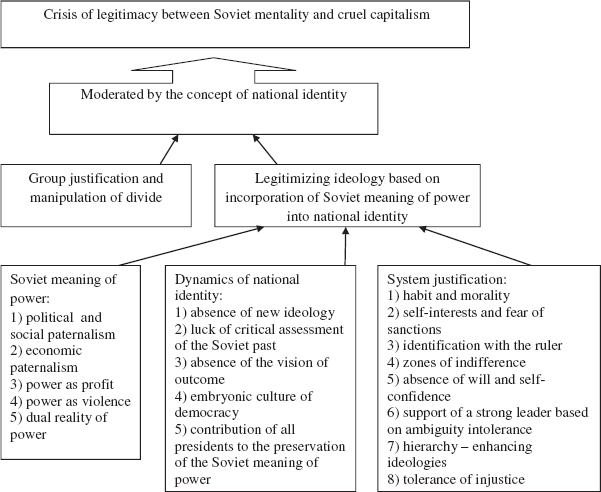
This paper argues that the crisis of legitimacy in Ukraine is not between a Soviet mentality and democratic values as discussed by many authors. Instead, the crisis of legitimacy is posed as being between a blatant cruel system of capitalism of a few oligarchs and a preserved Soviet mentality. A regime is legitimate if a leader represents and further develops a social identity dominant in the society (Haslam, 2011). While a Soviet identity in its blatant form could not be accepted in the Ukrainian society any longer, the use of ethnic differences in the society and the incorporation of the Soviet meanings of power into a new national identity helps the Government to moderate the existing crisis of legitimacy. These two strategies and the major mechanisms of this process are presented in Fig. 1.
Moderation of the crisis of legitimacy by incorporation of the meaning of power into a concept of national identity.
One strategy is to use people's tendency to cope with crisis through increased identification with ethnic or regional groups. Despite different interpretations of the ethnic and regional divides, the respondents in the interviews agreed that the Government is instrumental in using it as a tool of taking attention from economic and class issues and thus from the legitimacy crisis in society. The second strategy is the incorporation of the Soviet meaning of power into a new national identity. The Ukrainian President and his Government support and promote Soviet norms of power among the population and present them as core norms, believes, and values of the people of Ukraine.
The main features of the Soviet meaning of power that are incorporated into Ukrainian national identity are political, social, and economic paternalism, perception of power as source of profit and violence, and the dual reality of power with the gap between official narratives of power and a real life. Thus, Ukrainians are described as a tolerant, patient people, who value personal and family wellbeing above all, historically live their own life, and do not trust a government, but subsumes to its power. The process of incorporation of the Soviet concept of power into national identity is facilitated by the process of national identity formation that helped to preserve the Soviet perception of power, because of the absence of a new ideology, a lack of critical assessment of the Soviet past, an absence of the vision of outcome, an embryonic culture of democracy, and contributions of all the presidents to the preservation of the Soviet meaning of power. People justify the system as legitimate and fair for many reasons: out of historic habit and deemed moral obligations, self-interests and/or a fear of sanctions, identification with the ruler, zones of indifference, an absence of will and self-confidence, desire to support a strong leader based on ambiguity intolerance, hierarchy – enhancing ideologies, and a general tolerance of injustice.
The obedience of subjects is not constant and is a result of an act of volition; thus all government is based upon consent. The degree of control of the government depends on (1) the relative desire of people to control it, (2) the relative strength of independent organizations and institutions, and (3) people's relative ability to withhold their consent and assistance (Sharp, 1973). Thus, freedom is not given by a ruler but rather it is established by the strength of will of the subjects and the social structures of the society. In Ukraine, the society is not united, not organized, has no identity of “us”, no civic accountability, nor even any real interest in such matters. Civil society levels are very low, as reflected by an almost total absence of civil society organizations, limited opportunities for civic responsibility and participation, and few demands from the society. Even the Orange Revolution failed to build a civil society with civic responsibilities and citizen agency, resulting in replacing a “bad tsar with another tsar.” Further efforts to increase civil society options are stymied by the vertical systems of social connections, including the Soviet-style of Government and party system. Thus, incorporation of the Soviet meaning of power into national identity in Ukraine impedes the development of the only force that can destroy it – a mature civic society.
The escape from Soviet constructions of power is possible by changing existing norms and beliefs in the society. This norm change rests on a redefinition of existing themes and the introduction of new ones (Richards & Swanger, 2009). These may include generative themes whose syllabic elements could be recombined to form new themes, thus generating a culture of democracy. These may also include invader themes that completely alter the Soviet meaning of power; hinge themes that connect the existing meaning of power with learning one or more of the elements of a culture of democracy; and losable themes that provide a cultural change through everyday conversations. Thus, the five main features of the Soviet concept of power – (political, social, and economic paternalism, perception of power as source of profit and violence, and dual reality of power with the gap between official narrative of power and a real life) should be challenged through gradual redefinitions and connections with the themes of democracy and democratic participation in Government. This change can be produced through communicating with one another and acting ‘in concert’ (Arendt, 1970).
The model discussed here was developed to explain the moderation of the current crisis of legitimacy in Ukraine, but can be applied for other post-Soviet countries. While in the case of Ukraine the group justification rests on a historic and cultural divide between regions, in Russia group justification processes resulted in wars in Chechnya and Georgia. The legitimizing ideologies are more profound and evident in Russia, because they incorporate Soviet meaning of power developed by Stalin into the core of national identity. Similar processes can be identified in Central Asia. Another common feature that derives from the model is the process of system justification by people and the embryonic state of civic society. “The degree of liberty or tyranny in any government is…in large degree a reflection of the relative determination of the subjects to be free and their willingness and ability to resist efforts to enslave them” (Sharp, 1973, p. 29). Thus, the process of incorporation of the Soviet meaning of power into national identities in post-Soviet states and enhancement of authoritarianism will continue until the people will be able to organize themselves to become real agents of change.
Acknowledgment
I am thankful to the Office for Ukraine & Belarus and the Washington Office of the Ebert Foundation for their support of this research. I also express my gratitude to all Ukrainian and international experts who found time in their busy schedules to meet with me and share their ideas and views on Ukraine.