






Abstract
This article analyzes general perceptions of a good political leader of post-Soviet Kyrgyzstan by looking at how political leadership is perceived by the ordinary people in the country. This issue seems to be particularly important with country taking a new route – parliamentary republic and facing crisis of political leadership as a result of two revolutions of 2005 and 2010. Furthermore the article sheds some light at people's expectations which are important due to the presidential elections in fall 2011. The article looks at what type of a leader the people of Kyrgyzstan wish to see, and what are the qualities (personal or professional) a political leader must possess. In an attempt to answer these questions, the article identifies ten main qualities of a “good” political leader for Kyrgyzstan as a result of a filed study and tries to evaluate the Kyrgyz case within a broader body of literature about political leadership.
James MacGregor Burns said, “Leadership is one of the most observed and least understood phenomena on earth.” 1 In analyzing the issue of leadership in Central Asia in general and in Kyrgyzstan in particular, it can be said that there is overwhelming “reliance on leadership” which does not always bring about positive results for these country's societies. 2 This article aims to analyze the general perceptions of a good political leader for the ordinary citizens of post-Soviet Kyrgyzstan. Role of elites in the process of transition to democracy emphasized by the elite-led democratization approaches seems to be especially useful in understanding Kyrgyz leadership patterns in this era. 3 In this context, it is possible to suggest that Kyrgyz leaders portrayed themselves as the main actors of post-Soviet democratization process. The role that the two leaders, Askar Akaev and Kurmanbek Bakiev, played in the political life of the country was very important, as they were the main figures who shaped the process of transition to democracy by using political legitimacy as a major reference point in order to make their everyday practices acceptable for the people. In rhetoric, they claimed that they supported democratization and used certain methods (such as regular parliamentary and presidential elections as well as referendums) to legitimize their rule. Within this general framework, it will not be wrong to argue that the whole transition process in Kyrgyzstan was to a large extent shaped by the choices and preferences made by Akaev and Bakiev.
Burns, J. M. (1978). Leadership. New York: Harper and Row, p. 2.
For further information please see Cummings, S. N. (Ed.) (2002). Power and change in Central Asia, London: Routledge; Robert, C. T., & Colton, T. J. (Eds.). (1994). Patterns in Post-Soviet leadership. Boulder: Westview Press; Ray Taras, (ed.), Postcommunist Presidents, Cambridge: Cambridge University press, 1997.
For further information please see Graeme Gill, The dynamics of democratization, elites, civil society and the transition process (Macmillan Press, London, 2000); John Highley, Lengyel György, (Eds.), Elites After State Socialism, Theories and Analysis (Rowman & Littlefield, USA, 2000); Guillermo O'Donnell, Philippe C. Schmitter, Laurence Whitehead (Eds.), Transitions From Authoritarian Rule: Comparative Perspectives (The Johns Hopkins University Press, Baltimore, 1991); Terry Lynn Karl, “Dilemmas of Democratization in Latin America,” Comparative Politics, October 1990, 23(1); J. Samuel Valenzuela, “Democratic Consolidation in Post-Transitional Settings'” in Scott Mainwaring, Guillermo O'Donnell and J. Samuel Valenzuela (Eds.), Issues in Democratic Consolidation: The New South American Democracies in Comparative Perspective, (University of Notre Dame Press, 1992).
It is further possible to suggest that both Akaev and Bakiev, as the top two leaders of the country, exercised considerable amount of influence as long as they stayed in power. Once these two leaders were ousted however, in 2005 and 2010 respectively, their influence over the affairs of the country came to a sudden halt. Therefore, in order to better understand the political developments in Kyrgyzstan, it is in a way inevitable to analyze how political leadership is perceived by the people in the country. As such, what type of a leader do the people of Kyrgyzstan want, and what are the qualities that they wish to see in this person must be seen as important questions. In an attempt to answer these questions, this article focuses on the main qualities of a “good” political leader for Kyrgyzstan as seen by the ordinary citizens of the country and tries to evaluate the Kyrgyz case within a broader body of literature about political leadership.
One major reason why such a topic is worth studying is related to the fact that there is a relative void in the literature about leadership studies in the Eurasian region. As Ismail and Ford suggested, “Despite the critical importance of leadership effectiveness in the region, there is a striking scarcity of leadership studies that focus on [Eurasia].” 4 As such, more leadership research focusing on Eurasia can “explore the appropriate leadership style and behaviors that could result in leadership effectiveness” 5 in the region, an obvious necessity in the specific case of Kyrgyzstan, a country which suffered from political instability that resulted in two of its post-Soviet leaders ousted from power. Therefore, studying political leadership in Kyrgyzstan may help us understand more the reasons why the country faced two leadership changes by popular revolt, so far the only case in Central Asia.
Ismail, K. M., & Ford, Jr. D. L. (2010).“Organizational leadership in Central Asia and the Caucasus: research considerations and directions”, Asia Pacific Journal of Management, 27(2), p. 322.
Ibid. p. 323.
Another major reason why such a topic is critical is related to the fact that leadership studies have a tendency to focus on the leaders themselves and not their followers. In other words, what we see in these studies is an attempt to understand the general attitudes, beliefs, backgrounds, characteristics, leadership styles, decision-making patterns of the political leaders, and/or their relations with the subordinates. 6 We also see other studies which focus on the domestic or global context in which these leaders find themselves. 7 The limited number of leadership studies in Eurasian region is no different in this sense. In other words, these studies also put the main emphasis on the leaders themselves, how ‘effective’, ‘charismatic’, ‘authoritarian’ etc. they have been. 8
See for example, Blondel, J. (1987). Political leadership: Toward a general analysis. London: SAGE Publication Ltd.; Tucker, R. C. (1995) Politics as leadership. Revised Edition, London: University of Missouri Press; Kellerman, B. (1986) Political leadership: A source book. Pittsburgh: University of Pittsburgh Press; Paige, G. D. (1977) The Scientific Study of Political Leadership, New York: The Free Press; Burns, J. M. (1978). Leadership. New York: Harper and Row; Jones, B. D. (1989). Leadership and politics: New perspectives in political science. USA: University Press of Kansas.
Bass, B. (1997). “Does the transactional–transformational leadership paradigm transcend organizational and national boundaries?” American Psychologist, 52(2): 130–139; Bass, B. (1999). “Two decades of research and development in transformational leadership”, European Journal of Work and Organizational Psychology, 8(1): 9–32; House, R. J., & Mitchell, T. R. (1974). “Path–goal theory of leadership”, Journal of Contemporary Business, 4: 81–97; Ford, D. L., & Ismail, K. (2006). “The cultural convergence and divergence debate: an examination of perceptions of effective leadership for Us and Post-Soviet central Eurasian managers”, Journal of International Management, 12(2): 158–180; Pawar, B. S., & Eastman, K. K. (1997). “The nature and implications of contextual influences on transformational leadership: a conceptual examination”, Academy of Management Review, 22(1): 80–109; Bradford, D., & Cohen, A. (1998). Power up! Transforming organizations through shared leadership. San Francisco, CA, Jossey-Bass; Manz, C. C., & Sims, H. P. (1991). “Super leadership: beyond the myth of heroic leadership”. Organizational Dynamics, 19(4): 18–35; Pearce, C. (2004). “The future of leadership: combining vertical and shared leadership to transform knowledge work”. Academy of Management Executive, 18(1): 47–57; Yukl, G. (1999). “An evaluation of conceptual weaknesses in transformational and charismatic leadership theories.” Leadership Quarterly, 10: 285–305; Pearce, C., & Sims, H. P. (2000). “Shared leadership: toward a multi-level theory of leadership” In Beyerlein, M., Johnson, D., & Beyerlein, S. (Eds.). Advances in interdisciplinary studies of work teams: Team leadership: 7: 115–139, Greenwich, CT: JAI; Pearce, C., & Conger, J. A. (2003). Shared leadership: Reframing the hows and whys of leadership, Thousand Oaks, CA: Sage; Seers, A. (1996). “Better leadership through chemistry: toward a model of emergent shared leadership.” In Beyerlein, M., Johnson, D., & Beyerlein, S. (Eds.). Advances in interdisciplinary studies of work teams: 145–172. Greenwich, CT: JAI.
House, R. J., Hanges, P. J., Javidan, M., Dorfman, P. W., & Gupta, V. (2004). Culture, leadership, and organizations: The GLOBE study of 62 societies. Thousand Oaks, CA: Sage; Dorfman, P.W., Hanges, P. J.. & Brodbeck, F. J. (2004).“Leadership and cultural variation.” In House, R. J., Hanges, P. J., Javidan, M., Dorfman, P. W., & Gupta, V. (Eds.). Culture, leadership and organizations: The GLOBE study of 62 Societies: 669–719. Thousand Oaks, CA: Sage; Den Hartog, D. N., House, R. J., Hanges, P. J., Ruiz-Quintanilla, A. S., & Dorfman, P. W. (1999). “Culture specific and cross-culturally generalizable implicit leadership theories: are attributes of charismatic/transformational leadership universally endorsed?” Leadership Quarterly, 10(2): 219–256; Ford, D. L., & Ismail, K. M. (2006). “The cultural convergence and divergence debate: an examination of perceptions of effective leadership for US and post-Soviet Central Eurasian managers,” Journal of International Management, 12(2): 158–180; Ismail, K. M., & Ford, D. L. (2008). “Discerning leadership perceptions of central Eurasian leaders: an exploratory analysis.” Organization Management Journal, 5: 99–113.
As such what seems to be missing in the literature on political leadership in general and political leadership in Central Asia in particular is research on how the ordinary people perceive their leaders, in other words, a shift from the leaders to the led. What the public thinks about political leadership in general and/or their particular leaders in particular may shed more light on our understanding of a better, more smoothly and more democratically functioning political order. 9 Some studies suggest that how the electorate perceives leadership quality may be critical in determining the outcome of the elections. 10
Cartwright, D., “Public opinion polls and democratic leadership.” Journal of Social Issues, 2(2), May 1946, p. 32.
See for example, Jones, P., & Hudson, J. (Apr., 1996). “The quality of political leadership: a case study of John Major.” British Journal of Political Science, 26(2): 229–244.
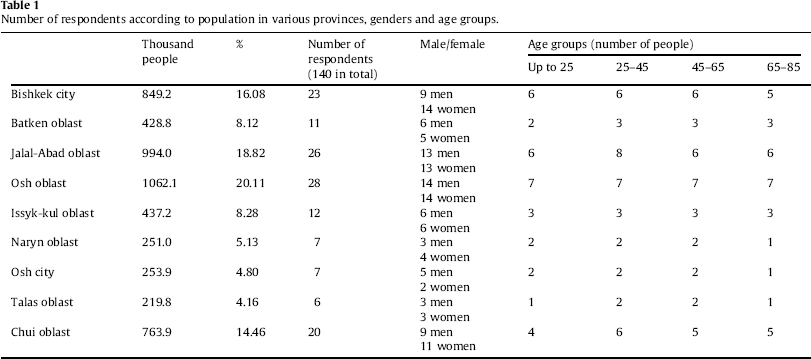
This study therefore, should be seen as an attempt to contribute to the literature in this sense in the specific case of Kyrgyzstan. Its data and findings are based on the results of an individual field research which was conducted in partial fulfillment of the requirements for a Ph. D. degree in Political Science at the Middle East Technical University, Ankara, Turkey. The field research was conducted between 15 February 2010 and 21 April 2010 in Kyrgyzstan. A total of 140 respondents (66 men and 74 women) answered questions about leadership, good/ideal leaders and about Askar Akaev and Kurmanbek Bakiev, by either filling in a questionnaire (79 people) or by participating to an in-depth interview (61 people). The respondents were selected from the seven regions of Kyrgyzstan – the Batken oblast, the Chui oblast, the Jalal-Abad oblast, the Issyk-kul oblast, the Naryn oblast, the Osh oblast, the Talas oblast and the two major cities of Bishkek (the capital) and Osh (the second largest city), from a variety of different occupations, ages (ranging from 19 to 80) and nationalities (129 Kyrgyz, 7 Russians, 2 Uzbeks, 2 Tatars). As such people from all regions of the country from genders, all age groups, professions, and to a limited extend from different nationalities were covered to make the sample representative. 11
The population of each region was considered in terms of its ratio to the general population of the country in order to represent the rural-urban division as well. There were 23 respondents from the Bishkek city, 7 respondents from the Osh city, 11 respondents from the Batken oblast, 26 respondents fron the Jalal-Abad oblast, 28 respondents from the Osh oblast, 12 respondents from the Issyk-kul oblast, 7 respondents from the Naryn oblast, 6 respondents from the Talas oblast, and 20 respondents from the Chui oblast. The respondents from these regions were also roughly equally divided into two in terms of gender. As for the age, there were four groups of people: the first group was composed of young respondents (16–25); in the second, third and fourth groups, there were people between the ages 25–45, 45–65, and 65–85 respectively. In terms of occupation, people from a variety of different occupations from the public and private sector, as well as NGOs and other institutions were interviewed. There were also retired people and students. For further information on the general profile of the respondents, please see Tables 1 and 2.
Number of respondents according to population in various provinces, genders and age groups.
Occupations of respondents.
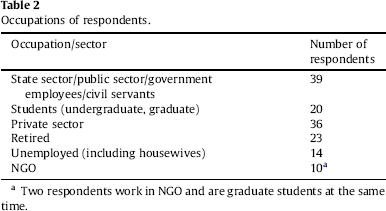
Two respondents work in NGO and are graduate students at the same time.
The respondents were asked to name the main qualities that they would like to see in a good political leader. In answering this question, they mentioned various personal and professional qualities that they expected from such a leader. It must be noted that a majority of the respondents indicated more than just one or two attributes, giving a combination of a variety of different expectations. When the answers are analyzed, ten qualities stood out as the most expected ones from a good political leader. 12 These qualities were patriotism, good education, honesty, political professionalism, charisma, intelligence, responsibility, strength of character, service to the people and bravery. For all of these indicated qualities, there were no significant variations in terms of region, age group, gender, and occupation.
Considering that there are various ingredients of leadership such as character of a leader, the followers with who he interacts, organizational and societal context in which the leadership interaction occurs, techniques which the leader uses to mobilize support, and effects of leadership, the 10 main qualities of a good leader partly included many of ingredients. (see Gillian Peele, “Leadership and politics: A case for a closer relationship?” Leadership, 1(2), 2005.).
The most frequently mentioned quality by 39 respondents (27.8%) was patriotism. Some of these respondents simply mentioned that a leader should be a patriot, with no further elaboration, whereas some, such as a 24 year old Kyrgyz woman from the Osh oblast who worked in a governmental agency, gave broader comments on this issue:
A good leader must have a clear objective, not an ambition but an objective on how to serve for his country and his people… Someone who has an objective, a clear goal to achieve, someone who will serve his country and not have his country serve him or her.
A 72 year old Tatar women from the Chui oblast who was a teacher said “A good leader must be … patriotic, and he should work for the country, not for himself.” Another respondent, a 24 year old Russian man from the Chui oblast who worked in an NGO, indicated that a good leader must be a “patriot, putting national interests above his own … Also a leader must have an exemplary character. He must be law-abiding to be a good example for the citizens of his country.”
Education was the second most important quality: 36 respondents (25.7%) indicated the importance of good, even excellent, education. Some respondents, such as a 49 year old Russian man from Bishkek who was self-employed, were more specific and they stated the need of at least “a university degree.” 13
It must however also be mentioned that the Russian word obrazovannost (education/edudition) used by some respondents implies not only good education but also good manners, it would be appropriate to add 6 more respondents who indicated that a leader must be “good mannered” or/“well bred.”
The third most important quality named by 34 respondents (24.2%) was “honesty.” One interesting opinion explaining “honesty” in Central Asian context was given by a 23 year old Kyrgyz woman from the Jalal-Abad oblast who was a student:
The good leader …must possess the qualities mentioned by Yusuf Balasaghuni in Kutadgu Bilig. Honesty and justice are the main qualities of a good leader. A good leader must perform all his duties and he must be just to the others. Moral qualities of a leader are very important. Just rule is about abiding laws and [being] fair in the society.
In this context, for several respondents (10%) an honest leader must be able to keep his promise and must also be “decent.”
26 respondents (18.5%) indicated that an ideal leader must be a professional politician or must have a professional experience in spheres related to government, administration, management and leadership. According to a 58 year old Kyrgyz woman from the Chui oblast who worked in a library, a leader must be “experienced in politics and administration” and for a 26 year old Kyrgyz man from the Osh city who was a student, a leader must possess “professional experience … going through all levels of public administration, starting from the lowest administrative post.” Some respondents, along with a quality of being a professional politician, indicated the need for being a “professional in at least one sphere.” 14 As professionalism is acquired through experience, for some respondents a leader must be “professional, informed about the life in all provinces of Kyrgyzstan, [and] able to acquire objective information.” 15 A related expectation was given by 9 other respondents as the possession of administrative/managerial skills. As a 52 year old Kyrgyz woman from the Osh oblast who worked in a pharmacy put it, “A good leader must be talented, able to govern, manage, organize, and motivate people.”
Personal interview with a 25 year old Kyrgyz woman from the Batken oblast who was a student.
Personal interview with a 45 year old Kyrgyz woman from the Osh oblast who was a doctor (psychologist).
22 respondents (15.7%) indicated charisma as a basic quality of a good leader. Charisma speaks for itself but as understood by a 67 years old Tatar woman from Bishkek who was retired, it has repercussion on leader gaining support of the people:
[A good] leader must possess charm and popularity, and should understand that it is the Kyrgyz people who are most powerful and so he should gain support and respect of the people.
A 58 year old Kyrgyz woman from Bishkek who worked in a private company expressed a similar opinion and said that “A leader should be charismatic, we should love our leader and he should earn the people's trust.” For a 25 year old Kyrgyz woman from the Batken oblast who was a civil servant, “A good leader must be charismatic. He must attract people and they must go after him.”
22 respondents (15.7%) indicated the importance of intelligence for a good leader. Most of these respondents did not elaborate further on this quality, but just indicated it. In addition to these respondents, 12 respondents (8.5%) indicated that a good leader must be smart/clever and 6 respondents (4.2%) indicated that he must be wise. Further, knowledge in other fields, such as economy, was also mentioned by some respondents as the quality of a good leader. For some respondents, a leader must possess “entrepreneurial mind.” 16 As another respondent suggested:
This quality was indicated by a 33 year old Russian woman from Bishkek who worked as a teacher at the secondary school.
A good leader must understand not only the economic market, but also the political market. A leader should not have “factory mindset” like Bakiev, he must be a strategist, an “entrepreneur-businessman.” 17
A 23 year old Kyrgyz man from the Talas oblast who worked in an NGO.
Another respondent expressed a rather optimistic opinion about the role that a leader can play in terms of developing the potential of the Kyrgyz economy:
[A good leader] must have the mindset of an entrepreneur. Kyrgyzstan is a smaller version of Switzerland. If our leader is smart, hard-working and thinks of his people and his country (rather than how to steal for the good of his family and his grandchildren), Kyrgyzstan can become a very developed country. 18
A 33 year old Russian woman from Bishkek who worked as a teacher at the secondary school.
Related to the same expectation, 10 respondents (7.1%) indicated the importance of a strategic mind, strategic thinking and strategic vision. For a 25 year old Kyrgyz man from the Jalal-Abad oblast who was unemployed at the time of the interview, “The good leader must possess a strategy and a good team to push the country to progress, and if necessary enforce people abide the laws and work hard.” Likewise, 7 other respondents indicated that a leader must possess “vision.”
Another quality mentioned by 19 respondents was being responsible. Though some respondents equated responsibility with the leader's deeds, others implied “the ability to take responsible decisions.” 19 For example, for a 58 year old Kyrgyz woman from Bishkek who worked in a private company, a leader must be “responsible for everything that happens in the state,” for a 25 year old Kyrgyz woman from the Jalal-Abad oblast who was an entrepreneur, a leader must be “responsible for his country” and for a 25 year old Kyrgyz man from the Talas oblast who worked in a human rights NGO, a leader must be “responsible for what he promises.”
A 19 year old Kyrgyz woman from Bishkek who worked at a factory.
Next quality mentioned by 18 respondents (12.8%) was “strictness” or strength of character. This quality had varying connotations for some respondents. For example, for one respondent, a strong leader is the one who can “keep power in … [his] hands”:
For development we need a strong leader. I always compare Nursultan Nazarbaev or Islam Karimov with our leaders. These two leaders are strong leaders who can keep power in their hands.
20
A 58 year old Kyrgyz women from the Chui oblast who worked in a library.
For a 28 year old Kyrgyz woman from the Issyk-Kul oblast who worked in a hotel, likewise, “strictness” implied the ability “to control the state of affairs”. A 54 year old Kyrgyz man from the Jalal-Abad oblast who was unemployed at the time, also said that “Under the present conditions of Kyrgyzstan, the President must be strict.” For one respondent, this was the quality of the Soviet era leaders:
Decency, patriotism, working for welfare of the people. During the Soviet Union, there were people possessing such qualities. They exist even now, but they are not given a chance to work in the government.
21
A 65 year old Kyrgyz woman from the Naryn oblast who was retired.
For 16 other respondents (11.4%), as an indicator of strength of character, a good leader must also be decisive. 2 respondents further indicated that a leader must possess “political will.”
9 respondents (6.4%) indicated that a good leader must represent the interests of the society and serve the people. For a 25 year old Kyrgyz man from Bishkek who was a master's student for example, a leader must possess an “ability to competently accumulate and adequately represent the interests of society,” whereas for a 25 year old Kyrgyz man from Bishkek who was unemployed at the time, a leader must have the “ability to represent and protect national interests.” Concerning national interests, 3 other respondents further stated that a leader must put national interests above his own. In this context, the leader's attitude to the people was also mentioned. For some other respondents, a leader must be close to the people, care for the people, listen to the people, work for the people, think of the people, and do his best for his people.
Similar ideas were presented by other respondents who suggested that a leader must be unselfish. As a 49 year old Kyrgyz woman from the Issyk-Kul oblast who worked as a medical assistant stated “A good leader must think not of himself but of his people.” For a 22 year old Kyrgyz woman from the Osh oblast who was a student, a leader should possess a “desire and commitment to work for the well-being of our country”; likewise for another respondent, he or she must “work towards the welfare of his people (create high standard of life, proper salaries, suitable credits for business, affordable prices.)” 22 Few respondents indicated the importance of “clarity of aim” to that end, which, for a 24 year old Kyrgyz woman from the Osh oblast who worked in a governmental agency, was “a clear objective, not an ambition but an objective on how to serve for his country and his people.”
A 30 year old Kyrgyz woman from the Chui oblast who worked as a teacher.
One respondent also expressed a pragmatic and realistic view in describing how a leader in the Kyrgyz context should work for the people, while at the same time not forgetting about his own interests:
A good leader must live for his people, along with working for [his own interest]. A good leader must work for his country and people. I understand that the president has his own family and he should also provide for his family, but this should not be the only objective occupying presidential office. Our leaders don't think about the future of their people. They only think about themselves and today. In other words, they do not possess a vision. Today the mayor of Bishkek is not a bad person, he works for himself and at the same time he is developing the city. I wish we had a president similar to our mayor of Bishkek.
23
A 65 year old Kyrgyz man from the Issyk-Kul blast, Jarkinbaevo village who was self-employed.
The final most frequently mentioned quality of a good leader indicated by 7 respondents was bravery. The meaning and content of bravery however were given differently by the respondents. For some, it was an ability to go against the system; for others it was defined as “bravery in decision-making” 24 ; and for some others it was equated with “political bravery.” 25 According to a 29 year old Kyrgyz woman from Bishkek who was unemployed at the time, “Given the inherent corruption in Kyrgyzstan, a leader must have the courage to go against the system. He must set an example for others.” Another connotation of bravery was given by a 52 year old Kyrgyz woman from the Chui oblast who worked in a hospital. For this respondent, a leader “must be brave and be able to defend his point of view, be able to listen to criticism and make appropriate conclusions.”
A 69 year old Kyrgyz man from the Osh oblast who was retired.
A 60 year old Kyrgyz woman from the Batken oblast who was retired.
In addition to these qualities, there were several others that were less frequently mentioned by the respondents. For example, 13 people (9.2%) indicated that a leader must possess “good communicative skills.” This quality was mentioned to be important in both international and domestic affairs:
As the leader and representative of the country it is his job to meet with the leaders of other countries. Also, he must meet with different people in our own country, and so he should be able to communicate well with all types of people. He should be able to attract the support of all of these different kinds of people. 26
A 58 year old Kyrgyz woman from Bishkek who worked in a private company.
Likewise, according to a 65 year old Kyrgyz woman from the Jalal-Abad oblast who was retired, a leader “must also be able to find common language with other leaders.”
For some other respondents, a leader must be able to “carry words into actions” 27 and “able to distinguish empty words from real deeds.” 28 A few respondents indicated that a leader must adhere to laws and/or respect laws and the constitution, must be a “good orator,” must be “just” as their basic qualities. For example, according to a 35 year old Kyrgyz man from the Batken oblast who was a civil servant, “Kyrgyzstan needs a leader similar to Stalin, who would be prepared [if necessary] to punish even his own children and not just his appointees.” 29
A 23 year old Kyrgyz man from Bishkek who worked in a state corporation.
A 55 year old Kyrgyz woman from Bishkek who was a civil servant.
This expression suggests that a leader must be fair and impartial to such an extent that he would not look at his feelings and punish even his own children, in case they violate the law.
Other less frequently mentioned qualities of a good leader included being able to find compromise, being morally-stable, talented, disciplined, objective, and ambitious. Some respondents further indicated that a leader must know the Kyrgyz traditions, the Kyrgyz mentality and be fluent in Kyrgyz language. A 23 year old Kyrgyz man from the Osh city who was a student, and a 65 year old Kyrgyz woman from the Osh city who was a teacher, indicated that a good leader must enjoy respect at the international arena. A retired 68 year old Kyrgyz woman from the Osh oblast indicated that a good leader must enjoy reputation. Presence of erudition, internal cohesiveness, self-respect, and innovative approach were also mentioned. Being tolerant, being married, and being optimistic were pointed out by some other respondents.
As can be observed from the responses, there were a variety of expectations and quite diverse opinions about the qualities of a good leader indicated by the respondents. Nevertheless, it is still possible to observe a general pattern for the 10 most important qualities: most of them are missing in their own leaders.
The first quality, patriotism, which was pointed out as the most significant attribute that the people would like to see in their leader was seen as lacking in the two presidents of the country. Likewise, honesty, which according to some respondents, was “the most important quality” 30 reflected peoples' wishes, who were tired of dishonesty on the part of the politicians in terms of corruption, unfulfilled promises, and unjust policies. Honest and respected leaders, therefore, were idealized. One of the reasons for the frequent mentioning of professionalism could be related to the fact that after the dissolution of the Soviet Union, the Kyrgyz Communist Party leadership was partially removed from office and some of the leading positions in government and administration were occupied by non-professionals who had no prior experience in such positions. As these people turned out to be rather incompetent, professional politicians are missed by the people. Another reason was related to the well-known method of appointments in Kyrgyzstan, that are not always based on merit, but rather on the basis of family/tribe/clan connections, further exacerbating the problem of unprofessionalism in government and administration. Therefore, the people wish to see a professional politician as a leader of the country. As for the desire to see a responsible leader, it can be explained by the well-known examples of irresponsibility of the leaders in the post-Soviet era. There are several such policies, decisions and actions of Akaev and Bakiev, so the people long to see a responsible leader. Also, as the mechanisms of holding the leaders responsible are either nonexistent or very vague, the respondents seem to expect a leader have such responsibility to the public for his deeds and actions. As for a need for a strict leader, probably the reason behind this is related to the fact that the people are being used to be commanded, given tasks, and said what to do; as such, they still feel a necessity to get orders. Likewise, the expectation that a leader must serve the people, and work and provide for them shows that the people in Kyrgyzstan still continue to wait for the state and the leader to take care of them. As such, quite understandably, for some respondents a good leader must be “like Putin.” A 65 year old Kyrgyz woman from the Issyk-Kul oblast who worked as an administrator, comprehensively elaborated on what it was to be like Putin:
A 29 year old Kyrgyz woman from Bishkek who was unemployed.
The ideal leader is Putin. He is strong, brave, competent in many issues, professional in whatever he does, not indifferent to people's problems, decisive and has cognitive style; responsible, patriot, hard-working and is completely devoted to his work and his country.
When these answers are further analyzed in terms of their relevance or relation to transition to democracy, which was the declared goal of both Akaev and Bakiev, it must be pointed out that only four respondents indicated that a leader must be “democratic.” The most comprehensive explanation of “democratic leader” was given by a 22 year old Kyrgyz woman from the Osh oblast who was a student:
A good leader must be democratic; admitting the supremacy of the Constitution and respecting and adhering to human rights; desire and commitment to work for well-being of our country; sufficient command in few languages; providing total freedom to media, NGOs and business sector. 31
One respondent, a 25 year old Kyrgyz woman from the Batken oblast, who was a civil servant, even said that a leader must be “authoritarian.”
There were some answers that focused on the tribal/family connections of a leader in a negative way as obstacles for democracy. According to both an 83 year old Russian woman from Bishkek who was retired and a 25 year old Kyrgyz man from the Osh oblast who was a student, a good leader must be free from tribal and clan connections and free from clan and nepotism influences. A 60 year old Kyrgyz man from the Chui oblast who was a retired engineer, said that a leader should have only a “few relatives” so that he would have no opportunity to engage in nepotism. According to a 45 year old Kyrgyz man from the Batken oblast who worked in the private sector, “In the Kyrgyz context a good leader must be somebody without family and relatives, because the Kyrgyz mentality presupposes helping and providing for family and relatives if you are better off.” For a 54 year old Kyrgyz woman from Bishkek who worked as a doctor “the leader must also be able to consolidate the North and South,” thereby prevent any possible conflict caused by clan ties.
Likewise, some respondents have mentioned the necessity of legitimacy of the leader. According to a 65 year old Kyrgyz man from Bishkek who was retired, “A leader must be legitimate; [meaning] elected through free and fair process.” For some other respondents, a leader must enjoy “people's support and confidence” 32 and must “be able to build and maintain public support”. 33
A 66 year old Kyrgyz man from the Chui oblast who worked as a teacher.
A 35 year old Kyrgyz man from the Batken oblast who was a civil servant.
Thus, as it is seen, the top main qualities that the respondents longed to see in their political leader (patriotism, good education, honesty, political professionalism, charisma, intelligence, responsibility, strength of character, service to the people and bravery) give us a picture of the potential future candidates for enjoying a genuine popular support. It is also possible to see from these expectations what the actual Kyrgyz leaders were missing; basically, the lack of professionalism, the inability to keep their promises and the failure to implement their previously declared policies. Such a perception on the part of the people seemed to jeopardize the legitimacy of these leaders as well as the stability of their rule. It must finally be pointed out that the general expectations of the people in Kyrgyzstan from their leader seem to be largely shaped by the Soviet era perceptions that revolved around a strong figure whose main responsibility was to serve and to take care of his people.
Kyrgyzstan seemed to have been embarked on a reformist democratic course at various times during the post-Soviet period. The events of April 2010 showed that people wanted a fresh start after Bakiev with a new form of government: a parliamentary republic. It is yet to be seen how a parliamentary form of government will work in Kyrgyzstan. The significance of the recent events from the point of the theoretical insights developed in this thesis suggests that lack of both democratic leadership and political legitimacy has become a major concern in the Kyrgyz society. Free and fair elections as well as referendum are seen as major pre-conditions of a legitimate rule and how a leader should stay in power. Neither Akaev nor Bakiev could realize this type of rule. Although it is not the aim of this thesis to analyze the April 2010 events which resulted in Bakiev's oust, one thing is clear: Kyrgyzstan so far has been the first and only country in Central Asia to realize two leadership changes by popular uprisings. Despite the fact that the Kyrgyz people are still going through a hard time of finding a proper system of government which would leave the majority satisfied, it seems as if both the people and the elites understood that political legitimacy is one major principle of a democratic order. It seems that Kyrgyzstan's new president Rosa Otumbaeva, who has already declared that she would not run for the next presidential term, set a good example of a leader who does not stick to his/her chair, who respects laws and the constitution and who understands the importance of free and fair elections. The parliamentary elections which were held on 10 October, 2010 were widely accepted as free and fair by international observers and Otumbaeva did not interfere in any way during the election process. Her example may give us a reason to be hopeful in the sense that after two decades of trial and errors of transition, the future may hold a more democratic Kyrgyzstan.