





Abstract
New Institutional Economics (NIE) and New Institutional Sociology (NIS) provide complementary paradigms with which to understand the relationship between formal institutional changes in a reform period and informal institutional structures with which household economies adapt to reform policies. Survey data gathered from rural Russian households from 1991 to 2006 provide an empirical test of hypotheses drawn from NIE and NIS. The most important finding is that in the absence of secure formal property rights informal institutional elements played the dominant role in entrepreneurship and inequality between households in the Russian countryside, but that as formal institutions became legitimized, and the overall economy stabilized, households that made use of these new institutional arrangements had significant advantages vis-à-vis other households. At the same time, regions which have provided opportunities for households to develop a “mixed economy” that combines household enterprise production, which relies to a significant degree on informal institutional elements, and wages and salaries (i.e., working for others), which is based on the legitimization of formal institutional arrangements, have produced substantially higher mean household incomes than have other regions.
Introduction
The introduction of market reforms under the rubric of “shock therapy” in the early nineteen nineties created a natural experiment with which to view the relative impact of formal versus informal institutional mechanisms upon entrepreneurship and economic inequality among rural households in the emerging rural Russian market economy. The collapse of the command economy led to a dramatic rise in inequality and poverty among rural Russian households, mirroring the situation that occurred throughout the country. At the same time, however, the instability of the newly introduced formal institutional arrangements of market reform stimulated the growth of rural household entrepreneurship. During the early post-Soviet years, informal household institutional resources, the “moral economy” (Netting, 1993; Scott, 1976), provided the cultural foundation to sustain household labor inputs and helping networks. This, in turn, supported a survival strategy that filled the gap in the agrarian economy that was left when federal government support for the large enterprises was substantially reduced.
Over time, however, the gradual legitimization of formal market reform institutions, including land rental agreements and loan contracts, along with the stabilization of the agrarian economy, has resulted in a reduction in inequality and poverty and the foundation for a more sustainable mixed income strategy in which households can generate income both from their own enterprises as well as from salary and wages obtained from working for others.
The same institutional changes that have created the opportunity for a mixed income strategy have resulted in the emergence of new entrepreneurial opportunities but also new sources of inequality between individual households and between different rural regions. The conceptual framework for understanding these changes is drawn from New Institutional Economics (NIE) and New Institutional Sociology (NIS). These complementary paradigms help us to understand the process in which informal and formal institutional elements have relatively greater or lesser influences on household business activity and rural stratification systems at different points in time. Identifying these time-specific effects of different institutional elements is crucial in understanding the changes that are taking place in post-communist rural economies as well as in emerging rural economies in general.
The empirical findings presented in this paper are drawn from surveys of households in rural Russia. Eleven surveys have been conducted from 1991 to 2009. The findings reported in this paper will focus on two cross-sectional surveys in two villages in 1991 and 1993 (shortly before and shortly after the collapse of the Soviet Union), four waves of panel surveys of households in three villages, conducted in 1995, 1997, 1999 and 2003, and two cross-sectional surveys, one in five regions (4 villages in each region) in 2001 and the other in nine regions (2 villages in each region) in 2006. The proportional stratified sampling strategy employed in all of the surveys reflects the relative numbers of different types of households – single persons, retired couples, working couples without children, working couples with children, working couples with children and other adults, single parent households, and a residual category of “other type” – found in rural Russian villages. The field researchers used face-to-face interviews to obtain detailed data on different types of income – salary and wages, household enterprise income and whether income was monetary (either in rubles or in-kind payments of grain or services) or non-monetary (i.e., what the household produced and consumed itself). Additional questions were asked of each household regarding the different ages of household members – to establish an index of household labor potential, household helping networks, and land rental. A full description of the methodology is found in earlier publications (O'Brien & Patsiorkovsky, 2006: 201–227) and on our Rural Russia blog/website (O'Brien and Patsiorkovsky, 2011).
The new institutional paradigms and understanding household entrepreneurship and inequality between households
The end of the Cold War and the emergence of rapidly growing economies in Asia, Eastern Europe and Latin America have posed a challenge to the simplistic models of both economists and sociologists. The world is much more complex than the traditional neo-classical economists or Durkheimian and neo-Marxian sociologists had suggested. In the search for a new paradigm, i.e., a new set of assumptions upon which to build theory and research to deal with the messy challenges to the traditional paradigms, a number of economists and sociologists have created the “new institutionalisms”; New Institutional Economics (NIE) (North, 1990) and New Institutional Sociology (NIS) (Brinton & Nee, 1998; Granovetter, 1973, 1985). Both NIE and NIS are connected to the traditions of their respective disciplines, but each contains some crucial new elements.
NIE, in contrast to the “Old Institutionalism”, retains the “rational individual” and the “methodological individualist” assumptions of neo-classical economics, but introduces as subjects for empirical investigation new institutional elements that affect the efficiency and certainty of contracts in the market place. This is especially relevant in the case of understanding economies that are attempting to transition from a pure command institutional structure to one that contains some significant market elements. Issues regarding corruption and the parties’ faith that contracts will be upheld by “third party enforcement” as well as the “transaction costs” associated with different institutional arrangements are an essential focus of the research agenda of NIE scholars.
NIS scholars retain the traditional sociological core belief in the importance of social relationships as explanatory variables, so that economic actions are assumed to be embedded in social relationships, but their research agenda also includes more “individualistic” and “rational choice” elements. Thus, scholars in this tradition focus on the way in which rational actors make decisions in significant degree according to the incentive structures provided by the socio-cultural environments in which they operate, as well as by creating informal social networks with which to navigate, and sometimes thwart, the formal institutional milieu.
Most important, the sociological approach to New Institutionalism assumes a priori that since informal institutional elements – culture, normative structures, etc. – exist side-by-side with formal institutional elements, the former can become a critical element in the transition from one formal institutional arrangement to another. Thus, for example, Szelyeni and Kostello (1998) note that during the communist era in Eastern Europe, the informal sector of the economy was a compensatory mechanism that provided as essential source of adjustment to the limitations of the formal command institutional arrangements. These same informal institutional structures play a critical role in the new market economies.
Taken together, the emphasis on formal institutional elements in the NIE paradigm and the adaptive features of informal institutions which are emphasized in the NIS paradigm, can provide us with a more complete understanding of the process by which entrepreneurship and stratification systems are altered during a transition from one type of economy to another. Specifically, the NIE and NIS paradigms suggest the following four hypotheses.
Most important, there are elements of the new formal institutional arrangements that can enhance the potential for growth of household enterprises, especially the stabilization of land use policies. Although the institutionalization of a land market for sale and purchase of land has been extremely difficult to realize, reform policies have addressed the issue of formalizing land leasing arrangements. Thus, our expectation is that,
Finally, as Szelyeni and Kostello (1998) point out, whenever there is a substantial shift in the institutional structure of an economy, such as occurred in post-communist societies, some of the informal institutional arrangements in the pre-reform economy, largely centered on the household's moral economy will remain but will complement rather than substitute for weaknesses in the formal economic system. The subsequent emergence of a “mixed rural household economy,” however, is likely to be dependent to a large extent on the opportunity structure for households in different regions. Thus, our expectation is that,
The institutionalization of market reforms in rural Russia
There have been many criticisms of the development of democratic and market institutions in post-Soviet Russia. The complaints about the slide away from democracy have included the efforts of Vladimir Putin to gain control of media outlets, limit the ability of foreign non-governmental organizations to operate in Russia, silence powerful oligarch adversaries (e. g., the Khodorkovsky imprisonment), eliminate virtually all political opposition and most recently, have himself selected as Prime Minister by his hand-picked newly elected President Medvedev. The limitations of Russian reforms of market institutions have included charges of corruption, crony capitalism, the failure of the court system to protect property rights, and various types of intimidation of foreign investors in the energy sector (Baumol, Litan, & Schramm, 2007: 170; Chazan & White, 2008).
Despite these obvious flaws in the institutional environment in Russia, however, there is evidence that substantial changes have occurred which have integrated the country further into the global economy, especially if they are assessed in relation to the Soviet-era command economy. Writing in the mid-nineties, during the early reform period, a scholar who had spent a number of decades studying the Soviet economy noted that: “Today it is easy to forget how fundamental the institutional changes have been in Russia. The transformation has been so far-reaching that it is hard to remember how absurd the old communist system actually was, and the current debate therefore focuses on the shortcomings of the new system” (Aslund, 1995: 273). A more recent World Bank assessment of how far Russia has moved toward a market economy concludes that:
“In the 15 years since the Soviet Union's collapse and the start of its economic transition, the institutions and structure of the Russian economy have greatly changed. Although much can be said about the inconsistency of the transformation and the incompleteness of many structural reforms, there is little doubt that Russia has moved from a centrally planned economy to a genuine market economy. All three main goals of economic reform initiated 15 years ago have been largely achieved. Prices are liberalized. Privatization is more or less complete. And the economy is now at least as open to international competition as many other market economies” (Desai & Goldberg, 2010: 11).
Nonetheless, for rural households, the primary effect of the “shock therapy” reforms of the first post-Soviet Yeltsin administration in the early 1990s was the elimination of government controls on wholesale prices, including inputs, equipment and products, the liberation of retail prices on most, but not all, food products, and the reduction of other material and monetary support to the agricultural sector. Caught in a vicious price scissors, the traditional places of employment in the Communist system, the collective and state farms, did not have cash to pay their employees and as a result households were forced to rely even more upon the production and sales from their personal plots in order to survive.
By necessity, most households relied almost exclusively on their own human and social capital (i.e., household labor and social exchange helping networks) to provide income from their private plots. This adaptation was built upon what Szelyeni and Kostello (1998) would term a compensatory mechanism in the Soviet agricultural system – i.e., a supplement to an inefficient state production system and a way of reducing discontent among workers on the collective farms. While rural residents reacted very negatively to the sudden loss of the traditional Soviet-era salary and social service supports, the institutional changes introduced by the Russian central government did create a positive incentive for rural households to become more entrepreneurial. Rural residents were not opposed to capitalism per se but rather to the clumsy and insensitive way in which the urban reformers in Moscow imposed the new institutional arrangements on them (Wegren, 2005).
Using grain that they received from the large enterprises as in-kind payment for labor, many households increased the number of livestock and the size of their vegetable and fruit gardens and began to produce value-added dairy products, such as sour cream. These products were then sold in regional farmers’ markets. The increased output by households, coupled with the decline in large enterprise production, due to the severe dislocations caused by the re-structuring of the agrarian sector, resulted in a substantial increase in the proportion of Russian agricultural output accounted for by households. This is shown in Fig. 1.
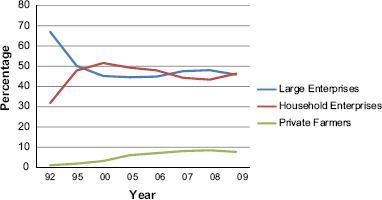
Percent of Russian agricultural sales by type of enterprise and year. Source: Rossiia v. Tsifrak 2010. (Moscow: FSSS, 2010), p., 245.
At the outset of the shock therapy reforms, from 1992 to 1995, the proportion of all agricultural sales in Russia accounted for by small household enterprises increased from 31.8 to 47.9 percent, while the proportion of sales contributed by the large re-organized former collective and state farms declined from 67.1 percent to 50.2 percent. This shift in sales was due, in large measure, to the collapse of the old formal institutional structures in Russian agriculture and the nascent but yet not fully institutionalized formal market mechanisms. This in turn, provided powerful incentives for households to utilize their informal institutional mechanisms, largely human and social capital (household labor and helping networks) to expand their plot production from a “compensatory mechanism” to a more important element in Russian agriculture. From 1992 to 1995 the Yeltsin government tried to create a new class of mid-size private farmers, mirroring the farm sector in Western Europe, but as shown in Fig. 1 they accounted for less than two percent of total agricultural scales.
In short, the aforementioned supports the expectation in the first hypothesis that economic differentiation between households would be largely a function of their relative abilities to generate income from their household plots. In the absence of a stable set of market institutions in the early period of transition from a command to a market economy, households did in fact rely almost exclusively on informal institutional arrangements based on the norms and values of their “moral economy”. This institutional foundation provided strong social support as well as material incentives for household members to cooperate with one another and to rely upon informal helping networks.
Nevertheless, during the Yeltsin administration several important formal institutional changes were introduced that were intended to increase incentives for the development of private agriculture. These changes included:
For the first time, in December 1991, the right to leave a large farm (the re-organized collective and state farms) and the right to receive land shares upon leaving In October of 1993 the legalization of private land ownership; the right to buy and sell agricultural land Presidential Decrees in 1992 and 1993 authorizing legal agreements to rent land In March of 1996, the right to receive a land deed
Thus, in some important ways, the Yeltsin presidency did lay the groundwork for major institutional changes which were taken up by his successor, Vladimir Putin. Putin, who Yeltsin appointed as Prime Minister in August of 1999 became acting President on January 1, 2000 and was elected president in March of 2000. The election of Putin in 2000 and his re-election in 2004 marked the beginning of a period of steady economic growth, averaging more than 7 percent a year from 2000 to late 2008. This growth was driven to considerable extent by high energy prices, but also by political stability and citizens’ belief in the legitimacy of institutions supporting a market economy.
Putin accelerated the process of institutionalizing the market economy in the countryside. Whereas the Yeltsin period was largely characterized by tearing down existing Soviet era institutions, with the resulting chaos, the Putin period was characterized by the development of new market institutional supports and a general goal of social, political and economic stability. These included:
In June of 2001, a Land Code that replaced the 1991 Soviet-era code In July of 2002, a law regulating the procedure to be used in rural land transactions In 2003, separate laws on private farms and private plots In December of 2006 a federal law regulating Agricultural Development
In addition, starting in 2006 a new program designed to stimulate agricultural development was introduced as part of the National Projects (nationaliye proekty). This program, which had substantial government financial support, brought large capital investments to the agricultural sector in order to increase agricultural production, in particular animal husbandry. Along with a goal of “food security,” substantial amounts of money have been spent on projects designed to improve the general quality of life in rural areas, thus encouraging younger, more educated persons with families to locate in those areas. Included here are programs to improve housing, water quality and delivery of natural gas, as well as better access to quality medical care, education and housing (National Project Priority Website 2010:4). The aforementioned changes, along with other improvements in the processing of contracts and other business transfers, as well as the often-cited increase in oil and gas export prices, further stabilized the Russian economy and have produced positive growth in the agrarian sector, even after the national economy began to contract (The Economist, 2008).
The stabilization of the formal institutions of a market economy, as well as direct government assistance to agriculture through various kinds of assistance programs, notably the National Project and the Development of the APK has had a significant effect on the proportional contributions of the different types of enterprises to overall agricultural sales. This is shown in Fig. 1. The proportion of sales accounted for by household enterprises increased to 51.6 percent in 2000, but declined to 49.3 percent in 2005 and 43.4 percent in 2008. At the same time, the proportion of sales by large enterprises increased from 45.2 percent in 2000 to 48.1 percent in 2008. The most striking change is the increase in the proportion of agricultural output by Private Farmers, which increased from 1.9 percent in 1995 to 3.2 percent in 2000 and then almost doubled, to 6.1 percent in 2005 and grew to 8.5 percent in 2008.
The world-wide financial crisis, which began in the fall of 2008, led to a decline in the proportion of sales contributed by large enterprises; from 48.1 percent in 2008 to 45.9 percent in 2009. Consistent with our argument about the compensatory nature of small household enterprises, household enterprises increased their share of Russian agricultural sales from 43.4 percent in 2008 to 46.4 percent in 2009.
Nonetheless, there is compelling evidence of a long-term trend of gradual legitimization of the formal institutions of market reforms in the eyes of Russian citizens. This is seen in Fig. 2 which shows the years in which households in our 2006 survey reported that they had obtained loans for improvement of the infrastructure of their household enterprises (e.g., money for construction of equipment for value-added production of dairy products or barns for shelter of larger numbers of livestock).
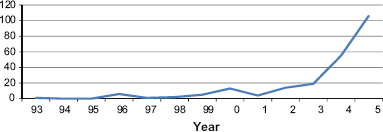
Number of households taking out credit from 1993 to 2005 in a nine region survey N = 900. (Source: 2006 NCEEER Survey).
There is very little credit activity in the 1990s, when the newly introduced institutional structures of market reform were in the process of becoming, but were not as yet, legitimized in the eyes of ordinary Russian rural households. There are small upward blips in the trend line in 1996 and 2000, but the most striking change is the steep increase in the number of households taking out loans after 2001 when the Putin administration's stabilization of the economy went into high gear.
Finally, it is critical to note that the legitimization of formal market reform institutions in rural Russia has had a positive effect on reducing poverty as well as the inequality gap between the better and lesser well-off, which is shown in Figs. 3 and 4. This has had the additional effect of reducing rural support for anti-reform parties, in this case the Agrarian Party.
Figs. 3 and 4, which are based on data from eight of our surveys, from 1991 to 2006, show that the periods in rural Russia with the highest proportion of households living in poverty and the greatest inequality were times when formal institutional elements were especially weak; the initial period of reform from 1991 to 1995 and in 1999 following the devaluation of the Russian ruble.
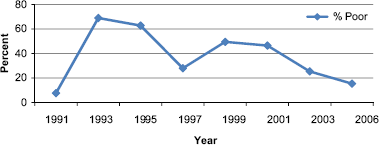
Percent of sample below the poverty level in Russian village surveys – 1991 to 2006. Source: Russian village surveys.
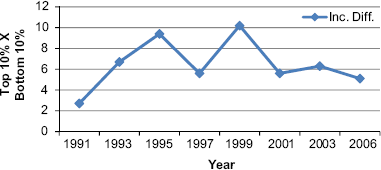
Income differentiation of top and bottom 10 % of households in Russian village surveys – 1991 to 2006. Source: Russian village surveys.
Fig. 5 provides us with a summary of how the legitimization of formal institutions has affected the entrepreneurial role of households in the Russian agrarian economy. There is strong empirical support for our second hypothesis that as the formal institutions of the agrarian economy became more legitimized, the relative proportion of the contributions of household entrepreneurship to the total household economy declined. Households continued to produce and sell commodities from their plots, but they also were able to draw upon salary and wage income from working for others in a more stable and growing formal economy. Growth in the proportion of income obtained from salary and wages is especially strong from 2001 to 2006 when the agrarian economy and the Russian economy as-a whole were growing at a 7 percent annual rate.
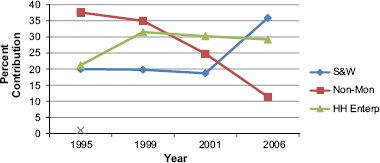
Changing contributions to households income in Russian village surveys – 1995 to 2006. Source: Russian village surveys 1995 & 1999, NCEEER surveys 2001 & 2006.
The overall improvement in the material condition of rural households is best illustrated by the line showing the sharp drop in the proportion of household plot production income that is non-monetary; i.e., that portion of total household income that is devoted to consumption. The curve lowers slightly from 1995 to 1999, consistent with the position that the Yeltsin regime did have some impact on stabilizing the formal economy, but the most substantial decline occurs after the accession of Putin to the Presidency in 2000. This is shown in the data points from the 2001 and 2006 surveys.
There has been, however, substantial variation in the extent to which individual households have achieved economic gains from the legitimization of formal market institutions and the general stabilization of the Russian economy. The critical question is: what explains variations in household success in the reform period? To answer this question we will turn to our panel surveys.
Hypothesis 3 suggests that although rural households as-a-whole have made significant gains from the beginning to the later stages of the reform period, those households that embraced new formal institutional arrangements would fare better than their counterparts that did not. One of the most critical indicators of adoption of new institutional arrangements is the willingness of households to lease land and thereby increase the production potential of their plots. The opportunity to rent land during the Soviet period was very limited but the passage of legislation (referred to above) that legitimized leasing arrangements became an important source of economic differentiation. The data to test this hypothesis was our panel survey in which the same households were interviewed in 1995, 1997, 1999 and 2003. Per capita household income was regressed on traditional informal types of household capital, household labor and household social helping networks (the informal institutional basis of the moral economy), which were critical during the initial survival period, and rental of land. The latter is a form of physical capital that became more available to households as the formal institutions of the market economy became stabilized. Land rental, initially was based on informal arrangements between households, but through federal government legislation it became institutionalized with leasing contracts between large enterprises and local governments, on the one hand, and household renters on the other.
Table 1 shows the effects of these different types of household capital on per capita income in 2003.
Impact of initial per capita income and household capital versus increases in household capital on per capita income in a panel survey of rural Russian households from 1995 to 2003. N = 382. Source: Russian village panel survey.
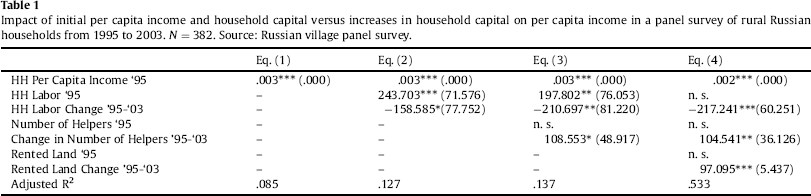
Impact of initial per capita income and household capital versus increases in household capital on per capita income in a panel survey of rural Russian households from 1995 to 2003. N = 382. Source: Russian village panel survey.
The initial level of household income in 1995 explains slightly less than 9 percent of the variance in household per capita income in 2003 (see Eq. (1)). Household labor is the traditional source of differentiation between households in a peasant economy and thus we might expect that as households gain more labor they would increase their level of income (Chaianov, 1966; Deere & de Janvry, 1981). This is the case with total household income (in a regression equation not shown here), but in the stricter, more conservative criterion of per capita income the effect of the traditional source of human capital is modest and mixed. Eq. (2) in Table 1 shows that the initial level of household labor in 1995 does have a positive effect on household per capita income in 2003, but increases in household labor from 1995 to 2003 actually have a negative effect on per capita income in 2003. This indicates that although more labor may increase total household income the addition of new members, on average, actually lowers per capita income, which creates disincentives for families to have more children (O'Brien, Patsiorkovsky, & Wegren, 2004). The two household labor variables only explain an additional 4 percent of total explained variance. Eq. (3) in Table1 shows that increasing the size of the helping network (O'Brien & Patsiorkovsky, 2006: 81–85) does have a positive but fairly small effect (about 1 percent) on household income over the long haul. In short, increases in household labor and social helping networks, based on the informal institutional foundations of the peasant moral economy do not explain a great deal of the variance in how well households are doing in 2003.
Eq. (4) in Table 1 introduces two variables pertaining to the amount of rented land obtained by a household; the amount of land rented in 1995, in an early phase of the reform period, and the total increase in the amount of land a household rented in the eight years from 1995 to 2008. In the initial period of reform, when the new formal institutions of the market place were not well established – there was rancorous conflict between the Yeltsin Government and the Communist dominated Duma (Legislative Branch) on this issue – and the majority of households were reluctant to enter into land leasing contracts. Thus, it is not surprising that the amount of a household's rented land in 1995 does not have a statistically significant effect on a household‘s per capita income in 2003. As formal institutions stabilized, however, an increasing number of households felt more secure about leasing land. Those households that increased the amount of land they leased have much higher per capita income levels. The total amount of variance explained by adding the land rental variables, in which the only significant coefficient is that of change from 1995 to 2003, is almost 40 percent, increasing the R2 from .137 to .533 (see Eqs. (3) and (4). Fig. 6 illustrates the substantive importance of land leasing as a source of income differentiation between households.
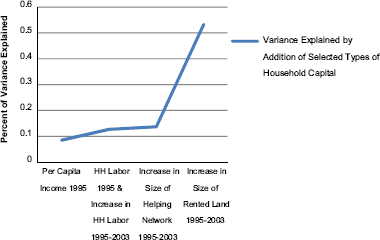
Amount of variance in 2003 household per capita income explained by per capita income in 1995, household capital in 1995 and changes in household capital from 1995 – 2003. Source: Russian village panel survey. N = 382.
Our fourth hypothesis suggests that those regions in which households are better able to develop a “mixed economy”, in which they can combine significant skills in entrepreneurship that were learned in the survival period, and are based on informal institutional arrangements, with new wage and salary opportunities will be better off materially than their counterparts in regions where there is not as much opportunity to develop a mix of the two sources of income. Fig. 7 provides support for this hypothesis.
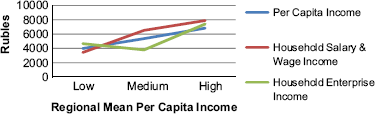
Mean per capita income, household salary & wages and household enterprise income in low, medium and high income regions N = 900. Source: NCEEER 2006 nine region survey. Low Income Regions – Krasnodar krai, Voronezh oblast; Medium Income Regions – Republic of Tartarstan, Kurgan oblast, Krasnoyarsk krai, Moscow oblast, Leningrad oblast; High Income Regions – Altai Krai and Amur oblast. ANOVA of Per Capita Income by Region: F(2) = 38.673, p < .001. Scheffe: middle income regions > low income regions; high income regions > middle income regions, p < .001. ANOVA of Mean Household Salary and Wage Income by Region: F(2) = 23.337, p < .001. Scheffe: middle and high income regions > low income regions, p < .001. ANOVA of Mean Household Enterprise Income by Region: F(2) = 14.249, p < .001. Scheffe: high income regions > low and medium income regions, p < .001.
Household salary and wage income is strongly positively correlated with the per capita income levels of regions. The middle income regions have significantly higher salary and wage income than the low per capita income regions and the high per capita income regions have higher salary and wage income than the middle income regions. These findings are consistent with the argument that as formal institutions of market reforms became more legitimized and enforced in the nation as-a-whole, those rural regions which were most successful in developing new sources of salary and wage income also would be places where average levels of household income rose.
The relationship between level of household enterprise income and regional per capita income, however, is more curvilinear. Low per capita income regions, which are in the most capital intensive agricultural regions of the country, offering little in the way of manufacturing and/or metropolitan commuter income earning possibilities, actually have higher household enterprise income levels than those found in the medium per capita income regions. But, consistent with our argument, the highest per capita income regions have the most balanced mix of income sources, deriving from both high salary and wages and household enterprise sales.
In part, the differences between the ability of regions to produce a mixed rural economy in which households earn money from working for others as well as working on their own small business enterprises can be explained by natural geographic and ecological factors. Yet, it would be a mistake to assume that these factors explain most, or even that they are the most critical explanatory variables. We have noted elsewhere, for example, that regional governments in Belogorod and Rostov oblasts, two regions in the “black earth zone” of southern Russia approached the introduction of formal institutional changes in the early 1990s in very different ways. While the Rostov government provided support to large enterprises, the Belgorod government, in addition to supplying support for large enterprises, also provided substantial help to households, especially through credit schemes and other mechanisms with which to build small- and mid-sized household enterprises. This early positive embrace of reform, coupled with support for existing informal institutions, i.e., household enterprises, resulted in higher levels of material and psychological well being for those living in Belgorod oblast (O'Brien, Patsiorkovsky, & Dershem, 1998).
To properly understand the relative impact of institutional elements on rural household entrepreneurship and the stratification system that results, it is necessary to understand the relationships between the informal and formal institutional sectors within a time frame in which formal institutions are legitimized.
The findings of the Russian Village Surveys illustrate that informal and formal institutional elements are not necessarily in competition but must be understood as playing different roles at different time periods in the process of market reforms. Informal institutions that support a peasant household economy are the best predictors of both entrepreneurial activity and differentiation between households in the early phase of reform when formal institutional elements of a market economy are not fully legitimized. But, as formal institutional elements become more legitimized, especially in the eyes of rural residents, they will begin to produce a “mixed” rural household economy, in which informal institutional elements become relatively less important than they were in the initial period of reform. But, households that utilize new institutional arrangements, especially land rental, will be substantially better off than their counterparts who rely primarily on the informal institutional supports of the moral economy. However, regional differences in creating institutional supports for a “mixed economy,” which depends on both informal and formal institutional foundations will produce inequalities in household income. Finally, the complex relationships between formal and informal institutional change means that we need to develop empirical indicators that measure both “bottom up” informal institutional structures and processes as well as “top down” formal structures and processes imposed by governments over a considerable period of time.