





Abstract
This article aims to give an overview of the analytical approaches to political economy of Central Asia. It argues that twenty years after transition paradigm we still find lingering separation between politics and economics that compartmentalizes studies of economic development, nation- and state-building into separate projects. 1
I am grateful to Peter Rutland, Philip Cerny and Frank Fischer for thought-provoking conversations that inspired me to write this article.
Two theories tried to solve the issue of separation. First is the theory of the “resource curse”, which argues for the inability of a raw material supplier to develop a healthy democratic system (Pomfret, 2006; Auty, 2006a, 2006b, 2006c). The second view, “varieties of capitalism” traces institutional and historical peculiarities as preconditions for a stable market-oriented democratic system (Lane, 2006; Luong, 2000). However, the first view is rather deterministic in relying on a single variable to prove the case; whereas, the second view is highly arbitrary by picking specific historical and cultural contexts that suit the case.
I argue that post-structuralist approaches and specifically, the framework of “governmentality” – a term coined by Michel Foucault, allows for more fruitful heuristic exercise. Governmentality as an analytical approach looks at the way the state positions itself in its society and determines the type of governing rationale it adopts. Particularly, it incorporates both discursive and structural-technological conditions of each state into analysis by augmenting the data before constructing the theory to argue what rationale drives government activities in the state. Governmentality speaks to both “resource curse” and the “varieties of capitalism” by enriching and complicating them while allowing identification of how rationales of governing evolve and change over time.
Introduction
The question of the relationship between economics and politics puzzled numerous scholars around the world. Modernization literature of the 1950s and 1960s shared, what Seymour Martin Lipset called ‘optimistic equation’, i.e., that economic development can lead to democratization (Lipset, 1963). It examined regimes and the conditions of democratization (Lipset, 1959, Friedrich and Brzezinski, 1968; Huntington, 1971; de Schweinitz 1964) rather than economic structures and concentrated on the political actors instead. Since then many critics dispelled the equation by complicating and enriching it with not-so-straightforward paths towards democracy (Moore, 1993; Schedler, 2006; Zakaria, 2003). Despite the disputed nature of the equation, democracy remains to be analyzed outside of economic structures, which is reflected in the transition paradigm – a ‘come-back’ of the modernization theory. Popular in the 1990s it was filled with high hopes for turning one-sixth of the world into democratic and capitalist states after 70 years of the Soviet burden. However, equation failed in Central Asia. Two Central Asian states remained verbose about the goals of democracy and capitalism, but in practice established authoritarian regimes with strong patronage networks although more liberal domestic markets. Until recently, transition theorists did not know what theoretical concepts to apply for the states like that. Uzbekistan and Kazakhstan, two representative cases for the analysis in this essay, were called pseudodemocracies, preemptive authoritarianism, hybrid regimes and illiberal democracies (Brooker, 2009; Diamond, 2002; Silitski, 2009) concentrating yet again on the codification of political regimes. According to such analyses, Uzbekistan and Kazakhstan are authoritarian states co-opted by the two former Soviet apparatchiks that have remained in power for the past 20 years. The puzzling nature of the regimes listed together with Russia, China, and Azerbaijan made scholars concede to the sustainability of the authoritarian regimes in the former Soviet states (Bermeo, 1990; Carothers, 2002; Schedler, The Menu of Manipulation, 2002) without coherent explanations in place. Although highly personalist and unsustainable in the long run, these states represent a viable option of government regulation. Under such conditions, both states face ‘authoritarian paradox’ – a situation when democracy could only be built by the authoritarian means. Some blame the leaders for stalling the political process (Kasparov, 2009; Shevtsova, 2009), others blame weak civil society (Bunce, 2003) and culture (Liu, 2005, pp. 225–237), still others fault bureaucracies and the legacy of Soviet institutions and practices (Luong, 2004) for retaining a functioning authoritarian regime for so long. For these scholars, economic platforms of two regimes are of little importance and are seen instrumentally, as an ideology or propaganda. Scholars who concentrate on studying political regimes are unable to explain fully why particular economic goals come about and what the outcomes of these economic doctrines are. However, the article ponders on the question of how two Central Asian leaders remained in power for so long without broad popular support and/or wide and popular resistance?
This article argues that it is impossible to trace political implications of the regimes in Central Asia without incorporating economic aspects. It also claims that economic structures facilitate several political outcomes. First, reliance on mineral, as in the case of Kazakhstan, or cotton production, as in Uzbekistan forces states to deal with various actors who bring the most revenue into the budget. These actors are interested in the stability of the regimes, because they benefit from it. The merger of economic and political actors creates patronage networks between business and bureaucracies that prevents political accountability of Central Asian governments to its population. In addition, the overall economic system is structured so that people's revenues directly depend on the sustainability of the existing economic system with other facets of economic activity being penalized or discouraged.
The ‘Resource Curse’ (RC) literature explains political outcomes of the merger between businesses and bureaucracies, whereas ‘Varieties of Capitalism’ (VoC) literature illustrates mechanisms behind the second outcome of how economic incentives operate within political realm. Informed largely by the Schumpeterian perspective on the importance of fiscal sociology, two theories accept the assumption that state funded by the collection of taxes is fundamentally different in the ways governing is organized (Moore, 2004, p. 298). Tax state threatened by the tax-payers bargaining abilities forms a fiscal social contract that provides more representation and accountability of the state (Moore, 2004, p. 303). Kazakhstan and Uzbekistan derive relatively small portion of their income from tax. Instead, they accumulate their revenue from exporting commodities abroad, which they redistribute among patronage networks and bureaucracy (see below). As a result of the predatory state intervention, according to VoC literature (Libman, 2008; Luong, 2000; Hollingsworth and Boyer, 1997; Hall and Soskice, 2001), establishment of a market-oriented democratic system is difficult, because of the absence of publically accountable political institutions. RC literature adds that the raw material suppliers are unable to develop a healthy democratic system because of the short-term economic incentives society gets from commodity exports (Auty, 2006c; Esanov, Raiserm & Buiter, 2006; Pomfret, 2006). Two theories are illuminating for the analysis of Central Asia because VoC explains why predatory regulation is adopted, and the RC theory explains the results of the regulation in both states. Although highly useful, I argue that the second view is rather deterministic in relying on a single variable to prove the case; whereas, the first view is highly arbitrary by picking specific historical and cultural contexts that suit the case. In other words, VoC is a version of historical path-dependent argument that has trouble explaining changes, like adoption of new policies and alteration of the old practices. On the other hand, RC literature is a version of the interest-based argument which allows one to examine entrenched interests, but does not explain how actors change perceptions and overcome disagreements. In addition, both theories cannot provide an examination of mismatch between regulation and its implementation in practice, whereas policies are aborted or altered when practical implementation remains difficult.
Foucault's perspective allows one to adopt a coherent framework of analysis that would add to interest-based and history-based explanations enriching them with the understanding of economic regulation and power politics. After evaluating the impact of economic structure on the political process, this paper will focus on the rationale of governance – a certain body of knowledge that informs government's attitude towards its subjects and resolution of social problems. At the same time the rationale of governance, or governmentality, points to how the state perceives itself in society, the role it chooses to play. Fundamentally, it approaches the study of political economy by looking at how the state perceives the utility of governing regulation (Foucault, 2008). Governing aims to rationalize reality for better ends (Foucault, 2008, 2). Hence, governmentality points to the ‘how’ of governing, i.e the rationales political regimes choose to reach socially acceptable goals. I define governmental rationale as a set of assumptions and ideas about the role of the state in society that informs government programs and responses to social problems. It serves as an internal logic of the state that determines the scope and scale of government regulation. Governmental rationale is an Ethos, a path for reaching the ultimate goal set up by the authoritarian leaders, which I call the telos. Telos is a meta-discourse that sets up general goals regimes want to achieve, and ethos that informs how to solve particular issues in practice in a way that reaches towards the telos (Dean, 1999, 33). Governing power and legitimacy of government regulation is provided through discourse coordination between government bodies and also through communication of regulation to the public that justifies the reasons of adopting proposed policies. Foucauldian perspective that I am introducing here links three crucial ideas: regulation and democracy in the following way. First, it takes for granted the fact that both regimes recognize ‘authoritarian paradox’: both leaders share the same goal of becoming a democratic state with the developed market economy (Karimov, 2007; Nazarbaev, 2005), however the way to achieve this goal is different in each regime. Second, I argue that Kazakhstan and Uzbekistan adopted two different governing rationales (two Ethos) 2
I have made similar arguments in Adams and Rustemova 2009.
Kazakhstan, on the other hand, sees regulation as a technocrat. In other words, government's role is not to interfere into society, but instead to provide the right incentives to social actors so that the system remains stable. Such internal logic makes a profound difference with Uzbekistan. Instead of arguing from the moral perspective, Kazakhstani government perceives governing as science, a technique. Government claims to know how to run the system as a good manager. Such managerial ethos exhibits legitimacy in the following fashion. If the government claims to be knowledgeable, then it can stay in power as long as it does what it claims to do and as long as the system works. Discursive strategy of the state warns that that change of leadership will bring instability threatening people's fortunes and benefits, which makes democracy a dangerous pursuit. In short, both regimes make people dependent on the economic system they've created either through patrimonial networks or via state-ownership of the majority of enterprises deriving their legitimacy from the promise of economic benefits in exchange for political authority. Both regimes claim that democracy is inappropriate as of today because it is unable to cope with inequality (Uzbekistan) and instability (Kazakhstan) reflecting governing rationales of each Central Asian state.
Some political theorists might object to the use of Foucault outside of his method, the archaeology of knowledge and outside of liberal democracies (Rose, 1996, 1999), however, I still believe it is possible to study the present using his distinctions of the discursive practices but also grounding it in the economic structures. I also argue that Foucault's perspective is incomplete on its own without depiction of the actual practices of regulation, which are explained and supplied by the VoC and RC literature. Governmentality points to the logic and the way regulation is framed to legitimize state policies, but not the actual state policies themselves. However, without Foucault two theories suffer from the lack of theorization of economy because they make assumption about its unchanging nature as either rentier states 3
Rentier State is a state derives a large fraction of their revenue from external rents. Please see (Ross, 2001).
This article will, first, outline interest-based and historical-based perspectives in order to depict their ‘story of Central Asia’ and then point to major drawbacks in those stories. After that, I will propose a heuristic approach of governmentality. Although, it may not shed a new light on what we already know, nonetheless, it will help us to complicate current theories of development and democratization by seeing the scope of interdependence between economic and political realms.
Political economy of Uzbekistan and Kazakhstan sets a challenge to the existing theories. On one hand, two Central Asian states claim to be developing market economies and democratic societies, on the other, they have been ruled by the same former Communist apparatchiks for the past 20 years with the strong personalist grip on power and state intervention in economic realm. In addition, they are and were predominantly resource-based economies. Two theories attempted to provide explanations for these regimes Varieties of Capitalism (VoC) literature and Resource Curse. VoC argued that two states have adopted different paths of transition in the beginning of the 1990s and they exist within the bounds of these decisions still ripping the benefits and limitations. Whereas Resource Curse claims that the differences are attributed to economic and political interests over mineral and agricultural rents. Although each paradigm has overlapping dimensions and academic works that utilize both, we can nonetheless discern the basic assumptions and propositions of each. In other words, this section will try to re-create an ‘ideal type’ of each paradigm in order to propose alternative scholarly practice.
Model 1 resource curse
‘Resource curse’ (RC) is a term that points to the danger of economic growth that is reversely correlated with mineral wealth in raw material exporting countries (Sachs and Warner, 1995). Once the resources run out, the growth stops. Resource Curse model provides an explanation of the undemocratic nature of Uzbekistan and Kazakhstan by examining its economic structure. It claims that authoritarianism is supported by rents – a surplus that government gets from regulating the sale of mineral and agricultural goods in taxes and/or control of state-owned enterprises. 4
It is important to note that rent can occur not only from extraction of natural resources, but also from managerial innovations, geopolitical rent, that includes aid and other forms of economic assistance, and contrived rent understood as excess revenue from the required effective public spending (Auty, 2006d, p. 4).
The assumptions that inform resource curse come from the formal economic model called Heckscher-Ohlin theorem. It argues that an economy will tend to be relatively effective at producing goods that are intensive in factors with which the country is relatively well endowed (Obstfeld and Krugman, 2006, p. 61). In other words, existence of minerals in Kazakhstan and cotton and gas in Uzbekistan create biased growth due to high profits, rents, governments get from simply extracting and shipping commodities abroad. Economic effects of biased growth, also called Dutch Disease, and dependence on rents creates movement of the factors of production where labor, capital and land resources shift from other industries to the most profitable industrial sectors, like oil, gas and mineral extraction. As a result, the non-tradable goods sector loses capital, land and labor resources. For a country that derives its wealth from the minerals, biased growth is also coupled with the spending effect, when rent revenue goes abroad as payment for imports rather than invested domestically, non-energy sectors lose positive externalities putting domestic producers at a disadvantage. In other words, as economic actors gain extra money to spend, they tend to buy cheaper imports rather than producing them domestically. Factor movement and spending effects make population more dependent on the successful industries for livelihoods and prevent revenue gain from non-rent sectors.
Dutch Disease creates the following political implications: first, by redistributing rents along the patronage or bureaucratic system both regimes prevent formation of opposition groups making people dependent on state regulation. 5
Often, these networks are called clans (please see (Schatz, 2004) or (Collins, 2006)), which I object to, because they are not based on ethnic, religious or cultural affiliation. Rather, they are based on the patrimonial relation to leadership with the following characteristics: a) bureaucratic recruitment is based on personal confidence with ruler seeking various guarantees of indivisibility of his power; b) social policy aimed at ensuring the benevolence of the masses; c) wealth and social influence concentrated in the hands of the small group of people who have access to commercial circuits (adopted from, Sarfatti, 1966, pp. 8–52).
Resource curse theorists argue that Uzbekistan's agricultural rents are fundamentally different from the mineral rents of Kazakhstan. Uzbekistan's cotton, its primary export commodity 6
Gold is next, but the value of it remains secret. Please see (Pomfret, 2006, p. 78).
Oil and mineral commodity exports created high resource rents in Kazakhstan, understood as pure profits generated by the extraction of natural resources (Esanov et al., 2006, p. 39). Rents allowed elites to remain in power (Esanov et al., 2006, p. 40) by redistributing resources through patronage networks, maintenance of low taxes and co-optation of opposition. However, due to the fact that half of the rent accrues by private investors as a return to the services they provide, makes Kazakhstani economy dualistic in nature. Capital-intensive industries that employ few workers provide high revenue, whereas labor-intensive industries oriented towards domestic demand like agriculture are lacking investments (Auty, 2006b, p. 68). This dualism increases gaps between workers in capital vs. labor-intensive sectors producing factor-movement effect and brain-drain. As a result, Kazakhstan loses manufacturing capacity due to the lack of positive externalities developing Dutch Disease. In order to regulate dualism that also creates a divide between rural and urban areas and between ethnic groups (Auty, 2006b, p. 69), government expanded bureaucracy 7
Specifically, new government bodies were established like the Development Bank of Kazakhstan formed in 2001 with 100% state participation, Investment Fund created in 2003 under 100% control by the Government, National Innovation Fund formed in 2003 also with 100% government funding. Also, most of the government shares in the joint ventures or production sharing agreements are operated by the national company Samruk-Kazyna that represents state interests in those projects. For more please see (Sultanov, 2005, pp. 67–78).
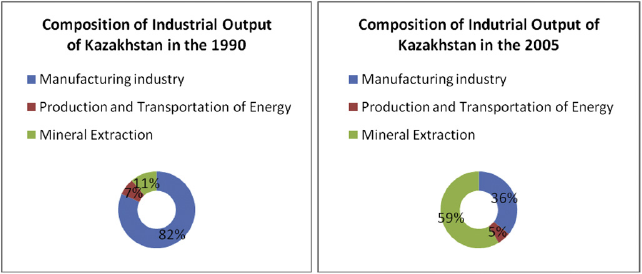
Comparison of the industrial output in Kazakhstan in the 1990 and 2005.
In addition, democracy in Kazakhstan is difficult to achieve because the state establishes patronage system of rent extraction that links government and businesses into a single political system, which is likely to nurture predatory government that distorts economy and prevents economic growth (Auty, 2006a, p. 274, Tsalik, 2003).
Although sources of rents are fundamentally different in Kazakhstan and Uzbekistan total rent as percentage of GDP in 2000 was high for both states: Kazakhstan 27.2% from oil and 1.5% from gas and Uzbekistan 17.8% from gas and 15.6% from oil (Esanov et al., 2006, p. 43). In addition, revenue for both economies is very much dependent on the external demand and ability to export, which produces the outward-looking and long-term political and economic reform strategies, with inward-looking patronage-dispensing agenda of central regional and local governments (Auty and De Soysa, 2006, pp. 148–149). In the political realm both regimes retain legitimacy by creating wealth in order to sustain GDP growth that is partially redistributed to people. The benefits of the story provided by the RC are embedded in the explanation of how economic structure precludes political reforms by sending incentives for the authoritarian political regimes that derive legitimacy from controlling sources of personal livelihoods for the majority of people. RC outlines the general system of incentives that regulate both economic and political realms, however, it is not detailed enough to explain the process and outcomes of state regulation. I will supplement this story by the second framework for the analysis of Central Asia called Varieties of Capitalism.
VoC treats political economy as production regimes where firms’ behavior is determined by government regulation and overall institutional setting (Hollingsworth and Boyer, 1997; Soskice, 1999). It argues that depending on the institutional configurations firms are able to advance, develop or forfeit technological innovations, and provide long or short-term employment of the population (Soskice, 1999). Hence, regulation becomes an important component of growth and includes both the behavior of those in power and the wider participation of citizens and representative organizations (Lane, 2006, p. 8). Institutions evolve through historical decisions that states adopt towards governance, that constitute peculiarities of the production regime in each country. The term institutional comparative advantage reflects instruments of regulation (market or non-market) and incentives sent to the private actors shifting economy to the virtuous (market-based capitalist system of production) or the vicious circles of growth (predatory system of capitalist production) (Coates, 2005, p. 17).
In this perspective political regime does not matter per se. The assumption is that authoritarian states can be productive if they act as developmental states (virtuous circle), but can become impediments if their interference into economy makes economic activities unprofitable whether due to high taxes and corrupt bureaucracies or due to the absence of law, order, contract enforcement and provision of public goods (vicious circle). The crucial question for the regime is its ability to limit and re-organize itself into an economic actor. VoC scholars believe that the goal of building capitalism could never be achieved based on the models and step-by-step approach. Instead, they argued that besides regular economic factors of production and endowments, local institutions play important role in the pace and quality of economic transition.
VoC scholars define firms relationally, as ‘actors seeking to develop and exploit capacities for producing, developing and distributing goods and services profitably’ (Hall and Soskice, 2001, p. 6). Profitability would depend on the three criteria:
industrial relations understood as relations between firms aimed at coordinating bargaining over wages and working conditions with their labor force; corporate governance defined as a realm of financing operations to which firms turn for access to finance and in which investors seek assurances of returns on their investments; and inter-firm relations – relationships a company forms with other enterprises, notably with suppliers and clients (Hall and Soskice, 2001, p. 7).
These arrangements reflect institutions - a set of rules, formal or informal, that actors generally follow (Hall and Soskice, 2001, p. 9) which provide firms with advantages for engaging in specific types of activities to produce goods more efficiently than others depending on high or low transaction costs. Under such setting, authoritarian institutional configuration could launch a virtuous circle by encouraging firms to develop profitable industries or vicious circle when forms become reliant on government's support and its subsidies. The dynamic of government regulation towards virtuous circle or away from it is path-dependent and historically evolves over time.
Two Central Asian states make the case for the analysis of regulation especially interesting. Industrial relations in both states are characterized by the existence of large successful enterprises, which developed not because of the market mechanisms, but because of the close relations to State in a form of a patronage network. However, despite similar political set up, firms’ relations with the state differ in Uzbekistan and Kazakhstan because of the different transition patterns both governments adopted at the beginning of the 1990s. Uzbekistan adhered to the ‘gradual path’ of reforms retaining state control over majority of industries, whereas Kazakhstan embraced ‘shock therapy’ model of rapid transition to market economy.
Kazakhstan's ‘shock therapy’ model based on privatization, decentralization and liberalization allowed firms to establish clusters of industries via market incentives. Some firms invited foreign investors, others tapped into financial markets in order to develop domestically-oriented industries and services. Cash source determined two types of institutional arrangements in Kazakhstan's capitalist system. First, firms that acquired Foreign Direct Investments were interested in maintaining their good standing with the government and therefore provided support through social projects, sale of shares to the government, and payment of taxes. In return, state invited foreign direct investments to develop large domestic enterprises by giving them preferential treatments, tax cuts and lax labor protection laws (Peck, 2004). Under such conditions, firms do not have strong incentives to concede to labor, because it is not organized and does not have a strong legal basis making labor relations in FSU more liberal and market-regulated than in the US (Knell and Shorlec, 2007, pp. 46–48). Inter-firm relations are politically motivated and not based on market instruments per se, because government owns shares in most of the enterprises and they are managed by a single government entity called Samruk-Kazyna. 8
This state body unites 404 various companies under one government umbrella endowed with the economic stabilization functions and support of the industrial-innovative projects. Please see www.samruk-kazyna.kzfor more information.
On the other hand, SMEs are mostly private. Only 1% of them are state-owned (Surveys, 2009a, p. 5). They thrive because of the relatively easy registration (1–30 days to obtain import licence), availability of credit and banking loans under a 90% collateral (compared with 100% and 120% in upper-middle income countries and Eastern Europe respectively) (Surveys, 2009, p. 8). In addition, SMEs thrive because government does not dependent on tax revenue from the broad social base per se. Capital availability determines development of the alternative economic sectors for firms outside of ‘national significance’. Corporate governance is widely used in Kazakhstan, allowing development of local financial and construction industries. So far there are two types of firms operating in the market: a) large enterprises with high share of FDI that are not looking for financing in corporate governance structures due to engagement in mineral extraction; b) alternative industries, including SMEs, like food industry, construction and financial sector that are able to raise capital abroad and operate outside of state control.
Kazakhstan's economic system has no incentives for democratization. Large corporations with the presence of FDI are interested in the stability and preservations of their contracts and maintenance of status-quo. Nazarbaev's regime serves the aspirations for stability and more or less respects of contracts. SMEs also support the regime because they have freedom to manoeuvre as long as they remain local and/or regional. Inability to develop large projects outside of government control created opposition movements staffed with successful businessmen appealing to the need for democracy with little public support. Under such conditions, VoC specialists see little chance for democracy in Kazakhstan (Gleason, 2003; Lane, 2006).
Uzbekistan, a country where regime implemented ‘gradual’ state-led transition retaining centralized control over economy with welfare support of the majority of population. Currently, Uzbekistan spends 54% of the annual budget on social sphere (News Agency, January 2009). Firms, the major actors in VoC paradigm, have no incentives to develop market mechanisms and instead await regulation from the state. With the majority of population engaged in agriculture (close to 35%) (Gleason, 2003, p. 120), such institutional structure prevents Uzbekistani economy from fostering backward and forward linkages. In other words, firms that rely on government support are not interested in nurturing relations with their suppliers (backward linkage) and consumers (forward linkage). Lack of incentives among firms to create internationally competitive goods is the second outcome of centralized institutional arrangement. As a result, present economic clusters are unable to exist outside of state support.
In Uzbekistan financing is provided by the state (Surveys, Uzbekistan: Country Profile 2009b), because of the underdeveloped financial markets in the country. Less than 15% of firms in the country have access to loans from the banks (Surveys, Uzbekistan: Country Profile 2009b). Ninety two percent of the domestic firms are funded by the domestic sources (Surveys, Uzbekistan: Country Profile 2009b, p. 3). Absence of funds and credit agencies outside of government institutions further exacerbates the development of alternative capital-intensive industries, like financial, technological services forcing firms to remain small on average employing 24 people with 50% of the firms having 10 or fewer employees (Surveys, Uzbekistan: Country Profile 2009b, p. 2). SMEs are usually registered as sole proprietorships uninterested in providing services of international quality. Uzbek government is the full or majority shareholder in half of all SMEs which account for most employment in the sector (Surveys, Uzbekistan: Country Profile 2009b). At the same time Uzbek SMEs suffer from high taxes that benefit local farms and state-owned enterprises. SMEs remain small to avoid predatory state practices (Auty and De Soysa, 2006, p. 141). Only 1% of firms have international certificate (Surveys, Uzbekistan: Country Profile 2009b, p. 4) compared to 11% in Kazakhstan (Surveys, Kazakhstan: Country Profile 2009a, p. 12). Most of them are oriented at the domestic market, which is reflected in numbers: only 2% of firms export abroad (Surveys, Uzbekistan: Country Profile 2009b, p. 3). Domestic orientation also prevents firms from acquiring technological innovations and communications. Only 7% of firms maintain a website (Surveys, Uzbekistan: Country Profile 2009b, p. 4). Fifty six percent of firms admitted that bribes are necessary to do business in Uzbekistan (Surveys, Uzbekistan: Country Profile 2009b, p. 4) keeping the size of the firms low in order to survive.
Under these conditions, democracy becomes difficult to sustain since people are interested in stability of the state being largely dependent on its salaries and subsidies. Single leader who provides for the people represents a convenient choice for the overall population. Opposition movement in Uzbekistan is largely exiled or exists as a sporadic force against severely corrupt government officials (Rustemova, in press).
VoC theory states that authoritarian regimes prevent establishment of free markets but set reasonably well with low level of labor protection and freedom for smaller businesses (Coates, 2005, pp. 15–16; Lane, 2006, p. 8). It also points to the outcomes of path-dependency of the historic decisions about the nature of transition adopted by both leaders. Kazakhstan adopted a ‘shock therapy’ transition that led to the development of the private sector and flow of foreign direct investments into economy making large corporations satisfied with the authoritarian leader due to the provision of stability of economic operations in Kazakhstan. On the other hand, independent corporations that do not rely on government for revenue are unsatisfied with authoritarianism seeking the rule of law and transparency. Uzbekistan on the other hand, chose gradual approach and state control of transition. State has control over liberalisation pace and decentralizing mechanisms thereby effectively precluding firms to have incentives to innovate or develop comparative advantages. State support and protectionism allows firms to flourish in the domestic market. Democracy in such economic system is difficult to sustain because the majority of people are dependent on government salaries, finances and support.
Both theories make illuminating conclusions about the nature of political and economic systems in Central Asia. They claim that:
Political economy of Central Asia cannot be analyzed by pure economic modeling and a priori prescriptions because politics and economics are woven together not only in an ordinary interdependent fashion seen in most developed states, but represented by a highly structured personalist political regime that pursues economic liberalization in two different ways. Economic structure matters and determines political conditions in both states making these differences crucial for the explanatory paradigm.
However, each paradigm has own limitations. RC story theorizes economy through an interest-based perspective but is inattentive to the new practices of governing. RC also does not explain how interests change how actors cooperate even under conflicting and incompatible interests. Whereas VoC story very much centers on the outcomes of the practices and regulation of each state, but does not theorize the economy behind these practices. In addition, both theories fail to examine the gap between regulation and its implementation in practice when the policies are aborted or altered.
Governmentality promises to alleviate these difficulties without negating the value of both theories. At the beginning of the article I defined governmentality as an ethos aimed to rationalize reality in order to reach the Telos, and as an internal logic that guides government's regulation. 9
Foucault himself gives fairly ambiguous definition of governmentality: Foucault gives three meanings to the term governmentality. First, he identifies the shift in the style of governance from the sovereign state of justice with subordinate subjects into states as administrative entities. This transition was accompanied with the development of a series of specific governmental apparatuses and a certain body of knowledge, which Foucault also identifies as governmentality. Finally, by “governmentality” he understands the result of the process by which the state of justice of the Middle Ages became the administrative state in the fifteenth and sixteenth centuries and was gradually “governmentalised” (Foucault, 2007, pp. 131–139).
To compare the type of problems important and worth government intervention that go beyond economic and political divide.
To compare the methods and techniques that authorities use in order to solve these problems.
Two discursive functions show the problems that the state considers important and also inform the techniques it uses to solve them: coordinative discourse calls state bodies and offices to share and pledge allegiance to the telos during practical implementation of policy. On the other hand, it has to be communicated to the public framed and justified in a continuous fashion. Division of the governmentality into coordinative and communicative functions allow for policy change in the particulars with Meta discourse or telos remaining the same. As a result, an all-intervening paternalist state will rely on the instruments of oppression, such as law and police force. Managerial state will use a set of positive and negative incentives to govern its population and will employ cost-benefit analysis to solve problems. Managerial rationale does not require eradication of problems per se, but aims only to avoid growth of problems that could challenge existing economic system. Paternalistic rationale is omnipresent and perceives all problems worth looking into regardless of their scope and fashion.
As a result, democracy is difficult not only because of rents and policies of economic development, but also because of the technologies of power used in two states. Paternalistic rationale of Uzbekistan dresses political decisions in highly moral clothes. 10
I have made similar arguments in Adams and Rustemova 2009.
I am thankful to Dr. Fischer who introduced work of Vivienne Schmidt to me. I am borrowing and modifying her terms of discourse theory developed for the democratic states in Western Europe.
Please see (Rustemova, in press).
Kazakhstan's communicative discourse promotes notion of the political as an economic enterprise where government acts a manager in the existing system of exchange. However, the managerial position also alters the nature of the political away from contestation and struggle, because the government claims to possess technical expertise and, therefore, treats genuinely political issues as technical and specific (Rustemova, in print). Coordinative discourse forces state bodies to support individual freedom of self-enrichment within the structures and conditions set up by the state. Repression takes a form of penalties, fines, criminal proceedings against opposition members that challenge technocratic bureaucracy in Kazakhstan, because they portray themselves as more knowledgeable and savvy than the people in power.
Authoritarianism is further entrenched through showing the success of governing rationales: how the problems posed were successfully solved by the techniques chosen. Kazakhstan's technocratic, self-limiting rationale calls for the goal-oriented programs with clear a priori set benchmarks. Its specific programs are written from the perspective of the cost-benefit analysis of a specific problem and manipulation of the positive and negative incentives. Therefore, progress is evaluated through the growth of abstract economic indicators like GDP, competitiveness rankings and trade turnover. Failure in managerial rationale is blamed on the lack of individual responsibility. In the paternalistic rationale progress is evaluated through the careful outline of the increasing individual well-being. Uzbekistan's paternalistic rationale perceives its role as an ultimate moral authority. Its primary tactics of governing towards progress are evaluated through the morally fair political campaigns with no clear benchmarks and only a posteriori report of the results. Instead of social problems, they pick social communities and tend to address all of their issues in a single annual political campaign. Failure is attributed to the specific government officials who are deemed immoral individuals undermining overall social progress. We notice two tactical differences of how progress and success of each rationale is portrayed and manifested through the prism of the political economy.
Although governmentality discourse requires a separate research, it allows for multiple reforms with contradictory goals to co-exist under the auspices of managerial or paternalistic styles of governing. It fosters theorization of the economy as a constant shift and change of regulation followed by the supporting discursive practices. It does not mean that two styles of governmentality are mutually exclusive; on the contrary, they co-exist in two states. However, the differences are especially pronounced in economic development and political realms.
Pure economic theories are incapable of analyzing economic growth and capitalist development together with political implications. Two theories provided an interesting perspective on how economic structures precluded democratizing incentives for the political regimes in Kazakhstan and Uzbekistan. I argued that Foucault's notion of ‘governmentality’ provides a coherent explanation of the entrenched authoritarianism in two Central Asian regimes. Echoing findings of the RC and VoC paradigms, economic structure created impediments for democracy in Central Asia. Kazakhstan that adopted ‘shock therapy’ path towards liberal market economy, perceives itself as a manager of the population. Its economic structure is based on resource extraction of rents that are redistributed through patronage networks. Authoritarian durability of the regime stems from the support of the large financial-industrial groups and ability to accrue wealth by the private actors unaffiliated with the state. In Uzbekistan, the situation is different. ‘Gradual’ way of reforms put Uzbek state into dominant paternalistic position. High concentration of enterprises in government's hands precludes development of SMEs and retains large portions of labor force dependent on state support. As a result, the regime in Uzbekistan functions as a redistribution mechanism providing salaries to the majority of population. In addition, persistence of rural population engaged in cotton production decreases uncertainty over revenues when the state provides subsidies and support regardless of international commodity prices and/or labor productivity. Under such conditions, democratization, i.e change of leadership, threatens the benefits of people within government hierarchies and those dependent on it.
However, these views seemed incomplete without discursive practices that followed economic regulation. M. Foucault's idea of governmentality, the ethos with which government approaches regulation informs not only the way economic reforms communicated to the population, but also the way they are coordinated through the bureaucracy, which requires additional research. It also explains the nature of the political realm that government wants to achieve where democracy is restricted not only by the economic structure, but also by the discursive strategies that point to the economic success of the authoritarian regimes in exchange for authoritarian durability. This article claimed that the governmentality framework would not have been valid without economic background and examination of politics because in countries where economic development is the sole legitimating principle for both regimes, economy becomes more important but also highly politicized. The path to the economic liberalization is crucial not only for the authoritarian durability of the ruler, but also to the overall economic and political nature in both states.