






Abstract
In marketing, Eurasia is currently still an area of terra incognita between the CEE and the Asia-pacific region. This paper deals from a linguistic cultural studies viewpoint with the question of how far Eurasia can be a relevant region for MNE marketing. To this end, the enrichment of the conception of Eurasia in Russia will be researched in its philosophical, political and economic dimensions using the original geographic dimension as a baseline. The individual conceptual components will be scrutinized in detail for their potential significance for regional marketing in post-soviet economic discourse, whereby neo-Eurasianism in contemporary Russian thinking deserves particular significance.
Introduction
Presently numerous multinational enterprises (MNE) run their international marketing activities on a regional basis by grouping together neighbouring countries with relatively homogenous historical, cultural, linguistic and economic conditions. Guiding slogans are thereby contrasted with a regional marketing concept based on a global perspective (Elango, 2004; Morrison & Roth, 1992; Rugman & Verbeke, 2004). The advantages of a regional marketing strategy on an internal level, such as cost minimization, efficient communication, achievement of a critical mass, respectively on an external level such as use of existing economic connections or bypassing of trade barriers are emphasised by Ghemawat (2005). Regional concepts stand out through closer market proximity since product and communication policy can be more efficiently customised to local circumstances. From a Western-European perspective, regions such as Central and Eastern Europe, Scandinavia, or the Asia-Pacific region are fixed factors whereas the central Asian region is far less in the limelight. In Asian activities pragmatic reasons lead to valuing of distances and transport connections more highly than political realities and cultural commonalities (Schütte, 1997, p. 443). Many successor states of the Soviet Union as well as Russia itself – 75% of whose territory is in Asia – are thereby not separately observed; and these states are due to the similar economic transformation processes, the transition from planning to market economy, often seen in a simplified and simplistic way as one of the Middle and Eastern European countries, or from an American viewpoint as a part of Europe as a whole (Daniels, 1987; Rugman & Verbeke, 2004). In contrast, in Russia and some central Asian successor states of the Soviet Union, in particular Kazakhstan, trends have been emerging since the collapse of the Soviet Union to establish new regional identities as well as political and economic entities based on long-standing shared history (Kaiser, 2004). Thereby ‘Eurasia’ as a cultural key-concept (cf. Hoffmann, 2004) plays an eminent role. It is very present in public discourse in Russia, and far more than just a technical geographic term. It is a cultural key-concept enriched by numerous dimensions of varying impact which are exploited to a different degree.
The present article is devoted to the issue of whether the Eurasian area as a presumed relatively homogenous, geographical, cultural and economic entity has particular relevance as a regional concept for MNE marketing. For this purpose we assume the working hypotheses that the Eurasian area in terms of marketing comprises Russia on one hand and the central Asian successor states of the Soviet Union along with additional states such as the Caucasian Republics and neighbouring countries under certain circumstances on the other. The prerequisites for the regional concepts such as commonalities in culture, in consumer behaviour, in the overall economic development or affiliations with economic communities (Fedorov, 2006) are differently evaluated in the restricted available literature (cf. in particular the articles in Kaiser (ed.), 2004). Thereby commonalities are found in the history, in the affiliation to the Russian and later to the Russian–Soviet empire, as well as in traditional contact between the Christian and Islamic religions and finally in cultural collectivism (Evers & Kaiser, 2004; Schrader, Skvorzov, & Wiener, 2004). In contrast the differences are especially perceived in the unequal localisation of the individual identities regarding time and space, furthermore significant differences are asserted in social stratification of the respective societies and the corresponding values, norms and attitudes (Balatskiy, 2006) as well as in the “trans-local collectivisation” between Moscow, Istanbul and Mecca (Evers & Kaiser, 2004, pp. 60–62).
An examination based on the cultural dimensions of Hofstede (1980) carries no prospects of success. On one hand there are no comparable surveys for the respective countries, on the other the individual studies (e.g. Ardichvili & Gasparishvili, 2001; Kuchinke & Ardichvili, 2001) carry too little significance or are not transferable to regional marketing strategies. Concerns regarding the significance of papers within the Hofstede framework (e.g. Bollinger, 1994, Naumov, 1996; Naumov & Puffer, 2000 for Russia; McSweeney, 2002) regarding marketing are more fundamental, since these papers emanate from an essentialist understanding of culture and imply an undivided national culture valid for everyone and everything (Hansen, 2000, pp. 283–285; Holden, 2004, pp. 564–566).
Addressing the question of relevance of the Eurasian area as a regional concept for MNE marketing, an attempt involving linguistic and cultural-scientific means is made to transform the components of the cultural key-concept ‘Eurasia’ into potential significance for operations of economic subjects. Subsequently, it should be verified whether ‘Eurasia’ can stop being terra incognita on the regional map of international marketing, and whether it deserves an independent marketing approach.
Research design
Eurasia as a cultural key-concept has like all other cultural key-concepts a long history. In terms of cultural linguistics (Palmer, 1999) it holds a stable core and less stable outer layers subjected to stronger discoursive processes. The emergence of the concept ‘Eurasia’ will be discussed in its multi-dimensional character in the third section. In Russia ‘Eurasia’ currently not only visualises geographical-geological and cultural-philosophical circumstances, rather more it also simultaneously contains a line of political and economic dictums. It has potential economic significance precisely as a dictum of Russian domestic and foreign policy. To comprehend this economic significance the extension of the originally purely geographic concept of ‘Eurasia’ as a super-continent, the largest landmass, is initially examined in additional dimensions. The question is therefore raised of what precisely is to be understood under Eurasia and how far it extends.
An analysis of the current importance of Eurasia links in the fourth section to consideration of Eurasia's scope in history. The existing representative opinion pools across the Russian population are evaluated in terms of low geopolitics. These query the localization of Russia as a separate Eurasian civilization between Europe and Asia. This analysis will be synchronized with an analysis of lexical meaning based on common Russian dictionaries and encyclopaedias.
The fifth section investigates the current importance of Eurasia in Russian economic discourse. It queries to what extent a Eurasian territory is contrived as the basis for a regional marketing concept. To answer this question a representative corpus from the economic discourse of the years 2004 and 2005 is collected. This period was also selected since a deepened geopolitical discourse on the ranking of Russia in the world in the context of EU eastern enlargement by a number of Central and Eastern European reform states and the re-election of Putin as president were to be expected as central discoursive events in Russia. The corpus is comprised of 4134 articles from Russian commercial press publications, 46 interviews and roundtables with entrepreneurs as well as 28 mission statements from Russian and foreign companies whose names contain the Eurasia component, i.e. a total of 1,632,343 tokens resp. 83,599 types. Therewith a mix between information and opinion based text types exists, representatively visualizing the Eurasia discourse.
Based on a quantitative evaluation, the process of the loss of the original geographic dimension of the Eurasia concept is examined in the corpus. Thereby attention is particularly paid to the individual levels of onymisation of Eurasia and its derivations. These levels reach from Eurasia as an onym (proper name) in a narrow sense through trans-onyms as a transition of the onym into other name classes (e.g. names of companies) up to the use as an appellative (common noun) where the original character of the name has completely disappeared.
The sixth section the quantitative analysis is complemented by a qualitative analysis. The basis of such analysis is formed by the appearance of lexemes referring to the political and philosophical dimension of the Eurasia concept. The seventh section summarizes the results and the eighth provides conclusions regarding potential consequences for further research. This will be necessary since using purely linguistic cultural-scientific methods the present analysis can only partly answer the question raised in the first section.
On the emergence of the cultural key-concept of Eurasia
The geographic dimension
Eurasia as a super-continent has a history with origins reaching as far back as the ancient period (Bassin, 1991). Greek geographers assumed that it should be possible to find a natural water border between the two continents of Europe and Asia which was then finally drawn along the legendary Tanais waterway. This doctrine remained unchanged through to the close of the medieval age. A sustainable rethinking process only began in the context of the opening of Russia towards the West under the rule of Peter I. The purely scholastic question of a border within the Eurasian continent recognised in the meantime as a unified entity turned into a question of identity for the self-image of the Russian empire, already reaching to the epicontinental seas of the Pacific during Peter's era at the beginning of the 18th Century. Stimulated by Peter I, the Russian scholar, Vasiliy N. Tatishchev, set the border along the Ural Mountains and the Ural River, which continued along the main ridge of the Caucasus Mountains as significant marking points of the giant continent. A major “natural” justification of simultaneous unity and separation of the dominant European centre and the colonial Asian–Siberian periphery was therewith established, which determined the geopolitical basis of Russian statehood up to the downfall of Tsarist Russia.
The philosophical dimension
The mismatch between the intended position of Russia as a European state and its Asian outlands founded the philosophical dimension of the concept of Eurasia in the 19th Century. It originated in the context of rejection of the cultural hegemony of Europe and the assumption of an unbridgeable cultural and historical gap between Russia and Europe due to the Pan-Slavs. One of its most famous representatives, Danilevskiy (1871/1991) combined physical geographical, historical, ethnographical and cultural arguments to characterize Russia as an independent continental entity of “All-Slavic Union” when compared with Asia and Europe. This was located in a triangle between Bohemia, the Aegean and the Pacific (Danilevskiy 1871/1991, pp. 57–61). No dividing line between Europe and Asia was thereby necessary.
The philosophical dimension of the concept ‘Eurasia’ reached its peak following the October Revolution with classical Eurasianism. In Russian emigration (a.a. Nikolay S. Trubetskoy) the collapse of traditional Russian statehood and along with this of the entire canon of values resulted in a philosophical counter-concept in the form of classical Eurasianism which was based on a special Eurasian “ethnical and culturally humanistic existence” (R. Jagoditsch, quoted in Polyakov, 2005, p. 443).
For a long time classical Eurasianism seemed to be a closed chapter of the history of Russian thought. In the meantime it has however been demonstrated that the Eurasian concept remained alive in a modified form through the precursor of neo-Eurasianism, Lev N. Gumilev, up to the second half of the 20th Century (Polyakov, 2005, p. 316) and since Perestroika has experienced general popularity amongst intellectuals in the Soviet Union. Eurasianism according to Gumilev contained a strong ethno-genetic component. It originated from ethno-genesis as a product of climate and landscape and divided the Soviet Union into graduated climatic zones with corresponding ethnic structures from the North down to the South. This established the foundation for the equivalence of Eurasia with Russian Eurasia (within the borders of the Soviet Union). The geographical dimension of the Eurasia concept had only a peripheral significance. It was hidden behind a contrived homogenous cultural, and finally also economic area.
The collapse of the Soviet empire from 1990 was yet another deep cut in recent Russian history. Often perceived in the country as an apocalypse, this renewed loss of statehood and value system also resulted in a revival of the Eurasian idea. This was a component of the quest for a new national concept accommodating changed geopolitical and domestic frameworks. Since then numerous media, cultural and political-scientific as well as philosophical papers originating mostly in conservative political attitudes in the early 90s are to be allocated to the wide spectrum of neo-Eurasianism.
A major core of numerous Eurasian theories is disputing the lost world-power position of the Soviet Union and the dissolution of the Russian empire (O'Loughlin & Talbot, 2005, p. 29) meaning that ethnic and national borders have only very little in common. The compensation of the lost world-power position is perceived in a multi-polar world as one whose centre should be Russia with Moscow as the third Rome. Numerous cultural configurations are formed around this centre, differently accentuating the three fundamental dimensions of culture as society, civilization and mentality. Simplifying – neo-Eurasianism deals with the design of a Eurasian commonwealth. At this point the question should be answered as to what implications for the economy are contained in the constellation of a Eurasian Commonwealth. For this purpose a closer look should be taken at the relations between politics, neo-Eurasianism and economy in Russia, with particular attention paid to the states of the Commonwealth.
The political dimension
The political dimension of the Eurasia concept is interdependent of its philosophical dimension. It is strongly linked to the elitist party Yevraziya and their leading sympathizers in the state and society. The party chairman, Aleksandr G. Dugin is a significant advocate of neo-Eurasianism and embodies the symbiosis of politics and neo-Eurasianism as an advisor to Gennadiy N. Seleznev, the former Duma chairman. In his function as party chairman Dugin also maintains strong relations with influential circles within the Putin administration, in the regions, in politics, orthodoxy and economy. President Putin tolerates the anti-Western, in particular anti-American geopolitical ideas of Dugin, in return Dugin forgoes clear criticism of Putin.
The freedom granted to Dugin and other representatives of neo-Eurasianism are connected to the attempts of Russia to preserve existing and create new imperial spheres of influence. Dugin can also be seen as a spiritual precursor of a neo-imperial, elitist discourse.
The economic dimension
The loss of spheres of influence affects the central Asian area in particular which is at the crossroads of American and European as well as Chinese interests (Walton, 2002). In reality the successes of Russian foreign politics directed at central Asia are rather fragmentary. Neither the Commonwealth of Independent States (CIS), nor Eurasian Economic Community (EEC), nor Common Economic Space (CES) have so far achieved any mentionable successes. Simultaneously Russia's foreign trade figures speak a clear language: according to such, Russia is the country mostly disintegrating from the “common” space. The share of CIS states in Russian foreign trade has since 1995 been dropping off at the same rate as the share of the EU states has been growing (cf. Sodruzhestvo, 1992–2005). Additionally, Russia is the CIS state where intra-CIS trade amounts to the lowest share of foreign trade. From this viewpoint only the outlines of a homogenous economic space, which can form a starting point for Eurasian marketing, are currently perceivable.
Eurasia in the present
High versus low geopolitics
Whereas the Eurasia concept in the present is dominated by characteristics of an elitist discourse and Eurasia is configured as a homogenous, cultural, political and economic area, the realpolitik speaks a clearly different language, then the individual conceptual components must be synchronized with use in public and private discourse in the widest terms and additionally with use in economic discourse. The question is: what do normal citizens away from the political elites think, and what do entrepreneurs think when they talk about Eurasia? To answer this question the results of opinion polls on the topic of ‘Eurasia’ are to be evaluated and subsequently put into relation with a corpus from Russian economic discourse.
No unambiguous statements regarding determination of ‘Eurasia’ can be derived from the opinion polls (approx. 35 bulletins for the period 2001–2005, performed by VTSIOM, the quasi state-like All-Russian Public Opinion Research Center, www.wciom.ru). Alone the frequency of polls in a comparably short period of four years demonstrates how current this issue is. Depending on the assigner, approval of the statement “Russia is a European country” varies between 13% (Dugin, 2001; Rossiya: zapadnyy put’, 2001) and 58% (Polikanov 1
Polikanov, D., “Vysokiy uroven’ zhizni i nevoinstvennost’ kak tsel’”. Nezavismimaya gazeta 10-24-2005 (http://wciom.ru/arkhiv/tematicheskii-arkhiv/item/single/1888.html?no_cache=1&cHash=5c3f70afb7, accessed 05-17-2010).
Viktorova, L., “Da, yevropeytsy my!” Komsomol'skaya Pravda 12-21-2005 (http://wciom.ru/arkhiv/tematicheskii-arkhiv/item/single/2142.html?no_cache=1&cHash=e7d1f86bc3, accessed 05-17-2010).
As a result of surveys by O'Loughlin and Talbot (2005) and by Kolosov (Kolosov, 2003; Kolossov, 2003) it can be stated that high and low geopolitics used to designate elite mental maps, i.e. of those having power position in public discourse and those of normal citizens, vary distinctively in two points: On one hand a clear disaccord between the Eurasian space construction of the elites and the desire of the normal citizens for reunion with the respective states exists. On the other, the Eurasian constructs of low geopolitics are clearly limited to the former Soviet area, whereas those of high geopolitics are less clearly constructed and simultaneously reach out beyond this area. Moreover it should also be stated that Russian–Eurasian integration endeavours are hardly perceived by the Russian population (Fedorov, 2005). In contrast the political elites does not perceive the real integration steps of the central and Eastern Asian states (Kleineberg & Kaiser, 2004, pp. 188–190) around the ‘New Silk Road’ metaphorically understood as a trade and transport corridor bypassing Russia.
To further narrow down what is meant when talking or writing about Eurasia the lexical meaning of Eurasia will be looked at as the meaning codified in the lexicon followed by the current resp. connotative meaning comprising the entirety of all associative, emotional, valuing or stylistic meanings and accompanying images of a word.
The relevant Russian dictionaries and lexica allocate the lexical meaning of ‘(super-) continent, largest, continuous landmass of the Earth’ to the term Eurasia. Also the Russian association dictionary (Karaulov, 2002) only shows this single-concept dimension. In this respect Russian hardly differs from other languages. In German for instance only 99 tokens of the lexeme Eurasia can be found in the mass-media language use corpus, containing 500 million words from the period between 1998–2007 (Quasthoff, 1998–2007). Also in the text corpus of the Russian language of the Perestroika period (‘Uppsala corpus’; www.sfb441.uni-tuebingen.de/b1/korpora.html) only this single-concept dimension was represented with a total of just four occurrences amongst 1.15 million words.
Less restrictive is the presentation of Eurasianism in the relevant lexica. In the most favourable case, Eurasianism is defined as: “One of the trends in Russian anti-Westernism, justifying the reasons for which the West and Russia cannot be unified ideologically. According to this concept, Russia is neither Europe nor Asia, but a continent in its own rights: Eurasia.” (de Lazari, 1999, 171). In most Russian cultural science reference works, published exponentially for a decade, a definitional arbitrariness prevails with simultaneous renunciation of statements regarding economic implications; this can be assessed as an expression of a linguistic transition taking place along with the inalienable concomitant phenomena such as use of ideological high value terms, flag and key words (comparable for exemplary study by Liebert, 2003 on ‘Globalisation’) with all its openness at the borders around the lexical core.
Eurasia in economic discourse
The research text corpus
Since the lexical meaning of Eurasia and Eurasianism can only be allocated to respectively one of the dimensions of the concept ‘Eurasia’ elaborated in section four, current linguistic usage in economic discourse will be looked at in more detail to explore the connotative meaning of the two words. The following question arises: Is a homogenous economic area in terms of a region being conceived which has significance for MNE marketing strategies?
To narrow the connotative meaning of Eurasia and thus the current enrichment of the underlying concept in economic discourse, the corpus described in section two was put into electronic form suitable for the subsequently used WordSmith© analysis tool and for the string yevraz* (euras*) searched. Thereby all occurrences of the Russian lexemes Yevraziya (Eurasia), yevraziyskiy (Eurasian), yevraziystvo (Eurasianism), yevraziets (Eurasian, referring to a person) in compounds containing yevraz- (euras-) as the first component are considered. The distribution of the individual occurrences to the sub-corpora is described in Fig. 1.
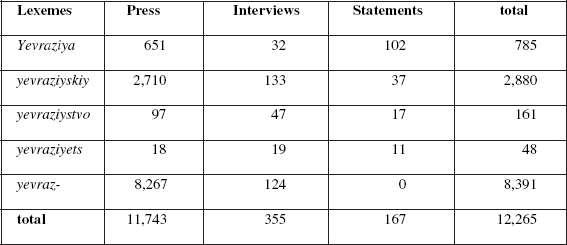
Occurrences of yevraz* (euras*) in the sub-corpuses.
In the course of the first analysis step the occurrences are broken down by the following criteria: a) onymic use in the narrow sense, b) onymic use in the broad sense and c) appellative use. This infers that these go back to a) a proper name (place name) designating the largest continuous landmass; b) conferment of the name to other name classes such as names of companies, political institutions etc. (ergonyms), product names (pragmatonyms) or event names (eventonyms); or to c) a common noun (appellative). The hypotheses underlying this breakdown is that these three groups are subject to different usage conditions within economic discourse.
The onymic occurrences for Eurasia amount to a total of 5.5% of all occurrences. Regarding the onymic usage in a narrow sense it could be expected that this is a reference to the geographical dimension of the Eurasia concept in the meaning of the super-continent. This is however only in particular situations the case. Indeed Eurasia appears to be broken down by natural dimensions (at decreasing frequency: Northern, Central, Eastern, Greater and Southern Eurasia) however closer examination of the occurrences shows that only Greater Eurasia can be definitely allocated to the geographical concept dimension. The use of a special determination Greater indicates that the geographical concept dimension in the language usage of the economic discourse has to be particularly emphasized. It is also characteristic that occurrences of Western Eurasia cannot be found in the corpus while a search using the popular Internet search engines also delivers sufficient evidence of the occurrence of this form. The occurrences understand Central Eurasia as Russia, Eastern Eurasia as Siberia and the Russian Far East. All these ostensible breakdowns by natural dimensions are most probably the result of the eastwards movement of the language and culture of Russia to be observed since classical Eurasianism was increasingly lost sight of in the West (Western Europe) (Sériot, 1995, pp. 57–59, 1999). Listings of the type the experience of Eurasia and Kazakhstan additionally indicate that Eurasia and Russia are increasingly perceived to be identical.
In most occurrences Eurasia stands as paraphrase of the ergonym Eurasian Economic Community which clearly belongs to the group of transonyms and thus to the economic concept dimension. In this form the agent usage of Eurasia is quite common. Eurasia can as for instance the lexeme market be seen as an agent fostering and needing something, and also growing.
The economic dimension between trend and pragmatism
The onymic occurrences in a wider sense (transonyms) form the major part with 83.5% of all occurrences of Eurasia. These include names of companies, institutions and parties and in some occasions also names of events. Normally they express a special spatial or political reference. The names can be broken down into four formation types. Some examples will be demonstrated for each of these types:
names containing Eurasia as an unregistered component or as an advertising component: fond “Yevraziya”, OAO Akcionernyy Bank “Yevraziya”, ING Bank (Yevraziya), Miss Yevraziya; names containing Eurasia as a component of compounds and nominal groups following the example of other languages, mostly of the English language: Yevraziya Treyding LTD, Yevrasiya Trans, Yevrasiya-Media-Tsentr, SP Yevraziya TAPO-Disk; names containing Eurasian as a component of onymic syntagmata: Yevraziyskiy media-forum, Yevraziyskoe ekonomicheskoe soobshchestvo, OAO Yevraziyskiy, Yevraziyskaya promyshlennaya assotsiatsiya; names going back to acronyms and short or initial words with the first component “euras”: YevrAzES (Russian abbreviation of Eurasian Economic Community), YevrazRuda, YevrazKholding, YevrazFinans.
The high the number of transonymic occurrences distributes across just a few entities which then in return are even more frequent. This has much to do with the economic power of a few enterprises and also with reference to the realpolitik circumstances which can be understood as a result of Russian endeavours to create a Eurasian economic zone, and receives, with however hardly any success, corresponding attention in the mass-media of the “controlled” Russian democracy.
The remaining names can only be contingently examined regarding their motivation and thus the localization of the corresponding entities. Although semantically transparent and lexically motivated they only became names by giving up their descriptive conditions in referencing. The required verification of some reference to the Eurasia concept was performed for the mission statements. It results only in references to the geographical area of entrepreneurial business activities, does not however allow conclusions regarding other dimensions of the Eurasia concept. The spectrum ranges from companies operating exclusively in Russia such as the YevrazKholding steel and metallurgy group (official English name: Yevraz Group S.A.) through to the German Commerzbank Eurasia (official English name: Commerzbank (Eurasija) SAO) with business activities covering many of the former Soviet republics, up to Xerox Eurasia, servicing since 2004 an area of 22 states which besides CIS states also integrates Baltic and Balkan states, and leaves the option open to respond flexibly to new markets requirements without the need to change the name every time.
From the material investigation it becomes clear that the use of transonymic name usage results in a parallel to the “boom following the collapse of the Soviet Union in the use of the Eurasia term in magazines, research institutes, beneficences, cultural projects etc.” determined by Kaiser, especially in the Anglo-Saxon and American space (Kaiser, 2001, 3). The journal Soviet Studies, published since 1949, continues as Europe–Asia Studies; the former Center for Slavic and East European Studies at the University of California at Berkeley is now called The Institute of Slavic, East European, and Eurasian Studies. Such usage is principally not to be seen any differently in the Russian language region. The majority of names with the Eurasia(n) component are held by economic entities with no profile in the sense of the philosophical dimension of the Eurasia concept at all. They refer to the Russian resp. former Soviet region in the most varied configurations. They are the result of a paradigmatic shift away from a Soviet, through a CIS localization, and finally to a localization around other post-Soviet communities up to increasingly pure Russian localization, which with Eurasia seems to be more linguistically economical and simultaneously more efficient in advertising and moreover creates the opportunity to promotionally-effectively interact with the vagueness of the geographical concept of Eurasia. From an efficient advertising image, such as Sport-Bar Eurasia, it is only a short step to a naming trend; just as the lexeme Eurasia has become a trendy word in the mass-media not always reflecting its connotation.
The appellative occurrences form 11% of all occurrences of Eurasia in the corpus and primarily comprise the occurrences of Eurasian as a component of nominal groups followed by the lexemes yevraziystvo and yevraziyets. A collocation analysis was performed for Eurasian resulting in typical connections with nouns consisting of one to two words trailing the adjective, such as yevraziyskiy kontinent, yevraziyskiy region, yevraziyskaya tsivilizatsiya, yevraziyskaya tektonicheskaya plita, yevraziyskaya integratsiya, yevraziyskoe dvizheniye, yevraziyskiy transportnyy koridor. The occurrences allow the conclusion that the geographical concept dimension stands in the foreground whereas the occurrences with kontinent (continent) and plita (plate) more clearly refer to such than the occurrences with region (area) and transportnyy koridor (transport corridor). With the exception of tsivilizatsiya (civilization), integratsiya (integration) and dvizheniye (movement) the political and philosophical dimensions of the Eurasia concept are hardly addressed. Only few occurrences of the lexemes Eurasianism and Eurasian can be allocated to the philosophical concept dimension, mostly as statements on neo-Eurasianism documents or in other meta and inter-discoursive contexts.
For the economic discourse the occurrences confirm the statement by Kozhinov (2002, 194) that apart from the partial restriction as Eurasian Economic Community Eurasia in the narrow sense as Russia has been increasingly used in public discourse over recent years. Thereby must be added that this Russia–Eurasia unifies virtually all of the conceptual dimensions, whereas one dimension is only more apparent than the others in each respective case. In this context Eurasia in the narrow sense of the word is largely freely configurable – geographically, ethnically, culturally and politically. Its conceptual core is definitely Russia; its peripheral layers can vary depending on the vested interests or – as is the rule – get lost in the darkness of the implicit. Thus the corpus contains examples allocating Turkey, Bulgaria and even Mongolia to Eurasia; in the narrowest sense only the individual nations of Russia with their European resp. Asian roots and varying religious beliefs.
Eurasia and Europe
The free configurability of ‘Eurasia’ leads to the conclusion that the effects of the Eurasia discourse in Russia on international economic collaboration, in particular trade prospects between Russia and European partners, can be assessed as rather low. A concordance analysis of Eurasia and its derivates by specifying Europe and the West and their derivates as context words was performed to support this statement. The frequency of the lexeme Dugin was also determined. The aim was thereby to validate a) how strongly interconnected the Eurasia discourse is with the discourse on Europe and the West; and b) how strongly represented is Dugin as the leading representative of neo-Eurasianism in economic discourse and what potential effects have his ideas on this discourse.
It turns out that the merely 354 occurrences of the lexemes Europe and West in the corpus allow conclusion of rather low relevance for the Eurasia discourse; especially since just 34 occurrences appear within the same syntagma, whereas 226 occurrences occur in paragraphs other than those containing the Eurasia lexeme. A complementary qualitative analysis of persuasive strategies demonstrates that – despite EU expansion by a number of states from the sphere of influence of the Soviet Union – the concept “Eurasia” stands in no relation with the concepts “Europe” and “West”. The missing evidence of Western Eurasia additionally support this conclusion. The just 27 occurrences of the lexeme Dugin in the corpus, 20 of them appearing in the sub-corpus “interviews”, demonstrate that the philosophical concept dimension tightly linked to his person has little place in economic contexts. ‘Eurasia’ and ‘Europe’ are then economically unconnected neighbouring concepts and it is quite appropriate to speak of independent regions in terms of MNE marketing. Both are used in various discoursive contexts and demonstrate that there are political, economic and cultural activities in Russia directed both at Europe and any configuration of the Eurasian area. These flow into the Russian identity constructs however do not create a homogenous space in terms of creating MNE regionalisation strategies and do not compulsorily require such.
Results
With ‘Eurasia’ having blurred borders with concentric inner and outer layers as a multi-layer, cultural key-concept in all its dimensions and with a fixed core of Russia, the vertices of regional marketing – such as MNE regional strategies, product diversification and geographic scope (of international operations) (Elango, 2004, pp. 432–434) – are only peripherally affected by the present investigation. Presently, the ‘Eurasia’ concept is a construction with dimensions solely generated from a Russian perspective, which however can be strategically filled out by international marketing. The analysis leads to the preliminary conclusion that for the regional MNE strategies, the geographical, political and philosophical dimensions of the ‘Eurasia’ concept have no – and the economic dimension minimal – significance. As a region, the Eurasian area is comprised from a Russian viewpoint most likely of Russia itself and the Slavic language and/or central Asian successor states of the Soviet Union.
The question whether the Eurasian area can be of particular relevance for MNE regional marketing as a relatively homogenous geographic and cultural entity can be answered with linguistic, cultural science instruments only as far as opportunities for “Eurasia marketing” arise through the virtually free configurability of ‘Eurasia’ with the fixed core of Russia. The relevance of the ‘Eurasia’ concept for regional marketing activities is also based on the realpolitik backgrounds which can be seen in the compensation through spatial constructs of the lost world power position of Russia. Precisely the cultural and geographic commonalities underlying the ‘Eurasia’ concept deserve closer consideration of this, so strongly structured and simultaneously yet homogenous region between Moscow and Vladivostok, between Arkhangel'sk and Almaty which as such clearly differentiates and delineates from Europe.
Conclusions
The investigation would not be complete, if no indication was simultaneously made to the limits of linguistics and cultural studies in the processing of a business management topic. It results in the question of relevance of the Eurasian area for regional MNE marketing concept being neither fully nor conclusively answerable. Particularly painful thereby is that the conceptualisation of ‘Eurasia’ from the perspective of economic discourse in Russia cannot be synchronized with the conceptualisation from the viewpoint of other entities in the central Asian area. With the survey focussing on this Eurasia discourse acting from its position of power, other discourses and economic and political circumstances fall into the background.
It remains for future investigations to interdisciplinarily network the individual results of current research into a coherent and workable model for MNE marketing in the sense of a regional concept of Eurasia. The surveys by Jelen (2001) and Evers and Kaiser (2004) allow recognition that the interaction between globalization and fragmentation in the Russian–Central Asian area creates an integration pressure comprising all states in their entirety – which equally affects the economic and political elites of these states both externally and internally and across the social strata. The political borders in the Russia–China–Near East triangle today already have a completely different significance than 10–15 years ago. Informal integration processes such as new forms of goods exchange (Evers & Kaiser, 2004, pp. 40–53) convey trans-local and trans-national identities and anticipate a formal regional integration along the Silk Road. The existing active integration “from the bottom up” should make a regional Eurasia MNE marketing concept not only possible but indeed necessary whereby Eurasia in terms of the objective survey can be flexibly attached to particular political borders and entities.