






Abstract
Why do some countries undergo regime changes despite legitimacy crises, while in others de-legitimation dramatically challenges democratic and non-democratic regimes? Post-Communist transformation in Russia can be viewed as a “natural experiment” in legitimacy's changing role during regime change. The de-legitimation of the Soviet political regime greatly contributed to the overthrow of Communist rule. However, although the post-Communism system had multiple troubles which led to the newly-emerged regime's lack of legitimacy, this has not caused major anti-system protests. Still, the legitimacy of Russia's current regime is not deeply rooted among the masses, and is based upon specific rather than diffuse support for the status quo. The article reconsider the analysis of the role of post-Soviet legitimacy (or lack thereof) in the process of regime changes through the prism of the “resigned acceptance” model within Hirschman's framework of “exit, voice, and loyalty”. The author will focus on the dynamics of public opinion and political behavior in the 1990s–2000s and analyze the impact of the “legacy of the past,” regime performance, and political elites and institutions in strengthening and/or challenging the existing status quo in Russian politics.
Why do some countries undergo major regime changes despite legitimacy crises, while in others de-legitimation dramatically challenges states and regimes, if not the very existence of these polities? Conventional scholarly wisdom holds that political legitimacy is a necessary condition for political order and successful performance in any given nation. In many instances, legitimacy crises have caused or triggered the breakdown of both democratic and authoritarian regimes. 1 However, some states and regimes have survived or transformed themselves even against the background of severe legitimacy crises, lack of public confidence in basic political and social institutions, and deep mistrust between citizens and the state. These “success stories”, even though they are relatively rare in the contemporary world, became possible under certain conditions which deserve further exploration.
See Linz (1978), Huntington (1991).
In this respect, the post-Communist transformation in Russia could be viewed as a “natural experiment” in the changing role of legitimacy and de-legitimation during regime change. The Soviet experience was unique in the world history given the magnitude of hardships and repressions that Russian people faced, especially under Stalin. No wonder that the Soviet Union, especially in 1970–1980s faced with de-legitimation of its political regime, which greatly contributed to the overthrow of Communist rule and the break-up of the Soviet state itself. However, although the post-Communist system had multiple troubles which deprived Russia's newly-emerged regime of legitimacy, this has not caused major anti-system protests. Despite evidence of public discontent and steady support of the Communist past among Russia's citizens, 2 it was elite reconfiguration which caused the trajectory of post-Communist regime change in Russia, while the role of mass support (or lack thereof) was secondary at the best. At the level of political demand, Russia's citizens have more or less passively adapted to political and economic changes rather than resisting them. At the supply level, the lack of viable alternatives to the status quo diminished political opportunities for protests. In the end, successful economic performance and the consolidation of the state in the 2000s have increased popular support for Russia's political regime and might lead to the rise of its legitimacy, although it is not deeply rooted among the masses and is based upon specific rather than diffuse support for the status quo. In short, over the last twenty years Russia moved from one (consolidated but illegitimate) authoritarian regime to another (not yet fully consolidated and not yet legitimate) despite legitimacy crises. But why and how was it possible? What lessons should be learned from Russia's late-Soviet and post-Communist experience? And can we expect Russia's new political regime to gain legitimacy over the long haul?
See Rose, Mishler, and Munro (2006).
This article seeks to reconsider the role of legitimacy crises during regime change, analyzing Russia's recent experience as a case study. First, I shall develop a framework of analysis based upon Hirschman's well-known “exit, voice, and loyalty” typology of reactions to crises. Then, I shall focus on the constellation of factors which contributed to the preference for “exit” rather than “voice” in post-Communist Russian politics. In particular, I will examine the impact of the Soviet legacy, the role of political elites and institutions, and changing perceptions of regime performance in strengthening and/or challenging the status quo in Russian politics. The dynamics of public opinion and political behavior in Russia in the 1990s–2000s will be analyzed through the prism of the “resigned acceptance” model, 3 which argues that the popular support for Russia's current political regime is based upon the rejection of alternatives to the status quo. Finally, I will discuss the possible challenges of dis-equilibration and their political consequences as well as the implications of Russia's experience.
See Rose, Mishler, and Munro (2006).
If legitimacy is “the capacity of the system to engender and maintain the belief that the existing political institutions are most appropriate ones for the society”, 4 then its necessity to the survival of a political regime is clearly important. If one compared the survival of political regimes with the survival of firms on the markets, regime legitimacy might be regarded as the functional equivalent of two basic practices of economic agents: investments and risk insurance. On the one hand, a regime's legitimacy is similar to a firm's capital stock and might be viewed as a basis for investment in a regime's effectiveness, which could bring the regime long-term capital gains due to the positive feedback between legitimacy and effectiveness. 5 On the other hand, a regime's legitimacy is also similar to risk insurance, which could provide regimes with at least some guarantees against bankruptcy even if they perform poorly in the eyes of their citizens. Regime legitimacy (both democratic and non-democratic) brings risk insurance if citizens support the “existing political institutions” (i.e., the status quo) not only because the regime is effective, but also because they trust in its institutions. The natures of these two functions of legitimacy are rather different, as David Easton pointed out in his analysis of the distinctions between “specific” and “diffuse” types of political support. 6 Still, they are closely linked and mutually reinforce each other: while specific support is sensitive to popular perceptions of regime performance, diffuse support operates irrespectively of it. Regimes (or, rather, governments) could invest both their diffuse and specific support into increase of their performance, but only diffuse support will bring risk insurance. Well-established democratic regimes tend to rely upon both types of political support, but the legitimacy of authoritarian regimes rests only on their specific support. However, during the process of regime change the emergence (or non-emergence) of political support for a regime is a more complex phenomenon, and building legitimacy in newly-emerged regimes (whether democratic or not) depends upon a constellation of factors. They include not only mass values and attitudes (mostly inherited from the past) but also popular perceptions of both the current and previous regime's performance, and the viability of alternatives to the status quo regime. In other words, while citizens choose whether or not the new regime deserves their legitimate support, governments have to preserve the new regime by investing either in the regime's performance (as Western Germany did after World War II) or (especially if they are unable to achieve success on this front) in diminishing the alternatives.
See (Lipset, 1960, p. 64).
See Lipset (1960), Linz (1978, pp.18–21), Beetham (1991).
See Easton (1975).
Certainly, not many newly-emerged regimes can successfully build their legitimacy from scratch, and some well-established regimes face losing their legitimacy for various reasons. But the popular reaction to a regime's loss of legitimacy depends not only upon (1) citizens’ support for the status quo regime (be it specific or diffuse), but also upon (2) popular support for alternatives to the status quo. Juan J. Linz captured the relative nature of legitimacy vis-à-vis its alternatives by defining legitimacy as “the belief that in spite of shortcomings and failures, the existing political institutions are better than any others that might be established and that they therefore can demand obedience” 7 (italics mine – V.G.). From this perspective, even if a regime lacks legitimacy, citizens will shift their preferences only if the alternatives are more attractive. Ceteris paribus, they will be ready to protest against the not-so-legitimate status quo regime. Otherwise, there is little chance that citizens will challenge even a status quo regime with little popular support. In this case, the status quo regime will survive simply by default, due to the “resigned acceptance” of its citizens. 8 Also, if the alternative to the status quo regime is attractive but the popular support for the existing regime is high enough, citizens will be unlikely to challenge the status quo, unless the gains from a regime change would outweigh the benefits of the status quo. In this case, a deficit of legitimacy 9 means that a regime's legitimacy is rather shaky and questionable. Following Linz, 10 who drew parallels between the concept of legitimacy and the theory of “loyalty”, 11 I label these two types of popular reactions to a political regime's lack of legitimacy in Hirschman's terms as “voice” and “exit”, respectively. Thus, instead of a linear understanding of legitimacy, which is based upon a continuum – from fully-fledged legitimacy (i.e., equilibrium of regime support) through its de-legitimization to illegitimacy (i.e., dis-equilibration due to the lack of regime support), 12 I propose the following 2 × 2 matrix, which better covers the range of citizens’ possible reactions to political regimes (Table 1):
See Linz (1978, p.18).
See Rose, Mishler, and Munro (2006).
See Beetham (1991, pp. 18–20).
See Linz (1978, pp. 54–55).
See Hirschman (1970).
See Beetham (1991, p. 35).
Popular support and possible reactions of citizens to political regimes.

Contrary to the equilibrium of “loyalty”, the upper right and lower left cells of the matrix represent partial equilibrium outcomes. The erosion of confidence and trust in well-established regimes might produce unstable loyalty 13 and poses a potential challenge to them because of troubles with risk insurance and investments. And the “exit”, or “resigned acceptance” outcome, in its turn, might result from the newly-emerged regime's failure to gain legitimacy. Such an outcome does not exclude the possibility that the regime will invest, but it makes their risk insurance very problematic. However, if the regime's economic, social, and international environments remain stable, the trap of “resigned acceptance” could last a long time.
See Dogan (1997).
Why do individuals, groups, or nations prefer “exit” rather than “voice” in different settings? Analysts have focused on institutional incentives for political activism and passivity as well as on the role of social networks and organizations, which are usually rooted in the legacy of the previous regime. Those dynamics increasing the likelihood of the “voice” option include previous experience of contentious politics, the existence of networks and organizations which are instrumental in resolving collective action problems, long-term rivalry amongst political elites and their use of mass mobilization as a tool in this struggle, and a particular constellation of political institutions. These dynamics encourage selection of the “voice” option by lowering the threshold for anti-regime protests if the regime lacks legitimacy. However, if the cost of “exit” for individuals, groups, or nations is much lower than the cost of “voice”, they would prefer the former option. At the same time, the ruling elites can encourage “exit” and/or discourage “voice” with strategic action, diminishing the potential for de-legitimation even if loyalty to the status quo regime is low. As one can see, the experience of post-Communist Russia has demonstrated the impact of these factors on citizens’ “resigned acceptance” of the political regime and its continuity over fifteen years.
During the Russian “triple transition” of the 1990s, some observers expected the simultaneous troubles with regime change, economic reforms and state- and nation-building to cause severe popular discontent and to result in regime illegitimacy, if not its overthrow. 14 In fact, the picture was more complicated. While survey data show deep popular mistrust and a lack of confidence in the post-Communist regime, government, and its policies, 15 citizens’ actual political behavior was far from “voice”. During the 1996 presidential elections Russians preferred the incumbent president, Boris Yeltsin, to his rival, Communist leader Gennady Zyuganov, 16 while various protest activities attracted limited mass participation. In the 1990s, according to VTsIOM survey data, not more than 3% of Russians ever took part in protest actions, some of which were sponsored by local officials or enterprise managers. 17 In the 2000s, despite the steep rise in President Vladimir Putin's popularity, 18 trust in public institutions in Russia has remained among the lowest in the world. 19 Still, despite the lack of legitimacy of both previous and new regimes, very few Russian citizens participated in any anti-regime activities.
See Offe (1991).
See Melville (1998), Levada (2000), Sil and Chen (2004).
See McFaul (2001, pp. 289–304).
See Levada (2000, p. 496).
See Rose and Munro (2002), Rose, Mishler and Munro (2006).
See Shlapentokh (2004).
How we can explain this passivity and lack of disobedience despite Russia's legitimacy crises? Some scholars refer to peculiarities in Russia's political culture stemming from its entire history and unique traditions. 20 However, I prefer to concentrate on a more narrow understanding of influence of the “legacy of the past”, examining its immediate incentives to certain patterns of political behavior. In this sense, Russia's Soviet “legacy” had a very difficult impact on regime's legitimacy due to its use of repressive practices and unsuccessful performance. No wonder that Soviet citizens became more and more critical toward the Soviet regime and its major institutions, which lacked both diffuse and specific support. At least, by 1980s Russians largely denied Soviet regime's legitimacy although sought no viable alternatives to the status quo. 21 The “Soviet legacy” was also hardly conducive to “voice.” First, the relative social homogeneity and egalitarianism of the Soviet period offered few bases for societal cleavages to form and act subsequently as a mobilizing factor, so they had a marginal influence on post-Soviet politics in Russia. Second, the Soviet regime prevented organized dissent from spreading: at least, anti-Communist dissidents in Russia played almost no role in Russian post-Soviet politics in terms of leadership and organizations. Third, although state-centered organized activism in Russia (including the Communist party) was instrumental in terms of selective incentives for personal promotion, 22 it provided little collective incentives in terms of identity formation. The organizational legacy of major Soviet-type organizations (Communist party, trade unions, etc.) was poorly utilized by their successors, and barely used as a tool of mobilization in the post-Soviet period. Fourth, the Soviet period's alternative to top-down state-centered activism, or the bottom-up inter-personal social networks of the Soviet period, serves as a survival kit for many Russians by providing them with access to an “economy of favors”. 23 These networks were instrumental in the post-Soviet period, involving people in various informal activities. To summarize: the legacy of the Soviet period ruined regime legitimacy and discouraged institutional trust while left little room for “voice” due to the low potential for anti-regime mass mobilization, but it did encourage a variety of “exit” strategies. Thus, upon the regime's liberalization and beginning of market reforms in early 1990s, Russian citizens preferred “exit” in various forms (including domestic migration and emigration), not getting very involved in anti-regime activities. In a similar vein, through the lenses of the “legacy of the past” scholars explained the sluggishness of the labor movement during market reforms in Eastern Europe as compared to Latin America. 24
See Keenan (1986).
See Bahry (1993).
See Di Franceisco and Gitelman (1984).
See Ledeneva (1998).
See Greshkovits (1998).
In the 1990s, the elite structure and institutional arrangements in Russia prevented popular discontent from turning into political protest. Although in August 1991 and October 1993 fierce struggles amongst confronting elite factions caused (a fairly limited) mass involvement, soon after this the elite fragmented into several competing cliques at the national and regional levels, weakening the potential for mass mobilization by political elites. The proliferation of so many competing parties caused oppositions of various colors to fragment (Communists, nationalists, and liberals). 25 These parties had little ground to cooperate on a “negative consensus” basis and in many ways often preferred “exit” rather than “voice” themselves. 26 In addition, Russian voters’ weak party affiliation 27 and the asymmetry of powers between president, parliament, and regional governments, as well as election schedules, posed limits to electoral protest; voter preferences were unstable over time and divided among various actors. 28 Moreover, in the eyes of general public, the targets of blame were divided: between federal and regional governments, between president and parliament, etc. Such a divided attribution of blame also discouraged various political entrepreneurs from mobilizing against the regime. 29 The beginning of Vladimir Putin's presidency in 2000 was a tipping point. On the supply side of Russian politics, Putin was able to consolidate Russia's elites through an “imposed consensus” 30 and establish firm control over regional elites, political parties, media, NGO's, etc. Shrinking the structure of political opportunity led to the “extinction” of political opposition, 31 thus eliminating the possibility of anti-regime mobilization. On the demand side, positive changes in the popular perception of political leadership were based on successful economic performance. 32 The tremendous increase in specific support for the regime not only lowered the potential for protest but also stabilized the “resigned acceptance” of the status quo regime; even though Russians remained critical of the current regime and distrusted its institutions, their incentives to challenge it remained much lower than in the “roaring nineties”. 33
See Rose (2000), Colton and McFaul (2003).
See Gel'man (2005).
See White, Rose, and McAllister (1997), Colton (2000), McFaul (2001).
See Colton (2000), Colton and McFaul (2003).
See Javeline (2003).
See Gel'man (2003).
See Gel'man (2005).
See Mishler and Willerton (2003).
See Rose, Mishler and Munro (2006).
Finally, post-Soviet Russia's rulers used their resources for diminishing (if not eliminating) possible alternatives to the status quo regime very effectively. As Andrew Wilson argues in his detailed account of post-Soviet “virtual politics”, the constellation of a powerful but amoral elite, passive electorate, control over information flows and the lack of foreign influence provide fertile grounds for manipulative political practices to predominate in Russia and other post-Soviet states. 34 While some authors refer to these practices as “managed” 35 or “faking” 36 democracy, they led to the distortion of political competition and to a dramatic shift in popular preferences, which were successfully converted into manufactured political outcomes. The 1996 presidential elections in Russia served as a case in this point: due to the incumbent campaign's overwhelming one-sided dominance of the media, 37 Yeltsin's spin doctors easily discredited all his challengers without major resistance. In particular, in campaigning against Zyuganov the “negative legitimacy” 38 of the previous Soviet regime was exploited so successfully that voters chose to support for Yeltsin as the “lesser evil”, even though popular evaluations of the regime's performance were low. 39 Similarly, in 1999 Yeltsin's transfer of presidential power to his successor, Vladimir Putin, was orchestrated by bomb explosions in Moscow and other Russian cities. Critics suspected that the security services had organized the whole series of explosions, but the media and politicians (who blamed Chechen rebels) strongly influenced public opinion. In the eyes of Russians, Putin – who had demonstrated a decisive and tough intention to punish terrorists, and had even claimed in an interview that he would “murder them in the toilet” – received all the credit. This episode was instrumental in his sudden rise to power. 40 Under Putin, the overall decline of the independent media and the “imposed” consolidation of elites opened plenty of opportunities for biased and one-sided information campaigning, and for major revision – if not perversion – of public opinion and mass attitudes. In particular, the elites’ politics of identity was based on constructing a negative image of the Western democracies and playing the “wild card” of Russian ethno-nationalism. 41 The ruling elites’ search for a “usable past” in Russian history led them to consciously develop a positive image of the Soviet epoch and especially of Stalin's policies among Russia's youth. 42 This was a sharp contrast with the early 1990s, when some surveys showed that the political attitudes of Russian citizens were close to their Western counterparts and that Western-style democracy considered as the most attractive political regime. 43 Given the weakness of societal cleavages and the distorted party competition in Russia, the great impact of the information factor on popular perceptions and political behavior 44 left much room for various manipulations by the elite, oriented at legitimizing the status quo regime by de-legitimizing any alternatives to it.
See Andrew Wilson (2005, p. 41).
See Colton and McFaul, (2003).
See Wilson (2005).
See White, Rose, and McAllister (1997, pp.251–252), McFaul (2001, pp.300–304).
See Huntington, (1991, p. 50).
See White, Rose, and McAllister (1997), Colton (2000), Levada (2000), Sil and Chen (2004).
See Colton and McFaul (2003), Wilson (2005).
See Levada (2006).
See Mendelson and Gerber (2007).
See Hahn (1991).
See Colton (2000), McFaul (2001), Rose and Munro (2002), Colton and McFaul (2003).
All three factors – (1) the “legacy of the Soviet past”, (2) the role of elite structure and institutional arrangements, and (3) the impact of information control on popular perceptions – were interrelated and mutually reinforced each other. Alongside the changing socio-economic environment, they greatly contributed to the phenomenon of the pendulum-like swing of authoritarian regimes in Russia despite legitimacy crises. They deeply affected both public opinion and political behavior.
As Rudra Sil and Cheng Chen correctly pointed out, both the Soviet and post-Soviet state in Russia have experienced problems with legitimacy not only because of the regimes’ poor quality as such (be they democratic or not), but from their poor infrastructural capacities as a provider of public goods. According to their careful analysis of different surveys in Russia, “… much more significant are substantive expectations that a state, democratic or not, ought to be able to do a better job in providing such valued public goods as social order, economic stability, guaranteed welfare and a greater measure of distributive justice”. 45 In fact, neither the Soviet nor post-Soviet state met the expectations of Russia's citizens satisfactorily, and this failure led to severe legitimacy crises for the regimes.
See Sil and Chen (2004, pp. 348–349).
After Stalin's death, (when mass repressions and terror were no longer used as major tools of political control) the Soviet regime was faced with the typical “dilemma of performance” outlined by Samuel Huntington: “because their legitimacy was based on performance criteria, authoritarian regimes lost legitimacy if they did not perform and also lost it if they did perform.” 46 The achievements of Soviet modernization, such as industrialization, urbanization, upward mobility and the spread of higher education led to the emergence of the Soviet equivalent of an urban middle-class This class began to challenge the legitimacy of the Soviet system over time due to its rising expectations and the decline of economic performance in 1970–1980s. 47 Still, the popular dissatisfaction and low trust in the Soviet regime were not crucial for the survival of the status quo before Gorbachev's reforms due to the lack of available alternatives. However, the proclamation of political liberalization in the late 1980s had a subversive effect; not only did democratic regimes appear as the most attractive alternative to the Soviet status quo 48 but also many Russians (first and foremost, educated urban residents) supported completely demolishing the (already illegitimate) Soviet system, likewise supporting the subsequent collapse of the state and its regime in 1991. 49 Furthermore, the broad mass support for political and economic reforms in the early 1990s 50 indicated the Soviet system's illegitimacy 51 rather than a manifestation of legitimacy of newly-emerging post-Soviet regime. 52
See Huntington (1991, p. 55).
See Bahry (1993), Melville (1998).
See Hahn (1991) Miller, Hesli, and Reisinger (1994).
See McFaul, (2001).
See Miller, Hesli, and Reisinger (1994).
See Melville (1998, p.157).
See Rose, Mishler and Munro (2006).
Russian citizens’ early hopes that regime change would be the key to building prosperity 53 and a new legitimacy soon turned into illusions against the dramatic decline in Russian state capacity over the 1990s. The new regime's legitimacy became problematic not only because of economic hardship, but also because of the lack of the law and order and a great deal of inequality and instability. According to survey data, many Russians demanded that these issues be resolved, 54 but the weak Russian state was unable to do so. 55 To put it bluntly, Russia's post-Soviet regime was unable to gain the new legitimacy without building its specific support. By 1998, even the Soviet regime, so heavily discredited in Russian eyes in the early 1990s, got comparatively more positive assessments than the post-Soviet one (see Table 2).
See Miller, Hesli, and Reisinger (1994), Melville (1998).
See Levada (2000), Rose and Munro (2002), Colton and McFaul (2003).
See Bova (1999).
Mass evaluations of Soviet and post-Soviet regimes in Russia, 1998. a
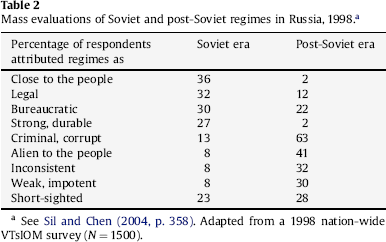
See Sil and Chen (2004, p. 358). Adapted from a 1998 nation-wide VTsIOM survey (N = 1500).
However, the (previously illegitimate) Soviet regime as a possible alternative to the status quo, in the manner of “back to the USSR,” was also unacceptable to most Russians. According to the New Russian Barometer survey data, 56 in the 1990s–2000s not more than 36% of Russians approved of restoring the Communist system, and more than 60% disapproved of it 57 while other alternatives to the status quo (such as military rule) were even less attractive. Andrei Melville best captured the inconsistency of public preferences – negative assessments of the status quo regime and the low attractiveness of other alternatives – by noting that Russians would like to combine “the best of two worlds:” the social guarantees of the Soviet system with the personal freedoms of Western democracies. 58 However, they were not ready to bear the full costs of either of these regimes. The fragmentation of alternatives on the supply side of the political system 59 as well as the multiplicity of citizens’ identities on the side of popular demands also endorsed the status quo regime, despite legitimacy crises. In sum, the combination of mixed public preferences and the lack of viable alternatives to the status quo provided fertile grounds for resigned acceptance; the political developments of 2000s reinforced these trends.
The project is conducted by the Center for the Study of Public Policy (UK) and VTsIOM (since 2004 – Levada-Center), Russia's reputable survey research firm. For details, see Rose, Mishler and Munro (2006, pp. 70–75), for some data, see www.russiavotes.org (access 14 December 2008).
See Rose, Mishler and Munro (2006, pp. 94–99).
See Melville (1998, p. 156).
See Rose (2000), Gel'man (2005).
Against the background of Russia's oil-induced economic growth of 2000s, the efforts of Vladimir Putin's government to strengthen both the coercive and infrastructural capacity of the Russian state were welcomed by most Russians, despite the regime's many anti-democratic moves such as limiting media freedom and the like. 60 According to the New Russian Barometer survey data 61 the period of 2001 serves as a tipping point: since then, in the eyes of Russian citizens, positive assessments of Russia's current regime have steadily prevailed over negative ones (Table 3).
See Sil and Chen, (2004).
See Rose, Mishler and Munro, (2006, p. 90).
Approval of the current regime in Russia, 1992–2005. a
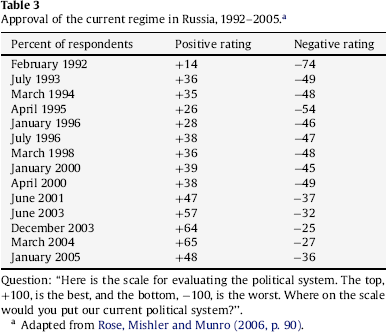
Question: “Here is the scale for evaluating the political system. The top, +100, is the best, and the bottom, −100, is the worst. Where on the scale would you put our current political system?”.
Adapted from Rose, Mishler and Munro (2006, p. 90).
Election results in Russia, 1993–2004. a
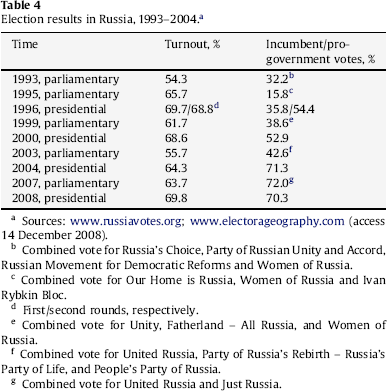
Sources: www.russiavotes.org; www.electorageography.com (access 14 December 2008).
Combined vote for Russia's Choice, Party of Russian Unity and Accord, Russian Movement for Democratic Reforms and Women of Russia.
Combined vote for Our Home is Russia, Women of Russia and Ivan Rybkin Bloc.
First/second rounds, respectively.
Combined vote for Unity, Fatherland – All Russia, and Women of Russia.
Combined vote for United Russia, Party of Russia's Rebirth – Russia's Party of Life, and People's Party of Russia.
Combined vote for United Russia and Just Russia.
Pro-government parties in the Russian parliament–State Duma (450 seats) a
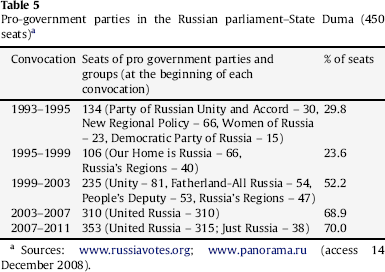
Sources: www.russiavotes.org; www.panorama.ru (access 14 December 2008).
The trend of growing support for the current regime among Russians in 2000s reflected the general positive evaluation of its performance due to improvements in the living conditions of large segments of the population: many Russian citizens have enjoyed benefits of the market economy due to the rise of real wages and consuming boom. Not only did international observers view Russia as a “normal country”, 62 but Russia's government also fulfilled some basic popular demands 63 so new regime's specific support in 2000s steadily increased over time. 64 This feeling of “normality” is, to a great extent, based upon the elite-led, top-down imposition of the “good Soviet Union” model. This consists of partially restoring the Soviet style of government – without Communist rule and a shortage of goods – with more personal freedoms and a rise in middle-class well-being, a model close to the ideals of many Russian citizens. 65 However, a close analysis of these trends in the light of trust in, support for and the legitimacy of the regime revealed a more nuanced picture.
See Shleifer and Treisman (2004).
See Sil and Chen (2004).
See Rose, Mishler and Munro (2006).
See Melville (1998), Levada (2000), Rose, Mishler, and Munro (2006).
As various survey data have demonstrated, popular support for the status quo regime in Russia is heavily based on Russian citizens’ personal trust in their president Vladimir Putin (and, since 2008, in his successor Dmitrii Medvedev), rather than on trust in the government and its institutions. According to VTsIOM/Levada Center surveys, from 2000 to 2006 Putin's approval rating fluctuated between 61% and 84%, while similar figures for the Russian government ranged from 25% to 46% (in April 2006–72% and 30%, respectively), leaving an average confidence gap of about 40%. 66 This confidence gap reflected many Russians’ dissatisfaction with the government's actual functioning. For instance, despite urgent demands for “law and order” among Russia's citizens, 67 an absolute majority of them expressed deep distrust in courts, police, and other law enforcement agencies, 68 though this was mainly due to widespread stereotypes, not due to personal experience of corruption. 69 No wonder that despite the generally positive assessments of current trends in political developments in 2000s, in 2003–2004 more than half of VTsIOM/Levada Center survey respondents considered the country's political situation to be “tense”. However, even the lack of institutional trust has not caused the regime to be perceived as illegitimate against the background of its relatively high specific support. As William Mishler and Richard Rose noted, “although trust in political institutions encourages citizen involvement in politics… it does not influence support for the current regime or for plausible… alternatives” See Mishler and Rose (2005, p. 1069). In other words, the combination of relatively positive assessments of the current regime and low trust in its institutions has preserved the trap of “resigned acceptance” in Russia during the 2000s.
See Rose, Mishler and Munro (2006, pp. 140–141).
See Rose and Munro (2002), Colton and McFaul (2003), Sil and Chen (2004).
See Shlapentokh (2004), Rose, Mishler and Munro (2006, p. 139).
See Levada (2006, pp. 233–247).
The dynamics of Russian political behavior have also demonstrated a persistent pattern of resigned acceptance over time. After 1996, when Boris Yeltsin was dramatically elected to his second term in office, 70 incumbents and/or their parties have never lost national presidential and parliamentary elections. Since 1999 onward, they have overwhelmingly dominated the State Duma, the lower chamber of the legislature, while by mid-2000s the weak, impotent, and internally divided opposition was about to extinct. 71 Moreover, the principles of competitive politics in Russia are questioned by its citizens. According to Public Opinion Foundation (FOM) 2006 survey (N = 1500), 47% of Russians denied the very idea of the party competition. 72 In 2004 and 2008, incumbent president, Vladimir Putin and his successor, Dmitrii Medvedev, got 71.3 and 70.3% of votes, respectively, while the dominant party, United Russia, established a super-majority in the legislature to hold up to 315 out of 450 seats (see Tables 4 and 5). One might argue that Russian voters endorsed the status quo regime by pro-incumbent voting. 73 Moreover, given the relative rise of their satisfaction on regime's performance, Russia's voters remained cynically indifferent to issues of electoral fraud and unfairness, despite rather widespread belief that the elections are unfair. According to Levada Center surveys, after the 1999 parliamentary elections 50% of Russians evaluated them as “unfair”, but in 2003 only 38% of respondents supported this statement; by 2007 the number of these respondents decreased to 31% 74 (paradoxically, most observers agreed that 2003 and, particularly, 2007 elections were more unfair than those in 1999). Anyway, on Russia's electoral arena both “loyalty” and “exit” prevailed over “voice.”
See White, Rose, and McAllister (1997), McFaul (2001).
See Gel'man (2005).
For survey data, see http://bd.fom.ru/report/cat/polit/polypar/dd062523 (access 14 December 2008).
See Colton (2000), Rose and Munro (2002), Colton and McFaul (2003).
For 1999, 2003 and 2007 survey data see http://www.levada.ru/press/2004011201.html and http://www.levada.ru/press/2007121702.html, respectively (access 14 December 2008).
Political activism beyond voting reveals a similar pattern: “exit's” prevalence over “voice”. Even though many Russians generally approve of the basic idea of “voice,” they were reluctant to join protest actions, 75 in a manner typical of free-riders. 76 The most striking wave of protests swept across the country in January 2005, in the wake of social benefits reforms which severely affected retired people and other disadvantaged groups. But it did not affect most of Russia's citizens: despite supporting the protest's goals, 77 the silent majority of Russians remained de-mobilized. Authorities were able to localize and contain public discontent rather quickly. A more detail analysis of regional protest patterns even led to a conclusion that the mass protest behavior in post-Soviet Russia was merely a projection of intra-elite struggles. 78
See Levada (2000, pp. 489–507), Rose, Mishler, and Munro (2006, pp. 82–85).
See Olson (1965).
See Levada (2006, pp. 129–39).
See Robertson (2007).
To summarize, the consequences of overcoming legitimacy crises in the 2000s were two-fold. The relative improvement of public assessments of the current regime has not converted to trust in major state institutions, and their effectiveness in the eyes of the population is rather dubious as yet. 79 In this sense, Russian citizens’ resigned acceptance of the status quo regime is still based on the lack of viable alternatives, not on trust in its institutions. The process of re-equilibrating Russia into a “normal country” which demonstrates some patterns of Soviet-style government without Communist rule brought only a partial equilibrium, which did not legitimize the regime in the long run.
See Sil and Chen (2004), Levada (2006).
From a comparative perspective of post-revolutionary stabilization, despite unfavorable historical “legacy” and troubles with legitimacy both before and during regime transition, Russia's experience of post-Communist regime change might be considered to be a “success story”. 80 Russia's rulers were able to prevent anti-regime mobilization in the “time of troubles” of the 1990s and gain some support for the status quo in the 2000s. However, at the moment its success is rather questionable. It is unclear whether the partial equilibrium of “resigned acceptance” is stable and, if not, what possible factors which might cause it to dis-equilibrate: in a sense, the ongoing economic crisis that began in 2008 might be a crucial test for continuity or demise of legitimacy of Russia's regime. Also, the steady popular support for the status quo regime in Russia has coincided with the undermining of such basic democratic institutions as competitive elections, media freedom, and the like. Besides these major reservations, one might assume that overcoming legitimacy crises through “resigned acceptance” of the status quo would be the second choice of any given government, if it could not build legitimacy for the newly-emerged regime from scratch upon the collapse of previous (illegitimate) regime. And should we expect that over time the status quo regime's “resigned acceptance” (be it democratic or non-democratic) will gradually evolve into fully-fledged legitimacy, if this regime demonstrates its long-term effectiveness, leading the possible alternatives to finally become irrelevant?
See Stinchcombe (1999).
Two other implications of the Russian experience are worth further consideration. First, Russia achieved re-equilibration rather quickly because of the shortage of supply caused by Kremlin's reconfiguration of elites by “imposed consensus”, not because of changing popular demands. 81 However, while electoral competition among elites (which is necessary, though not sufficient for democracy) was diminished, this makes the status quo regime vulnerable in terms of gaining legitimacy in the long run. Under these conditions, the above-mentioned “dilemma of performance” became even more serious. On the one hand, if the regime performs successfully, subordinated segments of elites as well as disadvantaged social groups will require redistribution of political power and wealth, and it will be difficult for Russia's rulers to satisfy these demands without meaningful political competition (unless they will resort to repressions). On the other hand, if the regime is unable to bring Russia law, order and justice – i.e., effective state bureaucracy and a relative decline in inequality – alternatives to the status quo regime may become more attractive to Russian citizens. Thus, without successful resolving its “dilemma of performance,” Russia's current regime might provoke replacement of the “exit” strategy by “voice”. Second, the coexistence of popular support for the current regime with the lack of trust in its institutions could have a potentially subversive outcome; like firms, regimes might be successful if they attract investments without risk insurance, but the chances of their bankruptcy are high. The regime lacks risk insurance because of the lack of trust in institutions, which is essential for the development of diffuse support for the regime. Given Russia's present situation, the regime faces a risk of bankruptcy not only from the threat of decline of its performance but also from the breakdown of the “imposed consensus” among Russia's elites, which is based only on personal trust in leaders rather than trust in institutions, similar to mass feelings. 82
See Gel'man (2003).
See Steen (2003, pp. 25–48).
In their turn, Russia's rulers are well aware of these challenges, and their responses are oriented at averting the risks of regime's de-legitimation. These responses include: (1) increasing the possible cost of “voice” and thoroughly eliminating any alternatives to the status quo regime; (2) building new political institutions and organizations, which aim to establish “loyalty” among both elites and ordinary citizens; and (3) attempts to convert popular support from investments into risk insurance for the current regime. As yet, the implementation of these policies led to partial success.
To some extent, institutional engineering has caused the cost of “voice” in Russia to increase: from 1993 to 2003, the threshold of parliamentary representation for political parties was set at 7% instead of 5%, and the organizational requirements to register parties were also toughened (registration can be denied at any given moment). A new law on NGO's brought their activities and funding under firm state control, and media can now be also prosecuted for “incorrect” contents, in the wake of anti-extremism campaigns. Even minor manifestations of opposition movements were brutally attacked by special police forces, in order to prevent them from spreading across the country. To a certain degree, these pressures served as pre-emptive measures against potential anti-regime activities or as a counter-offensive reaction by Russian authorities to the wave of “color revolutions” in Georgia, Ukraine, and Kyrgyzstan in 2003–2005.
Building new political institutions and organizations – such as the dominant party, United Russia, or loyal pro-regime NGO's – play a dual role in the regime's strategy. In the short run, potential challengers to the status quo regime were not wiped off the political and social arena, but rather co-opted, contained and even promoted in exchange for their loyalty. This was especially important for Russia's youngsters: as of yet, the regime has been more successful in getting credits among Russia's youth. Even though gender, ethnicity, education and place of residence have not influenced Russian patterns of “resigned acceptance” of the status quo regime, age matters in this respect. Young Russians are inclined to support the current regime more strongly than are their aged counterparts, 83 and they tend to fiercely reject alternatives to the status quo. 84 In the long run, successfully building a dominant party regime in Russia, similar to Mexico under PRI, might become a source of stability for the status quo due to the irrelevance of alternatives and possible resolutions of “dilemma of performance”. Comparative studies have suggested that dominant party regimes are longest-lived in comparison with other non-democratic regimes such as military rule or personalist dictatorships. 85 Although Kremlin's chief strategist, Vladislav Surkov, announced that United Russia should run the country for at least the next 10–15 years, 86 it is too early to say whether or not this strategy will achieve its goal.
See Rose, Mishler and Munro (2006, pp. 108–118).
See Mendelson and Gerber (2007).
See Geddes (2003, pp. 47–88).
See http://old.edinros.ru/print.html?id=111148 (access 12 May 2008).
Finally, if the newly-emerged political institutions and organizations perform successfully in the political arena, they could be instrumental for the current regime in building institutional trust in addition to trust in the personalities of leaders like Putin or Medvedev. Yet institutions and organizations could decrease the transaction costs of converting the regime's investments in efficiency into risk insurance, which is based on trust. But given the past record of legitimacy crises and the current trap of resigned acceptance, it is difficult to establish institutional trust in a non-democratic regime, especially with the existing gap between the pro-democratic aspirations of many Russians and their critical perceptions of post-Communist realities. 87 Whether or not it is possible to resolve the dilemma of converting investments into risk insurance for the status quo regime in Russia remains to be seen; it will depend upon the existence and continuation of long-terms sources of diffuse support for the non-democratic regime.
See Colton and McFaul (2003), Shlapentokh (2004), Rose, Mishler, and Munro (2006, pp. 126–130).
Due to the historically embedded persistence of “exit”, or resigned acceptance, and the lack of immediate domestic challenges, at the moment it is more likely that Russia will experience a possible dis-equilibration of their current political regime from above (i.e., at the level of elites) rather than from below (i.e., from “voice” of the citizens). However, it seems unclear how long will this partial equilibrium of the status quo survive, what kind of the state and political regime could fill such a vacuum of resigned acceptance, and whether or not they will be able to gain legitimacy.