






Abstract
Communist rule did not end suddenly in 1989, or in 1991. And for many, at least in Russia, there was no radical break but a complex evolution in which many of the former ruling group, and many of the values of the Soviet period, remained intact. According to the evidence of national representative surveys, levels of support for the principle of a union state have consistently been very high. In 2008 survey, more than half (57%) largely or entirely agreed that the demise of the USSR had been a ‘disaster’, and nearly two-thirds (64%) thought the former Soviet republics that had established a Commonwealth of Independent States should reconstitute a single state or at least cooperate more closely. Across the three Slavic republics, Russia, Ukraine and Belarus, it was guaranteed employment that was seen as the most positive feature of the old regime, and economic stagnation as its most serious shortcoming. Comparing the present and the Soviet period as they recalled it, ordinary Russians thought they had more opportunity to practise a religion, and to express their opinions. But ordinary people had (in their own view) no more influence over the making of public policy than in the communist period, and they thought they were less likely to be treated fairly and equally by government. Age and living standards were the most powerful predictors of Soviet nostalgia when other variables were held constant. Nostalgics were much more likely to support parties of the left, or at least those that favoured public ownership, a Soviet or ‘more democratic Soviet’ system of government, and a closer association among the former Soviet republics; they were much less likely to support the parties that favoured the dissolution of the CIS, a wholly market economy, or Western-style democracy.
‘Communism – world tour, 1917–1989’, declared the T-shirts. It was a judgement that reflected the dramatic changes that had just taken place in Central and Eastern Europe as long-established communist regimes gave way to their opponents, or even to governments that were headed by former dissidents like Václav Havel, a prisoner earlier the same year, or the Polish prime minister Tadeusz Mazowiecki, a prisoner in the early 1980s. Nicolae Ceauşescu, re-elected for another five years at the Romanian party congress in November 1989, had been executed a month later. The East German party leader Erich Honecker, forced to resign in October, was charged with corruption in December and placed under house arrest. Todor Zhivkov, Bulgarian party leader since 1954, was accused of establishing the ‘dictatorship of a clan’ and arrested at the start of the new year. The USSR itself dissolved at the end of 1991, and Boris Yeltsin took over the leadership of an independent Russia. All, apparently, had changed, and changed utterly.
This was, of course, a hasty and incomplete judgement. For a start, communist rule continued elsewhere: in Cuba, and parts of Asia. Taking into account the enormous and increasing number that lived in the People's Republic of China, there were almost as many who lived under communist rule in 2009 as had lived under communist rule in a rather larger number of countries ten years earlier: 1.4 billion, which was more than a fifth of the world's entire population, as compared with 1.6 billion in 1989. This was scarcely the ‘end of history’. And there were many more who lived under postcommunist rule as formerly ruling parties changed their name, dropped their claims to a political monopoly and contested elections, in some cases with great success; in Moldova the party that won two successive general elections was still called the Party of Communists. 1989 had certainly been a setback for Leninism; it was not necessarily such a reverse for parties that placed their emphasis on an emancipation of the working class that was to be the achievement of workers themselves, not of a vanguard party that took decisions on their behalf and then imposed them.
Nor was it entirely clear what kind of change had taken place at the end of the 1980s. For the Russian president Boris Yeltsin, speaking immediately after the collapse of the attempted coup of August 1991, the Russian people had ‘thrown off the shackles of seventy years of slavery’ and were on their way to a ‘parliamentary democracy’. 1 Writing later, he was even more extravagant. If the election of Russia's first president had been a ‘national’ development, he claimed, the defeat of the coup had been a ‘global, planetary event’ that had brought the twentieth century itself to an end – apparently anticipating Eric Hobsbawm's Short Century, which appeared later the same year (El'tsin, 1994). Yeltsin's prime minister, Yegor Gaidar, went further, claiming that the end of communist rule had been a ‘revolution comparable in its influence on the historical process to the Great French Revolution, the Russian revolution of 1917, and the Chinese revolution of 1949’ (Gaidar, 1996). For two Gaidar associates, the changes that were associated with the end of communist rule in Russia could be placed within a still more extended lineage, from Cromwell in the 17th century to the great social revolutions of more modern times (Starodubrovskaya & Mau, 2001).
Izvestiya, 23 August 1991, p. 1, and 12 November 1991, p. 1.
Others, however, were more doubtful, including the veteran sociologist Tat'yana Zaslavskaya. In her view, there were several reasons to reject the proposition that a fundamental social revolution had taken place. One of them was that the new ruling group consisted overwhelmingly of the former nomenklatura, while in Central and Eastern Europe it was ‘oppositional social forces’ that had mostly come to power (Zaslavskaya, 2004). The most elaborate study of its kind found that more than 80% of the former Soviet nomenklatura had moved into positions that were either in the first or second rank of the postcommunist elite, and conversely, that almost 80% of the postcommunist elite had enjoyed elite or ‘pre-elite’ positions in the late Soviet period. 2 There were grounds for arguing that the Soviet ‘transition’ had been precisely a takeover by this lower-level nomenklatura, seeking to convert their temporary advantages into the enduring form of private property in what Zaslavskaya suggested could be seen as the ‘completion of an anti-socialist (and in its social nature, bourgeois) coup, begun by Stalin in the late 1920s but not taken to its logical conclusion’. 3
Ershova (1994); there is a fuller statement in B. V. Golovachev et al., ‘Formirovanie pravyashchei elity v Rossii’, Ekonomicheskie i sotsial'nye peremeny: monitoring obshchestvennogo mneniya no. 6, 1995, pp. 18–24 (part 1) and no. 1, 1996, pp. 32–38 (part 2).
Zaslavskaya, Sovremennoe rossiiskoe obshchestvo, p. 191; this broadly ‘trotskyist’ perspective is well presented in David and Fred (1997).
Similarly, Zaslavskaya suggested, there had been no mass movement, no ‘people power’ that had driven the former ruling group from office. It had been the regime itself that had been the driving force of change, and the political energies of ordinary people had scarcely been engaged at any point. There had been very little violence, compared even with the ‘velvet revolutions’ in East-Central Europe. And it was hard to conceive of a great social revolution if, as in Russia, it had ‘scarcely been noticed by the society in which it had taken place’ (Zaslavskaya, 2002: 6). For Zaslavskaya, accordingly, there had been ‘evolution’, rather than ‘revolution’; what had taken place was more accurately described as a movement led by a well educated but dissatisfied intelligentsia against the power of the nomenklatura and in favour of a ‘perfection of socialism’ that would extend its democratic credentials and improve the well being of ordinary people. But the reform movement led by the intelligentsia had been blocked, and did not survive the collapse of the USSR itself; the political initiative had passed at this point to a clique around Boris Yeltsin, who had presided over the plundering of public assets, wholesale criminalisation and the collapse of state authority (Zaslavskaya, 2002: 6–9).
The USSR, meanwhile, remained a popular institution, and not just for Russians. 4 There was a turnout of 80% in the referendum that took place in March 1991 on its continuation as a ‘renewed federation of equal sovereign republics in which the human rights and freedoms of people of every nationality [would] be fully guaranteed’. More than 76% voted in favour; Belarusians (83%) were even more enthusiastic than Ukrainians (70%) and Russians (71%), and voters in Central Asia were more enthusiastic than any of them. There was little popular resistance to the attempted coup in August 1991, and little support for the hasty and probably unconstitutional decision to terminate the USSR the following December – an ‘elite pact’ of a rather peculiar kind, conducted by a Russian president, Boris Yeltsin, who was in no position to reason clearly (according to participants he was ‘so drunk he fell out of his chair’) (David, 1997), and who had in any case no prior commitment to the dissolution of the union (Aleksandr, 1997). Levels of support for the principle of a union state have consistently been very high; in our 2008 survey, more than half (57%) largely or entirely agreed that the demise of the USSR had been a ‘disaster’, and nearly two-thirds (64%) thought the former Soviet republics that had established a Commonwealth of Independent States (CIS) should reconstitute a single state or at least cooperate more closely.
Here and elsewhere I have drawn on an earlier discussion that uses different survey evidence: ‘Communist nostalgia and its consequences in Russia, Belarus and Ukraine’, in David Lane, ed., The Transformation of State Socialism: System Change, Capitalism or Something Else? (London and New York: Palgrave, 2007), pp. 35–56. Among several other discussions of communist ‘nostalgia’, see particularly Ekman and Linde (2005); Sarah and Theodore (2005–2006); and Neil (2006).
Substantial numbers, indeed, continue to insist that it would have been better if the Soviet system had remained, and in the form it had acquired before perestroika. About half of those who were asked by the Levada Centre in January 2005, for instance, thought it ‘would have been better if everything had stayed the way it was before 1985’. Why? Because ‘we were a big, united country’, and ‘there was order’ (both 26%); in addition, there was ‘certainty in the future’ (24%) and ‘prices were low and stable’ (20%). As for perestroika, just 21% thought it had been a positive development, but nearly three times as many (56%) took the opposite view (Yuri, 2005). And even if there were many who believed that perestroika had, all the same, been necessary, it should have been conducted in a different way: ‘without destroying the socialist order’ (33%), or by ‘firmly developing market relations in the economy, but not rushing the development of democracy’ (19%) (Gorshkov & Petukhov, 2005). Looking back, it was the industrialisation of the late 1920s and 1930s that was seen as the most positive period in Russia's entire twentieth-century experience, followed by the moves towards constitutional government at the start of the century and the ‘thaw’ under Khrushchev in the 1950s and early 1960s; perestroika was seen as the most damaging of all the changes that had taken place over the same period, followed closely by the transition to a market economy in the 1990s and the collectivisation of agriculture in the 1930s (Gorshkov, 2003).
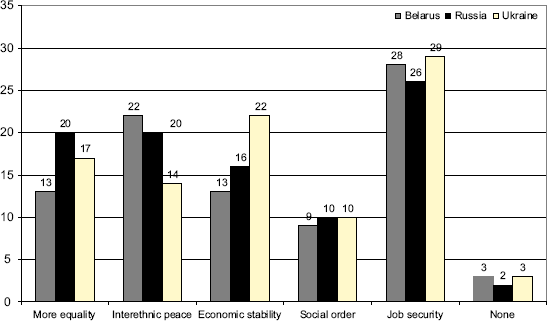
Communism: good features.
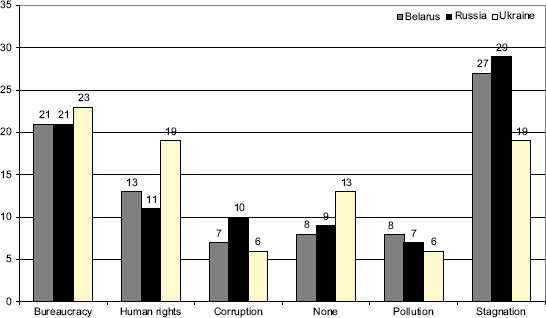
Communism: bad features.
Asked in October 2007 what view they took of the October revolution in particular, more than half thought it had ‘opened a new era in the history of the Russian people’ (24%) or ‘given a stimulus to economic and social development’ (31%), rather more than had shared this opinion in 1990 (see Table 1). Lenin was the figure of the time who, more than anyone else, aroused the greatest sympathy (27%); he was followed by the secret police chief Felix Dzerzhinsky and then Joseph Stalin. Some 17% said they would support the Bolsheviks in the hypothetical event of another October revolution and another 13% would at least cooperate with them, many more than the 6% that would support their opponents, although still larger numbers would remain on the sidelines or emigrate. In all three countries, the changes that had taken place were clearly more complicated than a ‘transition to democracy’: it was hardly a transition, not necessarily to democracy, led by a section of the regime itself. Russians, at least, often preferred to use the neutral term ‘the collapse of the union’ (raspad soyuza) for what had happened at the end of 1991, without making larger and more complex value judgements.
Views of the October revolution (1990–2007).
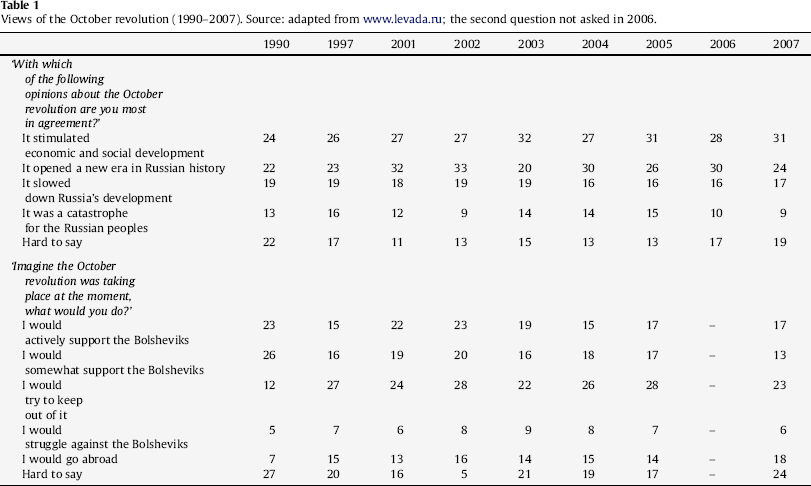
Source: adapted from www.levada.ru; the second question not asked in 2006.
The weekly paper Argumenty i fakty went out into the streets in the mid-1990s to ask ordinary Russians to put their responses into their own words. The first person they talked to, a young man temporarily out of work, was ‘for the USSR, however stupid that might sound’. Elena, a businesswoman, was against – it could ‘only mean the return of psychiatric prisons, lies and censorship’. But Ruslan from Tajikistan wanted ‘everything to be like it was before’. Sergei from Moscow thought the three ‘Slavic brothers’ were ‘simply fated to live together’. A visitor from Grozny was ‘for the Soviet Union, naturally’. And Boris, a down and out, had a simple explanation: ‘When there was a USSR, I had a flat. Now there is no USSR – and I've no flat either’. 5 The largest proportion of those who were asked in the late 1990s to identify their ‘homeland’, in fact, told interviewers it was the USSR (28%), just ahead of the proportion who thought it was Russia (27%), and nearly as many thought it was the region in which they lived (United States Information Agency (USIA), 1996).
Argumenty i fakty, no. 12, 1996, p. 1.
Russians, together with the other Slavic peoples, certainly have a complex and differentiated view of the Soviet system that was formally dissolved at the end of 1991. We asked, in a succession of national surveys, what ordinary members of the society thought were the ‘best’ and ‘worst’ features of the communist system they had recently experienced. The evidence is set out in Figs. 1 and 2; further details of the surveys themselves are provided in the Appendix. Across the three Slavic republics, Russia, Ukraine and Belarus, it was guaranteed employment that was seen as the most positive feature of the old regime. There was also approval for the way in which the former regime had maintained stable relations between the various nationalities, especially in Belarus (oddly perhaps, in that it was the least ethnically divided of the three societies). Economic stability was also important, especially in Ukraine. Substantial numbers, in addition, approved of the way in which the Soviet system had maintained a measure of social equality, and public order. There were in fact very few who could find no positive features at all in the former regime.
There was a substantial measure of agreement, equally, about the features of the old regime that were least acceptable. It was either ‘economic stagnation’, particularly in Russia, or ‘excessive bureaucracy’, particularly in Ukraine. Violation of human rights was in third place, but it was just as important a shortcoming as economic stagnation in Ukraine. Corruption and environmental pollution were mentioned by rather fewer, and about one in ten thought the old system had no negative features at all. We asked identical questions in Russia alone in 1993 as well as 2001, 2005 and 2008; the results are set out in Table 2. On the whole, there was more stability than change; but there was a striking increase in the proportion who thought the social equality of the Soviet period was to be commended. Among the negative features of the Soviet system, rather more drew attention to its failure to develop economically and rather fewer were concerned about its excessive bureaucracy. About 10%, over the whole period, thought it had no negative features at all.
The ‘Best’ and ‘Worst’ features of communist rule in Russia, 1993–2008.
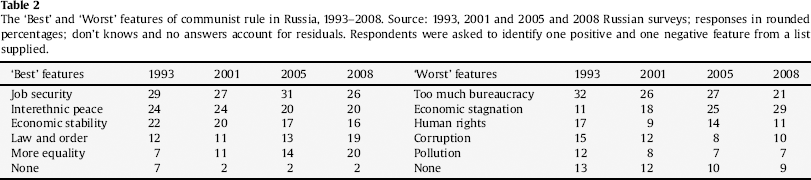
The ‘Best’ and ‘Worst’ features of communist rule in Russia, 1993–2008.
Source: 1993, 2001 and 2005 and 2008 Russian surveys; responses in rounded percentages; don't knows and no answers account for residuals. Respondents were asked to identify one positive and one negative feature from a list supplied.
Russians have also been asked to suggest the characteristics they associate with their current regime, and with the Soviet system of the 1970s and 1980s (see Table 3, which is based on the regular surveys of the All-Russian Centre for the Study of Public Opinion and subsequently the Levada Centre). Popular images of both systems have changed relatively little over the years. Communist rule, in spite of its lack of fully or – until its final years – even partly competitive elections, had many shortcomings: it was bureaucratic, short-sighted and secretive. But its virtues were more apparent. It was ‘close to the people’, ‘legal’, and ‘our own’ – in other words, accessible, indigenous, and (for ordinary Russians) legitimate. Postcommunist rule, by contrast, was associated with crime and corruption more than anything else; but it was also remote, irresolute, weak (less so under Putin than under Yeltsin), short-sighted, and more bureaucratic – by 2005 – than the communist system it had replaced. Indeed, the postcommunist system had hardly any positive features, in this inquiry; it was also parasitic, illegal (in spite of its independent courts and competitive elections), and incompetent.
Comparing Soviet and postcommunist rule in Russia, 1998 and 2005.
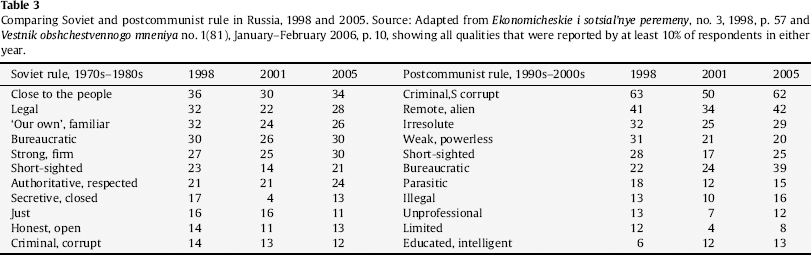
Source: Adapted from Ekonomicheskie i sotsial'nye peremeny, no. 3, 1998, p. 57 and Vestnik obshchestvennogo mneniya no. 1(81), January–February 2006, p. 10, showing all qualities that were reported by at least 10% of respondents in either year.
We asked a series of more specific questions about particular freedoms in the Soviet period and after it (Table 4). There is little doubt, for ordinary Russians, that they have more opportunity to practise a religion than in the late communist period, and to express their opinions in any way they wish. Similarly, they think it is easier to choose whether or not to join an organisation, and to decide whether or not to take part in politics (in the communist period, it was often suggested, everything that was not banned was compulsory); but they think there has been no more than a modest improvement in the protection of citizens from the threat of illegal arrest. Most strikingly of all, ordinary people have (in their own view) no more influence over the making of public policy than they enjoyed in the communist period, in spite of the introduction of competitive elections, the rule of law and freedom of speech, although the largest proportion of all think there has simply been no change; and they think they are less likely to be treated fairly and equally by government.
Changes since communist rule in Russia, 2001–2008.
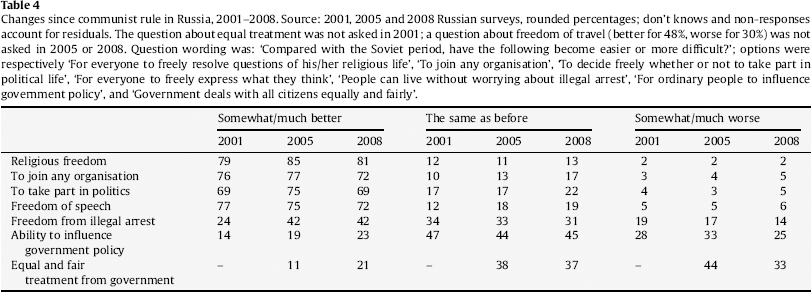
Source: 2001, 2005 and 2008 Russian surveys, rounded percentages; don't knows and non-responses account for residuals. The question about equal treatment was not asked in 2001; a question about freedom of travel (better for 48%, worse for 30%) was not asked in 2005 or 2008. Question wording was: ‘Compared with the Soviet period, have the following become easier or more difficult?’; options were respectively ‘For everyone to freely resolve questions of his/her religious life’, ‘To join any organisation’, ‘To decide freely whether or not to take part in political life’, ‘For everyone to freely express what they think’, ‘People can live without worrying about illegal arrest’, ‘For ordinary people to influence government policy’, and ‘Government deals with all citizens equally and fairly’.
These, moreover, were not just Russian responses (Table 5). By very large majorities, ordinary people in Belarus and Ukraine as well as Russia thought they had more freedom to express religious beliefs than in the years of communist rule, more freedom to decide whether or not to engaged in politics, and more freedom to decide whether or not to join a public organisation (Ukrainians were generally the most positive, with Belarusians at the other extreme). But there was much less evidence of a positive change in the relationship between citizens and government. On the contrary, there was nowhere that a majority thought they were less likely to suffer illegal arrest (Ukrainians thought an illegal arrest was slightly more likely than in the years of communist rule; similar numbers thought there had been no change). In every case there were more who thought it was less likely than before that officials would treat them fairly and equally (the differences were particularly striking in Ukraine). And in every case (although only marginally in Russia) there were more who thought they were less likely to be able to exercise an influence on their national government than had been the case during the years of Soviet rule.
Changes since communist rule, 2007–2009.
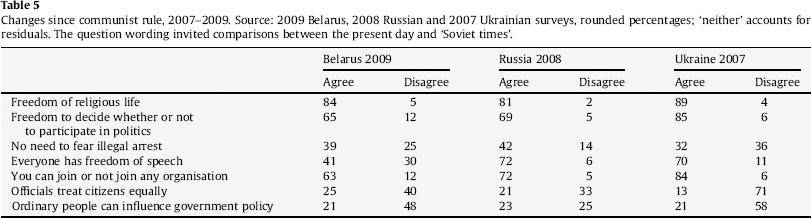
Source: 2009 Belarus, 2008 Russian and 2007 Ukrainian surveys, rounded percentages; ‘neither’ accounts for residuals. The question wording invited comparisons between the present day and ‘Soviet times’.
Taking everything together, did our respondents, on the whole, regret the demise of the USSR? The evidence is set out in Fig. 3. Russians clearly did so, by more than two to one; but a plurality in the other two countries took the opposite view. For Russians, it appears, ‘the USSR’ means the Soviet system, with its positive as well as negative features. But for Belarusians and Ukrainians it was also a time in which their countries had been union republics and not independent states, in spite of their representation in the United Nations. To regret the demise of the USSR was to regret the end of a period in which they had been ruled from Moscow, not by their own elected institutions; not to regret its demise was to affirm the importance of national sovereignty, without necessarily implying a rejection of the economic and political system that had prevailed in Soviet times. There was, of course, an association: those who regretted the demise of the USSR were the most likely to favour the Soviet system, and vice versa. But evidence of this kind is further confirmation of the need to disaggregate: a ‘nostalgic’ view of the USSR was not the same as a positive view of the Soviet system, and a negative view of the USSR, particularly outside Russia, did not necessarily mean a rejection of the principles on which it had been founded.
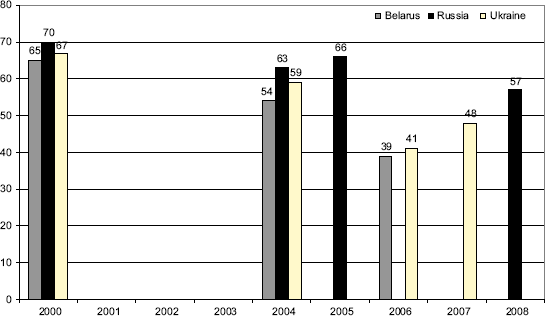
USSR nostalgia, 2000–2008.
Who – more than others – bemoaned the demise of the USSR? On the evidence of our surveys (Table 6), gender made relatively little difference, but age had strong effects, and in the expected direction; across all the variables we considered its effects were the most consistent and substantial. Residence (not shown) made little difference, but education was another powerful predictor, and in the expected direction. So was self-assessed income, in the same direction. We expected that previous membership of the Communist Party would also make a difference, in that they would be more likely than others to regret the demise of the USSR, and this was the case (although it made little difference if other family members had been in the party). In Belarus, 39% of the entire sample regretted the demise of the USSR, but 56% of those who had been members of the Communist Party; in Russia the corresponding figures were 57% of the entire sample but 74% of those who had been party members; and in Ukraine, 48% of the entire sample regretted the demise of the USSR but 66% of those who had been party members.
Nostalgics by social characteristic (proportion in each country in respect of each characteristic who agree or disagree with the proposition that ‘It is a great misfortune that the Soviet Union no longer exists’).
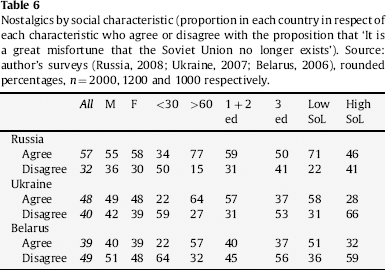
Nostalgics by social characteristic (proportion in each country in respect of each characteristic who agree or disagree with the proposition that ‘It is a great misfortune that the Soviet Union no longer exists’).
Source: author's surveys (Russia, 2008; Ukraine, 2007; Belarus, 2006), rounded percentages, n = 2000, 1200 and 1000 respectively.
Did any of these differences have consequences for the politics of the postcommunist years? We tested these relationships in Table 7, and in a separate multivariate regression. In Russia and Ukraine, but to a much lesser extent in Belarus, those who assigned themselves to the ‘left’ were more likely to regret the demise of the USSR than those who assigned themselves to the ‘right’, and vice versa. USSR nostalgics were also more likely than others to support the principle of state rather than private ownership, and in each of the three countries. We asked two foreign policy questions, one of them about the Commonwealth of Independent States and the other about NATO (which was the USSR's historic adversary, but which had begun to absorb former communist-ruled countries into its membership from 1999 onwards). By very large majorities, Soviet nostalgics were in favour of a closer association among the former Soviet republics, even the formation of another unitary state, and emphatically so in Russia and Ukraine. There were fewer differences in Russia when it came to the (entirely hypothetical) question of NATO membership; differences in Belarus and Ukraine were the most pronounced.
Nostalgics by policy preference (proportion in each country in respect of each policy preference who agree or disagree with the proposition that ‘It is a great misfortune that the Soviet Union no longer exists’).
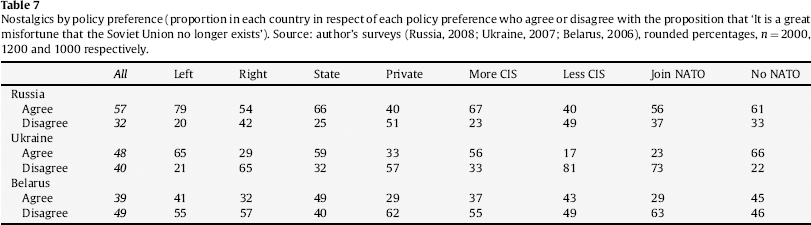
Source: author's surveys (Russia, 2008; Ukraine, 2007; Belarus, 2006), rounded percentages, n = 2000, 1200 and 1000 respectively.
Which of these differences ‘made a difference'? Was it, for instance, because older respondents were older that they were more likely to regret the demise of the USSR, or because they (perhaps) had lower living standards, or a lower level of education? We tested these relationships in a separate logistic regression (not shown). On this evidence, it is age and living standards that are the most powerful predictors of Soviet nostalgia when other variables are held constant. All were statistically significant at the **p < 0.01 level, and in the expected direction: older age-groups were more positive about the Soviet system, and so were the less affluent; younger age-groups and the more affluent were less enthusiastic. Perhaps surprisingly, education is not a statistically significant factor (secondary, but not higher education made some difference in Ukraine); nor is gender, as our bivariate analysis had already suggested. Among them, the variables in our model (age, gender, education and living standards) correctly predicted a satisfactory 67.5 of cases in Russia, 64.1 in Belarus and 63.4 in Ukraine, with a p-value of less than 0.000.
Overall, we find that communist nostalgia matters. Most Russians (but not most Belarusians or Ukrainians) regret the demise of the USSR, without necessarily wishing to return to it. President Putin has himself described the collapse of the USSR as the ‘greatest geopolitical catastrophe of the twentieth century’, 6 and surveys have found a consistently positive view of the USSR in retrospect, and of a closer degree of integration in the future. Belarusians and Ukrainians are less concerned about the demise of the USSR (it was obviously incompatible with the independence they had obtained in 1991), and less likely to support the formation of a unitary state of CIS member countries, but they strongly supported a closer degree of cooperation; very few, in any case, thought the CIS should be dissolved. Generally, it was a ‘more democratic Soviet system’ that was the most strongly supported form of government across the three countries, but a broadly market-based economy had more support than a command economy of the traditional kind. This was a differentiated, not a simple view of the communist legacy.
Rossiiskaya gazeta, 26 April 2005, p. 4.
But wherever the mass public offered support to the Soviet state and the economic and political principles on which it had been based, those who regretted the demise of the USSR were even more likely to do so. More than could be explained by random variation, they were more likely than other respondents to favour the restoration of a wholly Soviet system of government, more likely to favour a Soviet-type economy, and more likely (almost by definition) to support the formation of a unitary state on the basis of the CIS member countries. Regretting the demise of the USSR also made a strong contribution, all other things being equal, to the patterns of electoral support that were apparent at parliamentary and presidential elections in the three countries. Nostalgics were much more likely to support parties of the left, or at least those that favoured public ownership, a Soviet or ‘more democratic Soviet’ system of government, and a closer association among the former Soviet republics; they were much less likely to support the parties that favoured a ‘civilised divorce’, a wholly market economy, or Western-style democracy.
‘Communist nostalgia’, at the same time, had to be disaggregated. There were very different views about the restoration of a unitary state in Russia and in Belarus and Ukraine, where it was incompatible with their newly acquired independence. There was support for a ‘more democratic Soviet’ system of government, but at the same time for the principles of the market economy. Not many, in the postcommunist or indeed in the late Soviet period, wanted a single party that exercised a political monopoly, or restrictions on what they could say. But there was a much larger constituency for full employment, low prices, comprehensive social welfare, and a state that took direct responsibility for economic management, particularly so after the international financial crisis began to develop in 2008. In none of the three countries had there been a widely supported movement for the overthrow of Soviet rule; in each of them there was considerable support, in retrospect, for many of the principles on which it had been based; and attitudes of this kind were closely associated with electoral choices and broader policy preferences. In this sense, the communist everyday is also the postcommunist everyday.
Footnotes
Acknowledgements
I am grateful for the support of the Leverhulme Trust through their Major Research Fellowship F/00 179/AR, which provided time for writing and research, and for the support of the UK Economic and Social Research Council under grants RES-00-22-2532 and RES-062-23-1378, which helped to generate the primary data.
Appendix
Our surveys were conducted by the following agencies, and fielded on the dates indicated; full data files and questionnaires are available from the UK Data Archive, or in respect of the most recent surveys, when they have been deposited: Interviews were in all cases conducted face-to-face in respondents’ homes, based on the agencies’ normal sampling procedures and representative of the population aged 18 and over. The agency's standard procedures were employed to check the completion of questionnaires and the logical consistency of the data.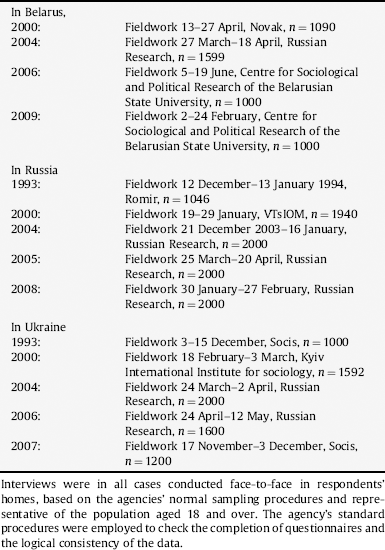
In Belarus,
2000:
Fieldwork 13–27 April, Novak, n = 1090
2004:
Fieldwork 27 March–18 April, Russian Research, n = 1599
2006:
Fieldwork 5–19 June, Centre for Sociological and Political Research of the Belarusian State University, n = 1000
2009:
Fieldwork 2–24 February, Centre for Sociological and Political Research of the Belarusian State University, n = 1000
In Russia
1993:
Fieldwork 12 December–13 January 1994, Romir, n = 1046
2000:
Fieldwork 19–29 January, VTsIOM, n = 1940
2004:
Fieldwork 21 December 2003–16 January, Russian Research, n = 2000
2005:
Fieldwork 25 March–20 April, Russian Research, n = 2000
2008:
Fieldwork 30 January–27 February, Russian Research, n = 2000
In Ukraine
1993:
Fieldwork 3–15 December, Socis, n = 1000
2000:
Fieldwork 18 February–3 March, Kyiv International Institute for sociology, n = 1592
2004:
Fieldwork 24 March–2 April, Russian Research, n = 2000
2006:
Fieldwork 24 April–12 May, Russian Research, n = 1600
2007:
Fieldwork 17 November–3 December, Socis, n = 1200