






Abstract
During the last decades, research on human resource management (HRM) has focused on examining the mechanisms that explain the effects of HR practices on employee performance. Drawing on the AMO model, our study constructs an integrative model to analyze the contribution of employees’ abilities, motivation and opportunities (employee AMO) to participate in the relationship between HRM and employee performance. In doing so, we test a multilevel model that analyzes the top-down influence of three HR bundles (skill-, motivation-, and opportunity-enhancing) on employee AMO, and the bottom-up contribution of these three employee-related variables on their collective performance. We use matched data from 83 HR managers, 83 R&D managers and 262 R&D employees in a sample of Spanish firms. Our results provide evidence that the skill-enhancing and opportunity-enhancing HR bundles increase both employee abilities and motivation; the opportunity-enhancing HR bundle also contributes to increasing employee opportunities to participate.
Introduction
At the beginning of the 21st century, some researchers identified a “black box” between HRM and firm performance, since the intermediate mechanisms through which this relationship occurs had largely been ignored in the literature (Gardner et al., 2001). This situation has changed, however, as numerous studies now address this issue (see Jiang et al., 2012a for a review), providing evidence of the relevance of several employee-related variables (e.g. abilities, behaviors, attitudes) as mediating variables that explain the influence of HRM on firm performance. Many of these studies (e.g. Butts et al., 2009; Chuang and Liao, 2010) consider employee performance as the dependent variable, since this is a key proximal outcome reflecting behaviors that are under employees’ control and that help to achieve organizational goals.
Despite the relevance of the abovementioned contributions, empirical studies in the literature analyzing the mediating role of the individual variables in the relationship between HRM and employee performance are fragmented in terms of their underlying theoretical perspective, which entails the testing of specific mediating variables (e.g. human capital, motivation), but not others. Indeed, few studies have considered several mediating variables simultaneously, which makes it difficult to gain a broader view of these intermediate mechanisms (Jiang et al., 2012a). The AMO model constitutes a comprehensive theoretical framework to address this issue, by allowing these complex relationships to be integrated in a single framework. According to this framework, employee performance depends on three variables: employees’ abilities (A), motivation (M) and opportunities to participate (O) (Cummings and Schwab, 1973). There are two advantages to adopting the AMO model as the guiding theoretical framework for our study. First, it includes the “O” component in the model, which has been largely neglected in previous empirical studies (Jiang et al., 2012a), despite its relevance in determining employee performance at work (Blumberg and Pringle, 1982). Second, the AMO model provides a broad picture of the intermediate variables between HRM and employee performance. Taking into account the benefits of this framework to explain the intermediate linkages between HR bundles and employee performance, the first objective of our research is to explore the extent to which employees’ abilities, motivation and opportunities to participate contribute to their performance at work.
The AMO model has also been used in recent decades as a framework to guide firms in their choice of HR practices (Bos-Nehles et al., 2013). Indeed, several studies have suggested that HR practices could be classified according to the same three categories, leading to three HR bundles (i.e. a combination of HR practices): skill-enhancing, motivation-enhancing and opportunity-enhancing (Bailey, 1993; Appelbaum et al., 2000). Thus, in the HRM literature the AMO classification coexists at two levels of analysis, one related to employee-related variables, and the other to the set of HR practices used in the firm. The second objective of this study is to analyze empirically whether the skill-enhancing, motivation-enhancing, and opportunity-enhancing HR bundles contribute to foster the employee-related variables for which they are theoretically designed, and also to examine whether there are any cross-domain relationships between the two levels of analysis. To date, studies that empirically test the relationships between the AMO components at the individual and the firm level are remarkably scarce. One exception is Jiang et al.'s (2012a) meta-analysis. However, this study only considers employee abilities (A) and motivation (M) and draws its conclusions exclusively from variables measured at the firm level, without considering the cross-level relationships between firm-level HR practices and employee-level variables. To our knowledge, there are no empirical studies that analyze the relationships between the AMO components at the individual and the organizational level (that measure these variables at different levels of analysis) in a single and integrative model. Besides the main effects between the organization-level and the individual-level AMO components, we also consider that the synergy among the bundles of HR practices should be taken into account in order to understand the contribution HR practices make to the variables of interest (Chadwick, 2010). In particular, many scholars in the HRM literature consider that the interactions among the HR bundles can influence employee and organizational results (e.g. MacDuffie, 1995).
In sum, since employees’ abilities, motivation and opportunities to participate (hereinafter, employee AMO) are the key determinants of their performance at work (Blumberg and Pringle, 1982), and given that HR bundles contribute to employee AMO, our study aims to contribute to the existing literature about the intermediate role of the employee AMO in the HRM–employee performance relationship from a multilevel perspective. We do so by testing a 2-1-2 mediation model design (Croon et al., 2014) on a sample of R&D employees in Spanish companies.
The rest of the paper is structured as follows. In the first section, we introduce the AMO model as a framework of work performance and argue how employee abilities, motivation and opportunities to participate may contribute to their performance at work. The second section presents the arguments that sustain the hypotheses about the relationships between the firm-level AMO components (HR bundles) and the individual-level AMO and about the influence of the synergy among the different HR bundles on the individual AMO components. After the theoretical review, we present our methodology and results, and finally, we discuss the main conclusions, implications and limitations of the research.
The contribution of employee AMO to employee performance
Studies that analyze the intermediate mechanisms between HRM and firm performance have usually focused on employee work performance as the dependent variable because it comprises the employee behaviors that are relevant to achieving organizational goals (Jiang et al., 2013). The focus of our research is on
The AMO model analyzes the variables that determine employee performance. The origins of the AMO model lie in the industrial psychology perspective, which proposed that performance was a function of employees’ abilities to perform (A) (e.g. Lawshe, 1945) and in the social psychology perspective, according to which performance was also dependent on employee motivation (M) (Wyatt, 1934). Later on, several studies added the variable “opportunity” (O) to this framework (Blumberg and Pringle, 1982). The A dimension refers to the employees’ abilities to carry out their work (Jiang et al., 2013). At the individual level of analysis, the A dimension can be defined as the knowledge, skills and abilities individual employees possess, and is closely linked to the occupational self-efficacy construct (Knies and Leisink, 2014), defined as employees’ assessment of their competences to successfully perform their jobs (Rigotti et al., 2008). The M dimension, in turn, comprises a range of employee attitudes and affects that reflect employees’ willingness to expend efforts at work (Jiang et al., 2013). Broadly speaking, motivation is “an unobservable force that directs, energizes, and sustains behavior” (Diefendorff and Chandler, 2011:66). While the A component emphasizes employees’ capabilities to contribute, M deals with the extent to which they are keen to use those capabilities (Liao et al., 2009). Finally, the O dimension “reflects the means through which employees’ abilities and efforts can be converted to outcomes” (Jiang et al., 2013:1463) and is closely linked to the psychological empowerment construct (Spreitzer, 1995). In particular, the opportunity dimension at the individual level includes the autonomy, task significance and impact employees perceive they have at work that, in general terms, reflect their chances to deploy their skills in their jobs and contribute to the firm's success (Purcell et al., 2003; Ehrnrooth and Björkman, 2012).
Classic work performance theories proposed that these three variables (A,M,O) determine the employee's performance (Vroom, 1964; Blumberg and Pringle, 1982). Studies drawing from the human capital theory (e.g. Chang and Chen, 2011) assume that employee work-related skills and competences are the main determinant of employee productivity. Ability relates to performance primarily through job knowledge, such that high-ability workers tend to demonstrate higher performance because they are better able to acquire and apply job-relevant knowledge than those with lower levels of ability (Van Iddekinge et al., 2017). Prior empirical studies provided support for the relevance of employees’ abilities (A) to increase their job performance (Youndt et al., 2004; Hong, 2009; Liao et al., 2009). Other studies (e.g. Rich et al., 2010; Christian et al., 2011; Alfes et al., 2013) suggest that employee productivity depends on the willingness of employees to use their capabilities at work, and have demonstrated the relevance of employees’ motivation (M) to increase their job performance. Employee motivation leads to the desired work behaviors and discretionary efforts that contribute to operational outcomes (Jiang et al., 2012a). Finally, several studies provide evidence that the opportunities to perform in the firm (O) are a relevant factor influencing employees’ performance (e.g. Aryee et al., 2012). These studies assume that employee performance depends on the extent to which employees are able to fully exploit their skills at work (Bos-Nehles et al., 2013). Without appropriate opportunities to use their abilities and motivation at work, employees will display lower contributions than similar employees provided with such opportunities (Jiang et al., 2012b). Drawing from these arguments, we propose that:
Hypothesis 1a
Employee abilities have a positive effect on employee performance.
Hypothesis 1b
Employee motivation has a positive effect on employee performance.
Hypothesis 1c
Employee opportunities to participate have a positive effect on employee performance.
Relationships between HR bundles and employee AMO
Following the reasoning of the AMO model of work performance, several authors have proposed that HR practices could be classified according to the same three-dimensions, distinguishing among three HR bundles: skill-enhancing HR bundle, motivation-enhancing HR bundle and opportunity-enhancing HR bundle (Bailey, 1993; Appelbaum et al., 2000; Lepak et al., 2006). Each bundle represents a combination of HR practices that share the same purpose. Skill-enhancing practices include comprehensive recruitment, rigorous selection, and extensive training (Jiang et al., 2012a). Typical HR practices classified within the motivation-enhancing domain are related to incentives and rewards, extensive benefits, and career development (Subramony, 2009). Finally, the opportunity-enhancing HR bundle includes initiatives to empower employees to contribute to organizational goals, such as employee participation in firm decision making, and the use of communication channels from the firm to employees (Gardner et al., 2001; Subramony, 2009). Following Jiang et al.'s (2013) call for more inquiry into the interrelationships between the AMO components at the firm and employee level, this section addresses the influence of the three HR bundles and their synergy on employee abilities, motivation and opportunities to participate.
Main effects of the HR bundles on employee AMO
Regarding the skill-enhancing HR bundle, training and staffing practices contribute to fostering firms’ human capital (Minbaeva et al., 2003; Youndt and Snell, 2004), and to increasing employees’ mastery of abilities, preparing them for future promotion in the firm (Gardner et al., 2001). Staffing practices allow the firm to hire employees with the required competences and abilities, and training initiatives contribute to enhancing the skills of current employees (Subramony, 2009), which corresponds to the “make” and “buy” approaches to increase the employees’ KSAs (knowledge, skills and abilities) suggested by authors such as Youndt and Snell (2004).
However, these practices may also increase employee motivation by providing them with the chance to develop their professional career in the firm (Tharenou et al., 2007; Liao et al., 2009). Practices in the skill-enhancing HR bundle are a means by which employees can broaden their competencies, and therefore experience more variety of tasks and greater challenges at work. This process offers employees more opportunities for development and personal growth, which stimulates their motivation at work (White and Bryson, 2013). Moreover, practices in the skill-enhancing HR bundle can also extend employee opportunities to participate in the firm, since the firm's developmental initiatives allow employees to initiate new work methods and to assume responsibilities for the quality of their work and their contributions in the organization (Pfeffer, 1998). Without the necessary investments in workforce development, greater autonomy for employees would entail their having to assume difficult challenges, which may undermine employee self-efficacy (Axtell and Parker, 2003). For all these reasons, we expect that:
Hypothesis 2a
The skill-enhancing HR bundle has a positive effect on employee abilities.
Hypothesis 2b
The skill-enhancing HR bundle has a positive effect on employee motivation.
Hypothesis 2c
The skill-enhancing HR bundle has a positive effect on employee opportunities to participate.
Turning now to the motivation-enhancing HR bundle, the literature provides arguments sustaining the relationship between this set of practices and employee motivation and opportunities to participate. Regarding employee motivation, from the social exchange perspective (Blau, 1964) firms reinforce employees’ perceptions that their contributions are valued by offering them incentives or chances for promotion in the organization (Allen et al., 2003). This perceived organizational support generates among employees a felt obligation to care about the organization's goals and to reciprocate with higher motivation to work harder (Rhoades et al., 2001; Minbaeva et al., 2003).
On the other hand, as Bowen and Lawler (1992) suggested, to promote employee participation in the firm, organizations should develop a reward system based on employee contributions. Through appropriate rewards, the firm generates the belief among the workforce that greater efforts and autonomy will pay off, which fosters employees’ willingness to be proactive in their job (Beltrán-Martín et al., 2017). Because greater opportunities to participate may call for additional effort from employees, practices in the motivation-enhancing HR bundle are needed to encourage them to persevere in their contributions (Frese et al., 1997). In addition, as Howard and Foster (1999) noted, employees will be reluctant to show initiative or autonomy at work if they do not perceive that the firm is offering them the possiblity for promotion. This reasoning leads us to formulate our next hypotheses as follows:
Hypothesis 3a
The motivation-enhancing HR bundle has a positive effect on employee motivation.
Hypothesis 3b
The motivation-enhancing HR bundle has a positive effect on employee opportunities to participate.
The opportunity-enhancing HR bundle, in turn, contributes to a climate of empowerment in the firm that fosters employee autonomy. Greater delegation of power to individuals, and higher employee participation lead to an organizational climate that boosts employees’ confidence in the significance and relevance of their work; as a consequence, employees take on a more active and autonomous role in the firm (Aryee et al., 2012). For instance, Seibert et al. (2004) empirically demonstrated that practices in the opportunity-enhancing HR bundle have a positive influence on employees’ autonomy.
These HR practices can also influence employees’ abilities, since allowing employees to play an active role in the firm increases their opportunities to share their KSAs and to put forward ideas, which constitute learning opportunities for employees (Jiang et al., 2012a). The opportunity-enhancing HR bundle also constitutes a source of motivation for employees, since the availability of a wider range of opportunitites to solve problems and propose changes in the firm generates higher self-esteem and interest in the job (White and Bryson, 2013). In addition, prior studies have suggested that employees are more motivated when the organization informs them about the firm, for instance, by sharing information about its performance, because it send signals to employees that they are trusted members of the firm (Delery and Shaw, 2001; Minbaeva et al., 2003; Peters et al., 2014). Drawing on the above reasoning, we expect that:
Hypothesis 4a
The opportunity-enhancing HR bundle has a positive effect on employee opportunities to participate.
Hypothesis 4b
The opportunity-enhancing HR bundle has a positive effect on employee abilities.
Hypothesis 4c
The opportunity-enhancing HR bundle has a positive effect on employee motivation.
Effects of the synergy among HR bundles on employee AMO
In addition to the direct effect of the skill-, motivation- and opportunity-enhancing HR bundles on employee AMO, the HRM literature, drawing from configurational theories, has analyzed the possible existence of synergies between the bundles of practices and employee-related variables (Chadwick, 2010). The concept of internal aligment lies at the heart of these synergistic effects, as HR bundles are part of a integrated HRM system (Ichniowski et al., 1997; Delery, 1998; Gerhart, 2007). It highlights the positive outcomes stemming from the complementarities among firms’ HR practices, and the fact that HR bundles are aligned with each other to capture desirable interactive effects (Chadwick, 2010).
Of the different theoretical approaches to synergy (see Chadwick, 2010 for a review) and following Jiang et al.'s (2012a) suggestion, we focus on the interaction among HR bundles to examine how their synergy might impact employee AMO. From this perspective, the influence of HR practices on the dependent variables is moderated by the other HR practices implemented in the firm (Delery and Shaw, 2001). By defining synergy as the interaction among the HR practices, each of the HR practices or bundles in a firm can have both direct and moderator effects on the outcomes (Chadwick, 2010). For example, the influence of the skill-enhancing HR bundle on employee abilities can be reinforced by developing motivation-enhancing practices that promote recognition of employees’ contributions. Similarly, the opportunity-enhancing HR bundle provides employees with more freedom, independence, and discretion to perform their assigned tasks, so they may strengthen the positive influence of the skill-enhancing HR bundle in developing employee abilities. In the same vein, Ichniowski et al. (1996) pointed out that training employees in problem-solving will be more effective when organizations allow them to solve more problems. Taking into account the idea of synergy or internal fit among HR bundles posited by numerous scholars in the HRM literature (e.g. Ichniowski et al., 1997; Delery, 1998; Gerhart, 2007) and following Jiang et al.'s (2012a) suggestion, we also include the interaction among HR bundles to examine how their synergy might impact employee AMO, and formulate the following hypotheses:
Hypothesis 5
The skill-enhancing HR bundle positively moderates the influence of the motivation-enhancing HR bundle on employee AMO.
Hypothesis 6
The skill-enhancing HR bundle positively moderates the influence of the opportunity-enhancing HR bundle on employee AMO.
Hypothesis 7
The motivation-enhancing HR bundle positively moderates the influence of the opportunity-enhancing HR bundle on employee AMO.
To sum up, stemming from the above arguments we expect that employee abilities, motivation and opportunities to participate are intermediate variables in the relationship between the HR bundles and employee performance. Fig. 1 depicts the theoretical model proposed in our study. As the figure shows, we examine the relationship between employee abilities, motivation and opportunities to participate and employee performance, corresponding to Hypothesis 1 (i.e. bottom-up effects). In addition, we analyze the influence of the three HR bundles on employee AMO (i.e. a top-down effect), as predicted in Hypotheses 2–4. The synergies among the three HR bundles are also tested by introducing the interaction effects among these bundles and their effect on employee AMO (Hypotheses 5–7).
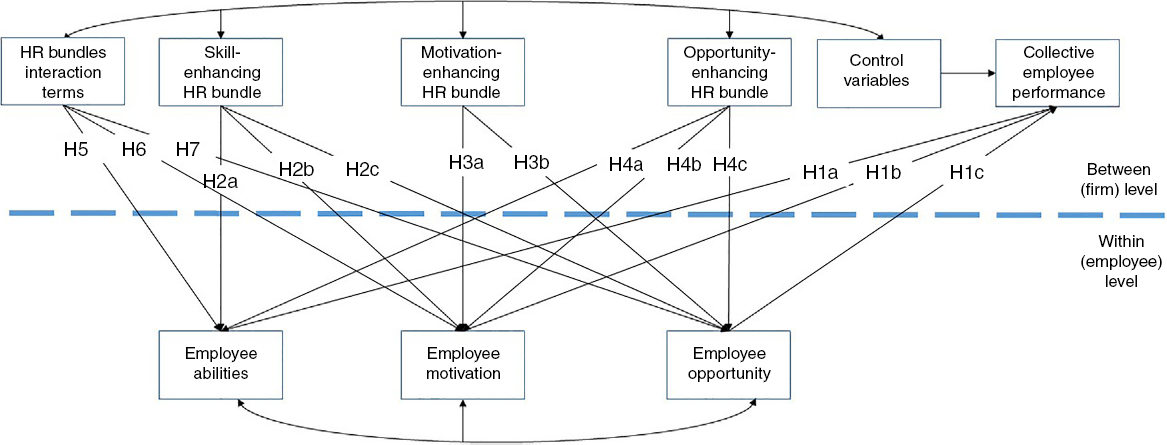
Theoretical model and hypotheses.
Method
Sample and data collection procedure
The fieldwork for this study was conducted on a sample of Spanish service and industrial companies selected from the SABI (
Prior to sending out the questionnaires, we made initial contact with a random sample of companies (
Of the 350 firms with an R&D department invited to participate, the HR manager provided answers on HR practices in 85 organizations. The HR managers were informed about our research and we asked for permission to distribute the employee questionnaire to a randomly chosen sample of R&D employees in each firm. The average number of employees in the R&D departments for our sample of companies was 13.48 employees (median = 5 employees). Resource limitations prevented us from surveying all R&D employees in each department, but we set a minimum of three employees to interview per firm. We obtained responses from 262 employees; the number of respondents per firm ranged between 3 and 6 employees. In a second wave of the study, five months later, we contacted the R&D managers of the 85 firms that had provided responses from the HR managers and the R&D employees and obtained responses from 83 R&D managers. As a result of matching, we obtained complete responses to all our variables from 83 firms. Fifty per cent of the firms were from the service sector (e.g. advertising and market research, computer programming and consultancy, etc.) and fifty per cent were industrial firms (e.g. manufacturers of machinery and equipment, metal products, rubber and plastic products, etc.)
Measures
Measures of the variables were based on previously published scales. We performed exploratory factor analysis (EFA) and confirmatory factor analyses (CFA) to assess the reliability and validity of the scales.
Dependent variable
To measure employee performance, prior studies have usually differentiated between task performance and contextual performance. While task performance refers to the extent to which the employee meets role requirements and achieves task goals, contextual performance is linked to the employees’ behaviors that facilitate the organizational, social and psychological context in which the key technical tasks are performed (i.e. organizational citizenship behaviors, OCBs) (Edgar et al., 2015). Attending to the nature of R&D work, employee performance in this area should reflect employee innovation and creativity.
1
For this reason, we focus on contextual performance, in particular challenge-oriented OCBs, as an indicator of employee performance. Employee challenge-oriented OCBs capture employee behaviors that involve making constructive suggestions for improving and challenging the status quo for the good of the organization (MacKenzie et al., 2011). We measure this variable using Van Dyne and LePine's (2008) six-item scale. Since our focus is on collective employee performance, and following MacKenzie et al. (2011), all the items were worded so that R&D managers rated the R&D employees as a whole (e.g. “communicate their opinions about work issues to others in the R&D department even if their opinion is different and the others in the department disagree with them”). The estimation of a CFA with the six items showed a good fit to the data (χ2SB = 11.73; d.f. =9;
We thank an anonymous reviewer for this comment.
Independent variables
HR practices were assessed using Gardner et al.'s (2001) scale, which includes three bundles of HR practices corresponding to skill-enhancing, motivation-enhancing and opportunity-enhancing domains. Respondents (HR managers) stated their level of agreement that the HR practices were used for the R&D employees in their firm (ranging from 1 = strongly disagree to 7 = strongly agree). We performed an exploratory factor analysis (EFA) and a CFA to test whether the proposed dimensionality of this scale corresponded to Gardner et al.'s (2001) original scale. The results of the CFA in which the three HR bundles (skill-enhancing, motivation-enhancing and opportunity-enhancing) were introduced as correlated factors showed a good fit to the data (χ2SB = 27.34; d.f. =22;
Mediating variables
We used Rigotti et al.'s (2008) scale to measure
Regarding
To measure
Control variables
We controlled for the influence of the sector and firm size. Regarding the sector, we use a dummy variable taking value 1 for manufacturing firms (two digit CNAE codes 01 to 45) and 0 for service firms (two digit CNAE codes 45 to 99). Firm size was measured by the logarithm of the number of employees.
Analytic procedures
To test the hypotheses (see Fig. 1) we applied multilevel structural equation modeling (MSEM) using MPlus software (Muthén and Muthén, 1998–2012). MSEM partitions the variance of the employee-level variables into two latent variable components (Asparouhov and Muthén, 2006), capturing the within-group variation (differences across employees in the same firm) and the between-group variation (differences across firms). An advantage of MSEM is that it allows us to specify a large variety of multilevel models. By structuring the relationships in the within- and the between-group variables, MSEM allows estimation of cross-level relationships (e.g. a 2–1 multilevel design), that is, relationships between variables measured at different levels of the data hierarchy (Preacher et al., 2010), in a large number of different type of models including, as in our analysis, multilevel mediation models (e.g. a 2 → 1 →
Results
Before estimating the MSEM models, we computed the within- and between-group variance for the employee-level variables, all of which were statistically significant. The ratio of between-group to total variance provided intra-class correlation coefficients (ICC1) (LeBreton and Senter, 2008) of 0.38, 0.32 and 0.40 for employee abilities, motivation, and opportunities to participate, respectively. This result suggested that it was appropriate to examine the influence of the HR bundles (Level 2 predictors) in explaining the variation of these employee performance components across firms.
Table 1 shows the estimates for the model in Fig. 1. The chi-square goodness-of-fit test statistic (
Parameter estimates and standard errors (in brackets) of the models.
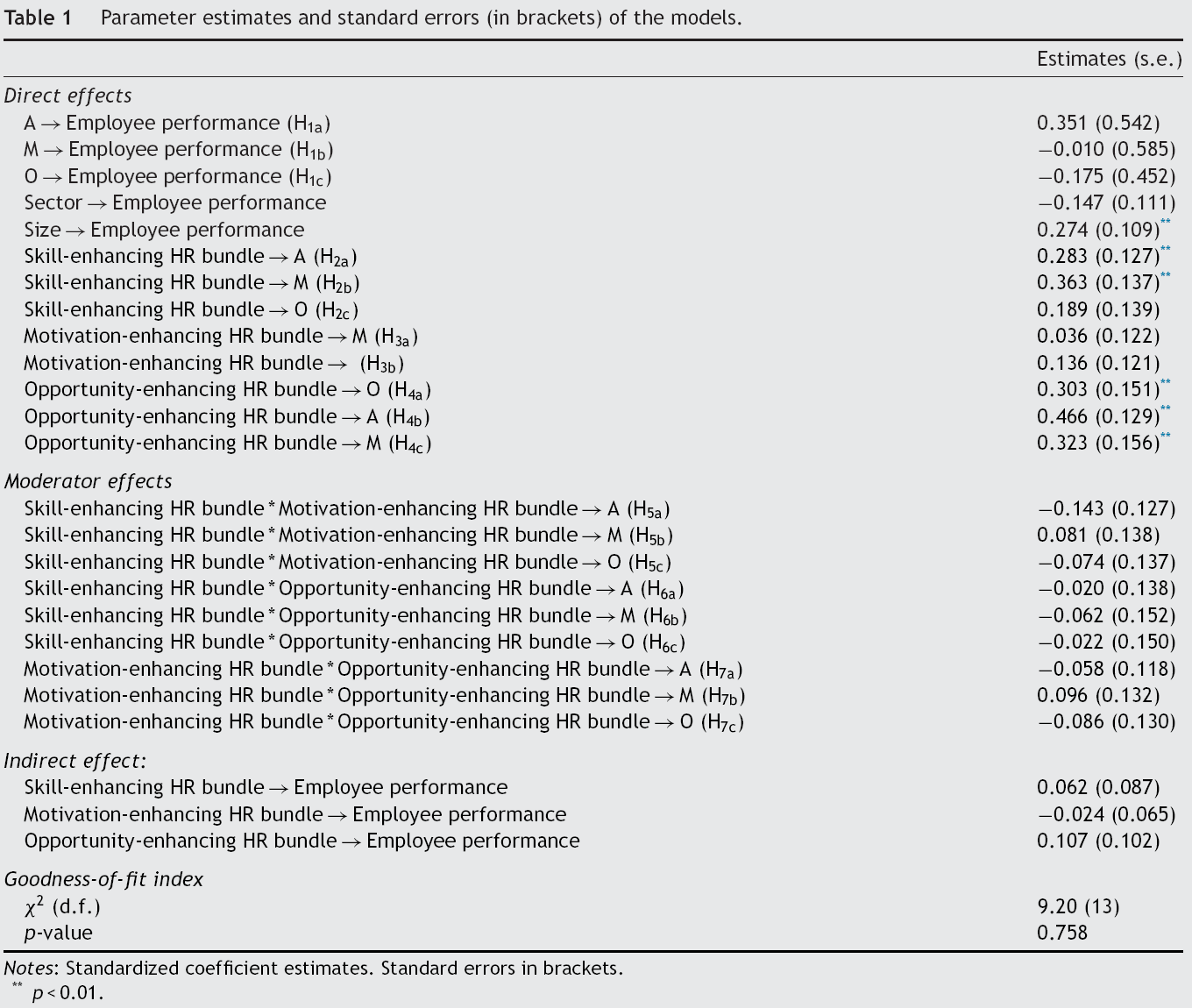
The table shows that the skill-enhancing HR bundle was positively associated with employee abilities, with a statistically significant regression coefficient of 0.28 (
Finally, Table 1 also shows the influence of the interaction between the HR bundles on employee AMO. We find that that none of the regression coefficients is statistically significant, so Hypotheses 5–7 are not supported by our data.
Discussion
For our sample of companies we found evidence that HR bundles have a positive influence on employee abilities, motivation and opportunities to participate, but we found no support for the contribution of these three employee-related variables to their collective performance. The incorporation of the AMO model in this analysis allows the integration of multiple intermediate variables in a single framework and thus enables us to extend prior models for the mediating variables in the HRM–employee performance relationship. We believe that our results contribute to the HRM literature in several ways.
First, our results suggest that there is a relationship between the AMO components at the firm level with their counterparts at the individual level of analysis. Using the three dimensions of the HR system instead of a undimensional measure has allowed us to examine the differential influence of the three HR bundles on different types of employee variables. Earlier studies that differentiated among the skill-enhancing, motivation-enhancing and opportunity-enhancing HR bundles (e.g. Appelbaum et al., 2000) proposed these classifications according to the employee AMO component that they were intended to maximize. Our results partially support this assumption. The skill-enhancing HR bundle has a positive influence on employee abilities, which is in accordance with prior studies, as Jiang et al.'s (2012a) meta-analysis demonstrates. Similarly, practices in the opportunity-enhancing HR bundle help to increase employee opportunities to perform. That is, practices that encourage employee's participation and involvement in firm decisions, and practices related to establishing communication channels from the firm to individuals, help to increase employees’ possibilities to deploy their skills in the firm and to actively contribute to the organization's success (Ehrnrooth and Björkman, 2012). However, we did not find empirical support for the influence of the motivation-enhancing HR bundle on employee motivation. The general tendency in the HRM literature to measure employee motivation as the individuals’ affective commitment may explain this result. In particular, our results are consistent with Meyer et al.'s (2004) suggestion that affective commitment is related more strongly to internal sources of motivation, rather than to external sources of motivation such as performance-based rewards or promotions. In addition, our results are consistent with prior evidence demonstrating that internal sources of motivation are more relevant than external rewards for R&D employees (e.g. Lee and Maurer, 1997; Owan and Nagaoka, 2011). In fact, in our study, skill-enhancing shows a stronger relationship with employee motivation than the other two HR bundles. In this sense, Kanama and Nishikawa (2017:199) state that “extrinsic rewards cannot be expected to be very effective when employees are charged with tasks that require innovation and creativity”. In sum, in our study, HR bundles are not only distinct in nature because they are made up of different practices but also because they contribute to employee AMO through different paths.
Second, our study demonstrates that each of the AMO components at the individual level is affected by cross-domain HR bundles. From a contextual perspective, organizational context can be viewed as a large set of constraints and opportunities (sometimes countervailing one another) that shape employee responses, in terms of their attitudes or behaviors (Johns, 1991). The large number of facets that make up the organizational context entails the possibility that the relationships between HR bundles and employee variables may also cross the theoretically defined domains, but this question has received little attention in the HRM literature (Foss et al., 2015). In particular, attending to the results of our analyses, employee abilities are not only improved by the skill-enhancing HR bundle but also by the opportunity-enhancing HR bundle. The opportunity-enhancing HR bundle provides employees with the possibility to choose alternative ways to approach tasks, to experience more ownership, to share knowledge with others, and to learn new skills (Den Hartog and Belschak, 2012; Jiang et al., 2012a). More specifically, our results indicate that the regression coefficient linking the opportunity-enhancing HR bundle with employee abilities is larger than the coefficient corresponding to the effect of the skill-enhancing HR bundle. This result contradicts the results of Jiang et al.'s (2012) meta-analysis, but in a R&D context the provision of opportunities to participate by the firm has been shown to be particularly relevant to increasing the development of work-related abilities (Cabello-Medina et al., 2011). Similarly, employee motivation is encouraged by both skill-enhancing and opportunity-enhancing HR bundles. From a social exchange perspective (Blau, 1964), employees may interpret firms’ investments in these practices as a signal that the organization cares about them, which may generate a feeling of obligation to reciprocate through more effort at work. In sum, our study takes an initial step to test the multilevel model of strategic HRM suggested by Jiang et al. (2013), based on the idea that there is a top-down process relating organizational HR practices to employee performance.
Third, in estimating the structural models, we did not find evidence that the interaction between the three HR bundles had a positive influence on the individual variables. This means that using the different HR bundles together results in higher employee AMO than using one alone, but not more than the sum of the individual effects of each bundle (Delery, 1998). A plausible explanation for these results can be found in the idea of strong HR systems posited by Bowen and Ostroff (2004). According to these authors, when the different HR bundles interact with one another (i.e. they form a strong HR system), they help to develop similar causal maps among employees, for instance by inducing uniformity in perceptions of the situation or expected responses, which facilitates “compliance and conformity through social influence” (Bowen and Ostroff, 2004:213). While this situation facilitates organizational control, such strong systems may be counterproductive with the diversity, flexibility and deviation needed in the R&D function (Andreeva et al., 2017).
Fourth, our results do not confirm the contribution of employee abilities, motivation, and opportunities to participate to their collective performance. Given the nature of R&D work, employees’ performance in this area depends not only on the employees’ abilities, motivation and opportunities to participate by themselves, but also on other critical factors related to the social capital of the organization (Cabello-Medina et al., 2011), such as the willingness of R&D employees to share knowledge with others, or the quality of exchange relationships with coworkers, which have been demonstrated to be important for sharing information, ideas and feedback (Thompson and Heron, 2006; Liu et al., 2011). In sum, contextual variables that contribute to create a climate of cooperation and information sharing may be more important to explain collective employee performance than employees’ individual abilities, motivation and opportunities to participate. For this reason, future studies could examine whether the proposed relationships between employee AMO and employee performance is moderated by these variables.
Managerial implications
According to our results, two of the bundles of HR practices are relevant to improve employee AMO, namely skill-enhancing and opportunity-enhancing. Managers who want to increase their employees’ contribution should therefore promote the use of both bundles in their firm's HR strategy in order to increase the levels of employee abilities, motivation and opportunity to participate.
In particular, employee abilities and motivation can be enhanced by including practices such as exhaustive staffing and training activities and by providing employees with the possibility to participate in the firm. Furthermore, if the purpose of the firm is to increase employees’ perception that they have the opportunity to participate, managers should consider how to involve employees in organizational decisions and how to communicate with them more effectively.
In addition, our results suggest that in the context of departments where creativity and innovation are required to perform tasks, instead of investing in external rewards as a source of motivation for R&D employees (e.g. pay raises based on performance), other practices such as empowerment or developmental initiatives can be used, which act as motivators for employees.
Limitations and directions for future research
This study has certain limitations that should be highlighted. First, our independent variables (HR bundles) were measured through managers’ opinions about the nature of HR practices used in the firm. However, HR practices as designed by managers do not always correspond to employees’ perceptions of such practices (Nishii and Wright, 2008). Future studies should also measure HR practices based on employees’ perceptions in order to analyze how far employees experience what management actually intends through its HR practices, and what effect these employees’ perceptions have on the individual-level AMO components.
In addition, our sample is restricted to the R&D departments of Spanish companies, which might limit the generalizability of our results to other types of organizations and employees. For these reasons, this research should be replicated and extended to other units or departments in future studies.
From a methodological point of view, our analyses suffer from some restrictions due to our small sample. More complex models, such as one using the original HR indicators within each HR bundle (instead of aggregated indices), would allow us to assess the influence of specific HR practices on employee AMO and also to take into account any possible measurement error. However, extending the model by including the full set of indicators leads to severe problems of convergence that impede the estimation of the model parameters. Future research, using larger samples, should assess the influence of individual HR practices on employee AMO.
Finally, we did not use individual control variables in our analyses because our database does not include information about individual characteristics such as tenure, age, gender, etc. Given the small size of the R&D departments that participated in our study, we avoided collecting this sort of information to protect the anonymity of employee responses.
Footnotes
None declared.
Acknowledgements
This work was supported by the Spanish Ministry of Science and Innovation (ECO2015-66671-P) and by Generalitat Valenciana (AICO/2015/029).