



Abstract

INTRODUCTION
Hydra Microdispensers are widely used in high throughput screening and genome sequencing laboratories for arraying small volumes of samples and reagents into microplates. The basic Hydra dispensing instrument uses precision syringes mounted in a fixed microplate well spacing. A microstepper motor moves all 96 or 384 syringe plungers simultaneously to aspirate and dispense liquids. In a standard operation, microplates are lifted on a motorized platform to the ends of the Teflon-coated syringe needles in coordination with syringe plunger movement. All syringe and platform motions are user programmable with the selected parameters (aspirate/dispense volume, wash etc.) stored as protocols in nonvolatile memory.
Introduced in 1993, the Hydra was the first 96-channel dispensing system that used fixed probes instead of disposable tips. Scientists were first skeptical that the syringes and needles could be cleaned sufficiently to prevent sample carryover. However, studies (1,2) using sensitive assays have shown that simple washing protocols reliably remove either aqueous or DMSO samples to undetectable levels. These and similar studies coupled with the testimony of the day to day use of the Hydra in hundreds of laboratories worldwide has led to widespread acceptance of fixed dispensing probes in most applications.
Following the success of the 96 syringe Hydra model, Robbins developed a 384-syringe version to meet the growing use of 384 and higher well density plates. Similar in overall design to the original model, the Hydra-384 uses 100μL syringes arrayed in a 16 × 24 pattern with 4.50mm spacing that matches the format of 384 well plates available from several manufacturers. This article describes work conducted over the last few years in developing an advanced, fully automated Hydra-384 system for dispensing submicroliter volumes of reagents and samples into high density microplates.
Hitting the Mark on 1536 Well Plates
After examining a number of approaches to automating the positioning of plates under the dispensing head of the Hydra (conveyor belt, rotating wheel, etc.) a small, precision X-Y microscope stage was chosen as the best alternative. The selection of a microstepping stage was made because it provides the reproducible fine positioning needed for not only 384 well plates but also 1536 and higher well density plates (
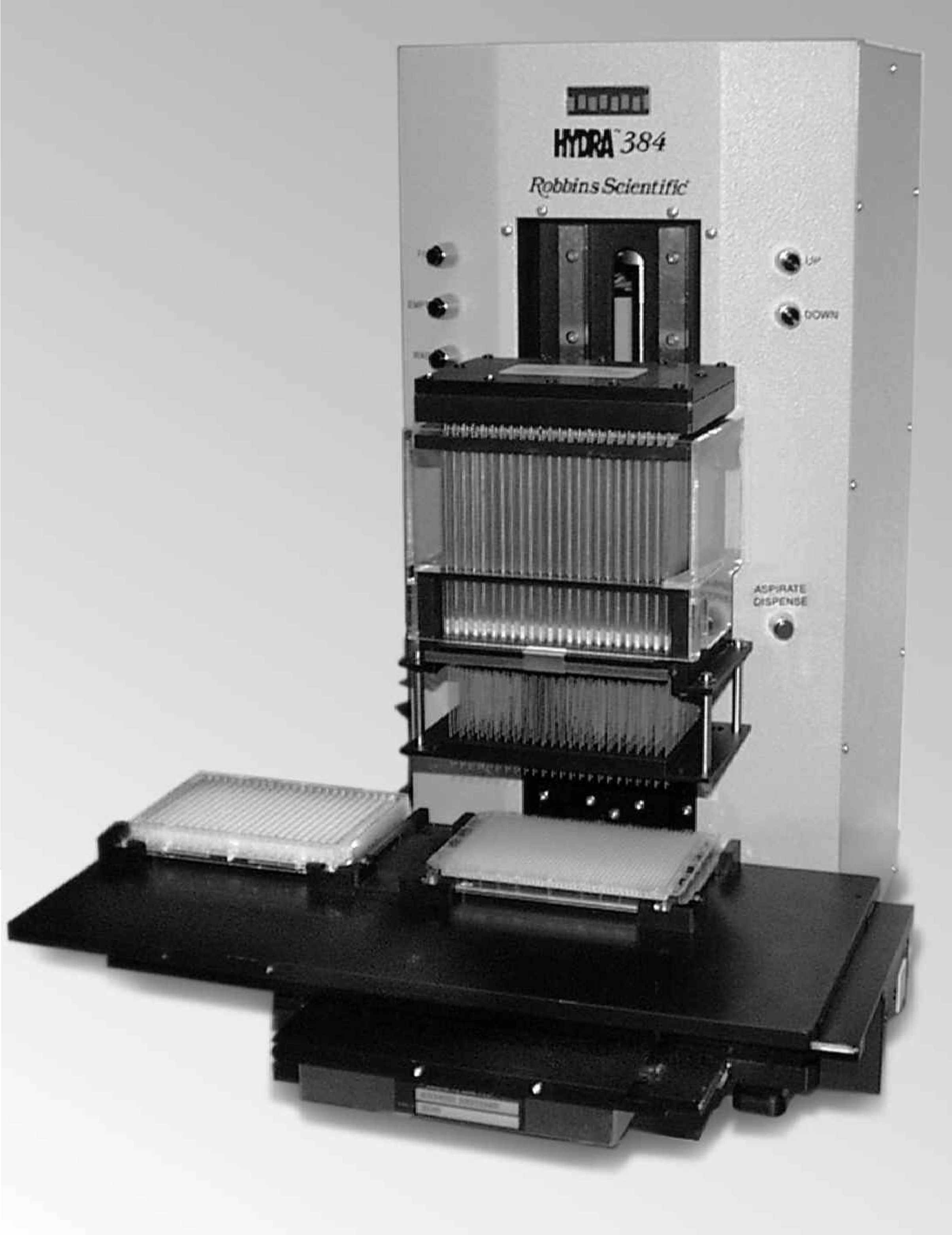
Hydra384 with Automated Plate Positioning system. Provides fully automated liquid handling, syringe washing and plate positioning for high density source and destination plates.
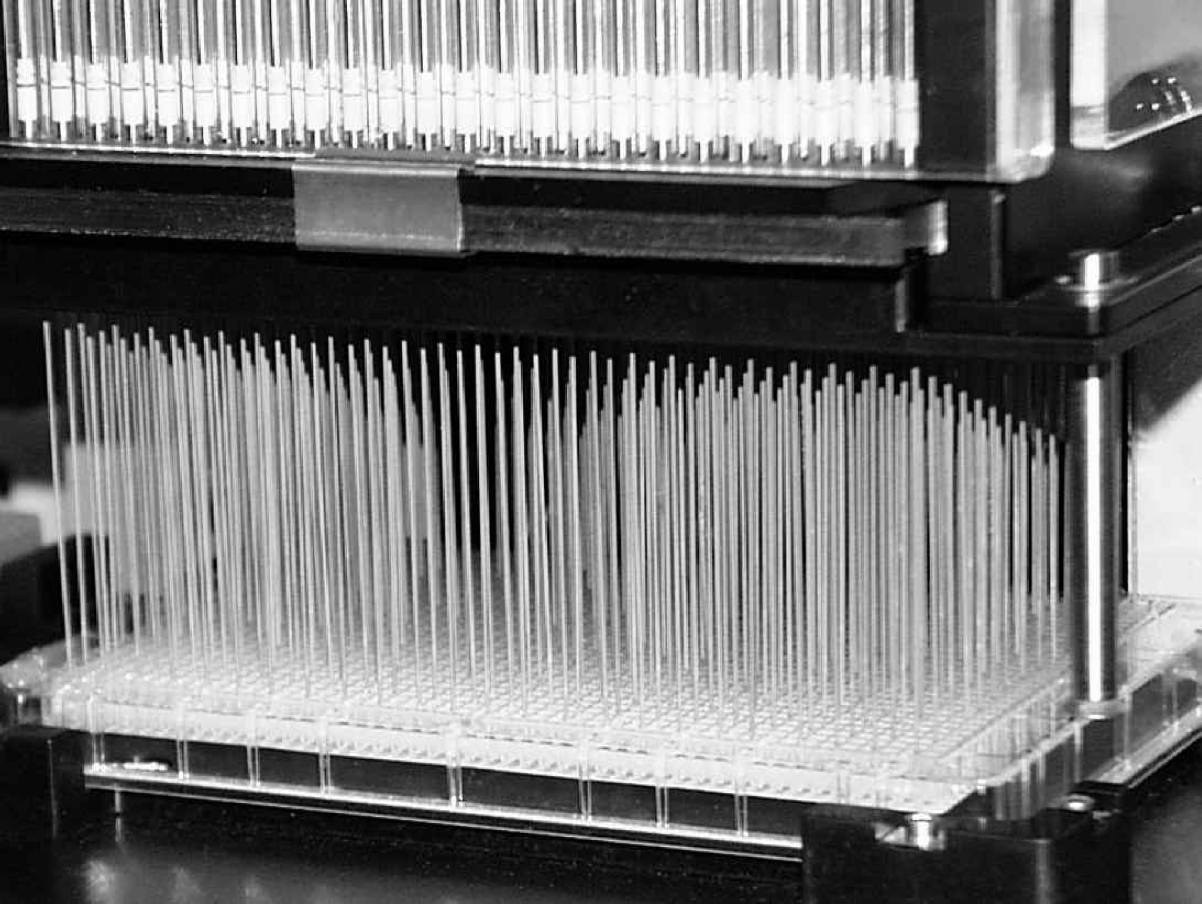
Hydra-384 dispensing into a 1536 well plate.
The Hydra with automated plate positioner is equipped with two spring loaded plate nests. One position is used to hold source plates for filling the syringes while the second nest is used for holding target/destination plates where liquids are delivered. The positioner also has a built in syringe washing system. During a wash operation, the stage automatically moves away from the dispensing head exposing a wash basin. The stage assembly is then raised so that the syringe needles enter the reservoir. Wash liquids are then cycled through the reservoir with peristaltic pumps while the syringe plungers move up and down removing residual samples.
Programming the operation of the Hydra with automated plate positioner is carried out on a notebook computer using a Wizard style interface for creating labware definitions and protocols. Once the labware to be used is defined (number and location of wells and syringe needle depth into the wells) using the Labware Wizard, complex, multistep protocols for filling, replicating or reformatting plates or pooling of samples from multiple plates can be easily created and stored using the Protocol Wizard.
Using the Hydra-384 and automated positioner with 1536 well plates presented one challenge that was ultimately overcome. Defining the location of the exceedingly small wells was found to be difficult when aligning the plate to the syringe needles. The solution to this problem was the creation of a “pin target”, a metal plate with the dimensions of a standard microplate with several rows of pins that match the well spacing of a 1536 well plate (
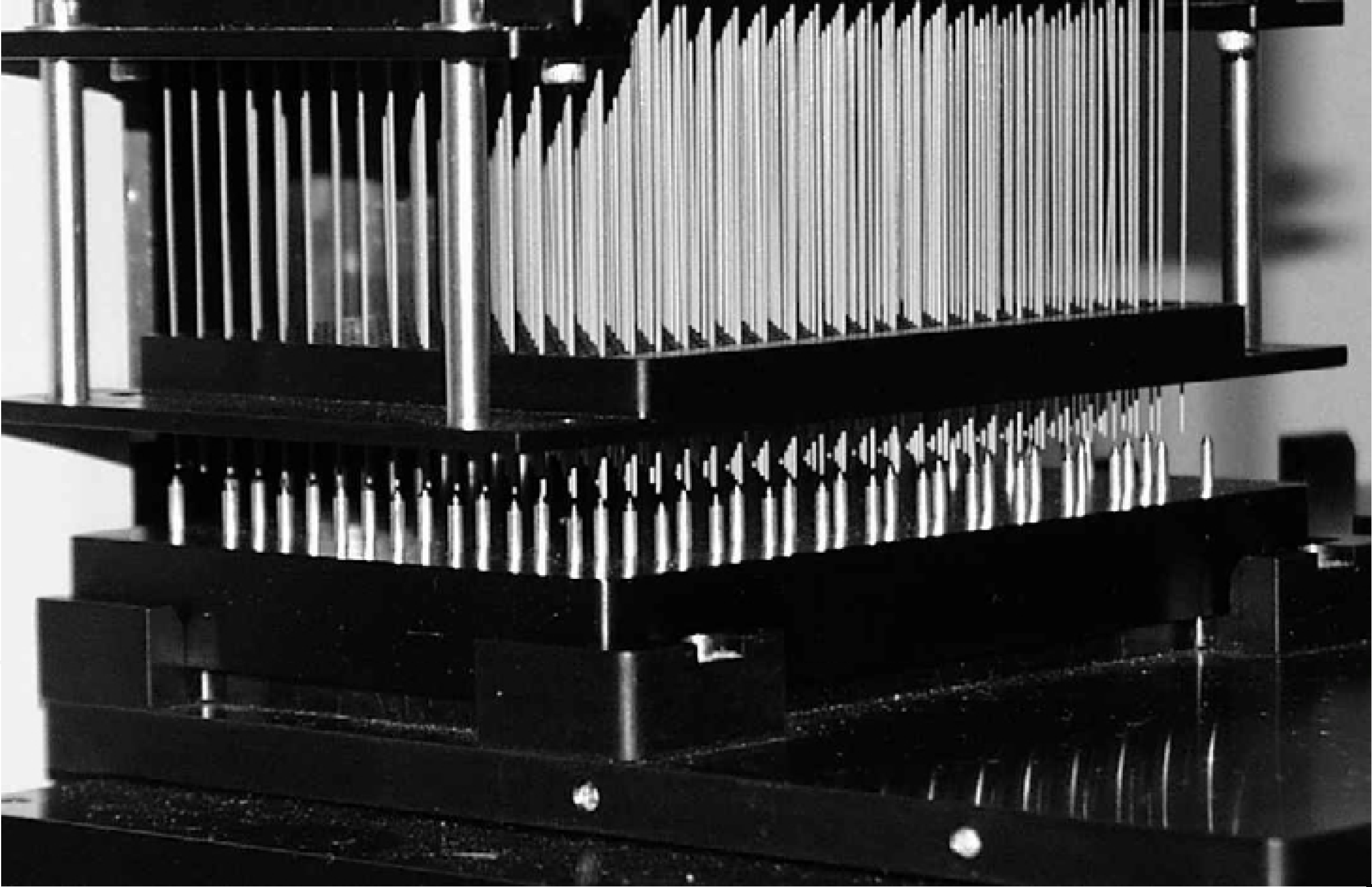
Close up of “pin target” aligned to syringe needles used for defining the well locations on 1536 well plates.
Turning Down the Volume
Assay assembly using a 384 channel dispenser and high well density plates, particularly 1536 well plates, requires precise liquid handling of volumes under 1μL. The liquid handling needs of high throughput screening laboratories are particularly demanding where submicroliter volumes of target compounds in DMSO are usually dispensed into dry plates before the addition of buffer and other reagents.
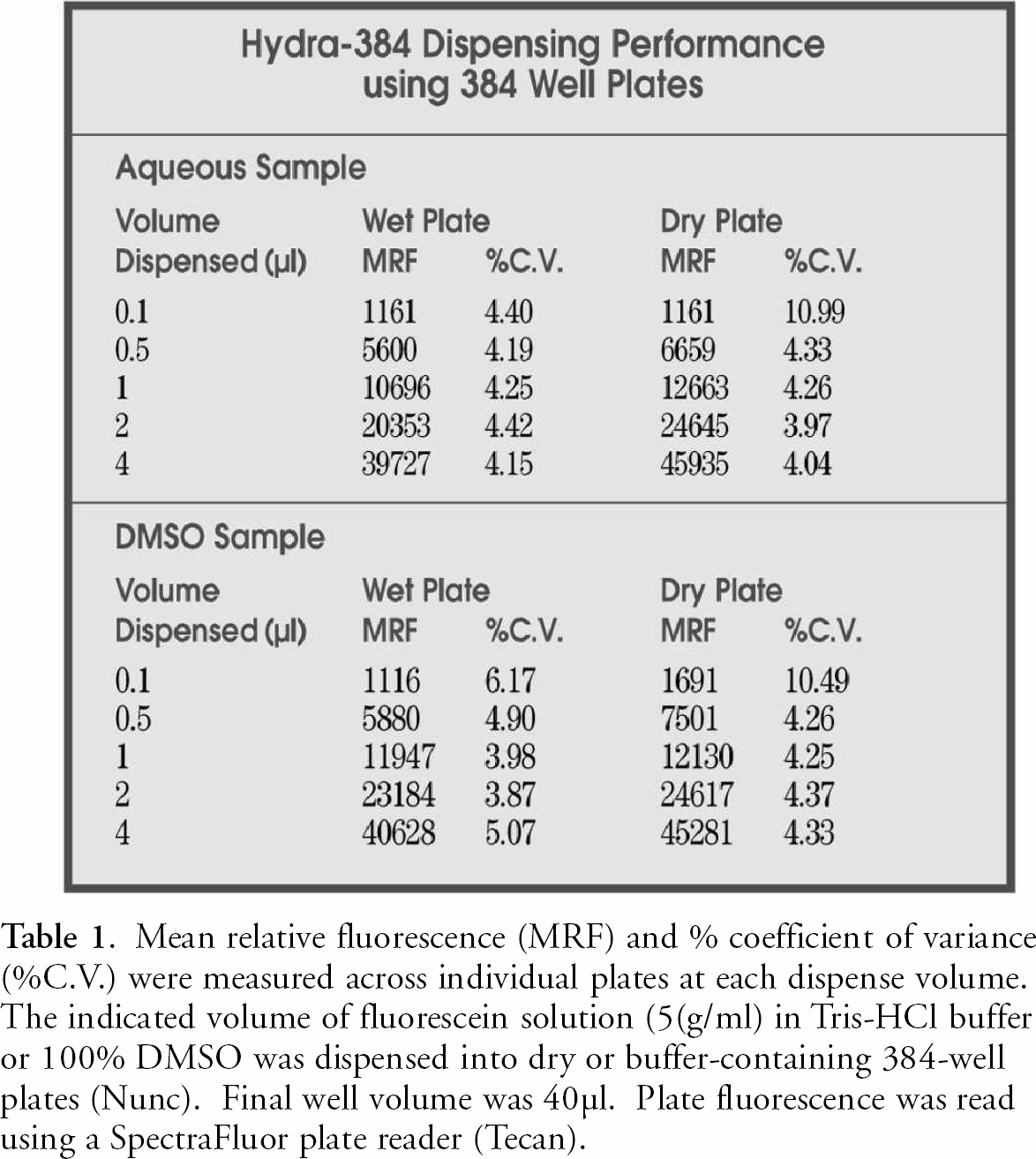
Studies designed to measure the liquid dispensing performance of the Hydra-384 were performed using aqueous or DMSO solutions and wet (buffer containing) or dry plates. Using a concentrated fluorescein solution prepared in either aqueous buffer or 100% DMSO, volumes from 4.0 to 0.1μL were dispensed into either dry or buffer containing 384 well plates. The results show that the coefficient of variance (C.V.) for dispenses from the Hydra-384 using either test solution was 4–6% for the range of volumes tested when using wet target plates (
Mean relative fluorescence (MRF) and % coefficient of variance (%C.V.) were measured across individual plates at each dispense volume. The indicated volume of fluorescein solution (5(g/ml) in Tris-HCl buffer or 100% DMSO was dispensed into dry or buffer-containing 384-well plates (Nunc). Final well volume was 40μl. Plate fluorescence was read using a SpectraFluor plate reader (Tecan).
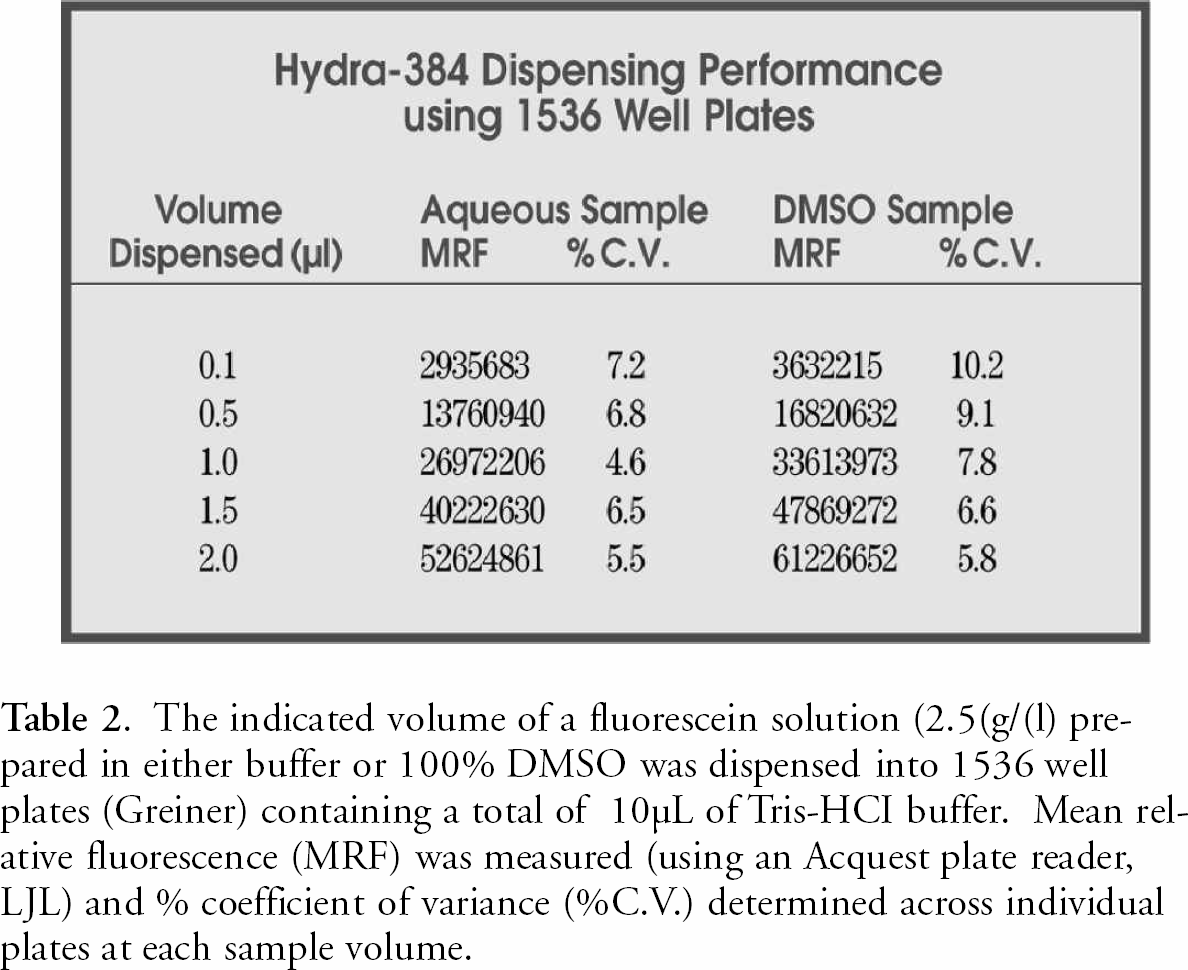
With the recent availability of a reliable high density fluorescence plate reader, (LJL Acquest, Sunnyvale, CA) a dispensing study using the Hydra384 and 1536 well plates (Greiner, Germany) was performed (
The indicated volume of a fluorescein solution (2.5(g/(l) prepared in either buffer or 100% DMSO was dispensed into 1536 well plates (Greiner) containing a total of 10μL of Tris-HCI buffer. Mean relative fluorescence (MRF) was measured (using an Acquest plate reader, LJL) and % coefficient of variance (%C.V.) determined across individual plates at each sample volume.
Blinding Plate Processing Speed
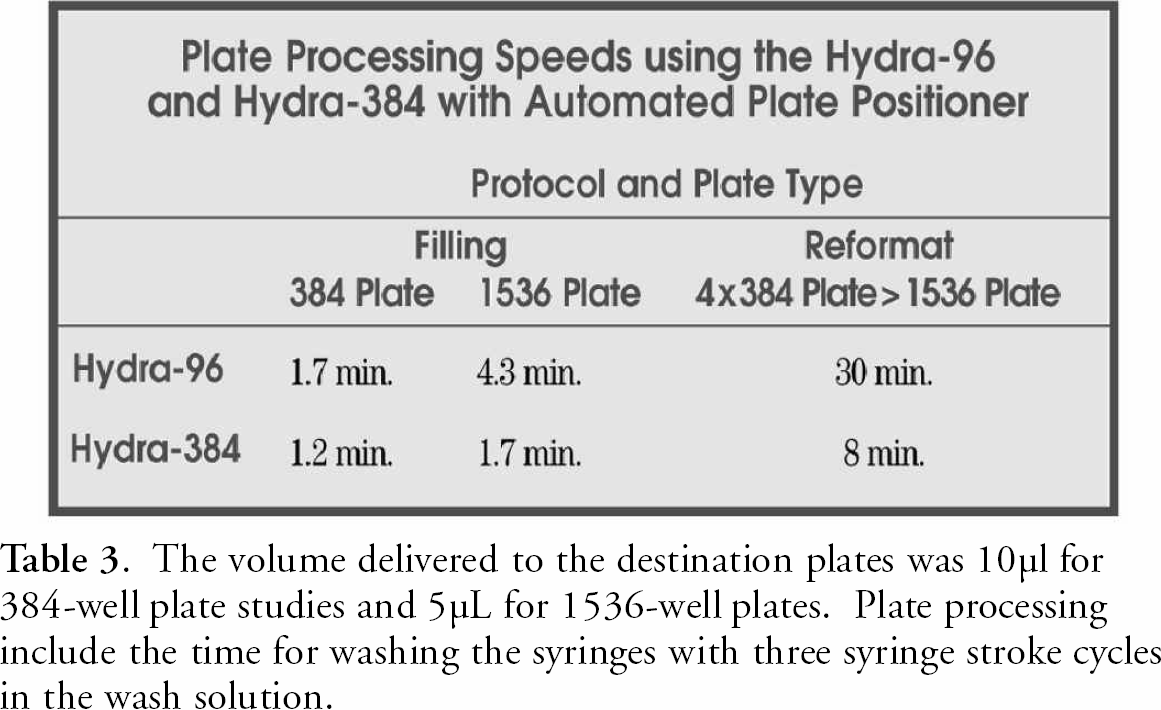
The obvious advantage of a 384-channel dispenser over one with 96-channels is the reduction in the number of liquid handling and washing steps when processing 384 or 1536 well plates. A comparison of the speed of the Hydra-96 and Hydra-384 dispensers with automated plate positioner for processing 384 and 1536 well plates is shown in table 3. In a simple filling operation with no wash steps between liquid transfers, the Hydra-384 fills a 384 well plate in just over 1 minute and a 1536 well plate in under 2 minutes. In comparison, the Hydra-96 takes up to twice as long when filling these plates. The advantage of the Hydra-384 for processing high density plates is most pronounced when used in a plate reformatting procedure. In this procedure samples are transferred from four discrete 384 well plates into one 1536 well plate with a syringe wash step between each transfer. Used in a reformatting protocol, the Hydra-384 prepares a 1536 well plate every 8 minutes while the 96-channel model requires 30 minutes to produce a single plate.
The volume delivered to the destination plates was 10μl for 384-well plate studies and 5μL for 1536-well plates. Plate processing include the time for washing the syringes with three syringe stroke cycles in the wash solution.
Complete automation of plate handling and liquid dispensing has been accomplished with the integration of the compact Twister robotic plate handler (Zymark, Hopkinton, MA) with any Hydra model equipped with automated plate positioner (
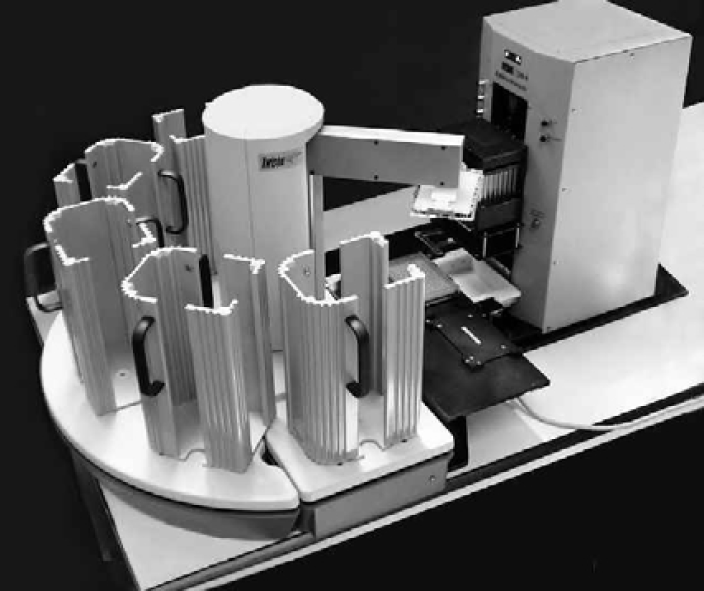
Hydra384HTS equipped with Twister plate handling robot. System provides automated handling of source and destination plates from five stacks of up to 20 plates each.
Conclusions
The Hydra-384 Microdispenser equipped with automated plate positioning and syringe washing system provides precise submicroliter liquid dispensing into 384 and 1536 well plates. The use of 384 discrete dispensing channels instead of 96 boosts plate processing speed so that a single 1536 well plate can be filled in under 2 minutes. The availability of walk-away plate handling automation with integration of the Twister plate handler makes the Hydra HTS an exceptional high throughput plate processing system for laboratories performing assays in high well density plates.